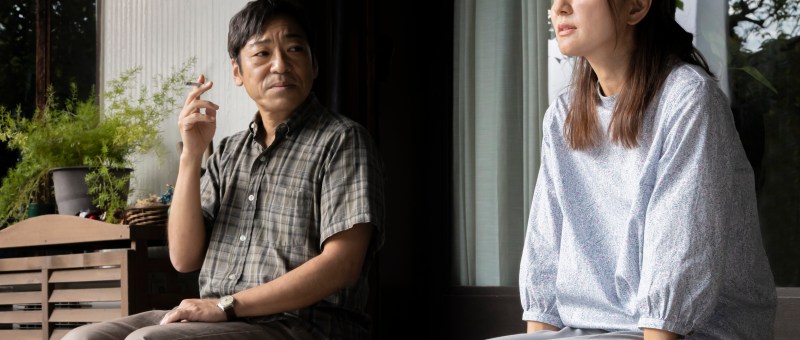
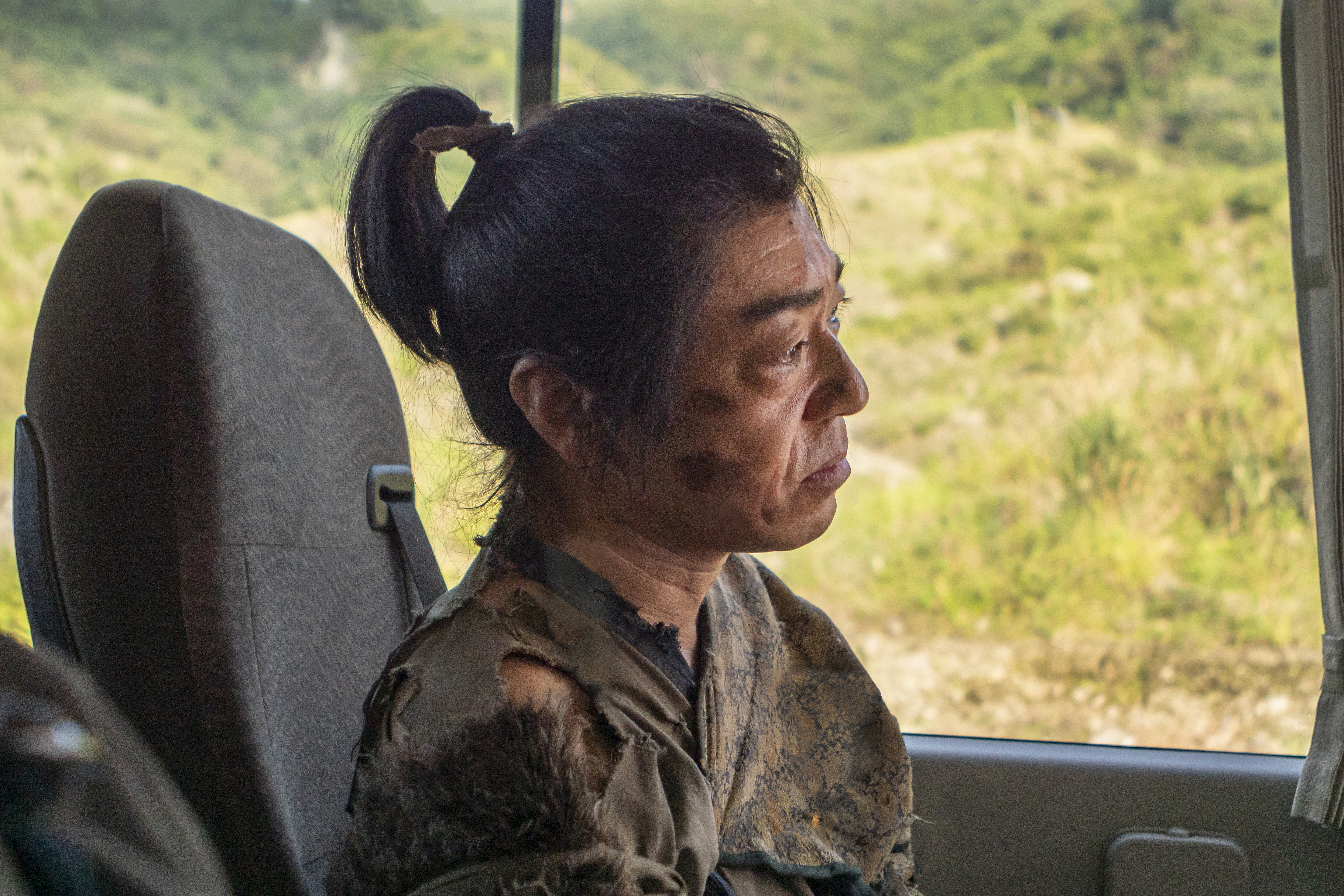
Roleless (宮松と山下, Masahiko Sato, Yutaro Seki, Kentaro Hirase, 2022)

Ever felt like a bit player in your own life? For the hero of Masahiko Sato, Yutaro Seki and Kentaro Hirose’s Roleless (宮松と山下, Miyamatsu to Yamashita), it’s more like he lives ten thousand lives if only for an instant in his life as an extra and may have, in a way, cultivated an image of himself as a blank canvas who no longer exists in an absolute form. In a way you could call it multiverse living, but when confronted with a possible point of origin, a lost selfhood he may have forgotten or wilfully rejected, it presents him with an existential question not so much of who he wants to be but if he wants to be at all. 

We first encounter him as an unlucky retainer in a jidaigeki who is quickly cut down only to rise again and run around the back to give his name as “Miyamatsu, a samurai” to the prop girl who gives him a different hat so can he go back out there and die a second time. Miyamatsu has an air of perpetual blankness in his often vacant expression as if he were both there and not. The film often wrong foots us and we can never be sure what is “real” and what part of a movie, except that it all obviously part of the movie we ourselves are watching. We see what we think are moments from Miyamatsu’s private life only to realise that the camera was rolling all along when someone shouts “Cut!” and it becomes apparent that Miyamatsu was not its main focus. 

Along the way he gives hints of his loss of selfhood, earnestly replying that he doesn’t know when a fellow extra quizzes him on the watch he’s wearing and how he got it but his discomfort could stem from several places and it’s never quite clear how much of an interior life Miyamatsu creates for his various roles, whether he really does just see them as performers of an action, is playing “himself” as he peers over a police cordon at a crime scene, or is a fully fledged person with an individual history. Later he tells a colleague who admires the way he fills in forms at his part time job working at a cable car that he’s always enjoyed the process of filling in a predetermined frame but also that he likes the floating sensation the cable cars give him. 

All of which might explain why he’s so destabilised when a man (Toshinori Omi) approaches him claiming that they worked together as taxi drivers more than a decade earlier and that his name is Yamashita. He apparently “disappeared” after sustaining a head injury and has been “missing” ever since. The man takes him back to the home of his much younger sister, Ai (Noriko Nakagoshi), who has since married and appears to be incredibly relived to see him even if it seems she might also be hiding something. He wonders if it’s suspicious that there are no photos of him in their family home, but is reminded that with the age difference he hadn’t lived there while she was a child and only came back after their parents died to take care of her because she was still in high school. Her husband, Kenichiro (Kanji Tsuda), seems to be constantly needling him though again, it isn’t always clear whether he actually wants him to remember or suspects that he already does and is choosing to pretend not to. 

Even so, Miyamatsu slides into the life of Yoji Yamashita as easily as any other role finding his way back into the character with unexpected moments of connection such as the muscle memory that grants him a perfect baseball swing, or the strangely familiar taste of cigarettes to a non-smoker. Then again, there’s obviously something sinister going on, a darkness underlying his “personal” history that might have made him want to absent himself from himself or else an oppressive sense of bullying that is reflected in Ai’s hesitant answer when Yamashita remarks on what a good husband Kenichiro seems to be. Miyamatsu claims that he’s ever only played one “real” role, and in a way this is it as he begins to claim something like a backstory even if it’s one he may not ultimately want that nevertheless renders him a little less vacant. Mysterious and unsettling, the film asks some probing questions about the nature of identity, whether it is self-defined or gifted, but also discovers a kind of serenity in Miyamatsu’s free floating life of transient realities.


Roleless screened as part of this year’s Nippon Connection

Clip (no subtitles)

Sekigahara (関ヶ原, Masato Harada, 2017)

Sekigahara posterWhen considering a before and an after, you’d be hard pressed to find a moment as perfectly situated as the Battle of Sekigahara (関ヶ原). Taking place on 21st October 1600 (by the Western calendar), Sekigahara came at the end of a long and drawn out process of consolidation and finally ended the Sengoku (or “warring states”) era, paving the way for the modern concept of “Japan” as a distinct and unified nation. In actuality there were three unifiers of Japan – the first being Oda Nobunaga who brought much of Japan under his control before being betrayed by one of his own retainers. The second, Toyotomi Hideyoshi, continued Oda’s work and died a peaceful death leaving a son too young behind him which created a power vacuum and paved the way for our third and final creator of the modern Japanese state – Tokugawa Ieyasu whose dynasty would last 260 years encompassing the lengthy period of isolation that was finally ended by the tall black ships and some gunboat diplomacy.

Loosely, we begin our tale towards the end of the rule of Toyotomi Hideyoshi (Kenichi Takito) though, in a nod to the novel, director Masato Harada includes a temporal framing sequence in which our author depicts himself as a boy during another war sitting in these same halls and hearing stories of heroes past. As well he might given where he was sitting, the narrator reframes his tale – our hero is not the eventual victor, Tokugawa Ieyasu, but a noble hearted retainer of the Toyotomi, Mitsunari (Junichi Okada).

Riding into battle, Mitsunari reminds his men that this is a war of “justice and injustice” – they cannot lose. Yet lose they do. The narrator recounts Mitsunari’s improbable rise as an orphan taken in by Hideyoshi on a whim who nevertheless became one of the most powerful men in late 16th century Japan. Despite his loyalty to his master, Mitsunari cannot abide the cruelty of the samurai world or its various modes of oppression both in terms of social class and even in terms of gender. He resents the subversion of samurai ethics to facilitate “politics” and longs to restore honour, justice, and fairness to a world ruled by chaos. Rather than the bloody uncertainty and self-centred politicking that define his era, Mitsunari hopes to enshrine these values as the guiding principles of his nation.

On the other hand, his opponent, Tokugawa Ieyasu (Koji Yakusho) is famed for his intelligence and particularly for his political skill. Hoping to swoop into the spot vacated by Hideyoshi which his young son Hideyori is too weak to occupy, Ieyasu has been playing a long game of winning alliances and disrupting those other candidates had assumed they had secured. Unlike Mitsunari, Ieyasu is ruthless and prepared to sacrifice all to win his hand, caring little for honour or justice or true human feeling.

The framing sequence now seems a little more pointed. Sekigahara becomes a turning point not just of political but ideological consolidation in which Mitsunari’s ideas of just rule and compassionate fair mindedness creating order from chaos are relegated to the romantic past while self interest triumphs in the rule of soulless politickers which, it seems, travels on through the ages to find its zenith in the age of militarism. Mitsunari is the last good man, prepared to die for his ideals but equally prepared to live for them. His tragedy is romantic in the grander sense but also in the more obvious one in that his innate honour code will not let him act on the love he feels for a poor girl displaced from Iga whose ninja service becomes invaluable to his plan. With a wife and children to consider, he would not commit the “injustice” of creating a concubine but dreams of one day, after all this is over, resigning his name and position and travelling to foreign lands with the woman he loves at his side.

Working on a scale unseen since the age of Kurosawa, Harada patiently lays the groundwork before condensing the six hours of battle to forty minutes of fury. The contrast between the purity of the past and the muddied future is once again thrown into stark relief in the vastly different strategies of Ieyasu and Mitsunari with Ieyasu’s troops armed to the teeth with modernity – they fire muskets and shout cannon commands in Portuguese while Mitsunari’s veteran warriors attempt to face them with only their pikes and wooden shields. Unable to adapt to “modern” warfare and trusting too deeply in the loyalty of his comrades, Mitsunari’s final blow comes not by will but by chance as a young and inexperienced vassal vacillates until his men make his decision for him, betraying an alliance he may have wished (in his heart) to maintain. Goodness dies a bloody death, but there is peace at last even if it comes at a price. That price, for some at least, may have been too great.


Original trailer (no subtitles)