Fragment (파편, Kim Sung-yoon, 2024) [Fantasia 2025]

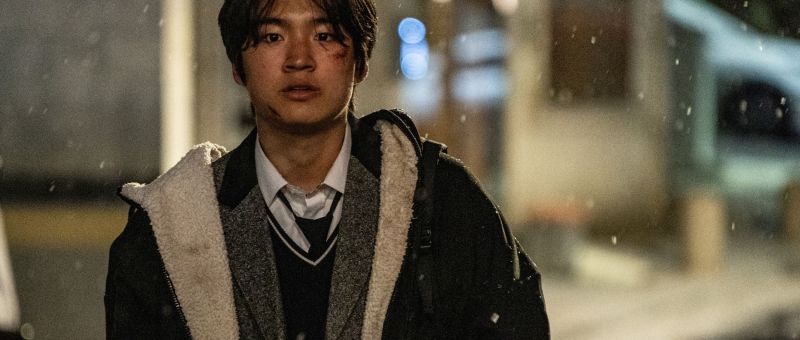
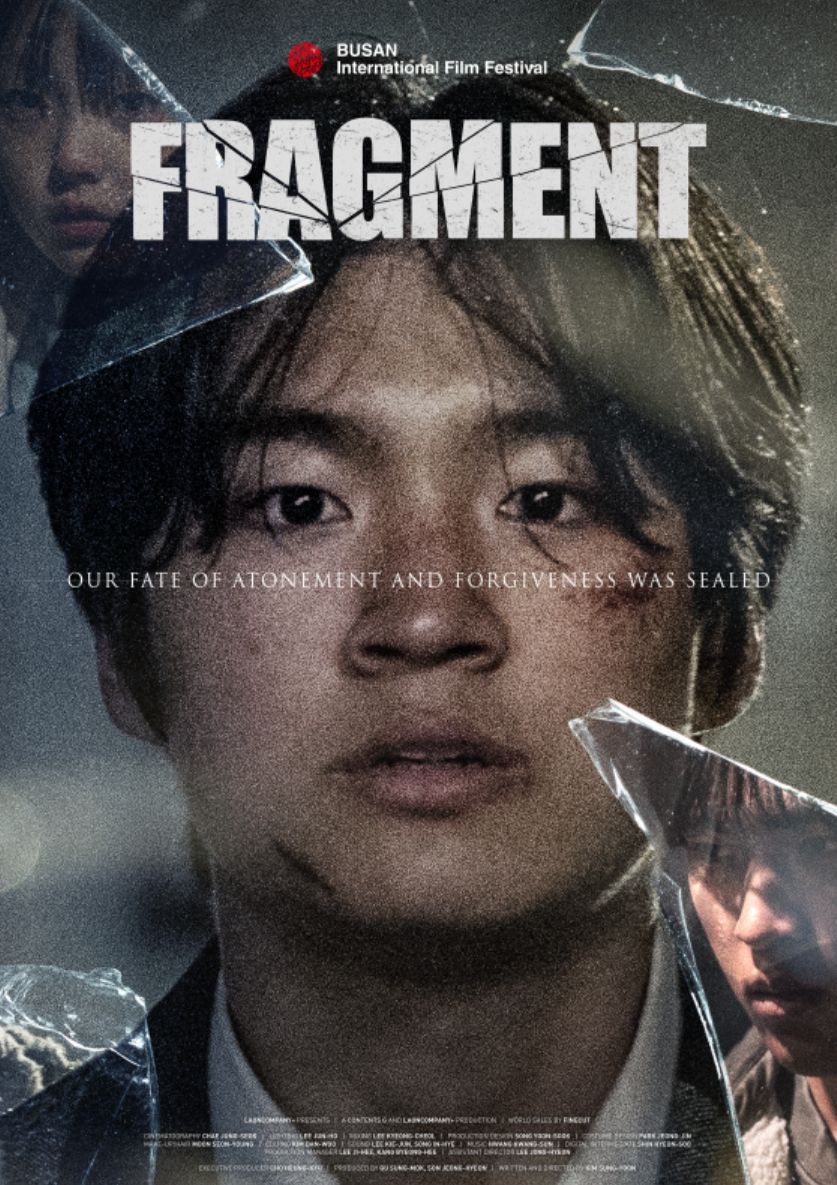
People often think of crime as something linear that ties together villain and victim but is otherwise an isolated event. The truth is that crime reverberates through the world around it, shattering the lives of others in the backdraught of its irrational violence. Son of the murdered couple, Gi-su is fond of saying that he’s the victim as if trying to reclaim this role and make it his identity while it remains to that Jun-gang and his sister Jun-hui are victims too for they have also lost their father who is now in prison.

Indeed, while Gi-su may face overbearing care from his well-meaning relatives, Jun-gang is burdened with the stigma of being a murderer’s son while trying to protect his sister from the fallout of this awful situation. His most pressing problem is that they don’t have any money. His father did not appear to have any before either, but now their utilities are about to be cut off and their landlady’s sick of being strung along. Yet these aren’t problems a 15-year-old boy can fix on his own. He tries to get a job in a local convenience store but is first turned away because boys his age should be in school, and then offered a job but only on parental consent which he can’t get for obvious reasons. His teacher, Mr Park, is one of the few people to know the truth and keen to help him but has few real ways of doing so. As the son of the murderer, most are content to leave him to his fate and believe that he simply doesn’t deserve support because of what his father has done.

Jun-gang too feels guilty, though none of this is his fault. He knew what kind of man his father was and is always eager to prove that he is different. But the fact that he seems nice, honest, and polite doesn’t really matter. He’s still chased and bullied with kids at school going on about killer genes and actively singling him out for a beating. Jun-hui too is ostracised by her friends who’ve been told not to play with her because of what her father did. Gi-su tries to ease his frustration on him, breaking into their apartment and smashing the place up after coming to school to find him. As much as Gi-su tries to insist that he’s the victim, Jun-gang is a victim too and unlike Gi-su has no further family to support him and no one else to turn to for help. He fights back with decency, but largely finds it thrown in his fate.

Gi-su, meanwhile, is broken by his trauma and in the midst of a nervous breakdown exacerbated by exam stress. Like Jun-gang he blames himself as a means of asserting control over the situation and struggles to accept the new world he now inhabits following his parents’ deaths. His sympathetic aunt tries her best to get through to him, but his well-meaning uncle is a font of toxic masculinity screaming at him that he’s wallowed in his grief long enough and needs to man up and get over it. Though they’re cast in the roles of killer and victim, the boys are really much the same, each having lost their homes and families and now being essentially displaced from within their new lives.

The battle is really whether they can hang in there long enough to begin to see the other side and that there are still possibilities in their lives. The reason for the killing is never revealed, nor is it particularly important, if hinting at the constant pressures of the outward society. Jun-gang’s father’s behaviour implies long years of paternal failure, domination, and abuse from which Jun-gang is trying to emerge unscathed while Gi-su must on the other hand come to terms with the implosion of a seemingly perfect family life. That they each come to recognise that none of this is their fault and they’re really just the same is testament the boys’ innate goodness and growing sense of solidarity in the midst of so much acrimony. Hard-hitting though it may be in its exploration of how societal prejudice can allow people to slip through the cracks, Kim Sung-yoon’s film is also in its way uplifting in the presence of those are willing to help and Jun-gang’s refusal to give in to what the world tells him he should be,


Fragment screened as part of this year’s Fantasia International Film Festival.
Sinkhole (싱크홀, Kim Ji-hoon, 2021)

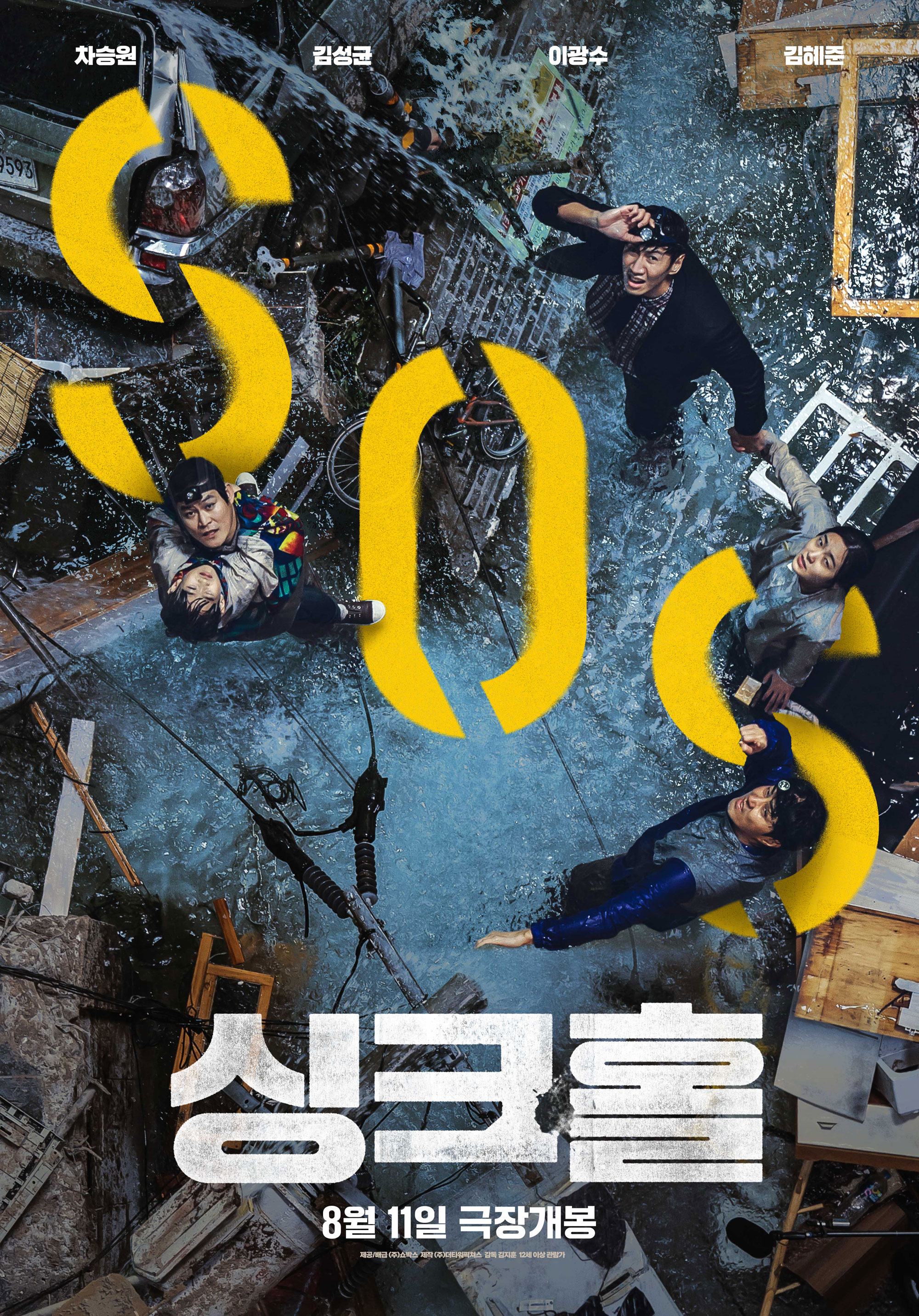
Financial security is built on shaky ground in Kim Ji-hoon’s harrowing disaster dramedy Sinkhole (싱크홀) in which one man’s home-owning triumph quite literally crumbles beneath his feet. The latest in a recent series of movies lamenting the sometimes lax safety culture of the Korean construction industry, Sinkhole is also a crushing indictment of a society ruled by house prices in which social status is largely defined by the owning of property while the young in particular struggle to climb out of a deep well of societal despair. 

As the film opens, the Park family is about to move in to their new flat, the first they’ve ever owned albeit with a frighteningly large mortgage, in the middle of a seasonal downpour. Only when they arrive, they discover the movers haven’t even started unloading because their apparently irresponsible neighbour Man-su (Cha Seung-won) has inconsiderately parked his car in front of the entrance and isn’t answering his phone. Patriarch Dong-won (Kim Sung-kyun) ends up in an awkward confrontation with the abrasive apartment dweller which is inconvenient because Man-su apparently works in just about every business in the area which means he continues to run into him just about everywhere he goes. 

Anyway, that’s the the least of his problems because, having made this giant investment, Dong-won can’t help thinking there’s something wrong with his new dream home especially when his adorably polite young son Su-chan points out that his marbles roll across the floor of their own accord. Worried they may have a subsidence problem, Dong-won checks his windows open properly and records evidence of ominous cracks in the pavement outside but struggles to get the other residents to agree to maintenance checks in fear that not getting the answer they want will bring down the value of their property. 

Property prices are apparently everything. Homeownership is an unobtainable dream for many, yet Dong-won already feels insecure in his purchase especially as his colleagues seem relatively unimpressed by the fact his flat is in a recently gentrified area and comparatively modest. Bamboozled into hosting a housewarming, he’s mildly embarrassed to realise the view from his balcony is of nicer, much more expensive luxury flats just across the river which are likely to remain far out of his reach. Nevertheless, his colleague, Seung-hyun (Lee Kwang-soo) declares himself jealous in part because he’s still renting a studio flat and feels that dating let alone marriage is impossible without being in a position to get a multi-room apartment. His colleague Eun-ju (Kim Hye-jun) is in the same predicament but prefers to see it as simply being at a certain stage on the ladder.  

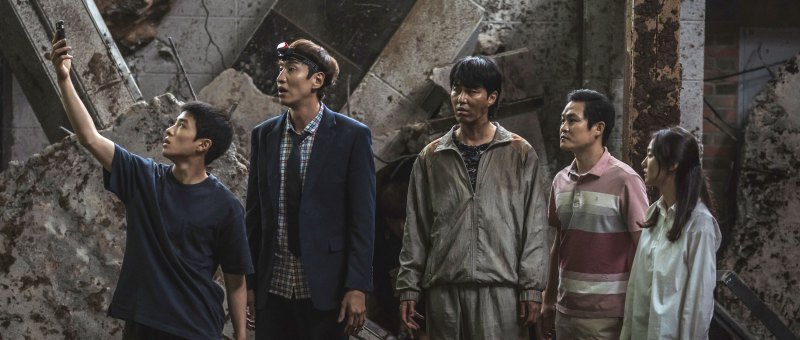
This dream of future security is however quite literally built on shaky ground. There are definitely problems with Dong-won’s new apartment which become increasingly severe from the tilting floors to cracked glass and interruptions with the water supply presumably caused by cost-cutting and shoddy construction practices. When the building collapses into a sinkhole, Dong-won is trapped inside with work colleagues Seung-hyun and Eun-ju along with Man-su and his teenage son Seung-tae (Nam Da-reum). Despite the inherent horror of the situation, Kim keeps the atmosphere light as the small band of survivors attempts to manage as best they can, finding an awkward solidarity while trying to attract the attention of the emergency services and eventually making a daring escape using whatever tools are available to them. 

Even so, as much as the small band of almost strangers bond thanks to their desperate circumstances, there is an uncomfortable conservatism at play especially in the film’s treatment of a working class single mother and her son living in an apartment on the floor below Dong-won’s. That aside, Sinkhole offers a fierce criticism of an increasingly consumerist society in which house prices are all anyone talks about and homeownership is the only badge of social success. 11 years of patient sacrifice is swallowed in an instant, sucked into an abyss of corporate malfeasance, while Dong-won is left to climb out of the hole he’s in on his own. It’s small wonder that some of the survivors decide to drop out of the system altogether, ditching the idea of rooted homeownership for nomadic freedom in buying a small caravan rather than participate in the property market or climb the corporate ladder. “Don’t be happy in 10 years, be happy today!” they enthusiastically chant. The entire society is, it seems, sitting on a sinkhole which might give any minute, what’s the point in investing in a future which could disappear from beneath your feet without reason or warning? 


Sinkhole screened as part of this year’s New York Asian Film Festival.

International trailer (English subtitles)