The Girl on a Bulldozer (불도저에 탄 소녀, Park Ri-woong, 2021)

“Everyone just takes it” the heroine of Park Ri-woong’s Girl on a Bulldozer (불도저에 탄 소녀, Bulldozere Tan Sonyeo) is advised by her partly well-meaning uncle, urging her to know her place, stop fighting and become complicit with the injustice that pervades their society. Already beaten down by life, he has come to the conclusion that there is no other way out other than to submit himself to the quasi-feudalistic social codes of contemporary capitalism, but Hye-yeong (Kim Hye-Yoon) is still naive enough to think that she’s entitled to fairness and that she has the capacity to resist if not exactly for the good of society then in standing up for herself and her family. 

Family is however something about which she feels conflicted, disappointed in her feckless father (Park Hyuk-Kwon) fearing his gambling and drinking problems may have got the better of him yet again. As the film opens, 19-year-old Hye-yeong is in court charged with assault after intervening in a convenience store dispute. She already has a criminal record but the judge is lenient with her in reflection of the fact that she stepped in to defend someone weaker than herself, sentencing her to community service and vocational training rather than prison but reminding her she is now old enough to receive a custodial sentence should anything like this happen again. It’s immediately obvious that Hye-yeong is a very angry young woman who has already lost any real hope for the future, staking everything on saving enough money from her part-time jobs to rent a flat so she can move out and take her younger brother Hye-jeok with her. 

What little stability she has disappears when her father leaves early one morning and does not return, Hey-yeong receiving a call from the police informing her he’s a wanted man having apparently committed an assault and stolen a car from his former employer which he later drove off a bridge harming two pedestrians in the process. Meanwhile she also discovers that her father may have lost the restaurant where they live and work, a couple turning up to make alterations as if they already owned the place, the woman claiming that her husband is the nephew of Chairman Choi (Oh Man-seok) her father’s former boss and the owner of the car which he is accused of stealing. Part of Hye-yeong’s problem is her liminal adolescent status. It’s obvious her father had been keeping a lot of things from her while she’s constantly asked when her mother is coming to sort everything out though her mother died years ago and even the aunt she later approaches for help is less than sympathetic partly as we discover because her father dragged his brother into his money problems by making him a witness to a deal with the increasingly shady Choi. 

Choi is an embodiment of corrupt chaebol culture, adopting a quasi-feudalistic authority that allows him to wield his authority over those lower than himself in the complicated class hierarchy of the contemporary society as if he were a lord and they merely serfs. Also in debt to him, Hye-young’s uncle tries to talk to her about the way the real world works, that she should stop resisting Choi whom she blames one way or another for her father’s accident and know her place, acknowledging that when you’re nice to men like Choi they’re nice to you blaming his brother not for his foolish decision to trust him but for his eventual rebellion in insisting on getting what he was promised rather than submitting himself to Choi’s whim. The fact that Choi is currently running for political office promising to “never surrender to injustice” while making this small corner of backstreet Incheon great again through almost certainly corrupt construction contracts is only another expression of the insidious links between business and politics that once again work to oppress young women like Hye-yeong. 

Meanwhile, she finds herself constantly at the mercy of shady insurance companies one working for the victims of her father’s accident who turn out to be, as she thought, scammers playing up their injuries in the hope of cash amid the compensation culture that defines the modern society. Then again on the other hand, she discovers that her father had reactivated a series of insurance policies of his own, some suggesting the accident may have been a suicide attempt in that he hoped to take his debts with him while providing his children with financial security through the payout. The dragon tattoo on Hye-yeong’s arm which she has to hide with a sleeve in mainstream society marks her out as someone not to be messed with, but also exiles her from conventional success making it difficult to get a regular job or walk around without the implication of violence following her while even the vocational training she chooses of learning how to drive heavy vehicles also rejects her the instructor flat out saying that he’s “not being sexist” but thinks the course is unsuitable for a woman and she won’t find work as one in the construction industry. Young, reckless, and naive Hye-yeong opts for short-term vengeance literally attempting to take a bulldozer to the comfortable lives of men like Choi whose wealth is founded on the exploitation of those like her in counting on their desperate complicity, but discovers that his position is already far too entrenched to be turfed out by a single mechanism alone. “We at Korea Insurance will always be a source of strength for you” she’s ironically told after finally receiving a payout rather than an invoice left with little other choice than to try and make her way free of the control of the Chois of the world in rejecting her complicity. 


The Girl on a Bulldozer screened as part of Osaka Asian Film Festival 2022

Clip (English subtitles)

The Bros (부라더, Chang You-jeong, 2017)

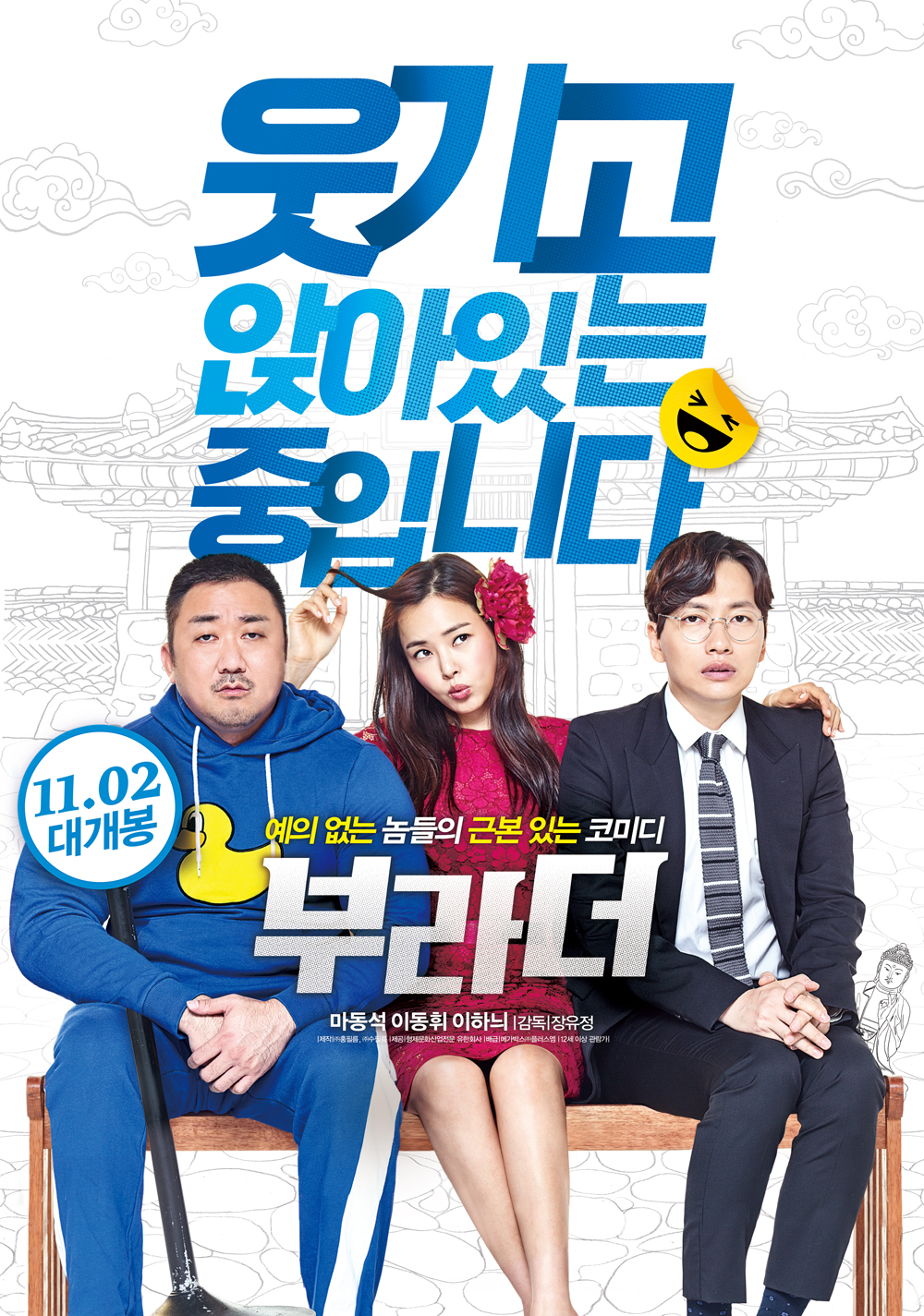
The Bros posterTime passes differently in the country. Two brothers from rural Andong thought they’d escaped the relative restrictions of an oddly feudal upbringing, but something keeps pulling them back. Ghosts literal and figural force them to return home, confront each other and their remaining family, and then attempt to come to some kind of acceptance of their places in the grand scheme of things in light of their newly acquired knowledge. The Bros (부라더, Buladeo) stars unlikely siblings Ma Dong-seok and Lee Dong-hwi and is adapted from the stage musical “The Brothers Were Brave” which was also directed by Chang You-jeong. Set in rural Andong, the film is an affectionate, if not entirely sympathetic, portrayal of the fiercely traditional way of life in tiny country towns in which it really still matters who accedes to be the head of a family and women are expected to know their place.

“Estranged” brothers Seok-bong (Ma Dong-seok) and Joo-bong (Lee Dong-hwi) have each skipped out on their familial responsibilities for lives of modern “freedom” in Seoul. Seok-bong is a “treasure hunter” who gives eccentric lessons on archeological ethics to bored students while overspending on the latest tools to aid him in his (permanently unsuccessful) quests, while Joo-bong is an ambitious salaryman whose career runs into a problem after he is accused of “embezzlement” for ruling out the cheapest route for a new road because (unbeknownst to his bosses) it would cut right past his childhood home. Just as Seok-bong realises he’ll have to pay back the outrageous sum of money he “speculated” on new equipment when a civil war breaks out in his prospective dig site, and Jong-boo frets over his workplace blunder, both sons get an unexpected text informing them that their “estranged” father has died and they’re “welcome” to attend the funeral, if they should wish. As both brothers are in need of a getaway plan (and also an opportunity to ask for some financial assistance), they find themselves finally going “home” only to unexpectedly find each other on the road, start bickering in the car, and then accidentally run over a random young woman (Lee Honey) apparently out walking in this otherwise barren and deserted stretch of land.

On their arrival, the brothers are not exactly embraced by their loving family. Nobody really expected to see them and, as it turns out, their grandfather didn’t even realise they’d been invited. The boys’ rural country home is one of fierce traditionality, seemingly cut out of time and existing in the feudal past where people refer to each other via archaic titles and it really seems to matter who is declared “first son” of the family. Both Seok-bong and Joo-bong left the village because they had no interest in all this feudal nonsense and resented the old fashioned authoritarianism which defined their relationships with the apparently tyrannical patriarch they have both come home to bury, if not perhaps to mourn. Seok-bong, in particular, remains extremely resentful towards his late father for the way he treated their mother who, he assumes, must have been very unhappy all her married life.

Rural Andong, it turns out is not a great place for women. The brothers do have a “friend” in the family complex in the form of Mi-bong (Jo Woo-jin) – a policeman recently married to a very nice but often frustrated young lady who has taken to smoking (still considered scandalous in these parts) in secret in order to relieve the stress of being a married woman suddenly expected to undertake all these arcane social responsibilities, which include being “nice” to her overbearing mother-in-law who seems to delight in scolding her for doing everything wrong. In fact Mi-bong’s wife wants to move to Vietnam to get as far away from the family as possible, but  finds it difficult to abandon the feudal way of thinking in wondering what it would be like to be the wife of a “first son”. Women here are supposed to know their place – stay silent, serve the men. When Joo-bong’s “lady friend” from the city shows up unexpectedly, everyone reacts to her as a “potential daughter-in-law” and sets about giving her the third degree which includes a pop quiz on the three duties of an Andong woman which include obeying a father, then a husband, and then presumably a son. In a running joke, no one can even remember the given name of the boys’ mother because she was always just referred to as “first daughter-in-law”.

All in all, it’s no surprise that Seok-bong and Joo-bong wanted to leave but then again, it turns out there was a lot more going on with the family than they were ever privy to know and they have perhaps judged their father unfairly without knowing all the facts. This being a comedy, the central point is the repair of a broken family – firstly in the brothers repairing their bond as they face the crumbling of their individual quests and are forced to work together, unwittingly uncovering the truth about their family history. Meanwhile, they also have to cope with the strange woman they apparently ran over who seems to have lost her memory but has valuable information to impart to each of them. Haunted by the ghosts of home, neither of the boys finds what they originally came for but gets something (arguably) better in rediscovering their roots and experiencing the upsides of familial connection.

Filled with the strangeness of the village tradition with its mourning suits, wandering monks, shamanic rituals, and uncles who speak only in incomprehensible four character idioms The Bros is an absurd affair but one with its heart in the right place. Chang enlivens the otherwise unremarkable comedic narrative with interesting visual compositions as the mysterious woman seems to drag the brothers away into a pretty fairytale land filled with oversaturated picture book images in which the moon is just a little bit bigger than you’d expect and oddly ‘70s fashions of purple and yellow lend a cheerful and nostalgic air. A comedic tale of family, brotherhood, and the unexpected endurance of feudal tradition, The Bros is a warm and fuzzy tribute to rediscovering one’s roots but also one with unexpected bite in its subtle undercutting of the pervasive misogyny which underpins it.


The Bros is currently available to stream in the UK (and possibly elsewhere) via Netflix.

Original trailer (Korean subtitles only)