Musicophilia (ミュジコフィリア, Masaaki Taniguchi, 2021)

What is “music”? Adapted from the manga by Akira Saso, Masaaki Taniguchi’s Musicophilia (ミュジコフィリア) finds its heroes grappling with a series of conceptual insecurities attempting to draw lines around what the what word might mean while torn between conservation and innovation as they struggle to find their own voices. Yet as the hero comes to realise, you can’t make music on your own letting go of his resentment and childhood trauma to remember his natural love of sound while repairing his relationship with his estranged half-brother in the wake of his father’s death. 

Gifted the talent of synesthesia in the ability to perceive shape and colour in the sounds of nature, Saku (Kai Inowaki) harbours a deeply held resentment towards “music” which he believes destroyed his family life, his mother (Misuzu Kanno) having been seduced by well-known composer Kishino (Kanji Ishimaru) as a student and thereafter forced to give up her dreams of becoming a professional cellist. Though he had contact with his father in his childhood, his stepmother never missed the opportunity to make him feel inferior while her own son, Taisei (Ikusaburo Yamazaki), became his father’s protege. Saku was not even allowed to touch his piano as if he were somehow unworthy of his artistic legacy. Having enrolled in art school in Kyoto, he nevertheless ends up being adopted by the contemporary music club which practices avant-garde and experimental techniques only to re-encounter his brother who is now in the third year of a PhD and an unpleasant elitist privately insecure about his musical talent. 

Everyone agrees that Taisei’s playing is technically perfect, but somehow dull lacking the individual spark of a true creative genius merely a carbon copy of his father’s teaching. Saku’s new friend Nagi (Honoka Matsumoto) compares Taisei’s skill unfavourably with the untrained talent of his brother, insisting that Saku’s music has the colour of joy and shape of kindness while Taisei’s sounds like notes arranged by a machine. Taisei is indeed cold and arrogant, snapping back at Saku’s question “what is music?” with the reply that music is what he’s played, as if he owned it and it only belongs to him. He even breaks with protocol and insults his professor claiming that his criticism is down to “internal politics” because he and his father did not get on, publicly criticising his translation of a German textbook on music telling him to “grasp the fundamentals of language” while his professor urges him to master the fundamentals of composition rather than arrogantly insisting his playing is unimprovable because it is the definition of “music”. Of course, some of this is his own insecurity afraid he can’t match up to his father and worried that in the end all he is is a poor imitation. For his part, Saku is often less than kind to Taisei, Nagi trying to point out to him that he’s better that but simultaneously finding him heading in the same direction as he tries to overcome an internal insecurity in order to rediscover his musical voice while unfairly lashing out at those around him. 

Taisei sucks the joy of out music, and indeed everywhere else, through his arrogant perfectionism his treatment of violin-playing girlfriend Sayo (Noa Kawazoe) approaching the abusive as he consistently runs her down and blames her for his own sense of dissatisfaction, while Nagi meditates on how freedom can make you lonely, herself seemingly the only one who thinks she’s in a musical, as the youngsters find themselves isolated by their own desire for artistic expression. Yet what the two men discover is that their father may have intended something else for them and that his desire was that they’d rediscover the innocent connection they’d had as children able to help each other should they become stuck either in life or in music. Saku’s natural talent is born of being immersed in the world around him realising that this too is “music” while Taisei struggles to move forward too obsessed with technical perfection to allow his music to breathe only rediscovering his humanity after an immense humbling that allows him to re-immerse himself in the natural world. At heart a coming-of-age tale in which two young men learn to put their differences aside and rediscover their childhood bond, Taniguchi’s gentle drama also offers a mild critique of academia and the tendency of institutions to exploit and manipulate talent only to wash their hands of it if something goes wrong placing funding above ethical concerns but eventually discovers that music is everywhere if only you’re willing to listen.


Musicophilia streamed as part of the 14th season of Asian Pop-Up Cinema.

Trailer (no subtitles)
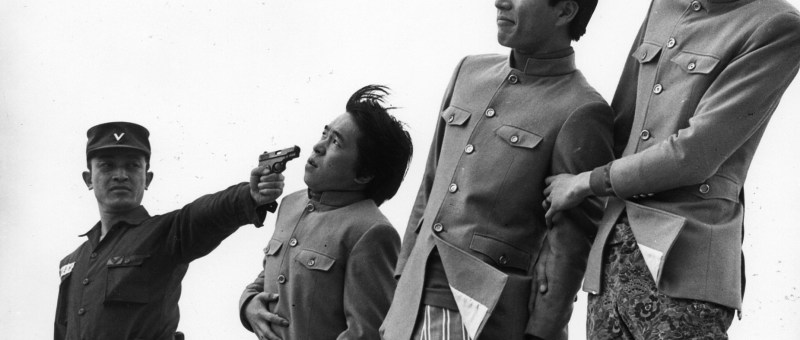
Three Resurrected Drunkards (帰って来たヨッパライ, Nagisa Oshima, 1968)

Three Resurrected Drunkards posterThe pop star movie has a long and distinguished history in Japanese cinema, but one might not have expected it to include Nagisa Oshima – a legendary iconoclast and conscientious objector to this particular strain of pop culture frivolity. Then again, taking a much hated form and turning it in on itself as a multifaceted form of protest is exactly the sort of thing one might expect Oshima to do. Therefore we find him in 1968 teaming up with The Folk Crusaders – a folk rock band enjoying a sudden flash of popularity after pressing their own indie record and seeing it go gold when radio stations picked up their North Korean themed Imujingawa and turned it into a giant hit. The band’s best known hit remains Kanashikute Yarikirenai which was released the same year, but it was perhaps Imujingawa with its melancholy Korean theme which attracted Oshima’s attention. A Monkees-esque surreal pop-star vehicle, Three Resurrected Drunkards (帰って来たヨッパライ, Kaette Kita Yopparai) is the third and most direct (strangely) in a series of films critiquing Japan-Korea relations, pushing further into the contemporary era with additional questions to ask about American imperialism and the complicity of both nations in the ongoing conflict in Vietnam.

Three students, played by the three members of The Folk Crusaders, frolic on a beach recreating the famous Vietnam war photo of General Nguyen Ngoc Loan executing a prisoner in the street, before stripping off to go swimming. While they’re enjoying the waters, a hand rises up from beneath the sand and exchanges their clothes for a set of Korean military uniforms and some cash. The boys put on the strangers’ clothes and try to go home, but run into trouble when they try to scam an old grandma running a tobacco stand by pretending to have forgotten the price of cigarettes has gone up by 10 yen, assuming a dotty old grandma out in the sticks might not know anyway. Instantly suspicious, and seeing as this is “crack down on stowaways week”, the grandma tips off the authorities. After all, no Japanese person could be unaware of the rise in the price of cigarettes, so our heroes must be the “them” everyone is looking for.

What transpires is a surreal adventure of mistaken identities and rampant xenophobia in which our three students become temporarily transposed with their Korean counterparts – a draft dodging corporal trying to escape being sent to die in Vietnam, and his friend who’s come with him in the hopes of getting into a Japanese university. The third student, “Beanpole”, gets to keep his “Japanese” identity as a kind of control, but finds himself punished alongside his “Korean” friends as they face the harshest of punishments in this increasingly cruel and arbitrary world.

The three “stowaways” are then chased by the “real” Koreans who want to kill them and fake their own deaths to become Japanese. Later the three turn the tables on their pursuers but find themselves unable to pull the trigger because “Koreans don’t kill other Koreans”. In a bold piece of narrative reframing, Oshima abruptly resets the narrative halfway through, literally “resurrecting” our three drunkards who are instantly aware of what’s going on and determine to do things differently this time around – offering the grandma the right money, not taking the Korean uniforms with them when they leave the bathhouse etc, but they still get caught by the “real” Koreans and manage to survive only by “becoming” Koreans themselves, owning their new identities and rejecting their Japaneseness whilst turning their captors’ questions back on them and accusing them of being Japanese.

Meanwhile, the students take to the streets for an extended voxpop session in which they ask the question “are you Japanese?” to which all of their interviewees reply “No.”, asked “so how’s that then?”, they all calmly state it’s because they’re Korean. Aside from a pointed shot at a Westerner, Oshima seems to be making the rather banal point that Japanese and Koreans cannot be distinguished visually despite what some rather ignorant people might think – hence the identity confusion resulting from putting on “Korean” clothes, but he goes a little further in muddying the waters with a comparison between ongoing American imperialism and that of the Japanese past. Koreans in Japan experience oppression and xenophobic racism, but their nation as a whole also suffers from external oppression born of their government’s reliance on America for military support in the event that their truce with the North will someday be broken. Hence they find themselves packed off to another controversial war killing other Asians at the behest of a foreign government and its intense cold-war paranoia. 

Japan of course is also subject to this same oppression in reliance on American military power and so is also complicit in the horrors of Vietnam. These twin threads meet not only in the melancholy folk song penned by The Folk Crusaders, but in the final image which sees the executed Vietnamese man replaced by a Korean “stowaway” and the soldier by a Japanese policeman. Concentric circles flash in and out but Korea is always left in the middle, suffering at the hands of external powers, though Oshima remains largely silent on that presented by the authoritarian government of the day save criticising its determination to cling to American military might. A pop star movie with a title named for one of the band’s biggest hits – the high pitched and cartoonish Kaette Kita Yopparai which is itself a nonsense adventure of silliness, Three Resurrected Drunkards is a psychedelic treatise against systemic prejudices, complicity, and the seemingly inescapable cycle of geopolitical manoeuvring such prejudices fuel and enable.


Original trailer (English subtitles)

Imujingawa

https://www.youtube.com/watch?v=1-eJDL3zLCQ