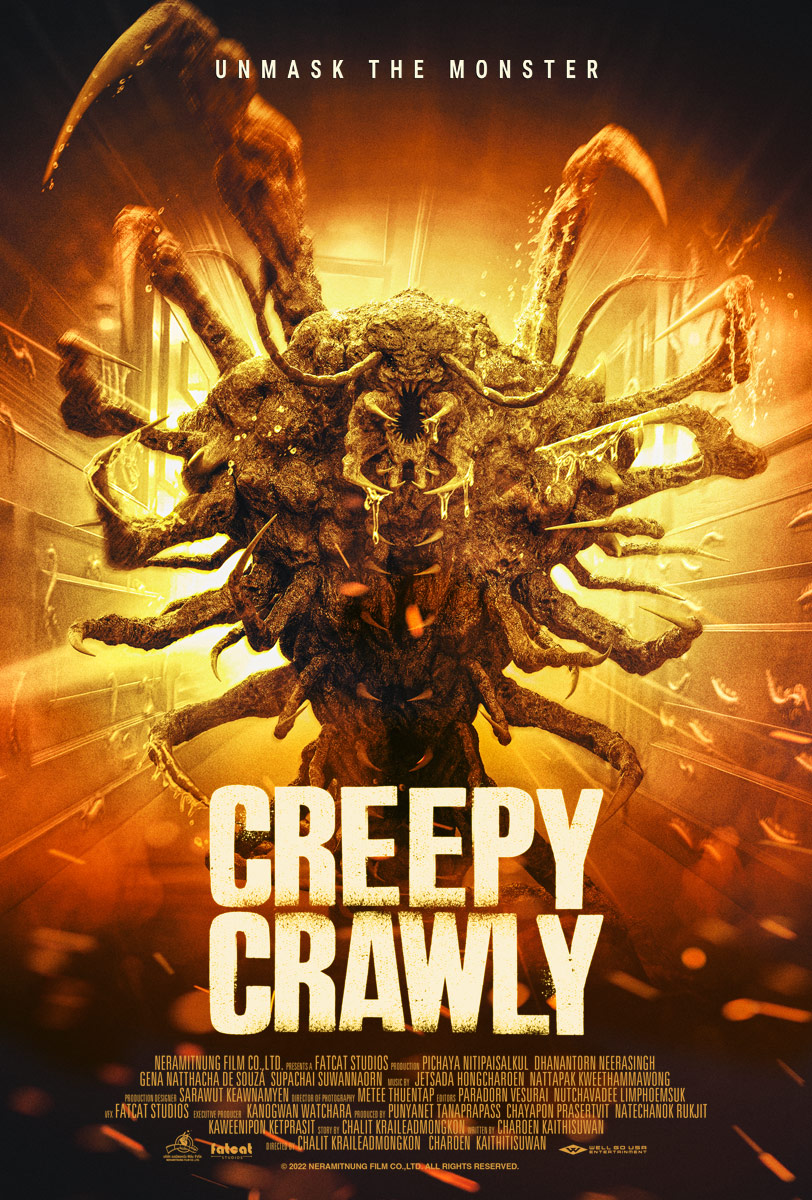
Creepy Crawly (๑๐๐ ร้อยขา, Pakphum Wongjinda & Chalit Krileadmongkon, 2022)

While everyone’s busy thinking about a high profile threat of infection, an unexpected aggressor raises its ugly head in Pakphum Wongjinda and Chalit Krileadmongkon’s insectile horror Creepy Crawly (๑๐๐ ร้อยขา). Centipedes in themselves are little creepy given the undulating motion of their many legs and tendency to crawl out from places where you’d least expect them, but this particular bug seems to have undergone a mammoth evolution to become a bloodsucking parasite capable of threatening the human race!

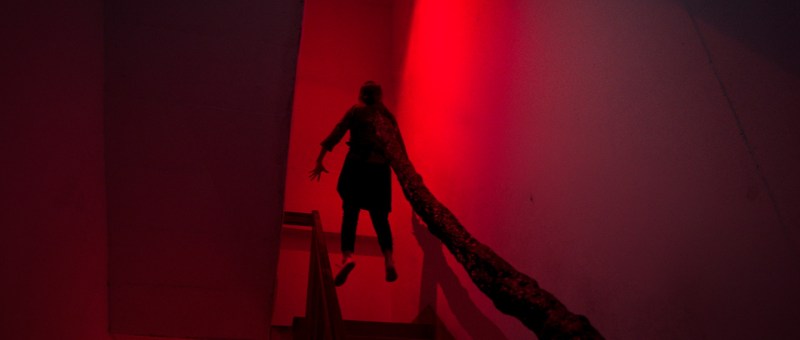
The film opens with a naive vlogger getting lost in the Thai countryside and deciding to pitch a tent in the middle of nowhere while unable to locate her campsite despite having encountered an elderly person bleeding profusely from the mouth whom she does nothing to help. During the night she’s bothered by giant centipedes and then has some kind of altercation with the elderly person. Some months later, an emergency order has been placed on the country due to the arrival of the coronavirus pandemic. Another YouTuber, Fame, who is well known for uploading videos criticising hotel accommodation, arrives at a hotel which has been turned into a quarantine facility along with her brother, Fiew, and a family of three, adult Taekwondo champion Leo, his naive sister Lena, and their father who is deaf. 

Obviously, the centipede, which is later described as a Tablongplum which can possess a human body and feast on its blood, has somehow made its way to the hotel and is particularly interested in Fame because she suffers from a rare disease which means that her blood would enable the Tablongplum to live a very long life. However, the bugs aren’t the only threat in the hotel even if they’re first discovered by the only remaining maid, Pond, feasting on a dead rat in a vacant room. The sleazy manager, Wit, is paranoid about the fortunes of his hotel during the pandemic considering it has already been dealt a reputational blow after being identified as the source of a covid cluster. It’s implied that he’s only got permission to re-open as a quarantine facility thanks to a dodgy deal with an important person who has also turned up, ironically belittling Wit for wearing a mask while describing covid as a “just a cold”, for a completely free and very discreet overnight stay with his mistress. 

Those are just a few of the reasons that Wit refuses to listen when Fame and Leo discover a body at the end of a blood trail, accusing them of being in cahoots doing a bit for the YouTube channel to further discredit his hotel which even on the surface of things seems not to be particularly well run. With the hotel technically in lockdown and patrolled by an armed guard, the tension begins to increase once it’s realised that the Tablongplum can possess and take on the form of any of the guests meaning no one can trusted and the bug could be anywhere. Somewhat improbably, not only is it able to fully understand human language even independent of its human hosts but also seems to have some knowledge of culture and is aware of how various things work rather than just being a giant blood sucking parasite apparently able to control vast armies of much smaller but admittedly nasty bugs especially when they appear in large numbers. 

The solution seems to be “kill it with fire”, though just the pandemic the bugs prove hard to stamp out with the infection seemingly continuing even after the big bad is supposedly eliminated as the centipedes continue to dominate human society. The film seems to be making a minor point about silly YouTubers who endanger themselves or thoughtlessly ruin the lives of others for clicks while also laying the blame on sleazy managers like Wit along with the political corruption that enables a health hazard to continue long after it should. Meanwhile, tiny bugs eat away at the surface, undermining the foundations as they go. Seeing an entire hotel covered in horrible insects is undoubtedly creepy though perhaps there was something rotten there all along. In any case, it seems there’s no escape from nature’s revenge or its bloodsucking tendrils. 


Creepy Crawly is released in the US on Digital, blu-ray, and DVD on Oct. 3 courtesy of Well Go USA.

International trailer (English subtitles)

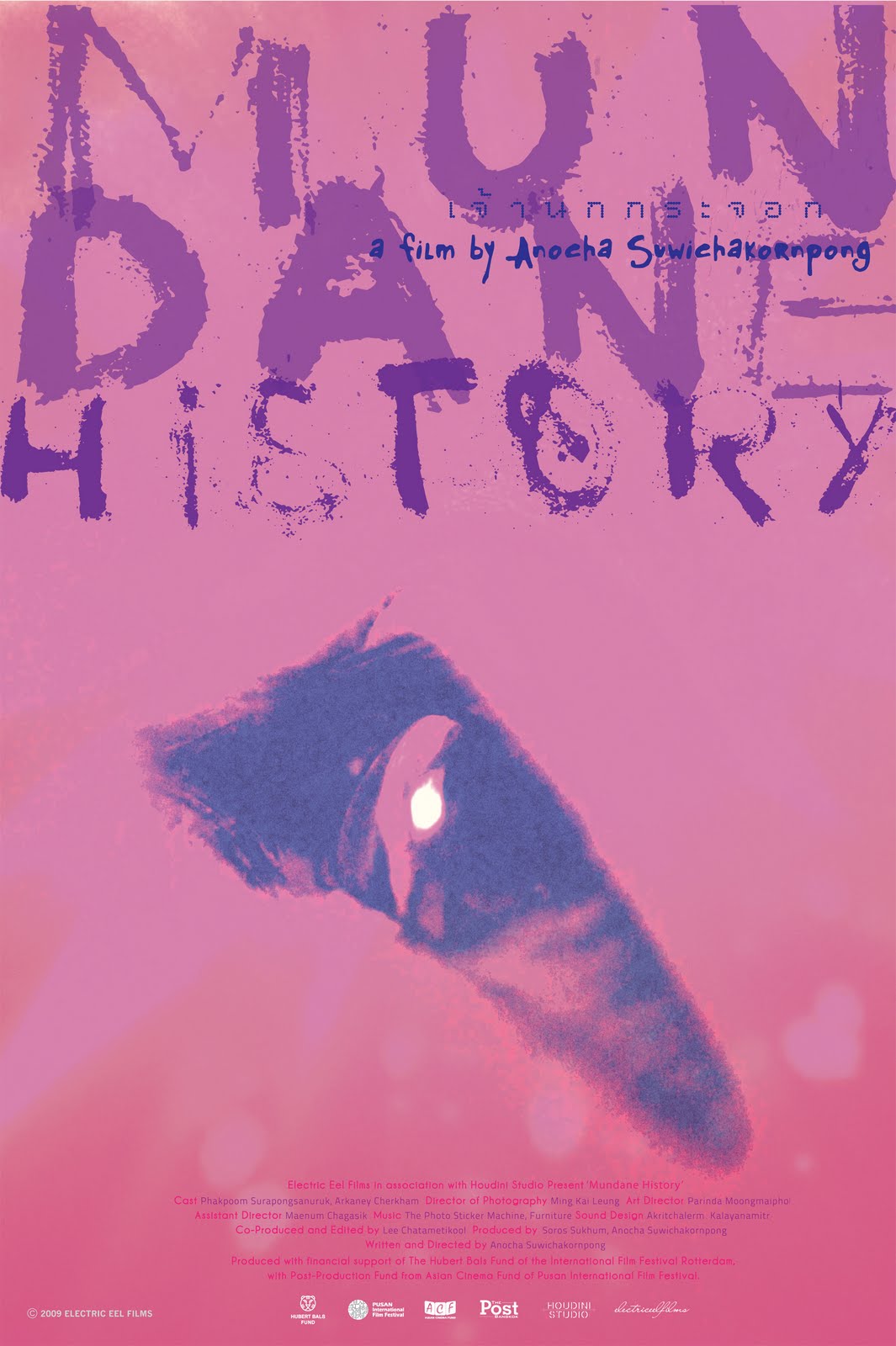
Mundane History (เจ้านกกระจอก, Anocha Suwichakornpong, 2009)

mundane history posterIs it possible to live without past or future, exist entirely within the pureness of the now? Anocha Suwichakornpong contemplates the bubble existence in her complex debut, Mundane History (เจ้านกกระจอก, Jao Nok Krajok). Class conflict jostles with the fading grandeur of a declining bourgeoisie while two young men lament their broken dreams, one believing himself a prisoner of his privilege and the other trapped by economic inequality. Yet despite their differences, the familial disconnections, and the austerity of their “soulless” environment, a connection is eventually formed making way for a rebirth, new life birthed in the ashes of the old.

Pun (Arkaney Cherkam), a nurse from a humble background, has travelled from the north to take a job as the full time carer for the son of a wealthy man, Ake (Phakpoom Surapongsanuruk), recently paralysed from the neck down after a mysterious accident. As Pun tells an intimate acquaintance, perhaps his sister, on the telephone, the house is beautiful but drenched in hopelessness and everyone within it seemingly dead inside.

Moody and resentful, Ake is now a virtual prisoner within his father’s household. Enraged by his new found impotence, he treats Pun with contempt, ironically enough embodying the role of the young master which is perhaps the key to his anger with his distant, austere father who has essentially outsourced his son’s care and then had him walled up at home like a guilty secret. Ake angrily refuses visitors, either embarrassed by his disability or not wanting to witness their pity, and spends his days doing nothing at all but staring blankly into the middle distance, unable to reconcile himself to the terrifying “mundanity” of his repetitive, unchanging existence.

As Ake becomes used to Pun’s gentle presence and allows himself to be cared for, a friendship begins to arise. Both men dreamed of becoming writers, one developing an interest in photography and the other film, but neither of them found their dreams fulfilled. Ake’s sense of defeat is palpable as he finds himself literally trapped by his father’s legacy, unable to escape the claustrophobic world of the family home and consumed by resentment as he convinces himself that his dream of becoming a film director is now unattainable thanks to his disability. Pun, meanwhile, is equally melancholy, perhaps secretly resentful but outwardly making the best of the hand he’s been dealt. From a humble background and orphaned young with siblings to support, his artistic dreams were taken from him by bad luck and socio-economic oppression though it hasn’t killed his kindly heart. 

The austere coldness of Ake’s father and the mansion’s emotional deadness perhaps represent an older generation’s longing for the safeties of an authoritarian world of rigid class boundaries and feudalistic loyalties. Ake’s housekeeper, the prim and proper Somjai (Anchana Ponpitakthepkij), is a relic of this all but forgotten world – a career servant who has silently watched Ake grow as her own youth faded and finally decides to puncture the class divide only to ensure its survival in urging Ake to maintain his stiff upper lip and avoid giving in to despair. Somjai resents Pun’s awkward, liminal status in the house as the only other member permitted to walk freely in the upstairs world and seeks to him keep down, eating with the other servants where he belongs. Pun, like the cook Kaew – also a northerner, doubts he can stay in this world indefinitely, already tired of its energy sapping rigidity and entrenched class-based social codes.

Ake’s resentment towards his father is also a rebellion against his old fashioned authoritarianism which stifles the natural desire of the young for freedom. Now literally unable to escape unaided, Ake feels as if his father has trapped him, deliberately, within the confines of his own value system with no possibility of salvation. The house is, in a sense, the eternal present that Pun and Ake talk about in one of their few moments of blissful togetherness as they lie alone on the grass lawn staring at the blue sky, but the inertia crushes them, driving young men to despair. A trip to the planetarium coupled with Ake’s youthful student films provides an opportunity for rebirth if only in destruction. Stars burn out, destroy themselves, but become nebulas in the process. Anocha Suwichakornpong’s fragmentary narrative is indeed nebulised, pulsing in brief fragments until the whole somehow connects and sparks into life. The spiritual rebirth echoes the political, the desire of youth to break free reasserts itself and the mundane history of an ordinary life regains its cosmic grandeur.


Original trailer (English subtitles)