Canola (계춘할망, Chang, 2016)

“Even when life is hard…if someone’s on your side, it’s possible to go on” the selfless grandmother at the centre of Chang’s heartrending familial melodrama Canola (계춘할망, Gyechun Halmang) imparts, just something she learnt naturally in the course of her life. Partly a tale of familial disruption, dislocation, and the corrupting influences of modernity, Chang’s eventually uplifting tale is also one of interpersonal salvation in which gentle support from a welcoming community can overcome personal trauma and allow those who feared they’d never recover to become a more authentic version of themselves. 

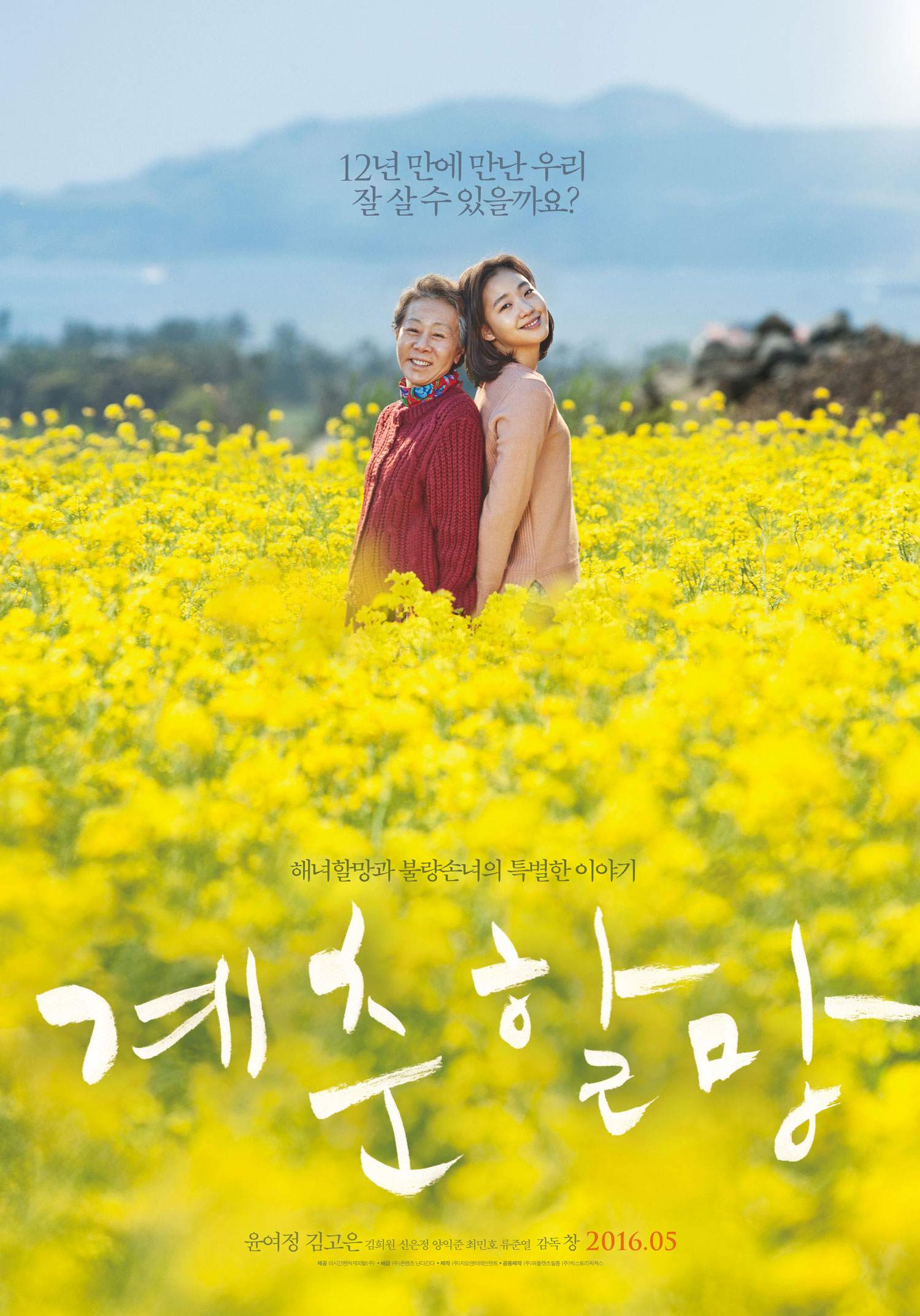
Granny Gye-chun (Youn Yuh-jung) is an ageing Haenyo diver on picturesque Jeju island currently raising her young granddaughter Hey-ji following the death of her son, his wife having left sometime previously. Clearly devoted to each other, tragedy strikes when the pair leave for the city to attend a wedding only to become separated in a crowded marketplace. Gye-chun frantically searches for Hye-ji, but is unable to find her. 12 years later, she’s still pasting missing child flyers all over town while refusing offers to sell her traditional home, which has no indoor plumbing, because she is afraid that Hye-ji may some day return and find her gone. And then a miracle occurs, a young woman (Kim Go-eun) telephones the missing hotline after seeing a picture on a milk carton and claims to be Gye-chun’s missing granddaughter, explaining that her birth mother abducted her from the marketplace and had her adopted by her step-father so she had a different name. Her mother later died and the step-father then callously placed her in an orphanage after which she ended up on the streets.  

Gye-chun is so happy to have her granddaughter back that she perhaps does not fully process the full implications of the situation, taking each of Hye-ji’s claims at face value while struggling to separate the idea of the child she lost with the young woman who has returned. On a shopping trip she buys her a colourful ribbon bow hair clip not entirely appropriate for someone of Hye-ji’s age while confused that she no longer needs her help to go to the outhouse in the dark and locks the door while having a bath. Nevertheless she also seems to worry about what her life might have been like during the time they spent apart, irritated by the other villagers’ disapproval in reminding them that they all reassured her Hye-ji was probably “fine’ when the evidence suggests that fine is something she hasn’t been for a long time. 

The fishing village is indeed a little more conservative than the city, many scandalised by Hye-ji’s short skirts and by the fact that she smokes, instantly labelling her a “delinquent” and possible troublemaker. There is then something uncomfortable in their insistence that she lead a “good life” needing to be guided back towards a more socially conservative path as if her fashion sense and minor rebelliousness make her a “bad person”, while only Gye-chun seems to appreciate that Hye-ji may have come back with trauma from which she will need love and support to recover while short skirts and smoking aren’t really much to worry about in the grand scheme of things. Letting Hye-ji know that she is always on her side, she tries to give her the gentle love and encouragement she needs to become her best self while Hye-ji both begins to feel a genuine connection to the older woman and consequently intense guilt for having kept something from her and perhaps unfairly taking advantage of her kindness. 

Nevertheless, in this more positive environment Hye-ji begins to blossom while Gye-chun begins to put the past to rest, the two of them finding in each other the means for salvation in which it ultimately no longer matters if they share a blood relation or not. Contrasting the beautiful Jeju landscape with its brilliant fields of yellow canola flowers, with the darkness of Hye-ji’s city life, Canola is keen to suggest the difference an environment can make to a quality of life while quietly stressing that in the end it’s people and the bonds between them that matter, just something you learn naturally as you grow. 


Canola screens 6th November as part of this year’s London Korean Film Festival.

Original trailer (English / Korean subtitles)

A Man and a Woman (남과 여, Lee Yoon-ki, 2016)

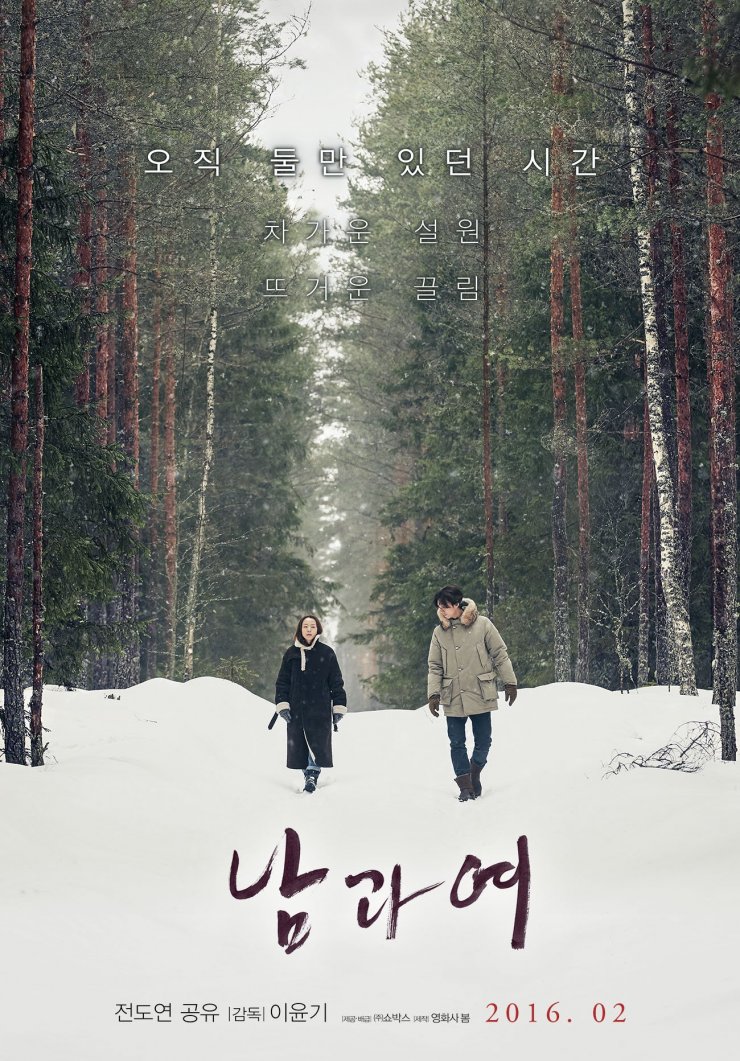
A man and a woman postetSome memories are better when forgotten, according to the heroine of A Man and a Woman (남과 여, Namgwa Yeo) – the latest romantic melodrama from Lee Yoon-ki. The title, deceptively simple as it is, makes plain Lee’s intention to reduce this melancholy love story to a universal level in which two people who share a deep and genuine connection choose to sever it rather than break with social convention and/or incur the additional risks of ongoing entanglement. An elongated Brief Encounter, the ballad of Sang-min and Ki-hong is a strangely old fashioned one in which unhappiness appears to be the ideal choice and a satisfied life an indulgent luxury.

Sang-min (Jeon Do-yeon) has brought her almost teenage son to Finland for treatment at a special needs school. Dropping him off for a school trip, Sang-min gets cold feet and tries to insist on accompanying the boy, only to be roundly refused by the carers. In the car park she runs into another Korean – Ki-hong (Gong Yoo) has been living in Finland for a couple of years and his young daughter attends the school to help with depression. Sang-min presses Ki-hong for information about where the camp is and eventually he offers to drive her. Predictably, they get caught in a snowstorm and have to stay overnight. A visit to a woodland sauna the next day leads to an intimate encounter but as soon as they arrive back in the city, the pair part ways without even exchanging names.

So begins the sad ballad of Sang-min and Ki-hong which eventually takes them back to Seoul where they resume their affair, putting each of their families at risk. Both parties are married already but each desperately lonely in very ordinary ways. Sang-min is a highflying CEO of a small fashion line but also shoulders most of the responsibility of looking after her son who needs a lot of extra help to cope with his autism. Her husband is rational and distant; the marriage is not unhappy but perhaps emotionally unfulfilling. Ki-hong’s marriage is also under strain as his wife has ongoing mental health issues leaving him to look after their equally distressed daughter whilst also pursing a career as an architect. 

The snowbound, silent forests of Finland are an appropriate point for the start of the affair, echoing the couple’s frozen, interior blankness. Sang-min has a pre-occupation with time in Helsinki which she abandons in Seoul, less because of a literal return to the alternation of light and darkness than a inner feeling of it passing at a more predictable rate. In Finland she wanted to know everything, in Seoul she decides perhaps it’s better not to know. Ki-hong, by contrast, is a vague sort of person in both places. Yet their instant connection is real and deep. They echo each other, repeating their shared phrases and sharing something to which they cannot give a name.

Though living in more permissive times, the love of Sang-min and Ki-hong remains impossible despite the ongoing unhappiness of their married lives. Sang-min looks on enviously at her younger sister who is dallying in marrying her American boyfriend. Her sister tells her she wants what Sang-min has – to be “happily” married, entirely unaware of Sang-min’s loneliness and dissatisfaction. Ki-hong’s moribund marriage is difficult enough but the spark has already gone – his wife tells him she feels like a patient, the subject of Ki-hong’s dutiful devotion rather than a woman who is loved by the man with whom she shares her life. Despite all of this the idea of leaving their unhappy situations to find happiness in each other is never a real possibility for either Sang-min or Ki-hong who each remain trapped both by adherence to social conventions and a lingering reluctance to fully commit.

The forces which keep them apart are less societal than personal, an unwillingness to embrace the possibility of happiness or perhaps a sense that it is not something which is permitted to them. Times have moved on since Alec and Laura said goodbye to each other in a station cafe, unspoken emotion filling the room as a busybody inserts herself into a private world about to end. There is no particular reason why Sang-min and Ki-hong cannot be happy, yet they each eventually choose not to be. Frosty indeed, this is a love which is apparently best relegated to memory, untainted by time and eternally pure. Beautifully photographed and heartbreakingly bleak, A Man and a Woman is a sad story of refused connection in which love is a risk too great for two lonely souls.


Original trailer (English subtitles)