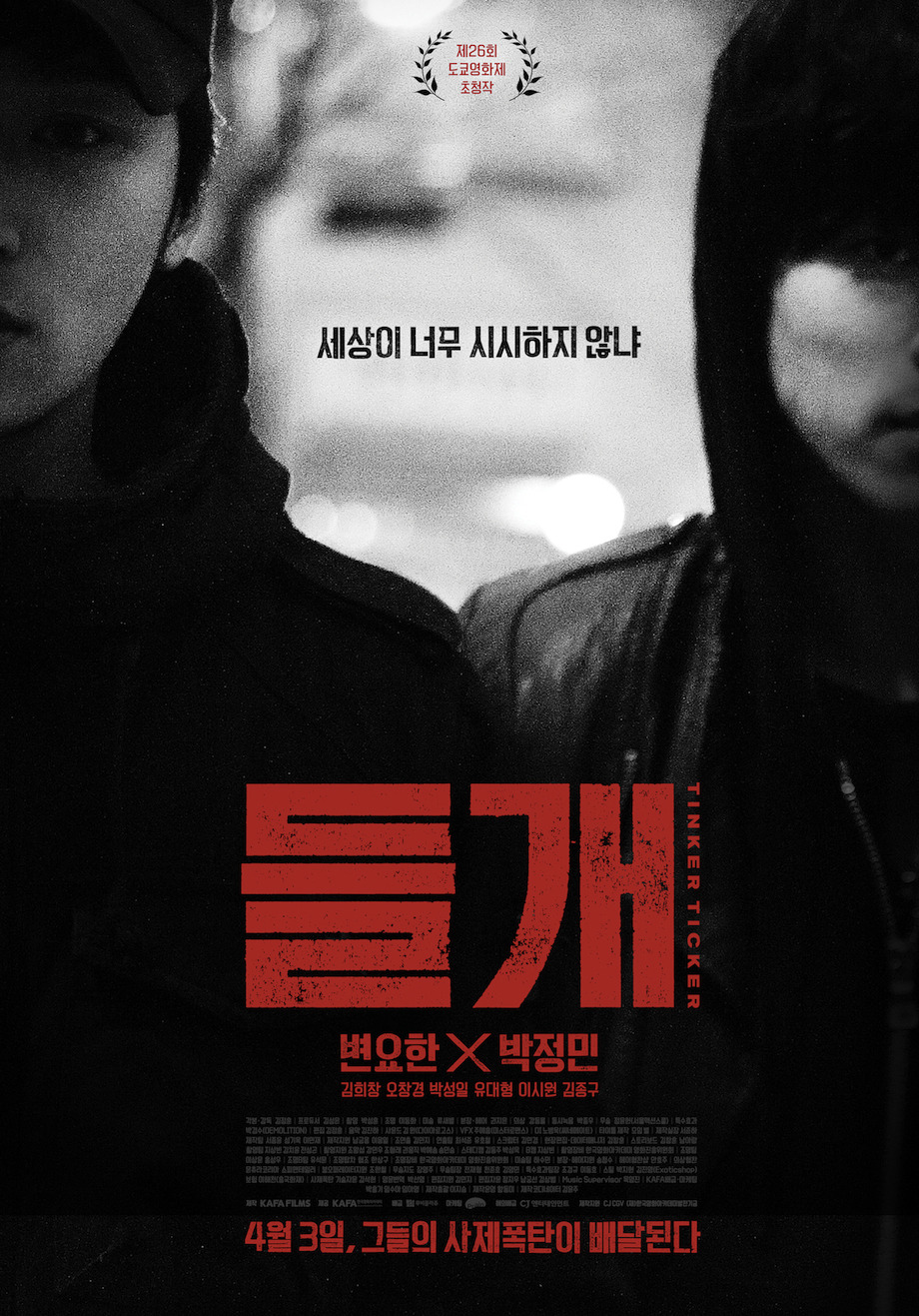
Tinker Ticker (들개, Kim Jung-hoon, 2013)

A jaded young man finds himself torn between continuing to fight the system and a total capitulation to it in Kim Jung-hoon’s explosive debut feature Tinker Ticker (들개, Deul-gae). Fit to explode, Jung-gu (Byun Yo-han) takes his revenge on a bullying culture by literally blowing it to hell but after a spell in juvenile detention emerges meek and mild, lacking in resistance and apparently willing to undergo whatever degradations are asked of him in order to achieve conventional success. 

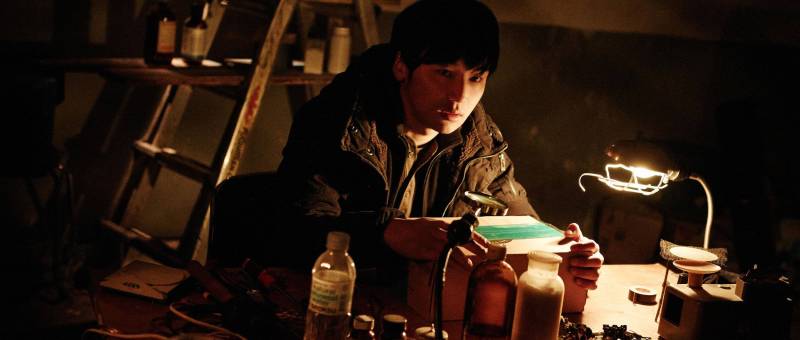
Having placed a bomb in the car of a teacher who was abusive towards him, Jung-gu was caught and sent to prison with the unfortunate consequence that he can no longer study chemistry as he’s been banned from using dangerous substances. He repeatedly attends job interviews where he is asked bizarre and invasive questions, but can only find work as a post-graduate teaching assistant to a marketing professor who, like his teacher, largely abuses his position to humiliate him. To ease his frustrations, Jung-gu makes bombs at home but offers to send them out on the internet for free on the condition that the recipient actually use them.

His life changes when he runs into rebellious drop out Hyo-min (Park Jung-min) who is done with capitulation and fully committed to bucking the system. Seemingly from a wealthy family, he’s cut ties with his parents and lives a squalid life in a bedsit while continuing to attend university lectures despite having been expelled. Jun-gu sends one of the bombs to him to see what would happen and though Hyo-min seemed like he was going to simply throw it away he ends up blowing up a van which ironically has the CJ Films logo on the side.

Hyo-min in a sense represents Jung-gu’s rage and resentment towards the system that oppresses him along with a desire for anarchic autonomy while he conversely leans closer to a conventional corporate existence by willingly debasing himself before his sleazy boss Professor Baek (Kim Hee-chang) who asks him to act unethically by “revising” the results of his research so they can secure funding and do a back door deal with his long-standing contact Mr. Kim. Baek also forces him to drink beer that’s been drained through his sock as part of a bizarre hazing ritual while otherwise running him down or insulting him at the office. 

Hyo-min tries to goad Jun-gu into blowing up his attempts at conventionality by taking out Baek, but he continues to vacillate apparently still interested in becoming a corporate drone whatever the personal cost. “I don’t want you to become dull,” a slightly spruced up Hyo-min later insists in trying to push Jung-gu into killing Baek, while Jung-gu isn’t sure which life he wants torpedo. In any case, he seems incredibly ashamed of his criminal past and wary of others finding out about it not just because of its practical consequences for his employment but on a personal level. If he wants to transition fully to the life of a soulless salaryman he’ll need to kill the Hyo-min within him and remove all traces of resistance and individuality.

Despite having promised to do so, none of the other men who request the bombs actually use them perhaps like Jung-gu lacking the ability to follow through but enjoying the power of having the ability to burn the world even if they’ll never use it. Jung-gu’s bombing fixation is indeed in its way passive, a vicarious thrill in the ability to cause havoc for no real purpose but not really doing anything with it all while his resentment grows in parallel with his desire to be accepted by mainstream society. Hyo-min eventually comes to the conclusion that nothing really changes, and it both and doesn’t for Jung-gu who finds himself succumbing to the consumerist desires of a capitalistic society willing to debase himself, and later humiliate others, to claim his rightful place on the corporate ladder. Kim takes aim at the pressure cooker society, implying that these young men are in themselves almost ready to explode in their twin resentments and jealousies while ultimately complicit in their own oppression in wilfully stepping in to a corporate straitjacket even at the cost of their freedom and individuality. 


Tinker Ticker screened as part of this year’s London Korean Film Festival.

International trailer (English subtitles)
Finding Angel (천사는 바이러스, Kim Seong-joon, 2021)

Every Christmas, a box full of money is left in a small village in Jeonju by a well-wishing philanthropist the villagers have taken to calling the “faceless angel”. The phenomenon is in someways a double-edged sword seeing as the anticipation often attracts the attention of the press with various reporters descending on the village hoping to unmask the unknown benefactor’s identity while the villagers have their own ideas who it might be though in practice perhaps it doesn’t really matter. 

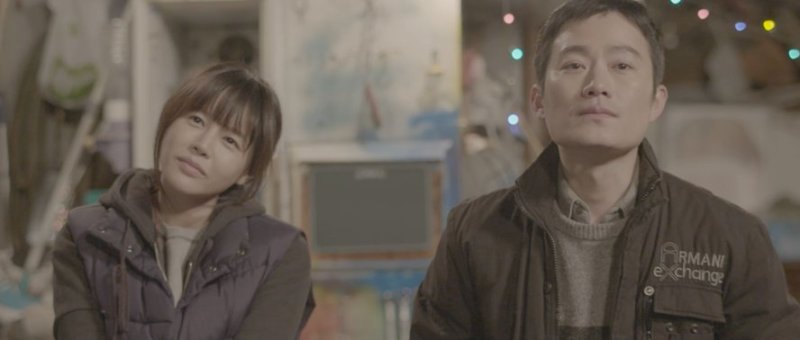
As Kim Seong-joon’s warmhearted seasonal comedy Finding Angel (천사는 바이러스, Cheonjaneun Baileosu) makes plain, however, motives are not always pure when there’s money involved and so to some the Angel’s identify matters a great deal. Jihoon (Park Sung-Il) arrives claiming to be a reporter charged with unmasking the mysterious benefactor but on discovering no one is keen to help him, makes up another cover story that he’s a writer researching a novel about small town life while drawing inspiration from the fascinating local legend. As junkyard owner Cheon-ji (Lee Young-ah) instantly realises, there is something a little suspicious about Jihoon that suggests neither of his cover stories is genuine while his true motives remain obscure as he sets about investigating the townspeople trying to figure out if one of them may be the mystery donor. 

As might be expected, the majority of the local residents are elderly though most of them are still working earning a mere pittance at the junkyard despite as Jihoon discovers being fairly well off. Though severe and aloof, many regard Cheonji, who shares the first syllable of her name with the word, as a kind of angel herself having adopted a little boy she’s raising as a single mother while generally being around to settle minor neighbourhood disputes and providing a place for the community to gather which they don’t currently have because the local council leader still hasn’t got round to building the promised old persons’ community centre though he apparently has time to show up for unarranged photo-ops delivering charcoal briquettes to the needy. A running gag sees Jihoon, having got a job at the junkyard to better investigate, struggle with the physical nature of the work while the elderly villagers just seem to get on with it if engaging in the occasional spat along the way. 

Shifting from one “suspect” to another, Jihoon begins to uncover the small secrets of village life learning something new about each of his new friends from bitter regrets to frustrated hopes for the future but his past soon catches up with him threatening to blow his cover as the timer counts down to the Angel’s arrival. What remains is a sad story of perpetual orphanhood and the healing power of the community, the villagers somehow believing that the Angel must be a boy they took in for a brief period 25 years previously who has since made good and wants to give something back though as they later discover the boy was largely betrayed by the world he returned to, encountering only indifference and exploitation away from the kind and watchful eyes of the villagers. 

The identity of the Angel may be beside the point, but what Jihoon discovers is a path back towards redemption through bonding with the villagers if feeling increasingly guilty in not having been entirely honest about his intentions. He is sometimes tempted to betray his new friends, but in the end also helps them to sort out various community problems such as the long held grudge between two elderly former lovers or the inner conflict of Cheonji’s young son who has been secretly siphoning off the best bits of junk while saving money to become “independent” because the junkyard is not an altogether cheerful environment. A warmhearted seasonal mystery, Finding Angel is full of the Christmas spirit as the community come together to protect their local legend aided by Jihoon who becomes ironically enough the fiercest believer in Faceless Angels as he too begins to deal with his childhood traumas, experiencing a Christmas miracle of his own as he learns to let go of his cynicism thanks to the gentle support of the Jeonju villagers. 


Finding Angel is released in UK cinemas on 26th November courtesy of The Media Pioneers.

Original trailer (English subtitles)