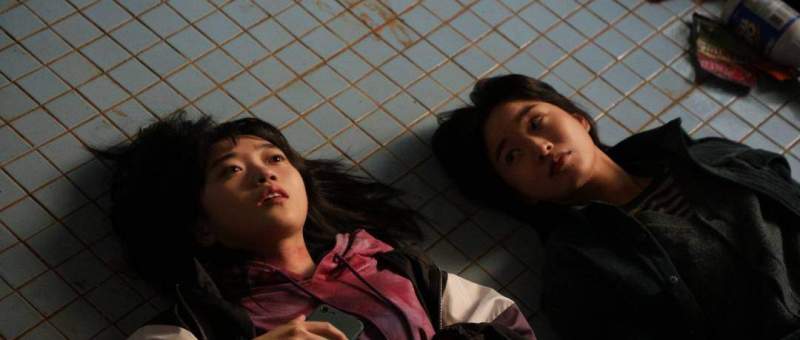

Two teenage girls swap thoughts of suicide for revenge on learning that their former tormentor is living well in Seoul but find their plans frustrated on discovering she has joined a religious organisation and apparently reformed in Lim Oh-jeong’s bullying drama, Hail to Hell (지옥만세, Jiogmanse). “Hell” is what the two girls, and a fair few others, believe their lives to be while seeing little way out other than taking their own lives but are confronted with questions of redemption and forgiveness not to mention death and paradise while plotting vengeance in the capital.
The surprising thing about high school girls Na-mi (Oh Woo-ri) and Sun-woo (Bang Hyo-rin) is that Na-mi was once part of popular girl Chae-lin’s (Jung Yi-Ju) gang and only left it when they turned on her. Nevertheless, the two young women have bonded in their shared victimisation and desire for an end to their suffering. After several failed attempts at taking their own lives, they change tack on coming across Chae-lin’s Instagram posts which imply that she is living the high life in Seoul and even planning to study abroad which the girls regard as a cruel irony given the extent to which the bullying orchestrated by Chae-lin has disrupted their lives. Unsure exactly what they plan to do, they board a bus to the capital and make their way towards Chae-lin only to discover she’s joined a weird cult in which the members are expected to earn points through doing service in order to qualify for a ticket to “paradise”.
The language itself is quite sinister even if the “paradise” that’s on offer otherwise sounds fairly conventional. Then again, there is no real evidence that “paradise” actually exists while Chae-lin claims that her mother is already there which is why she’s so desperate to go. When the girls first arrive, her expression is strange to the extent that it’s impossible to tell if she’s “happy” to see them or merely excited by the prospect of tormenting them all over again. She says that she’s already confessed all her sins and views the girls’ appearance as a miracle sent by god so that she could atone and earn their forgiveness. Then again, being forgiven for one of your sins is worth the most amount of points and Chae-lin would definitely win if Na-mi and Sun-woo could be talked in to publicly forgiving her.
Whether Chae-lin has changed or not the girls are divided on the prospect of forgiveness and whether the way they’ve been treated is something that even should be forgiven. Na-mi begins to concede that Chae-lin may have changed “a bit”, but is later forced to reflect on the ways she herself hasn’t changed or faced her complicity with Chae-lin’s bullying when she was a member of the gang while still apparently susceptible to her manipulation. Then again, it’s impossible to tell if Chae-lin is only in the religion for cynical reasons or genuinely believes in its teachings. The church itself has a distinctly eerie quality only deepened by talk of a possibly problematic article, onerous demands on members to buy “offerings”, and a points-based system of spiritual redemption.
Meanwhile, it seems there is bullying even here with a young woman abruptly silenced, threatened with both a loss of points and “punishment”, for even making the suggestion that someone may be bullying her. Though Sun-woo sympathises with her plight, she does not know how to help her or to change the culture within the church. “No matter how long you wait, no one will help you,” Sun-woo advises another trapped young woman as she in turn attempts to shake off the feeling of powerlessness she had experienced as a victim of bullying and harassment. Neither girl had found any help from those around them, Sun-woo’s family apparently preoccupied with her disabled sister and Na-mi’s mother blaming her for being bullied insisting it was her own fault for being “weak” rather than fighting back but if their experiences have taught them anything, it’s that they can rely on each other and that they don’t really want to die so much as live without fear which might be more possible than they’d previously assumed it to be. “Welcome back to hell” Na-mi somewhat cheerfully calls out, countering a sign on the bus which had ironically claimed that wherever we are is “paradise” but perhaps finding something in it as she and Sun-woo prepare to move forward together having exorcised a few demons and reclaimed a sense of their own agency.
Hail to Hell screened as part of this year’s New York Asian Film Festival.
Trailer (English subtitles)

 Windows on Worlds