I Love You, to the Moon, and Back (穿过月亮的旅行, Li Weiran, 2024)

The economic realities of a changing mid-90s China conspire against a young couple who find themselves stranded in different cities and only able to meet up once a month for a night of passion in a hotel in Li Weiran’s wholesome romantic dramedy, I Love You, to the Moon, and Back (穿过月亮的旅行, chuānguò yuèliang de lǚxíng). Based on a novel by Chi Zijian and themed around the Mid-Autumn Festival, the film has a quirky, nostalgic quality but also a degree of poignancy amid the absurd journeys the lovers make in pursuit of their love.

Gradual flashbacks reveal that Wang Rui (Hu Xianshu) and Lin Xiushan (Zhang Zifeng) married in their home village but like many youngsters of the day left soon after for the city in search of work. Forced to leave school by his farmer father who saw no point in education, Wang Rui quickly finds works in construction but Xiushan, who was also forced to leave school early, is unable to find anything in Shenzhen and eventually takes a job in a dumpling factory in Guangzhou where she lives in workers dorms. Their plight reflects the economic reforms which were taking place throughout the 1990s giving rise to a new, much more capitalistic society as embodied by the employers who give Wang Rui an extra day off for lying on TV that they’re not exploiting him, and an obnoxious businessman Xiushan has the misfortune to sit opposite on the train who talks loudly on his mobile phone about an important deal and even drips cigarette ash all over the old lady next to him justifying himself that he doesn’t want to damage his expensive suit. 

By contrast, Xiushan and Wang Rui are incredibly frugal shopping mainly at markets with Wang Rui padding a fancy pair of shoes that are too big for him but available at a large discount. They save all their money for their monthly meetups which, as they’re both living in communal dorms, take place in cheap motels. Xiushan tries to ameliorate their grimness by covering the stained mattresses with her own sheets featuring a pattern of large sunflowers and blue skies that help her feel as if they’re back in the village lying down together in a pretty garden. To this extent it’s clear that living in the city in addition to so far apart has corrupted the innocence of their romantic connection. Xiushan was warned by her brother that if she wanted to hear Wang Rui’s harmonica playing she should put off going out with him because the romance will die once he’s won her, and it’s true enough that Wang Rui never plays the harmonica for her anymore in part because they’re now quite expensive and he’d rather save up his money for another cross-country visit. 

Xiushan’s decision to buy one for him with some money from an unexpected windfall is then an attempt to rescue their romantic connection which is now under threat because of their geographical displacement and economic oppression. On the train, however, she runs into another man who plays harmonica and has apparently been arrested for an undisclosed crime. Out of compassion she asks the policeman escorting him to allow the condemned man to play a song which he does and reduces the entire carriage to tears hinting at other sad stories of separated lovers in modern China. Wang Rui encounters something similar in a one armed man caring for a wife from whom he was separated who has since become ill and is apparently in love with someone else. His cynicism causes Wang Rui to doubt Xiushan, so paranoid that another man may take a liking to her that he puts back the pretty dress he’d intended to buy as a present and gets the much more temporary gift of a bunch of roses instead.

These respective choices of items might signal where they are in their relationship, but there’s still a pureness to their love that can’t be destroyed completely. Both unexpectedly given an extra day off for the Mid-Autumn Festival they decide to make surprise visits to other’s cities only to perpetually miss each other, stuck travelling back and forth by train and only able to make contact via “their” set of payphones for as long as their phonecards would allow before fate finally, if briefly, smiles on them under the light of the autumn moon. Charmingly quirky and hopelessly innocent, the film nevertheless captures something of the chaotic undulations of the mid-90s society in which youth is on the move but love it seems is standing still.


Original trailer (Simplified Chinese & English subtitles)
The Invisible Guest (瞒天过海, Chen Zhuo, 2023)

Prestige mystery thrillers are definitely having a moment at the Chinese box office and like last summer’s Lost in the Stars, The Invisible Guest (瞒天过海, mántiānguòhǎi) takes place in a fictional South East Asian nation among a largely Chinese community where the policemen mainly speak English and almost everyone else Mandarin. Like many similarly themed films that might partly be because there is a strong suggestion of normalised judicial corruption which would otherwise be a difficult sell for the Mainland censorship board even if very much on message in its anti-elitist themes in which it is repeatedly stated that money cannot in fact solve everything. 

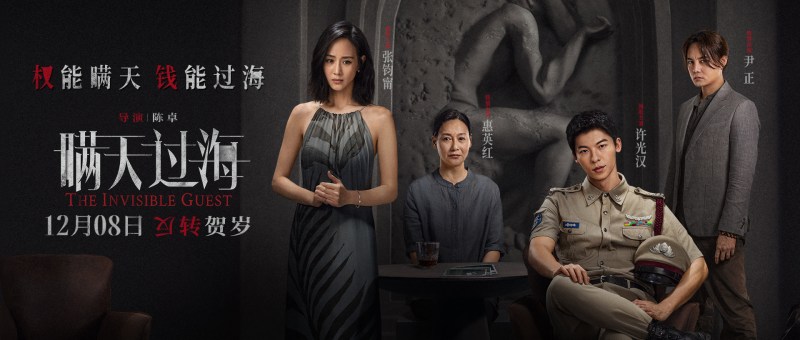
Adapted from a Spanish film which was a huge hit on its Chinese release and recently remade in Korea under the title Confession, the film opens as a locked room mystery. A well-known architect, Minghao (Yin Zhung), who is also the adopted son of the nation’s only Chinese lawmaker, has been brutally murdered in a luxury hotel. Joanna (Chang Chun-ning), the wife of a filthy rich real estate magnate, has been arrested but maintains her innocence. She claims that they were attacked soon after entering the room and that she was temporarily knocked out waking up to find Minghao with his throat cut, the attacker vanished, and police kicking down the door.  

The twist is that she’s then approached by Zheng (Greg Hsu), a local cop, who offers to “help” her for a small fee promising to sort out all the problematic evidence against her if only she’s honest with him about what really happened in the room. Obviously, the depiction of such an openly corrupt law enforcement officer would not be possible on the Mainland which explains the international setting but it soon becomes clear that Joanna may not be a very reliable narrator and Zheng obviously knows a little more about what’s really going on than he pretends.

Joanna had only recently married her superwealthy husband whose business interests have been very badly affected by the scandal, suggesting at least that she may be a patsy at the centre of a corporate conspiracy with her husband’s firm possibly hoping to get rid of her or someone else’s using her to get to him. But the most essential message is that the rich and powerful shouldn’t have a right to assume that everything can be solved with money and they can get away with anything so long as they have financial means to pay for it. In a flashback which we can’t be sure is completely reliable, someone suggests that the victim’s life was meaningless and killing them no different from crushing an ant, a view somewhat validated by Zheng when he tells Joanna that he isn’t interested in people like that only people like her, wealthy. 

Conversely, a tangenital victim of the case later insists that you shouldn’t underestimate what poor people will do for their families because in the end that’s all they have. The film is sympathetic to those like them who do not have the means to face off against someone like Joanna who probably could, if she is not actually innocent as she claims, evade justice thanks to her vast wealth and social standing assuming her husband’s company don’t decide to drop her in it. There is also, however, the implication that Joanna was once herself poor and downtrodden and has been corrupted by her desire for the illusionary freedom of wealth, abandoning her integrity while carrying the innocent dream of buying an idyllic orchard where she could live in peace and comfort. 

Playing out in near realtime, Chen keeps the chamber drama tension high with frequent on-screen graphics reminding us that Joanna only has a couple of hours left to clear her name before the dossier of evidence against her will be presented to the prosecution and she’ll be charged with murder. Zheng says he can help but keeps pressing her not only for more money but more information, the “real” truth, rather than a favourable narrative though arguably the flow of hypotheses made more sense in the context of a lawyer prepping a client than a policeman probing for evidence in order to neutralise it as did the accused’s willingness to trust the person poking holes in their story. A kind of justice, at least, is done and not least poetic as the truth begins to emerge though the guilty parties or invisible guests of latent classism and social inequality are very much here to stay. 


The Invisible Guest is in UK cinemas now courtesy of CMC.

International trailer (English subtitles)

If You Are Happy (学区房72小时, Chen Xiaoming, 2019)

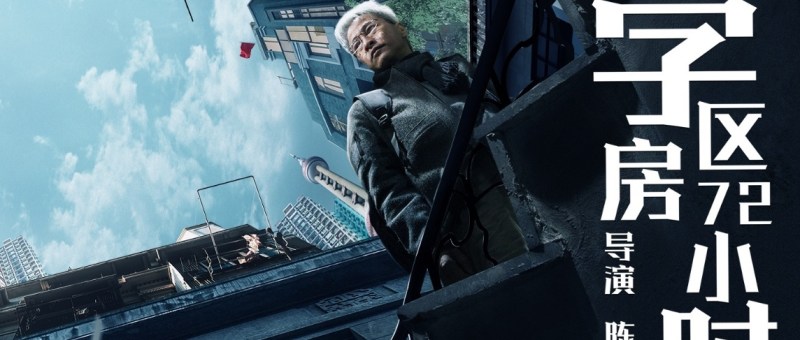
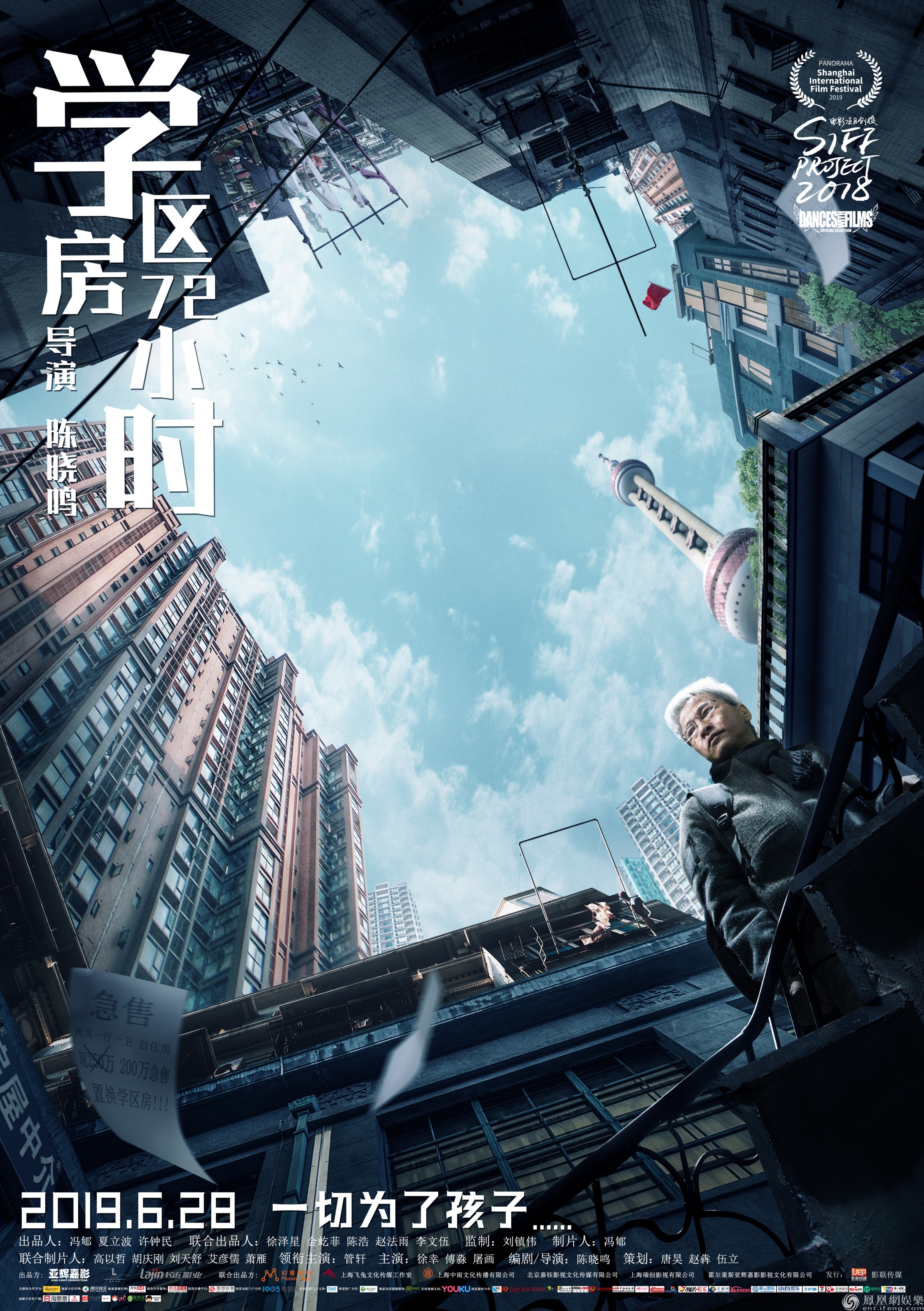
If you are happy poster 2“Win at the starting line” has become something of buzzword among parents eager to get their children the best start in the modern China where equality is no longer regarded as a social good. Even in the UK it’s not unusual for parents to go to great lengths to game the system so their children can get into the “better” state schools, but in China where educational background really can make or break a child’s future the stakes are obviously much higher. For the father at the centre of Chen Xiaoming’s biting debut, the ironically titled “If You Are Happy” (学区房72小时, X Fáng Xiǎoshí), the stakes are very high indeed as he bets pretty much everything – his family home, his career, and finally his integrity, on buying a grotty little flat in the rundown part of town where he grew up solely because it’s directly opposite the best primary school in the area.

University professor Fu (Guan Xuan) is a doting father to little daughter Cheng, but as keen as he is to keep up the facade of success his private life is falling apart. His wife, Jiayuan (Fu Miao), is suffering from long term depression and though Cheng seems cheerful, the atmosphere at home is frosty at best with husband and wife barely speaking. Meanwhile, Fu has also been carrying on an illicit affair with one of his students, Hang (Tu Hua) – a wealthy young woman whose mother (Rong Rong) is keen to send her abroad for graduate school to improve her prospects. Hang doesn’t want to go, she says because she’s become attached to Fu, but there are also rumours all over school about teachers accepting bribes to change students’ grades and the jury’s out on whether Hang has ulterior motives.

The main source of stress in Fu’s life is however his ongoing quest to buy a flat in the catchment area of a prestigious primary school. After two years of dashed hopes, an old friend working as an estate agent has a promising lead on a place that’s actually right by where they both grew up. Though the flat is in a bad state and really too small for a family (assuming they actually meant to live there), Fu is loathed to give up the opportunity even though he doesn’t have the ready cash together to seal the deal. Despite his outrage at the teachers who take bribes, he tries to force his friend to pull some strings before coming to the conclusion he’ll have to sell his flat. Fu goes ahead and lists it with another estate agent before even talking to his wife who is understandably not keen to move, insisting that the school around the corner is fine, only for Fu to snobbishly tell her that it’s fine for kids like Tao – a naughty little boy at kindergarten who accidentally slashed Jiayuan’s hand when he somehow got hold of a kitchen knife. 

Fu’s snobbishness is perhaps his defining characteristic. Forced to sell his family home, he bristles when the maid mentions that her son is looking for a flat, coming up with all sorts of excuses as to why he shouldn’t be able to afford it before accepting that money’s money no matter who it comes from. Auntie Niu’s (Xu Xing) son Bao (Liu Xiaodi) has troubles of his own, as they discover when paying him a visit and finding him near suicidal because his fiancée is thinking of breaking things off as her family have refused their blessing for the marriage until Bao can get hold of a flat in a very specific area. Bao’s case is frustrated because he’s not originally from Shanghai and a new law prevents non-locals from owning property. Luckily his fiancée is a Shanghai native but he doesn’t have the money to buy in the escalating Shanghai property market and only has this shot with Fu because he is a “motivated seller” and needs the deposit as soon as possible to put down on the property near the school.

Along with a superiority complex, Fu is also something of a prig and makes a point of being upstanding and respectable, even trying to return a box of expensive tea gifted by Hang’s wealthy businesswoman mother in the hope of currying favour. When someone gazumps him on the flat, he has a minor meltdown insisting on legal action and lamenting the decline of morality in the modern society, but then he turns around and does exactly the same to Auntie Niu despite knowing exactly what the flat means for Bao and having given his solemn word when signing the papers. Such duplicity is too much for Jiayuan who finally finds herself gaining the strength to defy her domineering husband to side with Auntie Niu who really has gone and got a lawyer when betrayed by Fu.

How much getting Cheng into a good school is about Cheng and how much about Fu’s status anxiety is up for debate, but nominally at least all of this is supposed to be for his little girl even though the stress of Fu’s ongoing quest is quietly destroying the family home, has sent his wife into a debilitating depression, and finally robbed him of his personal integrity as he continues to debase himself all in the hope of getting his hands on a really horrible flat in an otherwise undesirable area. Chen closes with a series of (seemingly) real interviews with parents who’ve considered bankrupting themselves just to move into the catchment area of a good school. Most of them concede it isn’t worth it, but are tempted all the same even if they intensely resent the way their society is going. After all, shouldn’t all children be starting in the same place? Why should one school be better than another, and why should the children have to pay for being born to parents with fewer resources to help them? There may not be real answers for any of these questions, but they’re ones the modern China continues to grapple with as the egalitarian past gives way to the moral dubiousness of a consumerist future.


If You Are Happy screens on 3rd July as part of the 2019 New York Asian Film Festival.

Original trailer (English/Simplified Chinese subtitles)