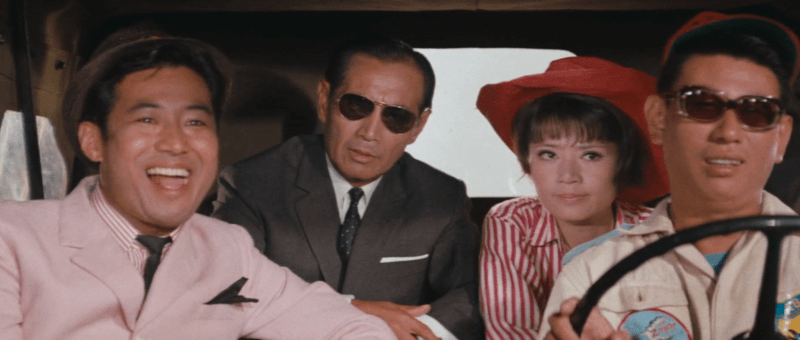
Wild Ducks and Green Onions (カモとねぎ, Senkichi Taniguchi, 1968)

Outside of Japan, Senkichi Taniguchi is most likely best known as the director of Toshiro Mifune’s debut film Snow Trail, or else as the screenwriter of one of Akira Kurosawa’s lesser known works The Silent Duel. Yet throughout the 1960s, he also made a series of silly comedies including Wild Ducks and Green Onions (カモとねぎ, Kamo to Negi), an absurd crime caper revolving around a gentleman thief’s attempts to plot the perfect crime while assisted by two bumbling henchmen and a young woman with a hidden agenda.

The film’s Japanese title is likely inspired by a proverb, “a duck comes carrying an onion” which means something close to “there’s a sucker born every minute” though it might be up for debate who exactly is the sucker here. In any case, dapper mastermind Nobukichi (Masayuki Mori) has plotted the perfect heist which involves rigging a speedboat race by nobbling the propellers on two of the four boats and then betting accordingly. So far so good, but the enigmatic Mami (Mako Midori) has been watching their every move and is able to swipe the bag containing the money before henchmen Yosuke (Hideo Sunazuka) and Kyuhei (Tadao Takashima) can return it to their boss who for once has agreed to an equal split. The guys eventually track her down, but she tells them she spent the money on bail for her husband but it turns out he left the police station with two other women and hasn’t been seen since. The gang then determine to track him down to get the money back, but become involved in several other scams along the way. 

Despite having been able to rob them blind, all the men seem to be under the impression that Mami is a brainless airhead though she later reveals herself to speak fluent English and in fact comes up with a few scams of her own that are better than Nobukichi’s whom the guys refer to as “Cap’n”. Nevertheless, the guys only tolerate her because they need to find her husband though all’s not quite as it seems. Kyuhei in particular seems to have a rather misogynistic streak and is somewhat jealous that Nobukichi gets to have Mami to himself though he remains a perfect gentleman, sleeping on the sofa and giving her the bed. But it’s Kyuhei’s lascivious nature that eventually gets them into trouble when he tries to drag a reluctant Yosuke into a cinema screening pink films only to be pulled aside by some kind of anti-delinquency brigade who read off some unconvincing statistics stating that 80% of young male sex offenders are fans of pink films. 

This annoys them so much they decide to scam the organiser, Tomiko (Hisano Yamaoka), by appealing to her vanity and tricking her association, which is dedicated to conservative family values, into watching (and apparently enjoying) a porn film on school premises believing it to be an “educational movie”. Tomiko in some senses represents the forces of order against which the gang are rebelling, though she’ll get her revenge in time. In any case, they find a more worthy target after travelling to a seaside town and encountering the daughter of a man who has been poisoned by industrial pollution while the local factory insists everything is within “safe limits” and they aren’t the cause of the sickness spreading across the area. 

Conducting another expert heist to steal the secret documents to prove otherwise, Nobukichi could make a lot of money blackmailing the factory owner but instead gives the report to the man’s daughter so she can pursue justice and compensation for her father much to the chagrin of Mami and proving that it isn’t all about the money after all. Then again, he has another document that, once translated by Mami, reveals the factory has actually been producing Napalm for the Americans which is a bit of a grey area as far as the constitution is concerned. This time, they play a nasty trick on the heartless factory owner (Eijiro Tono) though he is hardly remorseful and in fact was too greedy to pay their blackmail money despite the vast sums it would cost him if the news ever got out. 

Despite its silliness and absurdity, the film takes an ironic swipe at serious issues of the day such as scandals like the Minamata disease and Mary Whitehouse-esque social campaigners ranting about a decline in morals while simultaneously enjoying the platform that protesting them grants them. In some ways, the gang themselves exist as a kind of rebellion against the salaryman society with their various scams presented as silly games targeting faceless or ridiculous figures who can either afford to lose the money or were ripe for a comeuppance though in the end, crime doesn’t really pay either and the gang find themselves hoist by their own petards, robbed of enjoying their ill-gotten gains by unexpected twists of fate. Very much of its time the film has a kind of charm in its whimsical score and pastel colours but has lingering darkness in its threats of unexploded bombs and hidden Okinawan torture facilities in a society increasingly ruled by amoral capitalists.
Muddy River (泥の河, Kohei Oguri, 1981)

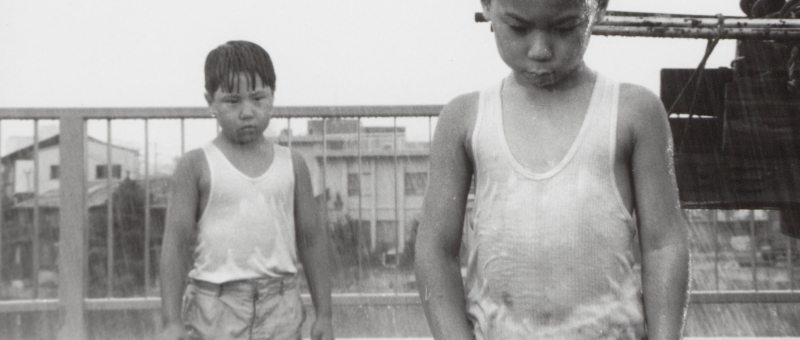
The post-war era refuses to die in Kohei Oguri’s heartbreaking exploration of childhood friendship and the costs of experience, Muddy River (泥の河, Doro no Kawa). Adapted from the novel by Teru Miyamoto and situating itself in the Osaka of 1956, Oguri’s realist drama takes place at a moment of transition not only in the life of the young hero but also of the nation which was at long last beginning to leave post-war privation behind thanks to increasing economic prosperity. Yet for men like young Nobuo’s father Shinpei (Takahiro Tamura), the traumas not only of the war itself but its aftermath will not be so easy to escape. 

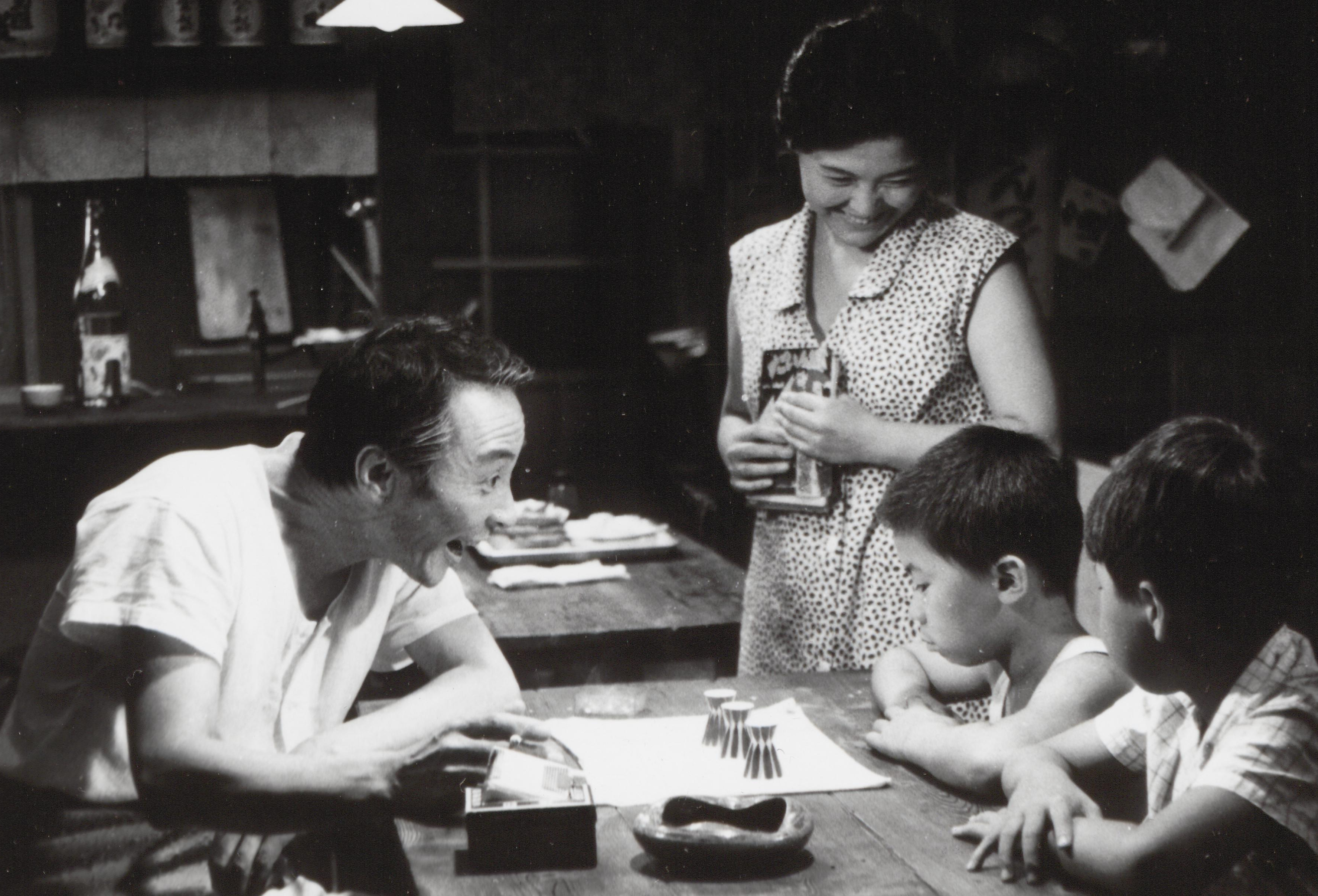
A shy child who often wets the bed, 9-year-old Nobuo (Nobutaka Asahara) lives with his parents Shinpei and Sadako (Yumiko Fujita) above a small riverside noodle bar mainly frequented by sailors and workmen such as Shioda (Gannosuke Ashiya), a regular who pulls a horse and cart for a living. Nobuo can’t stop staring at Shioda’s ruined ear, presumably a battlefield injury though the avuncular gentleman tries to raise his spirits with false cheerfulness explaining that he’s seen the writing on the wall and the days of cart pullers are coming to an end. He jokes about giving his horse to Nobuo as a pet though obviously he has no need for or ability to keep a horse, explaining that he’s going to buy a second-hand truck so he won’t be left behind in the race for modernity. Unfortunately, however, as Nobuo follows him out Shioda’s cart gets stuck in the mud. Somewhat bluntly he violently beats the horse to make him free it, but the cart ends up blocking the bridge and the horse is spooked by oncoming traffic. Crushed by his falling load, Shioda is pulled under the wheels and killed, his hopes for the future dashed while his wife and child are left without economic support. 

Emulating the visual imagery of silent cinema, Oguri frames this sequence perfectly with an inescapable anxiety that captures the inevitability of the moment. This is Nobuo’s first glimpse of death, running confused back to his father to tell him that the cart man’s dead, Shinpei at first not quite comprehending but later reflecting that he was like him another casualty of the post-war era as if his death were merely delayed remembering that he’d once said the war had already killed him and so he’d never die again. On an awkward train journey Shinpei opens a newspaper and reads that “the post-war period is over”, but of course for him it isn’t and perhaps never will be. Reflecting on the last 10 years of his life, he wonders if it was worth it, there must be many people who think it would have been better to die in the war than suffer as they did afterwards. Young Nobuo, born to him in his 40s, is his only achievement. Sadako meanwhile harbours her own guilt in feeling as if she wronged another woman with whom Shinpei had previously been involved after the war by stealing him away and building this life together in burned out Osaka which, while far from perfect, is comfortable enough and happier than most. 

That Nobuo learns for himself when he befriends another boy staring at the abandoned cart. 9-year-old Kiichi (Minoru Sakurai) and his sister Ginko (Makiko Shibata) live on a houseboat recently moored opposite, something which Nobuo finds unusual and mysterious but not itself bad. Still innocent and too young to have incorporated moral judgement, Nobuo simply befriends the other boy bonding over a strange tale of a monstrous carp in the river though perhaps also feeling sorry for him on noticing his ragged clothes and the holes in his shoes. On visiting their houseboat, he only hears only the voice of Kiichi’s mother Shoko (Mariko Kaga) a mysterious disembodied presence who lives in a separate area of the boat accessible only via a different entrance. When she instructs Kiichi to give him some raw sugar and tell him not to come back too often, he takes it that he’s unwanted later confused when his father tells him that it’s fine for his new friends to visit but he shouldn’t go near the boat after dark. 

Understanding people, neither Shinpei or Sadako, instantly grasping the situation, reject the family because of the stigma of sex work realising that people do what they have to to survive and in any case it isn’t the children’s fault or responsibility. On hearing Kiichi enthusiastically singing an old imperial song about losing friends in Manchuria, Shinpei begins to feel a kinship with his late father as another old soldier claimed by the muddy river of the post-war society. Like the cart man, and an old fisherman Nobuo witnessed “disappear” from his boat never to be seen again, he was simply a casualty of the times one of many unable to enter the new society promised by rising economic prosperity. Shinpei fears he may also be one of these men, left behind unable to break free of wartime survivor’s guilt and the traumas of what came afterwards. He also disappears from his son’s life abruptly and without warning if only temporarily, but accidentally deserts him at the time he needs him most allowing his fragile new friendship to fracture as the two boys fatefully return to the boat after dark and Nobuo encounters a loss of innocence on several levels Kiichi realising that something is now broken between them. 

Something is perhaps broken in the times, the end of Nobuo’s childhood coinciding with the the dawning of a new era free of post-war privation but one that also threatens to leave those who can’t catch up to it behind Kiichi’s boat bound for further down the river while Nobuo remains firmly on land his own foundation perhaps more secure now that his father has exorcised some of guilt over the recent past. Shot with a nostalgic realism in black and white and in academy ratio, Oguri’s quietly devastating drama sets one boy’s loss of innocence against the lingering affects of another as the adults all around him struggle to acclimatise themselves to a changing society but all he sees is the muddy river flowing past him taking his friend away because he saw something he shouldn’t have leaving him with nothing but sorrow and loneliness on the other side of an unbreachable divide. 


Muddy River screens at the BFI on 12/23 December as part of BFI Japan.

Opening sequence