The Burning Buddha Man (燃える仏像人間, Ujicha, 2013)

“There are many strange things happening in this world” according to the mysterious young woman who appears in the brief live action sequences bookending Ujicha’s debut feature, The Burning Buddha Man (燃える仏像人間, Moeru Butsuzo Ningen). Who is she? One of the “space people” mentioned in the accompanying voice over which also points out that humans are hard to trust seeing as they don’t even trust each other, or merely a stand in for the omnipotent artist sitting down as she does and looking over her creation her butler dutifully waiting at her side? Who can say, it’s just one of many mysteries at the heart of Ujicha’s beguiling retro sci-fi/horror Buddhist conspiracy thriller animated in his now trademark and equally retro “gekimation” style. 

Taking place in the director’s native Kyoto, the action opens with a strange, alien-like creature breaking into a temple and firing some kind of laser from a phallic device on his belt directly into the head of a colossal Buddha statue. The couple who look after the family-run temple, mindful of their duty to protect their ancestral legacy, are perturbed and politely ask the creature to stop but are later caught in the crossfire when the statue suddenly disappears leaving only their bottom halves behind. Cue the arrival of teenage daughter Beniko (Yuka Iguchi) in her school uniform who is quickly taken in by weird old monk Enju (Minori Terada) who explains that he’s an old friend of her parents and that the theft of the statue is part of a spate of similar heists across the Kyoto area perpetrated by a crazed cult who are apparently intent on “rescuing” neglected Buddha statues from “disrespectful” modern people. Staying with him in his temple, however, Beniko starts to have doubts especially after encountering the strange-looking children who run wild in the grounds Enju claims are “disadvantaged” kids he’s taken in after they were abandoned by their parents because of their odd appearances, not to mention an encounter with Enju’s sculptor grandson Enji (Ryuki Kitaoka) who suddenly frees a small dog apparently trapped inside the uchiguri cavity of an Buddhist statue after being caught in the range of the “Matter Transference Device” used by the thieves to teleport the neglected icons to “safety”. 

A weird tale of spiritual fusion, The Burning Buddha Man’s villains have apparently forgotten all their Buddhist teachings and become “addicted” to melding with statues in order to harness their power and become all powerful beings. Beniko, however, is still pure of heart and is not after revenge for what happened to her parents but to save the wrongdoers by making them “reform”. To do so, however, she’ll have to undergo an apparently reversible transformation herself as well as journeying to another world where, she discovers, her elderly catatonic grandmother (Chisako Hara) has apparently been in training for just such an eventuality for the last couple of decades. “It’s easy just to kill them” Beniko later explains, “but no one can get out from their suffering that way” apparently hoping to undo some of the pain in the world caused by this strange new technology through an act of healing. 

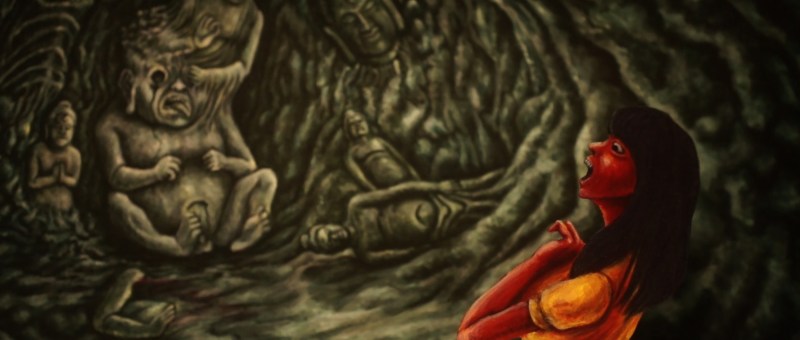
As showcased in the live action intro/extro sequences in which the young woman painstakingly assembles and then disassembles her world, pausing briefly to look admiringly at a figure perhaps representing herself before handing it back to her gloved butler for safekeeping, Burning Buddha Man’s aesthetics consist of a series of beautifully painted backdrops and paper cut out puppets of its strange cast of characters which include a gang of Giger-esque biomechanical former Buddhist monks rendered monstrous by their experiments in spiritual enhancement. Amping up the body horror quotient, real liquid often oozes from their mouths made sickening in its viscosity while blood later fills the screen. Yet for all that there’s a strangely childlike glee in the macabre grimness as the wholesome heroine and her pure-hearted friends push back against the corruptions of hyper-religiosity and spiritual madness hoping to restore rather than destroy but ultimately finding themselves forging a purifying hellscape that ends only in fire (and a peculiar kind of sludge making its way towards the drain of all humanity). Deeply strange yet strangely charming Ujicha’s Buddhist body horror conspiracy thriller is undeniably dark but also imbued with a sense of ironic playfulness in its truly bizarre cosmology.


The Burning Buddha Man is available on blu-ray in the UK courtesy of Third Window Films in a set which also includes Ujicha’s second feature Violence Voyager as well as a selection of shorts.

Original trailer (English subtitles)
Violence Voyager (バイオレンス・ボイジャー, Ujicha, 2018) [Fantasia 2018]

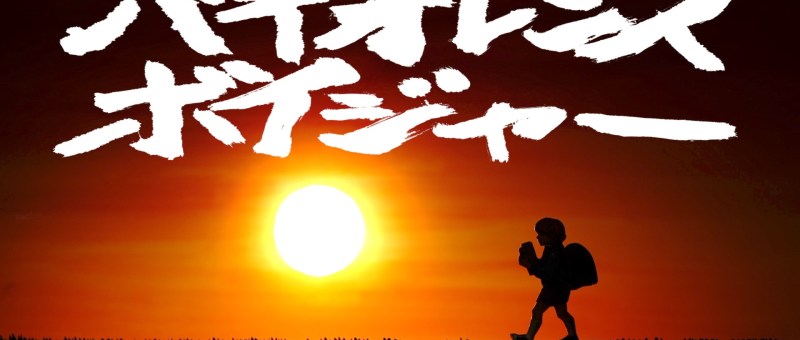
violence voyager posterWeird stuff happens out in the mountains, stuff you wouldn’t even believe. Ujicha’s Burning Buddha Man followup Violence Voyager (バイオレンス・ボイジャー) is a pleasantly retro treat, set sometime in the more innocent past when the landscape still held hidden mysteries for small boys to find and anything goes so long as you’re home in time for tea. There are some mysteries, however, that it’s better not to solve and if something seems too good to be true, that’s usually because it is. Little Bobby (Aoi Yuki) is about to become a hero, but his journey will be a one way trip of unwelcome transformations, losses, and betrayals.

Bobby, an American boy with a blond bowl cut living in a little rural town with his distant dad and bedridden mum for otherwise unexplained reasons, has impressed his best friend Akkun (Shigeo Takahashi) with his high-tech pinball baseball computer console he made for the science fair, even if it has put the strange monster toys Akkun and his brother Yakkun entered with the intention of masking a lack of skill with pure strangeness to shame. Ostracised by the other kids, Bobby and Akkun long to cross the mountain and find their other friend, Takaaki (Daisuke Ono), who moved away to the next village. Akkun has heard tell of a secret mountain path which would take them there for free and it’s only *slightly* dangerous even if it does take time. Luckily it’s the summer holidays so time is something the boys have plenty of.

Setting off despite the warnings of Old Man Lucky Monkey (who actually lives with a chimpanzee as a “friend”), the boys are sidetracked when Bobby spots a fallen sign for something called “Violence Voyager” which sounds like too good an opportunity to miss. Ending up at an abandoned theme park, the boys are surprised to find the proprietor (Tomorowo Taguchi) still hanging around and overjoyed when he offers to let them in for free seeing as he rarely gets any business owing to the rapidly declining number of children in the area (alarm bells should be ringing right about now). Handed a “voyager suit” (an anorak and pair of wellies), the boys are shown an informational video explaining that the world has been invaded by aliens in the form of robot soldiers who shoot alkaline from their plant-like hands. Choosing a “weapon” (water pistol) each (Bobby a rifle, Akkun a tiny little dolphin), the boys set off but it’s not long before they start to suspect something isn’t quite right. Discovering another little girl lying injured, Bobby and Akkun plan an escape only to find their bullying classmates also facing the same dilemma.

It will come as no surprise that there really is something not quite right going at Violence Voyager. Like a combination of Westworld and Soylent Green, the park exists to strip the young of their innocence by exploiting it. A mad scientist desperately trying to save his only family is literally eating his young – sacrificing the souls of innocent children and “remaking” them in his own image to feed his ruined son. Meanwhile, Bobby’s dad fights equally hard to track down and rescue his own errant boy from an obviously bad situation.

Bobby emerges scarred and fundamentally “changed” mentally and physically but with his humanity fully intact, carrying a pretty bunch of flowers to take to his mum to cheer up her sickbed (and presumably lessen the shock of seeing him as he now is). An extreme coming of age tale, Violence Voyager runs from exposing the cynicism of businesses aimed at children to the desperation faced by a parent prepared to protect their offspring at all costs (including their remaining family).

Ujicha’s trademark “geki-animation” is a perfect fit for the bizarre tale at hand, filled with beautiful hand painted backgrounds and accompanied by the sonorous narration of comedian Hitoshi Matsumoto (Symbol, Big Man Japan). The retro design from Bobby’s bowl cut to the ‘70s musical score and noticeably old-fashioned composition (one shot even seems to reference the poster for Fukasaku’s Virus) allows the warmth of nostalgia to mix with its less positive elements all while indulging in a surreal B-movie adventure which starts with “aliens” and ends with the horror that men do. Whether a metaphor for the conformist meat grinder which strips children of their individuality to trap them in the straight jacket of the salaryman world, the ravages of grief, or just a B-movie body horror adventure, Violence Voyager is a surreal fever dream of bodily corruption but undercut with its own sense of fantastical whimsy and an oddly innocent heart for so dark a tale.


Violence Voyager was screened as part of Fantasia International Film Festival 2018.

Original trailer (English subtitles)