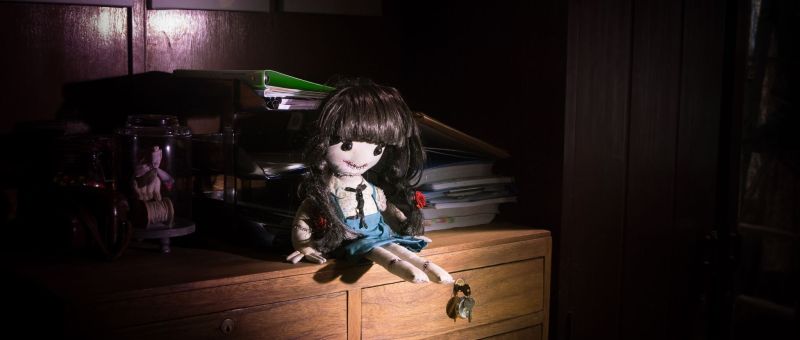
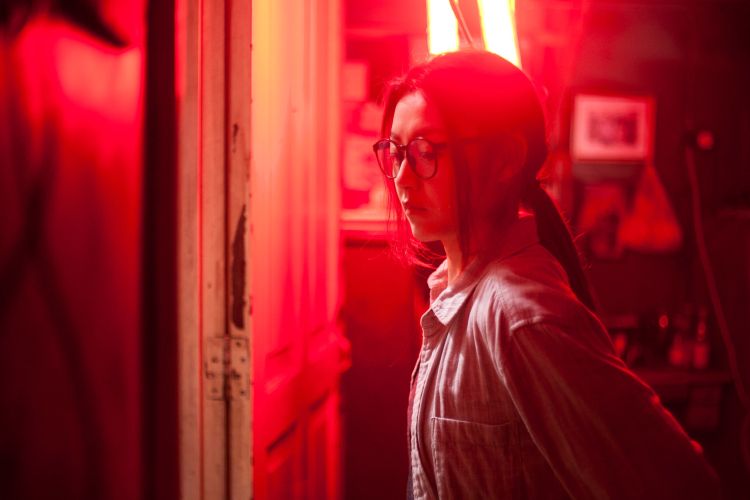
 “I will be at your side for ever and ever” promises a creepy doll at the centre of Ryon Lee’s Walk with Me (雙魂, Shuāng Hún). It might be better to have the creepy doll on your side rather than on someone else’s but, all things considered, it’s a heavy thing to carry. At least, that’s how the heroine, Sam (Michelle Wai Si-nga), begins to feel when she starts to wonder if spilling all her anxieties onto the doll was the best idea seeing as now people around her seem to be “disappearing”. Is the ghost inside the doll angry and taking its revenge, or is it just trying to protect? Assuming, as Sam does, that ghosts even exist.
A 20-something woman still living at home with an abusive, gambling father (Richard Ng Yiu-hon) and a mother (Anna Ng Yuen-Yi) still grieving for her lost little boy, Sam has a dead end job in a factory where she is being sexually harassed by the male bosses and mercilessly bullied by the other ladies on the floor. Part of the reason Sam is being bullied is that a woman in her building was recently “possessed” by the spirit of a dead child which is judged more than a coincidence seeing as Sam’s mother maintains a shrine and makes offerings to her late son. The strange goings on only started when Sam’s family moved in around 18 months previously so the obvious conclusions have been drawn.
Intensely lonely and a perpetual victim, Sam later tells a childhood friend she unexpectedly reconnects with that she has grown so used to being bullied that she just accepts it and has given up. Dao Dao, the creepy doll, has been her only companion for most of her life and Sam has been used to using it as a kind of therapy device, something she can talk to freely without fear of recriminations. Harbouring the uncomfortable belief that the doll may be possessed by the ghost of her little brother who died before he was even born, she is starting to worry that her father’s constant attempts to get rid of Dao Dao by cutting it up or otherwise brutally disposing of it may have made it angry. To test her belief that Dao Dao is the cause of the unexplained strangeness in her life, she’s started carrying it around with her which, of course, seems to be making the danger spread – conveniently into her work life where most of the people she most hates are located.
Meanwhile, she’s reconnected with York (Alex Lam) – a guy who used to be her only friend when they were kids and bonded over being bullied (her nickname was “bony”, his was “chubby” – he’s been working out ever since). Like the doll, York promises that he’ll always be by her side to protect her from mean people and ghosts too – he doesn’t believe in them but if Sam does then he’ll go with it. Pretty soon, York has moved into the spare room in their building and is doing his best to stand by Sam but the strangeness of events keeps escalating while Sam’s mental state fluctuates. She keeps thinking that she sees the ghost of a little girl in pig tails, but remains more afraid of bad people than of supernatural threat. Even her boss’ little daughter seems to be a budding psychopath, posed eagerly with her iPhone in front of the microwave in which she’s placed an adorable little puppy just to watch it go pop.
York tells Sam that if she wants to beat the darkness she’ll have to become a part of it, apparently meaning that she’ll need to become as strong as it is in order to stave it off. Events however point towards her interpretation, that she’ll eventually have to turn to the dark side in trying to stand up for herself or else remain a perpetual victim. It may very well be irrational to blame a doll for a crime spree, but then nobody seems to think getting possessed by a ghost, or trying to keep one in your home like pet, is anything out of the ordinary. In any case the ghosts Sam is most afraid of are the ones within herself, the ones that hint at her own duality, and embody all of the rage, despair, and guilt of which she is unable to speak. Dao Dao will indeed “always” be with her, only perhaps not quite in the way she thinks. A psychologically acute tale of painful repression and low self esteem, Walk With Me is less the story of a creepy doll and its supernatural revenge than of a lonely soul’s gradual fracturing under the intense pressure of constant rejection and wilful misuse.
Walk with Me screens on 4th July as part of the 2019 New York Asian Film Festival
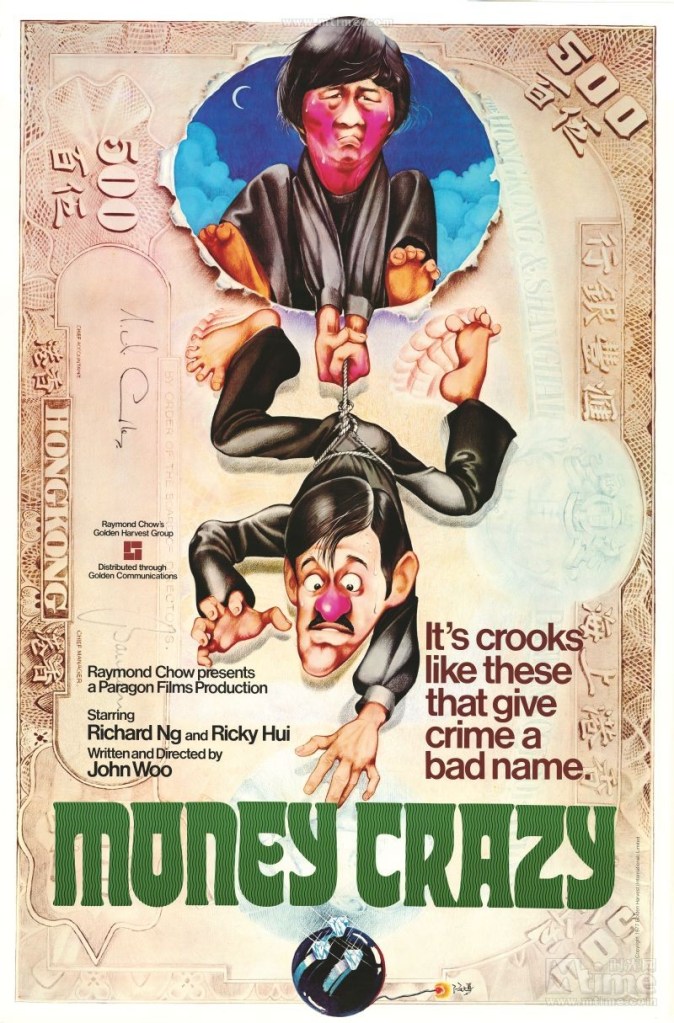 John Woo is best known in the West for his “heroic bloodshed” movies from the ‘80s in which melancholy tough guys shoot bullets at each other in beautiful ways. However, he had a long and varied career even before which began with Shaw Brothers and a stint in traditional martial arts movies. What often gets over looked outside of Woo’s native Hong Kong is his many comedies, of which The Pilferer’s Progress (AKA Money Crazy, 发钱寒, Fa Qian Han) is one of his most successful.
 Windows on Worlds