You’re Not Normal, Either! (まともじゃないのは君も一緒, Koji Maeda, 2021)

What’s so great about being “normal” anyway? As the title of Koji Maeda’s quirky screwball comedy You’re Not Normal, Either! (まともじゃないのは君も一緒, Matomo Janai no wa Kimi mo Issho) suggests neither of its heroes is quite in tune with the world around them but then again, is there really such a thing as “normal” or is it more that most people are making themselves unhappy by settling for less simply because they think that’s just how things are and resistance only makes you seem awkward? 

Nerdy cram school maths teacher Yasuomi (Ryo Narita) thought he was OK with being a little different, but just recently he’s begun to feel lonely and fears the possibility of being alone for the rest of his life. Perhaps inappropriately, he looks to one of his students, forthright high schooler Kasumi (Kaya Kiyohara), for romantic and life advice hoping that she will teach him how to be, or at least present as, more “normal”. Unbeknownst to him, however, Kasumi is not quite “normal” herself and is in fact obsessed with a tech entrepreneur, Isao (Kotaro Koizumi), who is all about a new and freer future in which humanity is freed from the burden of labour. Finding out that her crush is already engaged to Minako (Rika Izumi) the daughter of a hotel magnate, Kasumi hatches a plan to break them up while training Yasuomi in the art of seduction. 

Kasumi’s insecurities seem to be down to her failure in her middle school exams, attracted to Isao’s philosophies because they offer a possibility of freedom outside the rigid demands of academic success in Japan. She tells Isao in a not quite by chance meeting that she wants to become a teacher in order to expand children’s minds rather than force them into a fixed perspective as the rather authoritarian, rote learning system of education often does. Yet she also feels out of place among her peers whom she sees as vacuous always gossiping about part-time jobs and boys. She frowns at Yasuomi when he accidentally cuts the conversation dead with an awkward comment while attempting to chat up a pair of bubbly office workers in a bar, but often does the same thing herself while sitting with her high school girl friends who fall silent and then change the subject after she injects a little realism into their mindless chatter. 

Yasuomi had viewed himself as “normal” and never understood why others didn’t, noticing that people often stopped associating with him but not knowing the reason why. Obsessed with pure mathematics, over literal, and overstimulated by the complications of life he takes refuge in the forest and the sensory overload of its nocturnal creatures speaking quite eloquently about the beauty of numbers and actually fairly emotionally intelligent in his understanding of the two women. Resolutely failing at Kasumi’s Cyrano act, he comes into himself only when speaking more honesty much to Kasumi’s annoyance actually hitting it off with Minako who is herself just as lonely and alienated but perhaps wilfully trapped. 

Predictably enough, Isao isn’t exactly “normal” either or perhaps he is but only in the most depressing of ways, his rosy vision of the future delivered with more than a little snake oil and just as much sleaze. Minako may know what sort of man Isao is, that her marriage is largely a dynastic affair set up by her overbearing, authoritarian father, but she too may think this is “normal” and might have preferred not to have to confront her sense of existential disappointment while attempting to fulfil the role of a “normal” woman content with creating a comfortable space in which her husband can thrive.  

Romantically naive, Kasumi wonders how people come to fall in love informed by two relatively mature classmates that for them at least falling in love is a gradual process of increasing intimacy generated through casual conversation. This turns out to be pretty much true for Kasumi too, though in ways she didn’t quite expect watching as Yasuomi opens up to Minako and finding herself unexpectedly jealous while reluctant to let go of the idealised vision she had of Isao as some kind of messiah for a better Japan. There is something a little uncomfortable in the potentially inappropriate relationship between a student and her teacher even as the roles are, on one level at least, reversed but there’s also a kind of innocence in their childish friendship and later determination to start small and let things grow while abandoning the idea of the “normal” altogether to embrace their true selves in a freer future of their own creation. 


You’re Not Normal, Either! screens in Chicago on Oct. 7 as part of the 13th season of Asian Pop-Up Cinema 

Original trailer (English subtitles)
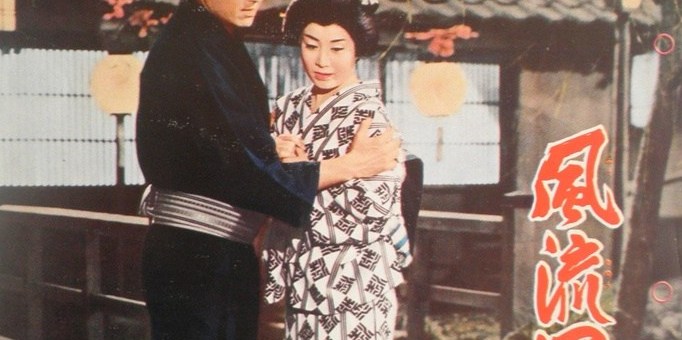
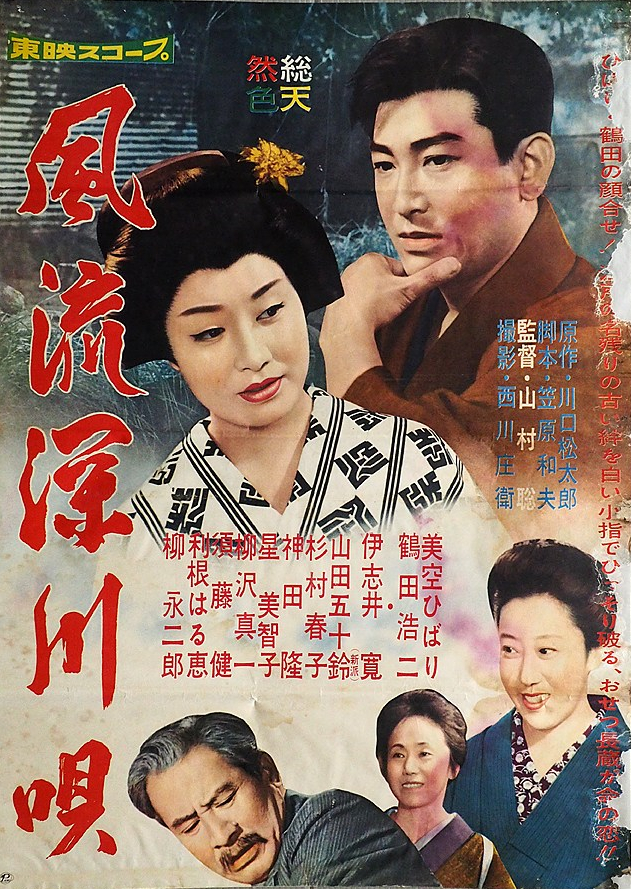
Deep River Melody (風流深川唄, So Yamamura, 1960)

Deep River Melody poster 2An actor with a long and distinguished career, So Yamamura first stepped behind the camera in 1953 with an adaptation of the famous proletarian novel by Takeji Kobayashi, The Crab Cannery Ship (later adapted by Sabu in 2009), and eventually completed six features. Deep River Melody (風流深川唄, Furyu Fukagawa Uta), released in 1960 and adapted from a novel by Matsutaro Kawaguchi, was last among them and starred post-war singing sensation Hibari Misora in the leading role. Hibari Misora was a frequent presence at Toei through the ‘50s and ‘60s, appearing in a series of musical dramas both period and contemporary but Deep River Melody is among the small number of purely dramatic pieces in which she starred which do not feature any musical numbers even over the opening and closing.

Set in the early years of militarism, the story revolves around Setsu (Hibari Misora) – the daughter of a restaurant owner, and her head chef, Cho (Koji Tsuruta). Having grown up together, Setsu and Cho have quietly fallen in love but these are times in which it is difficult to state one’s feelings plainly. Luckily, Setsu’s father, Isaburo (Kan Ishii), and his warm hearted mistress (Isuzu Yamada), have noticed the growing affection between the pair and are only too happy for them. What could be better after all than the head chef marrying into the family? Despite some qualms on Cho’s side in breaking a class ceiling taboo, the matter appears to be settled and both he and Setsu are blissfully happy.

However, tragedy soon strikes. Isaburo unwisely agreed to become the guarantor of a loan taken out by Shunsuke Ohta (So Yamamura) – the leader of the communist party in Japan (not an easy thing to be amid the rising tides of militarism). He, of course, defaults on the loan putting the restaurant at risk. The other relatives, learning of the prospective marriage between Setsu and Cho are extremely unhappy, viewing it as improper for mere servant to inherit the restaurant. Isaburo stands firm, but matters are pushed to crisis point by grumpy uncle Koshikawa who is determined to act as a go-between for the wealthy son of a rival restaurant who has long had designs on Setsu.

Though this is definitively a pre-war story, many of the problems faced by Setsu and Cho are the same as those in Hibari Misora’s contemporary movies in that she, in particular, finds herself trapped by a series of outdated social codes in which her extended family expect her to consent to marry a man she does even like for money in order to save their “good” name. They believe Isaburo is a feckless fool who has lost the restaurant through a needless gesture of loyalty towards a man who had been good to him in the past and was now in trouble. Isaburo places human relationships above money and politics, remaining uninterested in the relatives’ insistence on class hierarchies and preservation of the family’s good standing. Though he may, to a degree at least, be sympathetic towards Ohta’s political intentions, he acts as guarantor out of respect and gratitude rather than deep belief in a cause.

Nevertheless, the barriers between Cho and Setsu are less physical than they are psychological. Cho, raised as a servant, feels himself inferior and has difficulty accepting Isaburo’s talk of marriage owing to their differing social status. Isaburo, somewhat embarrassed, has not yet spoken with Setsu, but then knows his daughter well and is right in assuming the pair will eventually sort things out on their own if given a gentle push. When the relationship is tested by the restaurant’s failure, Isaburo and Setsu stand firm. No one entered this relationship for the wrong reasons – Cho loves the restaurant and everyone who works in it, but he fell in love with Setsu independently and would marry her for nothing. He remains uncertain, however, if his devotion is selfish and if the best way to love her is to leave her and allow her to save her familial legacy by marrying a man with money.

Like many post-war films, Deep River Melody is essentially about learning to let go of outdated ideas and that the maintenance of tradition is less important than individual happiness. Setsu and her father are ready to let go rather than commit themselves to a course of lifelong unhappiness solely to please their snooty relatives. Cho, however, struggles to free himself of a feeling of social inferiority. His own family tell him that his desire to marry Setsu is not only wrong but dangerous, that they have built a life for themselves though being loyal servants and that crossing the class divide risks all of their futures. Conflicted, Cho remains unwilling to fight for his love because he does not believe he can win and not only that, he feels it would be inappropriate to even try. If the pair are to find true happiness, they will have to find the courage to move on from the past and build their own future free of feudal ideas but to do so will require both sacrifice and support in the belief that a better life is possible.