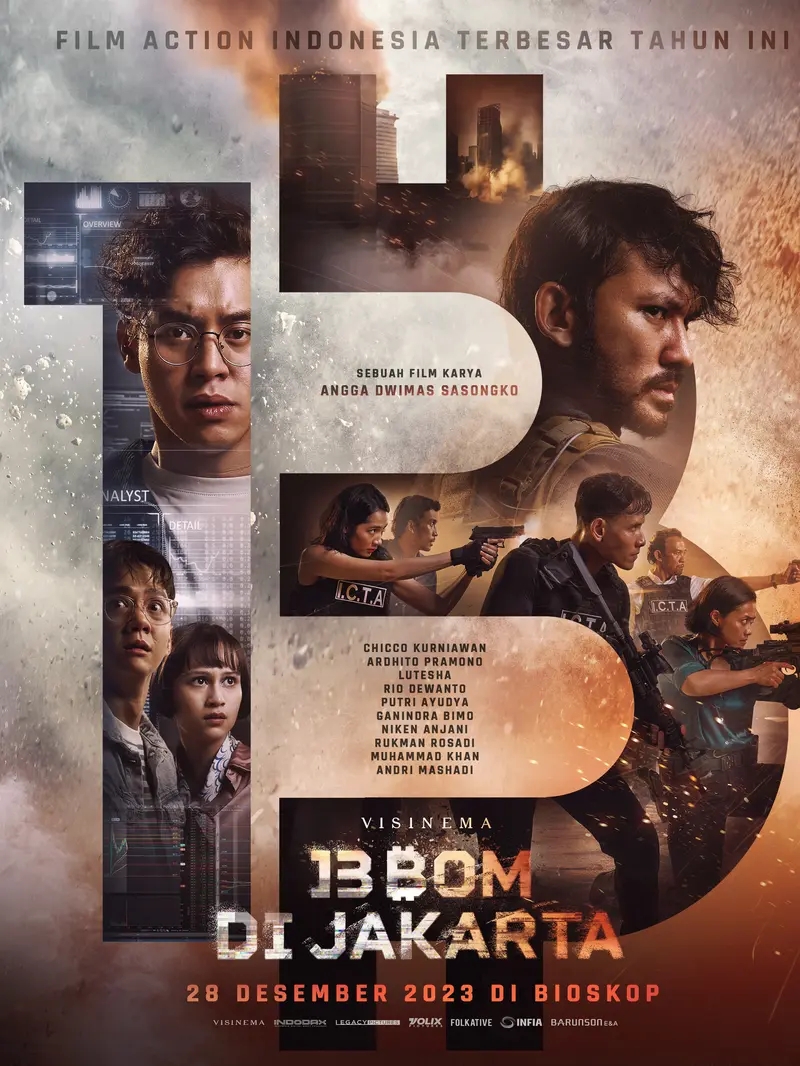
13 Bombs (13 Bom di Jakarta, Angga Dwimas Sasongko, 2023)

There’s an interesting juxtaposition in opening scenes of Angga Dwimas Sasongko’s action thriller 13 Bombs (13 Bom di Jakarta). A security guard in a cash van listens with exasperation to a radio broadcast voicing the nation’s economic decline before remarking that his mortgage keeps going up but his pay stays the same. Meanwhile, across town, two youngsters celebrate after receiving a huge payout from the cryptocurrency exchange app startup they’ve been running, drinking and partying oblivious to the poverty that surrounds them. Yet it’s the two youngsters that have unwittingly spurred a desperate man towards revolution, giving him the false idea of a utopia uncorrupted by money.

The interesting thing about the terrorists is that after attacking the cash van they blow the doors open and then leave without the money, allowing the people to pick it up instead. The explosion was apparently one of several more to come as the gang have placed 13 bombs around the city which they are holding to ransom, demanding to be paid in bitcoin solely through the boys’ exchange. The level of the crypto kids’ complicity is hard to discern, but it soon becomes clear they weren’t up for loss of life even if there’s a large payout at the end of it though they don’t really trust the police either. 

The police, or more precisely, the Counter Terrorism team, don’t come out of this very well. They’re originally quite reluctant to view the incidents as “terrorism” because that will make everything very “complicated” and also worsen the already precarious financial situation. They also seem to be fairly blindsided, arguing amongst themselves about the proper course of action with the sensible and reliable Karin (Putri Ayudya) often shouted down for relying too much on gut instinct as in her decision to trust bitcoin boys William (Ardhito Pramono) and Oscar (Chicco Kurniawan) only for them to immediately run away hoping to find the gang’s hideout for themselves after being disturbed by a strange message from the gang branding them as their allies.

Bitcoin seems like a strange thing for the revolutionaries to pin their hopes on, though it later seems they hope to do away “money” in its entirety, though it’s true enough that all of them have suffered because of the evils of contemporary capitalism. Many were victims of the same pyramid scheme, one man losing everything after his mother invested the family fortune and died soon after, and another scarred by the suicide of his wife and later death of his child. You can’t say that they don’t have a point when the press the authorities on their failure to protect the poor along with their uncomfortable cosiness with wealth and power. As their leader says, people starve to death every day because of poverty or die earlier than they would have because of a lack of access to healthcare yet the authorities don’t seem to be doing much at all to combat those sorts of “crimes”.

Nevertheless, there’s tension in the group with some opposing leader Arok’s (Rio Dewanto) increasingly cavalier attitude to human life and worrying tendency to suddenly change their well designed plans. The battle is essentially on two fronts, the police stalking them with traditional firepower and Arok fighting back with technology, harnessing the power of the internet to disguise his location while hacking police systems and public broadcasting alike to propagate his message of resistance against corrupt capitalism and oppressive poverty. Counter Terrorism does not appear to be very well equipped to deal with his new threat, but can seemingly call on vast reserves of armed troops even if in the end it’s mostly down to maverick officer Karin to raid the villains’ base largely on her own trying to rescue the boys after realising they are trying to help her after all.

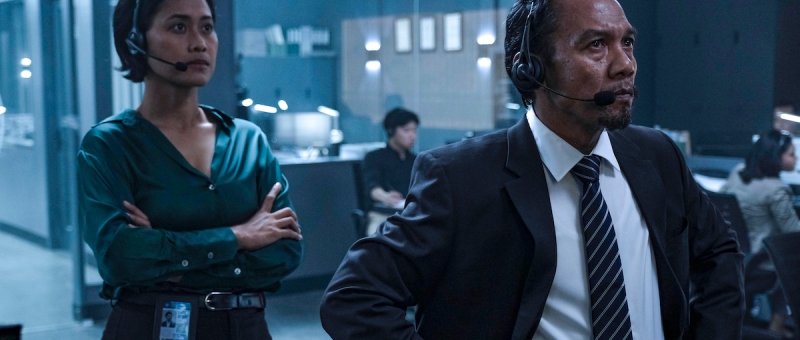
These action sequences are dynamic and extremely well choreographed even if some of the narrative progressions lean towards the predictable and the final gambit somewhat far fetched in its implications. Then again, it’s also surprising that Counter Terrorism doesn’t seem to have much security and should perhaps have considered paying a little more for bulletproof glass in the control room. The subversive irony of the seeing the words “New Hope” and “deactivated” on the final screens cannot be overstated even as a kind of order is eventually restored in an otherwise unjust city.


13 Bombs screened as part of this year’s Osaka Asian Film Festival.

Original trailer (English subtitles)

Gundala (Joko Anwar, 2019)

“If we see injustice before our eyes and do nothing then we’re no longer humans” the idealistic father of a future superhero instructs his young son, trying to impart a sense of humanitarianism as a basic moral good. It’s a lesson the boy will find himself unlearning and resuming later, his innocence well and truly destroyed by an often cruel and cynical society only to be reawakened to the idea that it doesn’t need to stay that way. Among the most recognisable names of Indonesian cinema, Joko Anwar turns his hand to the creation of a local comic book cinematic universe, adapting the 1969 comic Gundala by Harya “Hasmi” Suraminata for the present day filtering contemporary Jakarta through classic Gotham. 

Operating as an origin story for the titular hero, Gundala opens with the young hero Sancaka (Muzakki Ramdhan) unable to prevent his father’s (Rio Dewanto) death due to his fear of electrical storms when he is first set up by a duplicitous factory boss and then assassinated while leading a protest for fair pay and conditions. Soon after, Sancaka loses his mother (Marissa Anita) too after she is forced to go to the city for work and never returns. Ending up a ragged street kid, he’s saved from an attack by a rival gang by an older boy (Faris Fadjar Munggaran) who teaches him how to protect himself physically and mentally by convincing him that the only way to survive on the street is keep his head down and walk on by even if it looks like others are in trouble. 20 years later the adult Sancaka (Abimana Aryasatya) is an aloof young man working as a security guard at a print house where his sympathetic mentor Agung (Pritt Timothy) begins to remind him of his father in his conviction that “living is no use if you stop caring and only think about yourself”, while he also finds himself defending the woman next-door, Wulan (Tara Basro), and her young brother Teddy (Bimasena Prisai Susilo), from hired thugs sent to intimidate them because of their involvement in a protest against the forced redevelopment of a local marketplace.  

Events seem echo around him. The major villain Pengkor (Bront Palarae) is also an orphan but on the opposing side as the son of a cruel plantation owner murdered by his not altogether ideologically pure workers whose desire for fair pay and conditions he had resolutely ignored. According to cynical politician Ridwan (Lukman Sardi), Pengkor became a union organiser of his own, leading an uprising at the abusive orphanage he was placed into by a cruel uncle hoping he’d die and free up the inheritance, thereafter becoming a kind of godfather to the fatherless with a thousands strong army of eternally grateful orphans he saved acting as sleeper agents for a coming revolution. 

Pengkor’s nefarious plan involves fostering a conspiracy surrounding contaminated rice said to make the unborn children of the women who eat it turn out “immoral”, a generation of psychopaths unable to tell right from wrong. Fairly unscientific, it has to be said, but playing directly into the central questions of the nature of “morality” in a “immoral” society. Can it really be “moral” for bosses to exploit their workers and get away with it, for politicians to cosy up to gangsters and remain complicit with corruption, and for a man like Pengkor to be the only hope for orphaned street kids otherwise abandoned and ignored by a wilfully indifferent society? Pengkor decries that hope is the opiate of the masses, but that’s exactly what Gundala eventually becomes for them in his “electric” ability to resist, eventually rediscovering his humanity as he designates himself as the embodiment of “the people” pushing back against the forces of oppression and seeming at least to win if only momentarily.  

Young Sancaka’s fear of lightning is, in essence, a fear of his power and his social responsibility something he is quite literally shocked into accepting. In a world of quite striking social inequality, he finds himself the lone defender of the oppressed whose very existence spurs others, including previously cynical politician Ridwan, into rediscovering their own humanity in the resurgent hope of a better future. As someone puts it, peace never lasts long but you keep fighting for it because every moment is precious. Not so much a battle of good versus evil as a battle for the meaning of good, Anwar’s Gundala recalibrates the anxieties of the late ‘60s for the modern era and creates an everyman hero not only to resist them but to foster a spirit of resistance and humanity in the face of heartless cynicism. 


Gundala streams in Poland until 6th December as part of the 14th Five Flavours Film Festival.

Original trailer (English subtitles)