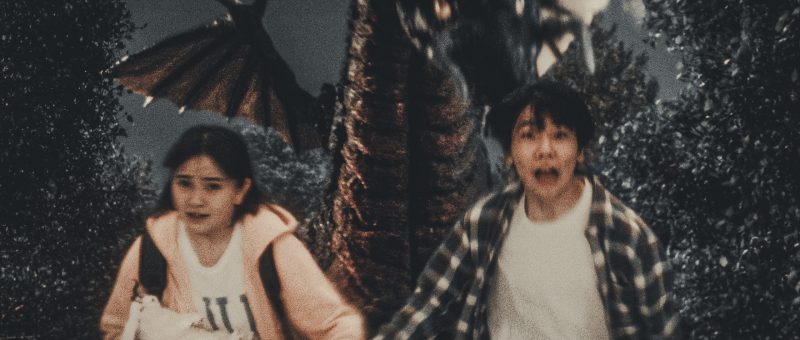
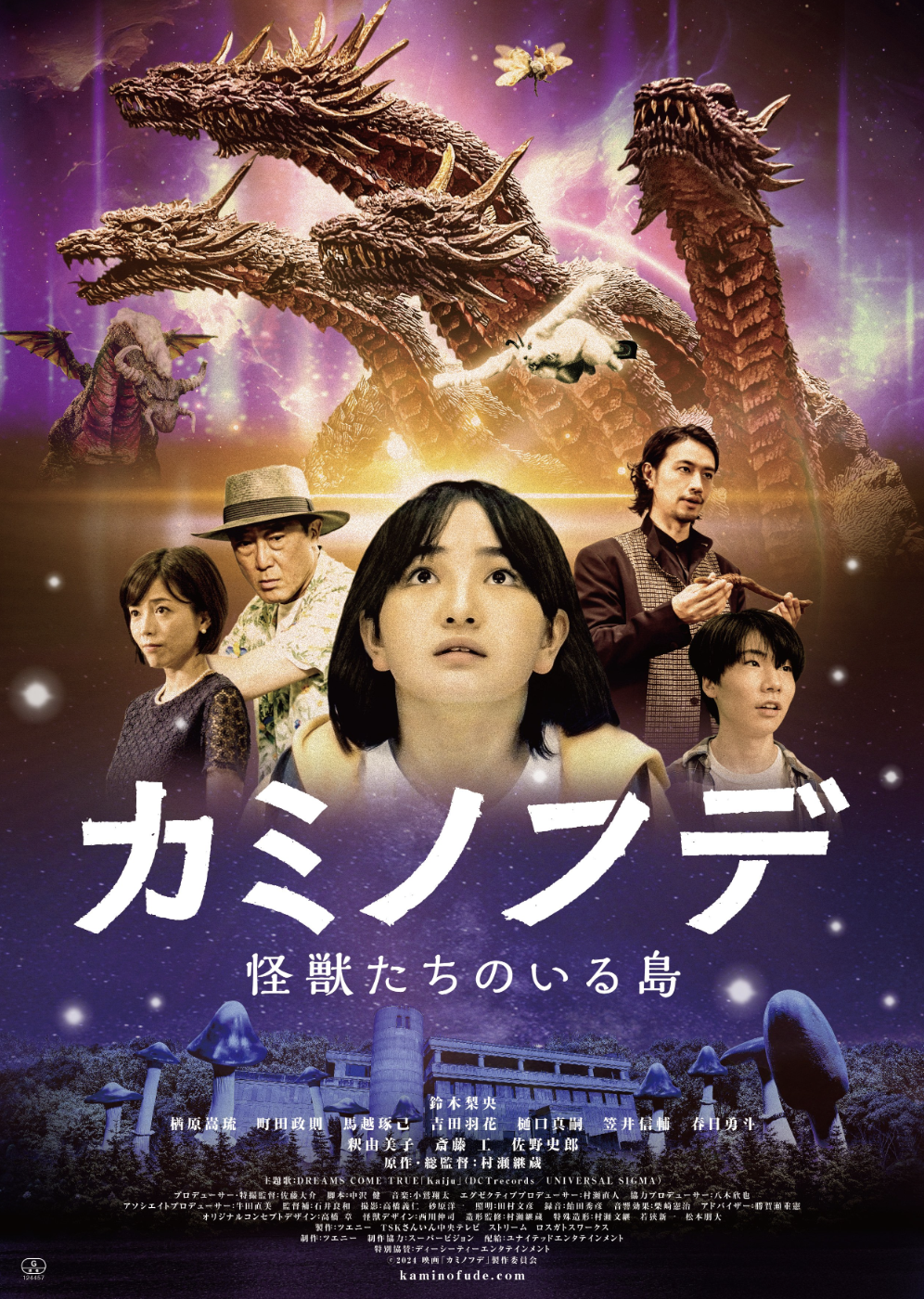
High schooler Akari (Rio Suzuki) couldn’t care less about something as “uncool” as tokusatsu movies and the fact her recently deceased grandfather once made them makes it even worse. Though they had once been close, Akari harbours a degree of resentment towards her grandfather, Kenzo (Shiro Sano), whose behaviour even in earlier years could be somewhat intimidating. Holding Kenzo responsible for the scar on her mother’s arm, Akari wonders out loud why a public memorial event is even necessary when they’ve already had a funeral, and why her mother isn’t just throwing all this useless rubbish out rather than hold an exhibition honouring a man she believes harmed her.
“Useless rubbish” is largely what Akari thinks of Kenzo’s legacy, embarrassed by his connection to otaku culture which has a social stigma attached to it that a teenage girl in particular would find embarrassing. Sullen and grumpy, she looks on with sadness mixed with irritation when some of her classmates charge off without her to go look at make-up and is rude to a young man from her class who’s come to attend her grandfather’s memorial event because she wouldn’t be caught dead talking to a nerd. In a way, it’s some of these social attitudes that Keizo Murase’s Brush of the God (カミノフデ ~怪獣たちのいる島~, Kami no Fude ~Kaijutachi no iru Shima) wants to deconstruct, recovering a memory of the classics of the genre as a world of boundless creativity and goodness that was as much about overcoming obstacles as it was creating visions of marauding dragons wreaking havoc on the modern world.
This is Murase’s first, and sadly only film as he passed away at the age of 89 in 2024 and was already in his late 80s when the film was made. Prior to that, he’d been a legendary figure in the tokusatsu industry working as a suit sculptor, prop maker, and stunt man. His self-cameo laying flowers at his own stand-in’s memorial service echoes the meta-quality of the film which he’d first come up with while working on Mighty Peking Man (in the movie Revenge of the Might Primate) in Hong Kong and subsequently reworked to take place in Japan just as Kenzo does in the film. At heart, it’s a tribute to classic kids special effects adventure movies in which Akari must reclaim the fond memories of her grandfather in order to save his interior universe and legacy which is now in danger of being forgotten while even she herself wanted to junk the whole thing.
She does so in the company of Takuya (Takeru Narahara), the classmate she’d hardly even noticed because of his nerdiness but is also primed to be another kind of inheritor of Kenzo’s mantle as represented by the Brush of the God, a magical paintbrush that allows the wielder to create in reality anything that they can imagine much as Kenzo and Murase had done when they created their monsters and the means to beat them. Reminiscent of that of Nobuhiko Obayashi, Keizo’s world has a retro aesthetic that is at once both artificial and fantastical making it clear that the children have been sucked into a world of imagination on the invitation of the mysterious Mr Hozumi (Takumi Saito) who offers them a copy of Keizo’s unproduced script and asks them to save his universe from destruction at the jaws of a mystical dragon.
There is real love and affection for this era which has now all but passed that valued practical effects and rejoiced in finding unexpected solutions to practical problems and creating a world which was often simpler than expected in which there were monsters who were bad but could be beaten or otherwise were good and could never be vanquished. Along with recovering more positive memories of her grandfather whom she realises to have misunderstood, a tortured artist who loved them in his own way, she regains a sense joy and creativity that had otherwise been lost to her with Takuya remarking that she seems much more lively in the midst of their adventure than she ever had at school. He meanwhile is very much in his element, but though he’d dreamed of becoming a tokusatu hero is effectively reduced to a damsel in distress whom Akari must then save by reawakening her imagination. Warmhearted and wholesome, the film is an advocation for this world of lost charm and childhood adventures powered by egg boxes, garden hoses, and the boundless potential of creativity.
Brush of the God screens in Chicago 13th April as part of the 19th edition of Asian Pop-Up Cinema.
Trailer (English subtitles)

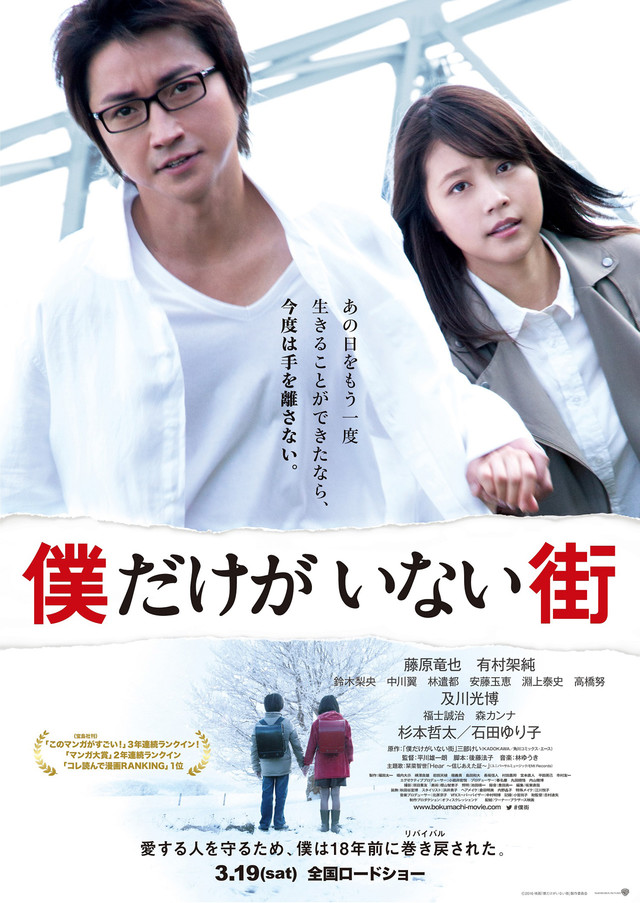 Erased (僕だけがいない街, Boku Dake ga Inai Machi), a best selling manga by Kai Sanbe, has become this year’s big media spectacle with a 12 episode TV anime adaptation and spin-off novel series all preceding the release of this big budget blockbuster movie. Directed by TV drama stalwart Yuichiro Hirakawa, the live action iteration of the admittedly complicated yet ultimately affecting story of a man who decides to sacrifice himself to ensure his friends’ happiness, acquits itself well enough for the most part but changes two crucial details in its concluding section which unwisely undermine its internal logic and make for an unsatisfying conclusion to the ongoing puzzle.
 Windows on Worlds