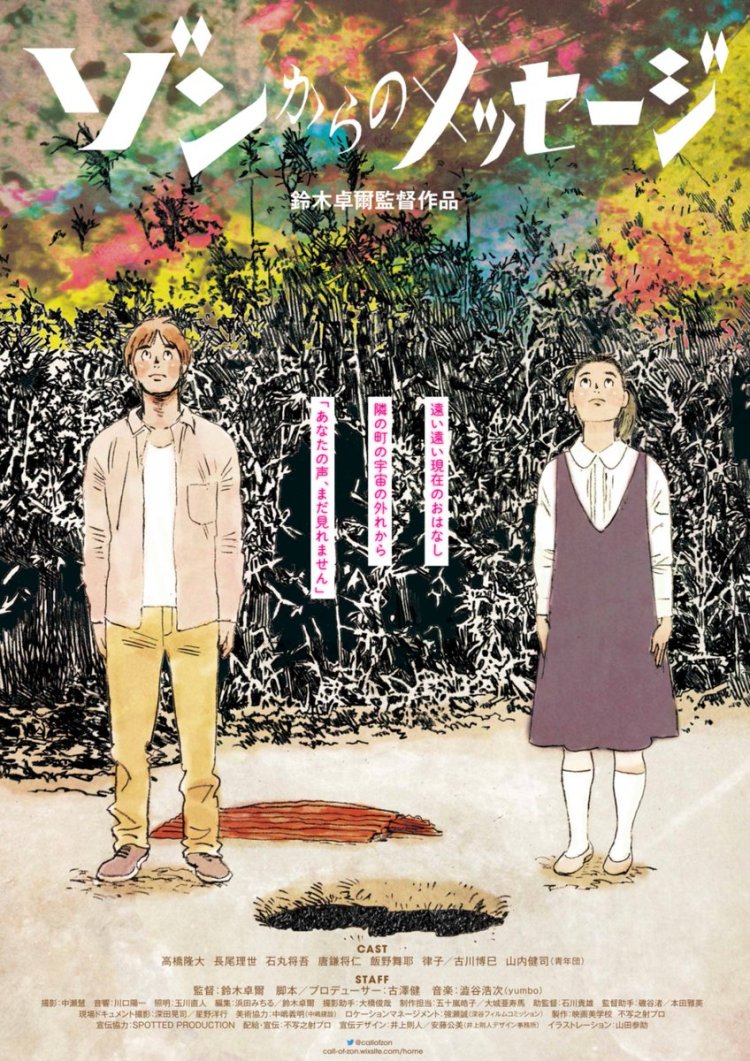
 Walls – do they constrain or protect? The residents of Yumetoi which has been sealed off for the last two decades by a mysterious force known as “Zon” cannot help but ask themselves the question. No-one claims to know what Zon is or why it arrived, but everyone has their own opinion on its existence from the youngsters brimming with curiosity about what lies outside to the older residents who think perhaps its best not to question the thing which keeps you safe.
Among the curious, intrepid youngster Ippo (Ryudai Takahashi) has got his hands on a videocamera and begun investigating the local environment, venturing well beyond “safe” limits in his quest for truth which is how he encounters the eccentric figure of Kantaro (Shogo Ishimaru) – a strange middle-aged man living in a disused building right next to the Zon barrier. Thanks to Kantaro, Ippo learns that Zon likes to throw things out into the world and is particularly intrigued by a strange black box (it’s a VHS tape but he’s too young to know what that is) he thinks might be some kind of message.
The small town of Yumetoi is a wholesome, nostalgic place filled with happy, innocent people who ostensibly want for nothing. Most of them have become used to Zon and accepted it as their new reality, neither resenting it nor particularly feeling its presence because they have little desire to leave. Others however, like Ippo, are intensely curious and begin to doubt everything they’ve been taught, wondering if Zon is really “dangerous” at all and if what lies outside of its walls really is nothing more than the land of the dead or if a lie has been spun to keep them from venturing forth.
Conceived in the wake of the 2011 earthquake and tsunami, Zon makes a subtle point about invisible barriers and the business of sealing off “unsafe” territory in wondering which side of the wall one is really on. Many residents of Yumetoi, like Kantaro, think Zon keeps them safe from external “evil” (as evidenced by adult magazines, apparently), while Ippo wonders if it might not be the opposite and it’s Zon keeping them prisoner. In any case, he wants to understand the message even others warn him that it’s best not to poke the beast and he’s better to let things lie. Nevertheless, he begins trying to communicate with the strange manifestation of existential dread through its own medium – by sending it video messages asking for greater clarification.
His quest has a profound impact on the town at large and most particularly Kantaro along with his former friend turned creepy cult minister running “rebirth” workshops, Ninomiya (Masahito Karakama). The pair “lost” a friend to Zon when he decided to cross the barrier in search of his own sound never to return. Though many have ventured outside, none have made it back. Some believe they died, others that they merely could not return, but still there are those who wait for them, like Michiko – the owner of Bar Yu who regards it as her calling to provide a place to which those who are lost can return.
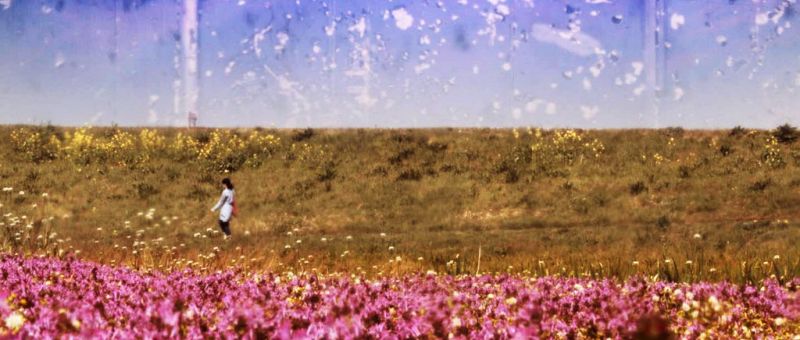
Shooting in a constraining 4:3 and heightened colour palate, veteran director Takuji Suzuki adds an unexpectedly meta dimension to his already surreal exploration of physical and mental imprisonment in allowing the film crew to to appear on screen and including scenes of retake and rehearsal. In a roundabout way, the film crew itself becomes a manifestation of “Zon” as it literally captures the dreamy world of Yumetoi from outside as if trapping it in cinematic amber. Zon in itself may be a state of mind, a manifestation of the complex push and pull between the anxious need for safety and natural longing to understand the nature of the world, but it also serves as a literal barrier to transgressive thought as the more conservative residents resent any attempt to question its true purpose while the curious young insist on change and inquiry. The gift of Zon may be a kind of paradise but it’s one that comes at a price that the young are increasingly unwilling to pay. Zon’s message is its own undoing, urging the curious to free themselves from the accepted order by questioning its authority and finally finding the courage to step outside its bounds.
The Call of Zon was screened as part of the 2019 Nippon Connection Film Festival.
Original trailer (no subtitles)


 Windows on Worlds