
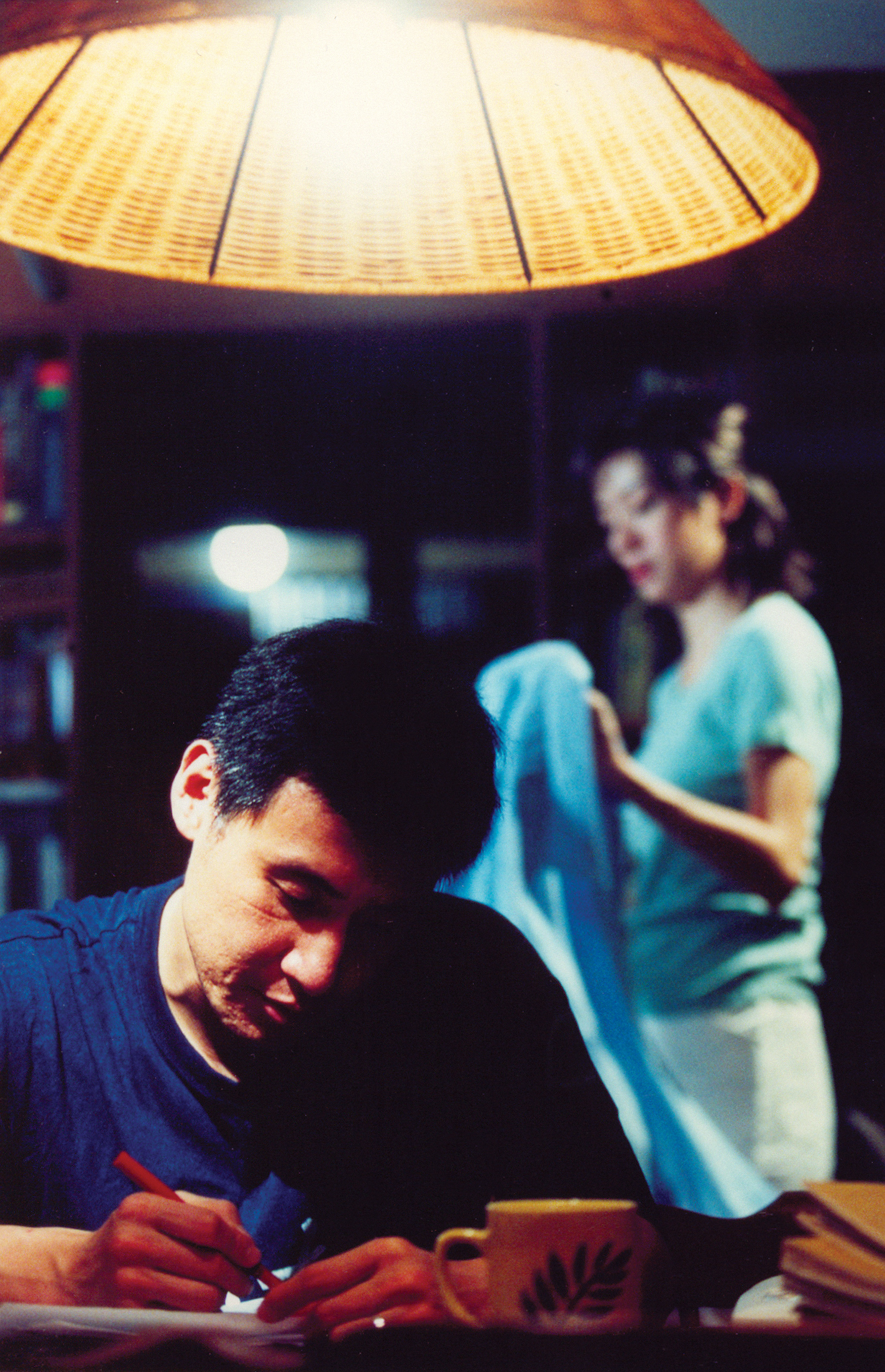
“Not every ending fulfils your expectations” a weary mother advises her son sharing long buried family secrets which will at least set them free if not perhaps happily. Scripted by Ivy Ho, Ann Hui’s July Rhapsody (男人四十) is as the Chinese title “a man at 40” implies a film about mid-life crises and quiet desperation as a middle-aged school teacher begins to resent the loss of his youth while transgressively drawn to a free-spirited student.
Lam (Jacky Cheung Hok-Yau) describes himself as “stiff”, a “boring” man who teaches Chinese literature to disinterested students while privately consumed by a sense of inferiority observing with envy the yachts that litter the horizon on a trip to the beach with his son. At a reunion dinner he gets up with irritation when one of his former classmates now a wealthy financier tries to pay the bill for everyone insisting on paying his own way while perhaps exposing the sense of belittlement he feels around his more successful friends. His wife Ching (Anita Mui Yim-Fong) questions his decision pointing out that even if he could afford to pay his bit perhaps his friend Yue (Eric Kot Man-Fai) couldn’t and would feel equally insulted should Lam simply agree to pay his share too. To add insult to injury, one of his friends also wants to hire him to tutor his young son in classical Chinese poetry which leaves him feeling somewhat humiliated but on the other hand not wanting to turn the money down.
These feelings of dissatisfaction with the way his life has turned out only intensify as he reaches the age of 40 and begins to feel his options narrowing wondering if this is really all there is. He and Ching recall a melancholy poem they learnt at school in which a scholar on a boat laments “the limitations of life” only for the poem to be ironically cut short when the couple’s younger son, Stone, comes to fetch his mum because the soup is boiling dry. Even without knowledge of the final revelations told in a two part story divided between a mother and a father to a son, we can gather that Lam married extremely young and became a father soon after. He studied at night school and became a teacher as a steady job to provide for his family and perhaps to a degree resents them for limiting his choices. His classmates, aside from Yue, all went on to find more lucrative careers while he lives in a small two bed flat snapping at his wife that he’s unlikely to find the money to buy a bigger one.
When he irritably tells her a tube of glue they bought is “all dried up” it sounds like an insult and a way of describing their moribund relationship. Beginning to bond with free-spirited high school girl Wu (Karena Lam Ka-Yan), Lam initiates intimacy with Ching but then turns away leaving her lonely and disappointed. She meanwhile explains to him that a figure from their past whom he seems to resent has become ill and is all alone. She would like to care for him but only with Lam’s consent which he gives but grudgingly. Talking to her son, Ching admits that she isn’t sure if she’s helping this man out of pity or because she simply wants to see him suffer given the effect he has had on her life. Similarly Lam later confesses to Wu that he may have befriended Yue because he was a poor student and unpopular. At his side, Lam was always going to look good bearing out his sense of insecurity in wanting to be seen as the best, idolising his Chinese literature teacher and desperate for his praise only to find himself ironically echoing his transgressions in allowing himself to be seduced by a student.
Ironically enough, Lam tells his son that he became a teacher because he sat behind Ching in class and wanted to stand out front so that he could see her face. Wu represents for him that same innocent teenage romance, but also a sense of the path not taken in her free-spiritedness and confidence. Lam followed the conventional path, did everything right, and now he’s unhappy. Wu rejects education and goes straight into business, supported by a wealthy father, planning to go travelling in India to look for new stock for her shop. His sons too perhaps echo his conflicting desires, Ang the older studious and responsible, and the younger Stone (changing his name to the cooler “Rocky”) uninterested in his studies. The melancholy poem which frequently recurs hints at a parting while husband and wife each attempt to resolve something but are left only with uncertainty and perhaps tragically in opposing positions in considering the further course of their lives.
This very literary drama is related in a series of stories, Lam’s told to his son first in person and then in a letter, followed by Ching’s and the constant stream of classical Chinese poetry that floods the screen guiding the couple towards the expanse of the Yangtze River. As Ching had said, not every ending fulfils your expectations because in the end life is not so neatly packaged. There may be no real accommodation with middle-aged disappointment but there may be new ways forward to be found in resolving the traumatic past.
July Rhapsody screens at Garden Cinema, London on 10th July as part of Focus Hong Kong’s Making Waves – Navigators of Hong Kong Cinema.
Original trailer (Traditional Chinese / English subtitles)

 Windows on Worlds