90 Years Old – So What? (九十歳。何がめでたい, Tetsu Maeda, 2024)

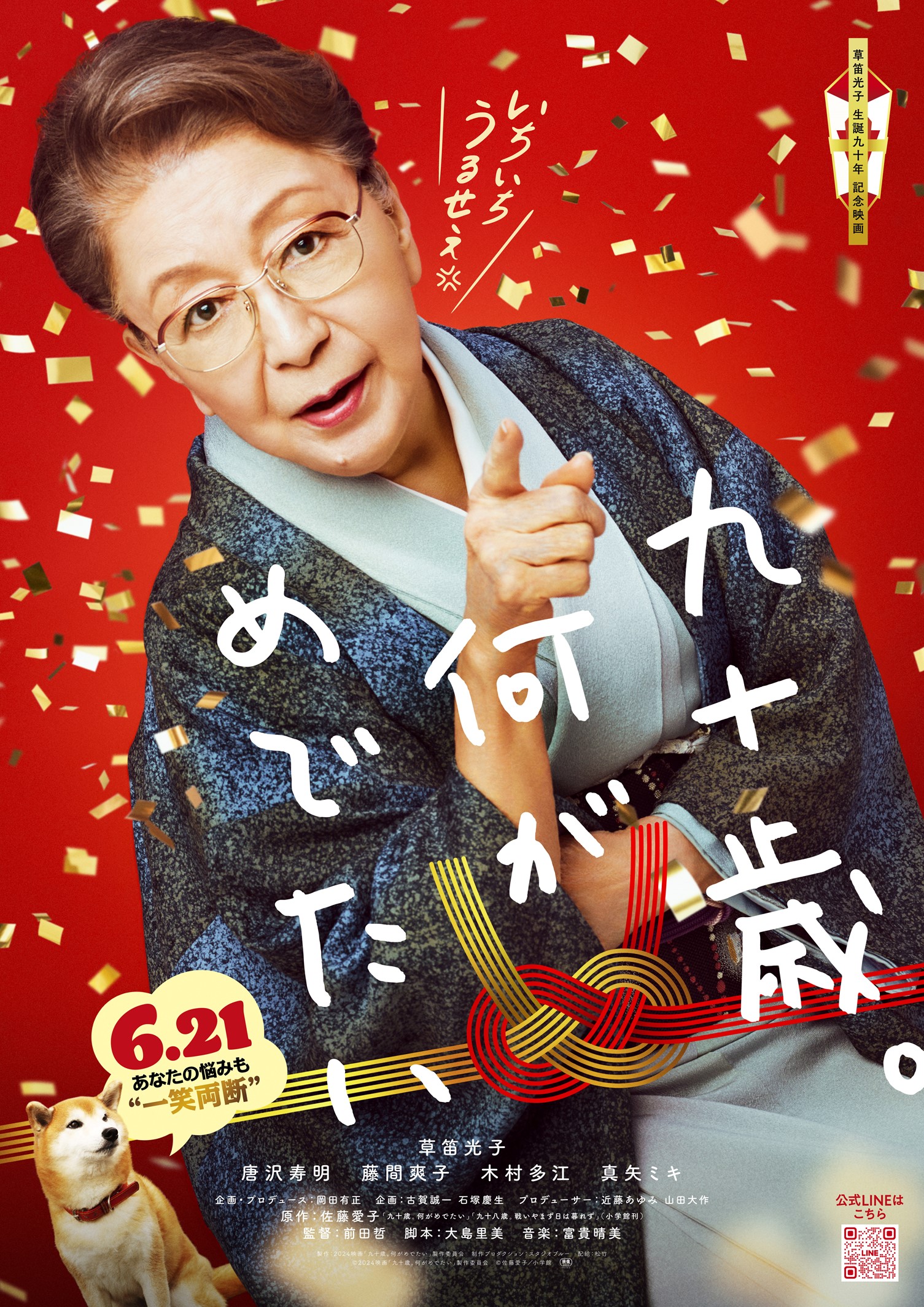
Everyone keeps congratulating Aiko Sato (Mitsuko Kusabue) on reaching 90, but she can’t see what’s so special about it. Having retired from writing after publishing her last novel at 88, she’s really feeling her age and has little desire to anything but sit around waiting to die. That is, until she’s badgered into picking up her pen by a down on his luck, “dinosaur” editor certain that her words of wisdom will strike a chord with the young people of today.

Marking the 90th birthday of its leading lady Mitsuko Kusabue and directed by comedy master Tetsu Maeda, the film takes its name from a collection of essays published under the title “90 Years Old, So What?” which largely deal with what it’s like to be old in the contemporary society along with the way things have changed or not in Japan over the last 90 years. It does not, however, shy away from the physical toll of ageing despite Kusabue’s sprightliness or the undimmed acuity of Aiko whose only barrier to writing is that she fears she’s run out of things to say and the energy to write them. During her retirement, she remarks on the fact that her legs and back hurt while she also has a heart condition and everything just feels like too much bother. Her daughter Kyoko (Miki Maya), who lives with her along with her twenty-something daughter Momoko (Sawako Fujima), asks her why she doesn’t go out to meet a friend, but as Aiko says, most of her friends have already passed on or like her don’t really have the energy to leave the house. 

In many ways, her age isolates her as she finds herself slightly at odds with the contemporary society. She turns the television up louder because she finds it difficult to understand what younger people are saying and doesn’t get why they stare at their phones all the time. Though she manages most things for herself, she has to call repair people, which costs money, if something breaks down while her daughter’s not around to fix it, even if it’s something as simple as a paper jam in a fax machine or pushing the off button on the TV too hard so it won’t turn back on again. Nevertheless, so intent is she on “enjoying” her retirement that she repeatedly turns down the entreaties of a young man from her publisher’s who wants her to write a column and always turns up with fancy sweets which are, as she says, well-considered gifts, but also a little soulless and superficial being driven by fashionable trends of which Aiko knows nothing and by which she is not really impressed.

There is something quite interesting about the contrast between herself and fifty-something Yoshikawa (Toshiaki Karasawa) who is also a man behind the times and a relic of the patriarchal culture she railed against in her writing and rejected in her personal life, divorcing two husbands and going on to raise her daughter alone. In the opening scenes, she reads an entry from an advice column about a woman who’s sick of her husband of 20 years because he’s a chauvinist who dumps all of the domestic responsibilities onto her while looking down on her because of it. Aiko tuts and contradicts the advice of the columnist, remarking that the answer is simple. She should just tell him to his face that she hates him and then leave. Nevertheless, the fact remains that not all that much has changed since she was young. The husband’s behaviour is considered “normal”, while the woman’s desire to be treated with respect or leave her marriage is not. Yoshikawa is effectively demoted because he has no idea that his treatment of a female employee amounts to workplace bullying and sexual harassment even if he didn’t intend that way because he’s trapped within this old-fashioned patriarchal ideal and is unable to see that his behaviour is not acceptable nor that he’s been taking his family for granted while considering only his own needs and positioning himself as the provider. 

Yet it’s 90-year-old Aiko rather than his humiliating demotion or the failure of his marriage who begins to show him the error of his ways by accepting him into her own family like a lonely stray. Aiko’s essays don’t really say that everything was better in the past, even if she’s confused by modern people who are annoyed by the cheerful sounds of children playing and a city alive with life because she remembers how everything went quiet during the war and how depressing that could be. But she does sometimes think that progress has gone far enough and things were better when people had more time for patience with each other. That said, patience is one of the things Aiko has no time for, advising Yoshikawa to charge forward like a wild boar because one of the benefits of age is that you just don’t care anymore what anyone thinks so get ready to annoy people or exasperate them but carry on living life to the full. Ironically, that might be a gift that he gave her by convincing her to write again which returned purpose to her life and gave her a reason to engage again with the world around her lifting her depression and making her feel as if she still mattered. The real Aiko turned 100 in 2023 and carried on writing, while 90-year-old Kusakabe is herself undergoing something of a career resurgence in recent years proving that even if you’re 90 years old, so what? There’s still a lot of life left to be lived and you might as well carry on living it doing what you love for as long as you can.


90 Years Old – So What? screens 21st June as part of this year’s Toronto Japanese Film Festival.

Trailer (English subtitles)
Rainy Blue (レイニー ブルー, Asuna Yanagi, 2025)

“You never know when it will end,” Aoi mutters to a concerned teacher. “The streaming period, and my life.” Asuna Yanagi’s Rainy Blue (レイニー ブルー) is a semi-autobiographical tale of a young woman figuring out how to live in the world while immersed in cinema. Her father may insist that she look at the reality, but Aoi’s world is already quite surreal even as she pours all her efforts into writing screenplays and watching films but otherwise floundering for direction.

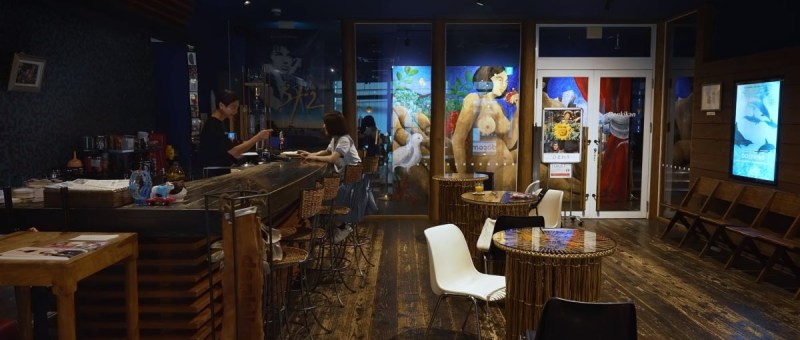
To begin with, Aoi isn’t interested in cinema She just gets sent to see a film as punishment after getting caught setting off fireworks on the school roof because a local cinema has a special retrospective dedicated to actor Chishu Ryu who attended the same high school though probably 100 years previously. Despite scoffing at the idea and chuckling that everyone in the cinema is “old” while even the usher double checks to make sure she’s in the right place, Aoi is captivated by Ozu’s filmmaking and becomes a true convert to cinema to the extent that it completely takes over her life. She becomes the only member of the school’s film club, or as she’s find of reminding people “society”, and regularly turns up late after staying up all night watching movies. 

To that extent, Aoi’s film obsession may not quite be healthy in that it leads her to make some questionable decisions with unintended consequences, such as getting arrested for “stalking” people after following them around as research for her screenplays. She also finds out that one of her old friends, who is also her father’s favourite example of a “good” daughter, is into compensated dating and in reality perhaps just as lost as she is. Aoi’s father no longer understands her and has become authoritarian and unforgiving. He regularly berates and shouts at her while making no real attempt at communication. He simply asks why she can’t be “normal” and concentrate on going to uni like the other girls while complaining about how “embarrassed” he would be if she doesn’t go because it would reflect badly on him as a parent. 

Perhaps it’s not surprising that Aoi retreats into cinema to escape, but it’s also true that she finds a more supportive paternal presence in the guy at the cinema who turns out to have been a classmate of her mother’s. There’s a kind of poignancy in Aoi and her sister’s moment of confusion on realising that their mother was interested in films but they rarely watch them at home because her father doesn’t like them, while her mother rarely has time to go alone. Aoi’s love of cinemas as mediated by an old script she finds in the club room is also a way of connecting with her mother as a potentially more supportive parental figure in contrast to her father’s hardline authoritarianism.

But then, in her love of cinema Aoi is absolutely certain and she’s no reason why she should hide it from anyone else. Her best friend at school is rather bafflingly played by 43-year-old film director Hirobume Watanabe who dresses in a pre-war school uniform complete with student’s cap and little round glasses that make him look strangely like a Studio Ghibli character. Usami is an otaku with a love of anime he thinks he’s kept hidden despite having several anime badges on his backpack and is too afraid to be out and proud about it because he knows he’ll be bullied, which he eventually is when Aoi enters a deeper moment of crisis and more or less abandons him and the school. Watanabe also appears as a weirdly inspirational film director who has a go at an audience member at a q&a who asks him why his film is so nihilistic only for him to turn the question back on her and angrily insist that film can illuminate the way forward for those like Aoi who feel themselves to be lost. 

Thanks to all these strange adventures, her various friendships, and even her father’s animosity, Aoi eventually figures out what she wants to do with her life and gains the courage to go after it no matter what anyone else might say. Set in the picturesque environment of rural Kumamoto, the film’s gentle, laid-back aesthetic belies the storm at its centre and the rainy blue that surrounds the heroine until she too finally finds her way through the labyrinths of cinema.


Rainy Blue (レイニー ブルー, Asuna Yanagi, 2025) screened as part of this year’s Osaka Asian Film Festival.

Original trailer (no subtitles)

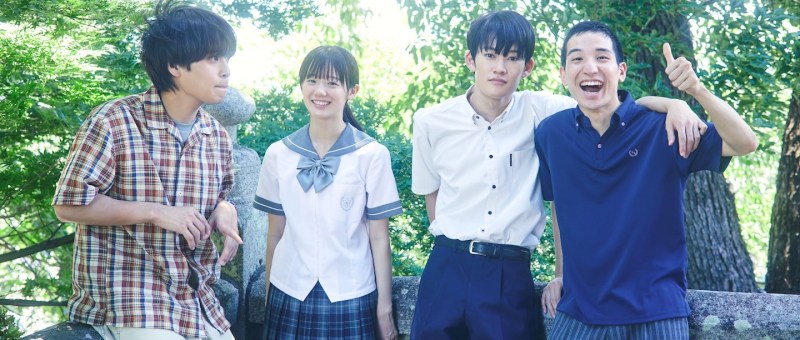
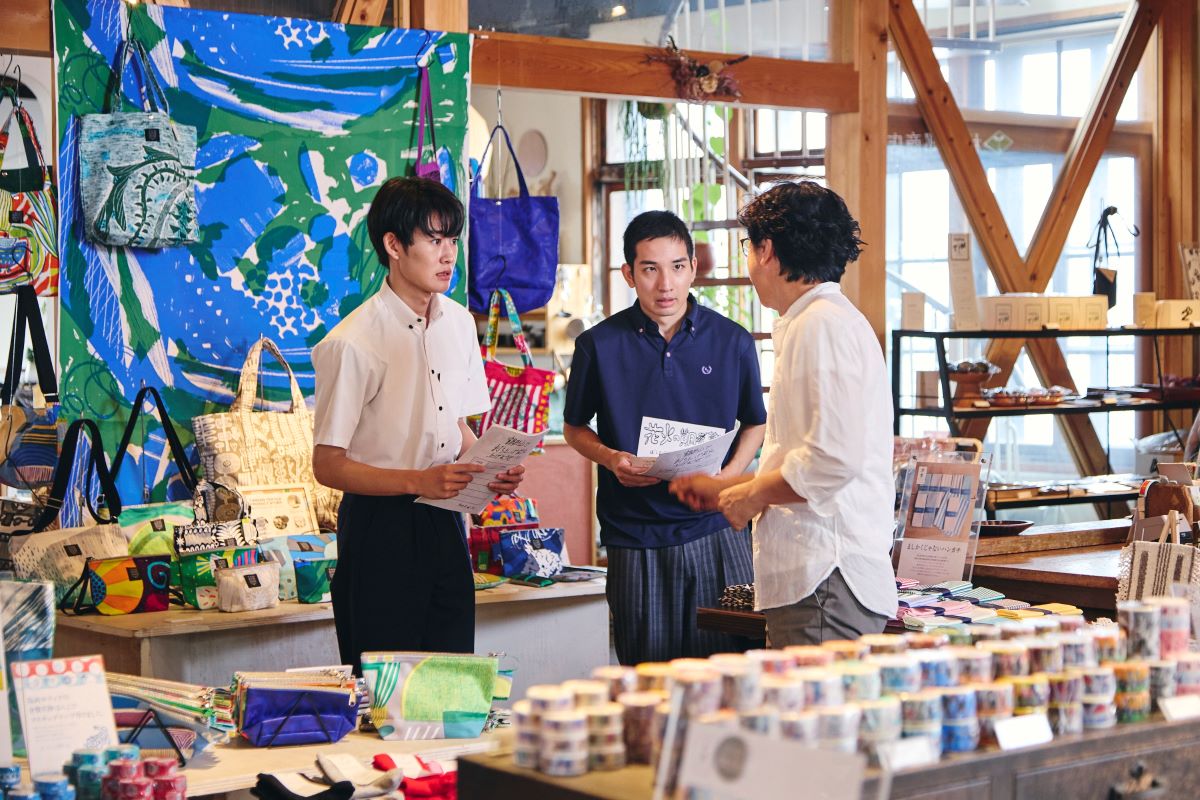
The Tales of Kurashiki (蔵のある街, Emiko Hiramatsu, 2025)

Beniko’s high school art project involves recreating a picture her mother left behind that immortalised a memory of a happy family moment during the rare sight of fireworks. But Beniko can’t seem to make progress with her artwork and she’s thinking of giving up art altogether along with her ambition of attending an art school because for her painting is intrinsically linked with her familial trauma and fears for the future. It is also, however, the force that keeps her family together though not perhaps in the way she intended.

The attempt to recreate her mother’s drawing is that to reclaim her family as it was though as she later realises attempting to recreate the past exactly is a futile effort. Resentful towards her mother for leaving and perhaps also towards her father for his emotional abandonment and the absurd jealousy that left her mother with no choice but to leave, she reinvents herself as a caretaker as a way of rooting herself in the domestic space by taking care of her autistic older brother Kyosuke, affectionately known around the neighbourhood as Kyon-kun. Looking after Kyon-kun is one reason she gives for not going to art school, but as her friend points out much to Beniko’s shame, perhaps that’s not really fair to him either if she’s exploiting his need as an excuse for her cowardice while denying him the right to his own life too. He is after all a little more capable than she might give him credit for, travelling to the correct station on his own and waiting for her patiently at the other end when she misses her regular train. 

Beniko’s childhood friend Aoi later realises that he did something similar. When Kyon-kun wandered off while Beniko was distracted and climbed a tree at the shrine to watch imaginary fireworks, Aoi and his friend Kiichi, who is the son of the shrine owner, promised to set off some real fireworks for him without really thinking it through or having much intention to actually do it. But as Beniko points out, Kyon-kun never forgets a promise so now he’s asking every day when the fireworks are and is continually disappointed. Chastened by Beniko, Aoi’s half-hearted attempt to keep his promise backfires and he realises that he too thought that it didn’t really matter because it was Kyon-kun and he wouldn’t know the difference. 

Aoi’s desire to make good on his word is partly a sense of guilt and shame in his realisation of the way he’d thought of Kyon-kun, partly due to his feelings for Beniko, and partly adolescent insecurity in the acceptance that his unnecessarily harsh father has a point when he says he never follows anything through. Kiichi too is experiencing similar anxieties as his father threatens to leave the shrine to his more studious younger brother and is exasperated by his goodhearted goofiness. The trio are all really looking for new paths towards adulthood by trying to make peace with their younger selves and gain the confidence to follow their dreams even if it takes them away from the picturesque settings of provincial Kurashiki.

Beniko’s mother was fond of saying that there was a deity of waiting in the town, and there is a white-clad figure perhaps visible only to Kyon-kun who follows the youngsters around and looks on cheerfully as if embodying the sense of fun and warmth that lingers in the city. Kurashiki does indeed look like a nice place to live with its continual sunniness and traditional architecture though as someone points out that’s largely because the bombers flew past here and hit somewhere else instead. Fireworks are as apparent disruptor but eventual healer Kojo says a way of bringing people together, a source of joy happiness even amid difficult times just as they were during the pandemic. There’s something quite wholesome and comforting about the way the whole community comes together to make Kyon-kun’s dream come true, overcoming the obvious objections of the powers that be that it’s not a good idea to have a fireworks festival in a town that’s almost entirely constructed in wood to create a small marvel of human kindness and solidarity. It’s this that finally allows Beniko to remake her family, giving it her own light and colour while keeping a place for her mother having come to an acceptance of why she couldn’t stay and a conviction that she will one day return when she too has begun to heal her heart.


The Tales of Kurashiki screened as part of this year’s Osaka Asian Film Festival.

Trailer (no subtitles)