An Outlaw (ならず者, Teruo Ishii, 1964)

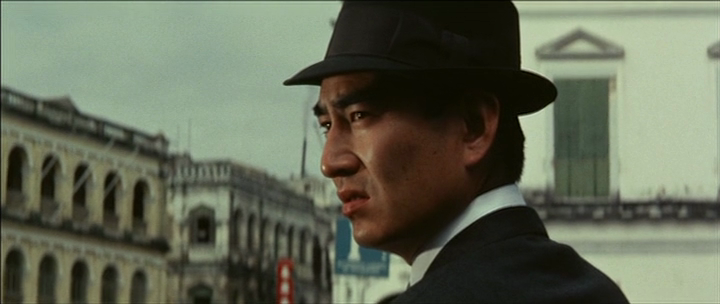
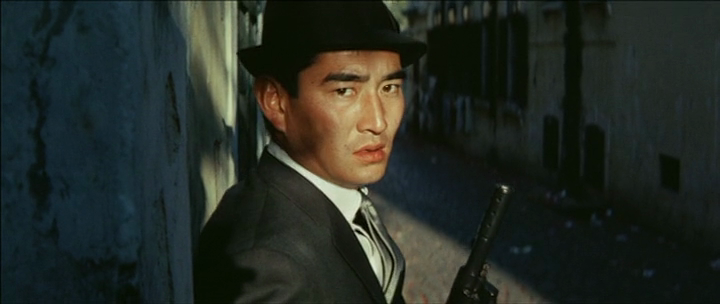
Outside of Japan, “king of cult” Teruo Ishii is most closely associated with a particular brand of transgressive ero-guro exploitation films such as Horrors of Malformed Men, yet his career was much more eclectic than many might assume. Starring Ken Takakura with whom Ishii was developing a professional relationship which would eventually lead to the hugely successful Abashiri Prison series, 1964’s An Outlaw (ならず者, Narazumono) is one of a string of noir thrillers from the earlier part of Ishii’s career this one taking place mainly in Hong Kong and Macao. 

China-based Japanese hitman Nanjo (Ken Takakura) runs into trouble after he offs a man he assumed to be “the biggest thug in the underworld” but actually turns out to have been a law enforcement official working against a people trafficking ring. To make matters worse when Nanjo returns to his hotel where he was supposed to get his pay off, he discovers the body of a young woman in his bed who is later identified as the official’s daughter. Understandably annoyed, Nanjo starts trying to track down the people who hired him to figure out what’s going but is accidentally dragged into underworld intrigue after being mistaken for a drug deal middle-man owing to the yellow flower he’s wearing on his lapel. 

Like any good noir hero and especially one played by Takakura, Nanjo is basically a good guy with a strong sense of justice and an acute moral compass. He doesn’t like having been manipulated into killing someone who wasn’t in the game nor does he approve of those who make their living by exploiting women such as arch villain Mao (Toru Abe) whom he discovers to have been running a nefarious international trafficking ring getting Japanese women hooked on drugs, shipping them to Hong Kong and Macao, and working them to death before abandoning them once they’ve served their purpose. Then again, he also has a strange problem with women who like to lie in bed in the middle of the day which seems slightly puritanical for a man who kills for a living yet you’d have to admit no one could call him lazy. 

Not much of Nanjo’s past is revealed save that he was born in prison to a woman who stabbed her former partner because he left her for another woman while she was pregnant with his child, raising her son to be anything but dishonest especially with women. In any case, he appears to have been based in China and Hong Kong for some time, claiming that he came down from Xiamen for the job and speaking fairly fluent Cantonese and Mandarin though in another strange coincidence many of the people he meets turn out to be Japanese. In this there’s a slightly ironic inversion of the normal patterning of post-war crime films which sees Japan exporting crime to China the big mcguffin revolving around a tin of drugs Nanjo was given by mistake intended for the local market while the secondary target becomes Mao’s people trafficking operation bringing sex workers who’ve gotten into his bad books to Hong Kong or to be used for the pleasure of wealthy men. Despite his apparent disapproval, Nanjo reveals he was given part payment for the job in the form of a girl who he could use for his “convenience” though it seems unlikely that he did so.

On the other hand, the secondary villain, the Japanese-speaking Minran (Yoko Mihara), is painted as something of a femme fatale playing off Nanjo and her boss while trying to get her hands on the drugs to split the proceeds with her Cantonese-speaking lover who accidentally kills a young girl Nanjo had befriended in Hong Kong. The girl’s death is in part Nanjo’s responsibility in that he placed her in danger without warning or an understanding of what he was asking her to do, yet he later proves no better when he kills the landlady of the hotel who had watched as she died and then blackmailed Minran for financial gain. Aside from the girl and her Japanese friend Aki (Yoko Minamida) who is dying of consumption after being worked to death as one of Mao’s trafficked women, and a detective with whom Nanjo later forms an unexpected alliance, Nanjo is the representative of humanist morality despite his morally compromised existence reminding Mao that his mistake was in thinking that there is nothing money could not buy in rejecting his efforts to pay him off. 

Shot largely on location in Hong Kong and Macao, Ishii adds to the noirish tone with frequent voice over and a melancholy jazz score while making full use of the atmospheric environment with its deserted alleyways and cobbled streets not to mention the naturally canted angles of the Victoria Peak funicular, while there is a fair amount of lowkey sleaze more typical of his later career along with a bizarre scene in which Nanjo sucks out blood from the mouth of a woman suffering a pulmonary haemorrhage. First and foremost a fatalistic noir thriller in which the hero, unfairly damned by a corrupt society, is unable to outrun his past transgressions, An Outlaw nevertheless suggests that true nobility is to be found only in those existing outside of its borders.


Original trailer (no subtitles)

Feisty Edo Girl Nakanori-san (ひばり民謡の旅シリーズ べらんめえ中乗りさん, Masamitsu Igayama, 1961)

Nakanori-san posterThe voice of the post-war era, Hibari Misora also had a long and phenomenally popular run as a tentpole movie star which began at the very beginning of her career and eventually totalled 166 films. Working mostly (though not exclusively) at Toei, she starred in a series of contemporary and period comedies all of which afforded her at least a small opportunity to showcase her musical talents. Directed by Masamitsu Igayama, Feisty Edo Girl Nakanori-san (ひばり民謡の旅シリーズ べらんめえ中乗りさん, Hibari Minyo no Tabi: Beranme Nakanori-san, AKA Travelsongs: Sharp-Tongued Acquaintance) once again stars Hibari Misora as a strong-willed, independent post-war woman who stands up to corruption and looks after the little guy while falling in love with regular co-star Ken Takakura. 

Nobuko (Hibari Misora) is the daughter of a formerly successful lumber merchant whose business is being threatened by an unscrupulous competitor. With her father ill in bed, Nobuko has taken over the family firm but is dismayed to find that a contract she assumed signed has been reneged on by a corrupt underling at a construction company who has been bribed by the thuggish Tajikyo (Takashi Kanda). Unlike Nobuko’s father Sado (Isao Yamagata), Tajikyo is unafraid to embrace the new, completely amoral business landscape of the post-war world and will do whatever it takes to become top dog in the small lumber-centric world of Kibo.

Tajikyo has teamed up with the similarly minded, though nowhere near as unscrupulous, Oka (Yoshi Kato) whose son Kenichi (Ken Takakura) has recently returned from America. Kenichi, having come back to Japan with with clear ideas about the importance of fair practice in business, is not happy with his father’s capitulation to Tajikyo’s bullying. Of course, it also helps that he had a charming meet cute with the spiky Nobuko and became instantly smitten so he is unlikely to be in favour of anything which damages her father’s business even if they are technically competitors.

As in the majority of her films, Misora plays the “feisty” girl of the title, a no nonsense sort of woman thoroughly fed up with the misogynistic micro aggressions she often encounters when trying to participate fully in the running of her family business. Though her father seems happy enough, even if casually reminding her that aspects of the job are more difficult for women – particularly the ones which involve literal heavy lifting and being alone with a large number of men in the middle of a forest, he too remarks on her seeming masculinity in joking that her mother made a mistake in giving birth to her as a girl. Likewise, Tajikyo’s ridiculous plan to have Nobuko marry his idiot son is laughed off not only because Tajikyo is their enemy, but because most people seem to think that Nobuko’s feistiness makes her unsuitable for marriage – something she later puts to Kenichi as their courtship begins to become more serious. Kenichi, of course, is attracted to her precisely because of these qualities even if she eventually stops to wonder if she might need to become more “feminine” in order to become his wife.

To this extent, Feisty Edo Girl is the story of its heroine’s gradual softening as she finally writes home to her father that she is happy to have been born a girl while fantasising about weddings and dreaming of Kenichi’s handsome face. Meanwhile, she also attracts the attentions of an improbable motorcycle champion who just happens to also be the son of a logging family and therefore also able to help in the grand finale even if he never becomes a credible love rival despite Nobuko’s frequent admiration for his fiery, rebellious character which more than matches her own.

Nevertheless, the central concern (aside from the romance) is a preoccupation with corruption in the wartime generation. Where Nobuko’s father Sado is “old fashioned” in that he wants to do business legitimately while keeping local traditions alive, the Tajikyos of the world are content to wield his scruples against him, destroying his business through underhanded methods running from staff poaching to bribery and violence. Kenichi’s father has gone along with Tajikoyo’s plans out of greed and weakness, irritated by his son’s moral purity on one level but also mildly horrified by what he might have gotten himself into by not standing up to Tajikyo in the beginning.

As expected, Nobuko and Kenichi eventually triumph through nothing more than a fierce determination to treat others with respect. Working together cheerfully achieves results, while the corrupt forces of Tajikyo eventually find themselves blocked by those who either cannot be bought or find the strength to refuse to be. Nobuko’s big job is finding prime lumber to be used to build a traditional pagoda in America as part of a cultural celebration. She wants to do her best not only because she takes pride in her work but because she knows this project will represent Japan overseas. Tajikyo, however, would cut corners, believing that the Americans wouldn’t notice even if he sent them rotten logs riddled with woodworm as long as the paperwork tallies. Filled with music and song, Nakanori-san is an action packed outing for Misora in which she once again succeeds in setting the world to rights while falling in love with a likeminded soul as they prepare to sail off into kinder post-war future.


Some of Hibari’s songs from the film (no subtitles):

https://www.youtube.com/watch?v=gCeE4lCTpW4