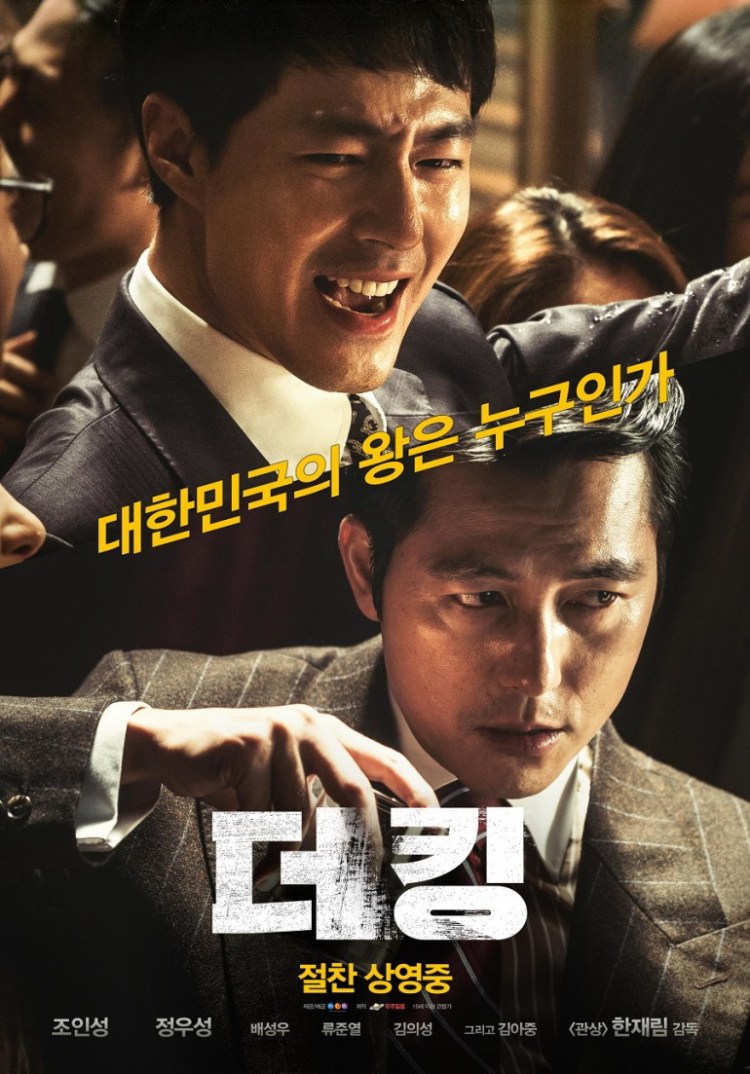
 Absolute power corrupts absolutely, but such power is often a matter more of faith than actuality. Coming at an interesting point in time, Han Jae-rim’s The King (더 킹) charts twenty years of Korean history, stopping just short of its present in which a president was deposed by peaceful, democratic means following accusations of corruption. The legal system, as depicted in Korean cinema, is rarely fair or just but The King seems to hint at a broader root cause which transcends personal greed or ambition in an essential brotherhood of dishonour between men, bound by shared treacheries but forever divided by looming betrayal.
Tae-soo (Jo In-sung) is the classic poor boy made good. His mother abandoned the family when he was only six because she couldn’t cope with his father’s rampant criminality. Do bad things and you’ll go to hell, she told her son but perhaps Tae-soo already feels himself to be there and so doesn’t worry so much about those “bad things” that are a normal part of his life. The top fighter at his school, Tae-soo finds his calling when he sees his tough as nails father kneeling on the ground, pleading furiously in front of a skinny bespectacled man wearing a fancy suit. The man is a prosecutor and walks with the swagger of someone whose every action is government backed, his authority is absolute.
Tae-soo knuckles down, starts studying and gets into Seoul University. An accidental brush with the pro-democracy protest movement lands him in the army but thanks to lying about his hometown on his registration form he gets an easy posting meaning he has even more time to study for the bar. Everything seems to fall into place – he qualifies, gets his dream job, even marries a beautiful, intelligent, feisty woman who also happens to come from a wealthy elite family. The poor boy from Mokpo has made it, but prosecuting isn’t all he thought it would be. Tae-soo is a civil servant which means, like it does the world over, that he’s overworked and underpaid. When he rubs up against a dodgy case he’s made an offer he can’t refuse – drop it, and get a promotion to the big leagues where celebrity prosecutors enjoy lavish lifestyles filled with parties, drinks, and pretty girls. He knows it’s not right, but this is what he’s always wanted and Tae-soo is soon seduced.
Tae-soo’s seduction causes him a few pangs of conscience, but he was, as he was assumed to be, easy pickings. The case in question is a sickening if ordinary one – a teacher has molested a pupil but as the teacher is the son of an influential man and the single mother of the girl in question has learning difficulties, the case has been made to go away. Tae-soo is outraged, hauls the man back in, re-opens the case and obtains additional evidence and witness testimonies which confirm the girl’s story and will have the teacher sent to jail. His seduction is easy – they simply offer to make him one of them, and Tae-soo agrees, sacrificing not only this little girl but potentially many others for his own greed and satisfaction.
Tae-soo is redeemed, in a sense, thanks to his association with a childhood friend who helps him out by taking care of the teacher through “unofficial” means. Choi Du-il (Ryu Jun-yeol) is Tae-soo’s flip side, another poor boy done good but this time on the other side of the law. An ambitious gangster, Du-il is also loyal, just, and honourable – at least within a gangster code. The “errand boy” for this group of thuggish lawyers who behave like gangsters while the gangsters act like politicians with literal rather than metaphorical attack dogs, Du-il senses he’s walking a dangerous path to nowhere at all and has only his friendship with Tae-soo to believe in.
The genuine bond between the two men is one of the few redeeming features of Tae-soo’s increasingly compromised existence in which he sells his soul for the false approval of the man he regards as a “King” in the figure of all powerful, amoral chief prosecutor Han (Jung Woo-Sung). Tae-soo’s story is a conventional one of a basically good yet weak man struggling with a choice he’s made against his better judgement yet it’s not until it’s cost him everything he holds dear that he starts to reconsider.
Han Jae-rim weaves in archive footage and musical cues to evoke the changing eras which will be more obvious to Korean audiences – a case in point being the dramatic positioning of the suicide of former president Roh Moo-hyun in 2009. Roh had been a progressive president, often unpopular during his time in office thanks to his inability to pass his policies, and was later tarnished with a corruption scandal but found his reputation posthumously reappraised following his death which was seen both as a declaration of innocence and as a symbol of his deep love for his country and its people. Tae-soo’s change of heart seems to accelerate after Roh’s suicide which drew vast crowds of mourning (and knowing smirks from sleazy prosecutors Han and his sidekick Yang) as his own run in with death prompts a re-evaluation of his place in the grand scheme of things.
The King ends on a rather trite message – that every man is his own king and in the end the choices are all yours (though it seems to hope the choices made will be more altruistic than those of Han, Yang, and the earlier Tae-soo). The power wielded by men like Han is fragile – they need lackies, and if they can’t get them the system crumbles, but they’re also hollow, frightened opportunists who are so desperate they’re even bringing in shady seeming shamans to avoid having to make difficult policy decisions. Tae-soo turns their own tricks back on them with masterstrokes of irony, vowing revenge and perhaps getting it, along with self respect and a re-orientated moral compass but then again, power abhors a vacuum.
Screened as part of a season of teaser screenings for the upcoming London Korean Film Festival 2017.
Original trailer (English subtitles)
 Windows on Worlds