Hey! Our Dear Don-chan (おーい!どんちゃん, Shuichi Okita, 2022)

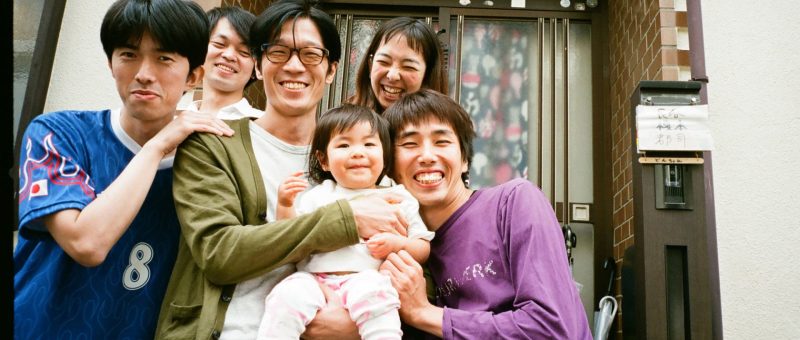
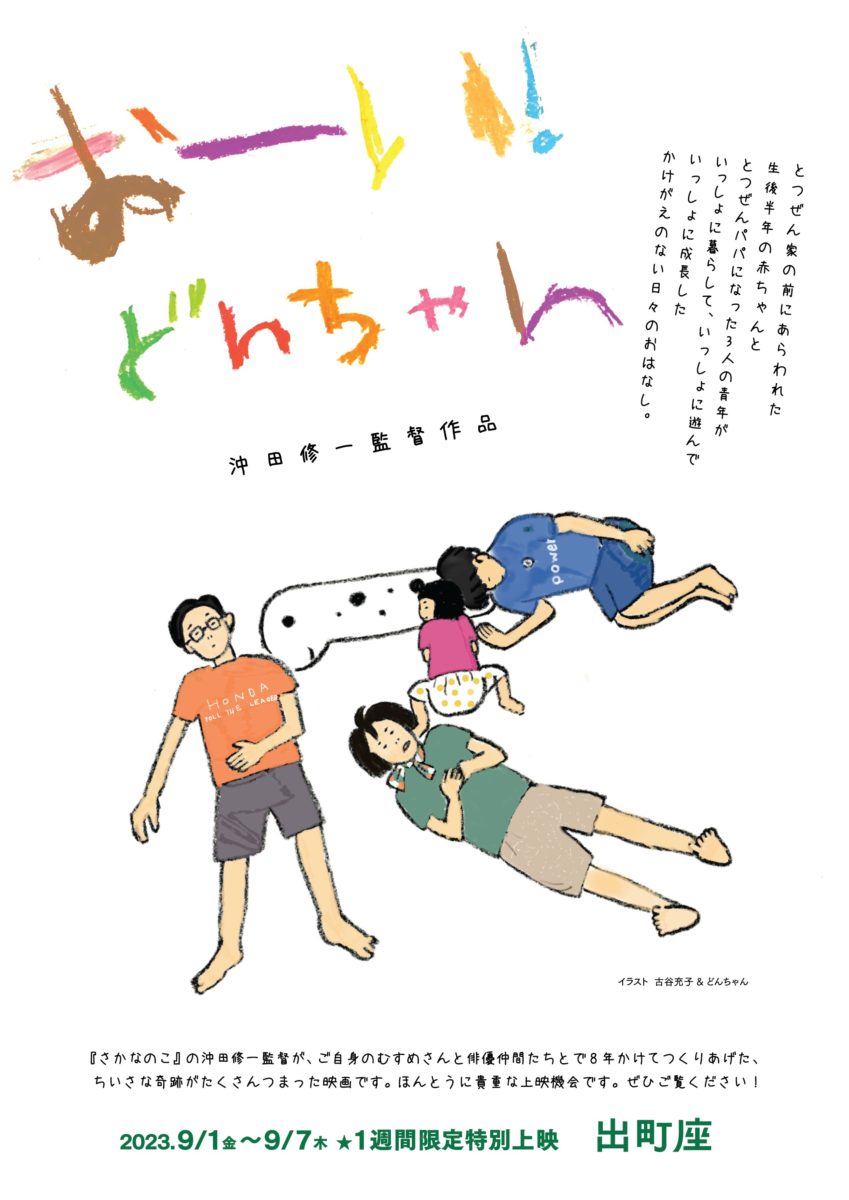
A trio of actors undergo a coming-of-age tale of their own when a baby is suddenly abandoned on their doorstep in Shuichi Okita’s charming slice of life dramedy, Our Dear Don-chan (おーい!どんちゃん, Oi! Don-chan). A take on Three Men and a Baby, the film stars the director’s own daughter and follows her over a period of three years as the actors attempt to adjust to fatherhood and the new kind of family that has arisen between them. 

As the film opens, Michio (Tappei Sakaguchi), Ken (Hirota Otsuka), and Gunji (Ryuta Endo) are struggling actors working in slightly different media but having about the same amount of luck and continually dejected about their lack of career success. Ironically while playing the game of life, Ken has a baby girl in the game but is surprised to hear one crying for real on the street below. On reading a note in her pushchair, Ken realises that the baby has been left by a previous girlfriend, Kaori, with the instruction that he raise it. 

Of course, the situation gives rise to a degree of panic, Ken wondering not only if he is the father but if he can be while supported by the other two guys, along with former houseman Sakamoto and his girlfriend Akari, taking care of more practical matter likes getting nappies and baby food. Then again, some of the practical details are already overcome by virtue of their occupations which allow them to be home during the day taking shifts to watch the baby they christen “Don-chan” on account of not knowing her real name. 

As they struggle with the demands of fatherhood, the three men each commit themselves to Don-chan’s well being, mindful of the memories she’ll make in the future and wanting to make her present as happy as possible. At one point they decide to take a camping trip in order to show her that they can be “manly dads”, but otherwise entertain her at home or take her on trips to the aquarium acting as a trio even if Ken is technically the primary dad forming a new kind of family that makes it easier to care for a small child than it might otherwise have been. If Ken had been on his own, he may not have been able to raise her. Michio and Gunji both complain at the precarious state of childcare facilities, lamenting that you can’t get a place unless you work full-time but you can’t work full-time if you can’t get childcare for when you’re at work. 

Meanwhile, they continue to struggle in their professional lives. A humiliating audition for a TV commercial causes Ken to rethink his career plans, stopping off to buy new toys for Don-chan on the way home lamenting that he “danced like an idiot for no reason.” Michio continues to go full method over researching all his roles for seconds of screen time in TV and movies, while Gunji’s stage career is disrupted when the manager of his troupe decides to admit himself to a psychiatric facility for long term care. Through their interactions with Don-chan, however, they all begin to grow up gaining further life experience which enhances their performance ability and gives them a greater goal to work towards aside from mere career success. 

A heartwarming familial drama, the film doesn’t gloss over how difficult it can be to raise a child in contemporary Japan especially as a single-parent but rather embraces a larger idea of the word family which centres platonic friendship and community while simultaneously understanding of Kaori’s position in the knowledge that none of this is easy and she may not have had access to the kind of support that made it possible for Ken to care for Don-chan with so much love and attention. In any case, little Don-chan is certainly lucky to have so many people around her all invested in her happiness and future whose lives she has also enriched just by her existence. A truly happy film, Okita adds small doses of absurdity to the already surreal events along with a nostalgic sense of childhood comfort right down to the childish font of the film’s titles complete with corrections and crossings out that are, much like life, evidence of joyful trial and error. 


Trailer (English subtitles)

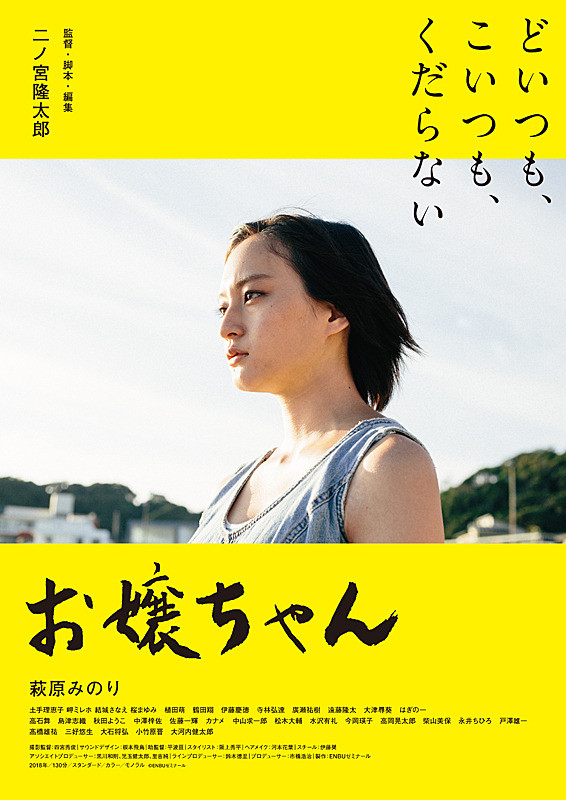
Minori, On The Brink (お嬢ちゃん, Ryutaro Ninomiya, 2019)

“Days like this make me feel I’m wasting my life” sighs just another dejected youngster in Ryutaro Ninomiya’s quietly enraged takedown of millennial malaise in a fiercely patriarchal society, Minori, On The Brink (お嬢ちゃん, Ojochan). In a culture which often favours politeness and avoids confrontation, Minori is a rare young woman determined to speak her mind though always with patience and grace and in turn a willingness to apologise if she feels that she has acted less than ideally, but her words often fall on deaf ears while those around her stumble through their lives chasing conventional illusions of happiness to mask a creeping despair. 

We first meet 20-something Minori (Minori Hagiwara) as she challenges a man who tried to force himself on her friend, Rieko, cowering quietly behind her. Minori wants an apology, but predictably he denies everything and quickly becomes angry, held back by his equally skeevy friend who advises him to apologise if only to defuse the situation. In the end Minori doesn’t get her apology and has to settle for having made a stand, retreating to avoid causing her friend more harm, but on exit the third man chases after her to ask for her contact information. Really, you couldn’t make it up. 

Part of Minori’s anger is bound up with being a so-called “cute girl” and everything that comes with it in a society still defined by male desire. Parades of idiotic young men, for some reason always in threes, come through the cafe where she works part-time expressly because a “cute girl” works there, while she’s forever being invited out by female friends who want to bring a “cute girl” to the party. Somewhat insecure, Minori worries that people are only interested in her cuteness and might otherwise reject her if, say, she were badly disfigured in some kind of accident. But what she resents most is that it’s other women who enable this primacy of the cute, the way her bashful, “homely” friend Rieko is always apologising for herself, while the other women who self-identify as “ugly” willingly cede their space to the conventionally attractive. 

In short, they submit themselves totally to pandering to male desire while men feel themselves entitled to female attention whether they want to give it or not. Dining in a local restaurant, Minori and Rieko are invited to a party by the proprietress which neither of them seem keen to go to but Rieko is too shy to refuse even when Minori reminds her of the traumatic incident at the last party with the guy who forced himself into the ladies bathroom and tried to kiss her against her will. The older woman laughs it off, affirming that he “meant no harm”, he was just drunk. This is exactly what Minori can’t stand. She keeps telling people she isn’t angry, but is she is irritated by Rieko’s need to apologise for something that isn’t her fault, seeing it as enabling the culture that allows men to do as they please while women have to obey a set of arbitrary rules of which remaining quiet is only one. 

In her own quiet way, Minori refuses to toe the line but is constantly plagued by unwanted male attention. Getting into an altercation with a creepy guy who waited outside her place of work to find out why she didn’t reply to his texts, she explains that he was just a casual hookup and that she finds his overly possessive behaviour frightening even as he continues not to take no for an answer, eventually branding her a “slut” for daring to embrace her sexuality. She demands an apology, not for what he called her but for the use of such misogynistic language. Earlier, in the trio of friends which contained Rieko’s attacker, another man had claimed he remembered Minori from a previous gathering, branding her as a “pigheaded mood wrecker” for daring to take them to task for their bad behaviour. The men talk about women only in terms of their desirability, the same man insisting that he has no interest in “strong willed women”, probably for obvious reasons. Another recounts having bullied a girl he fancied in middle-school, unable to understand why she avoided him despite bragging about having terrorised her and organising her ostracisation by the other girls (supposedly, he could do this because he was “popular”) until she finally transferred out (whether or not this actually had anything to with him remains uncertain). 

Perhaps to their credit, the other two guys immediately declare him uncool and are mildly horrified that he sold this to them as a funny story from his youth with absolutely no sense of repentance or self awareness. But their response is also problematic and born more of their boredom than their outrage, engaging in a bet over who can make him cry first as they “bully” him so that he’ll develop empathy for people who are “bullied”, never actually explaining to him why he’s being “punished”. Minori questions the problematic attitudes around her with straightforward candour, taking her cafe friend to task for her hypocrisy in taking against older men while expressing an uncomfortable preference for the very young.  

Nevertheless, Minori remains exhausted by the hypocrisies of the world around her. She declares herself “happy” with her ordinary life, a 4-day part-time job, low rent thanks to living with grandma, and spare time spent playing games. To that extent she has no desire to change her life, but the very fact of her “happiness” also depresses her in its banal ordinariness. “It’s all worthless” she suddenly cries, stunned by the inescapability of her ennui. On the brink of despair, Minori finds herself sustained only by rage not only towards an oppressive society but her own inability to resist it.


Minori, On The Brink was streamed as part of this year’s online Nippon Connection Film Festival. It will also be available to stream worldwide (excl. Japan) as part of this year’s Udine Far East Film Festival.

Original trailer (no subtitles)