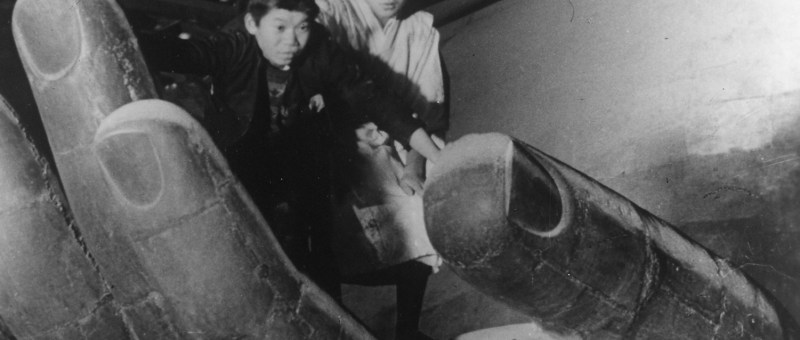
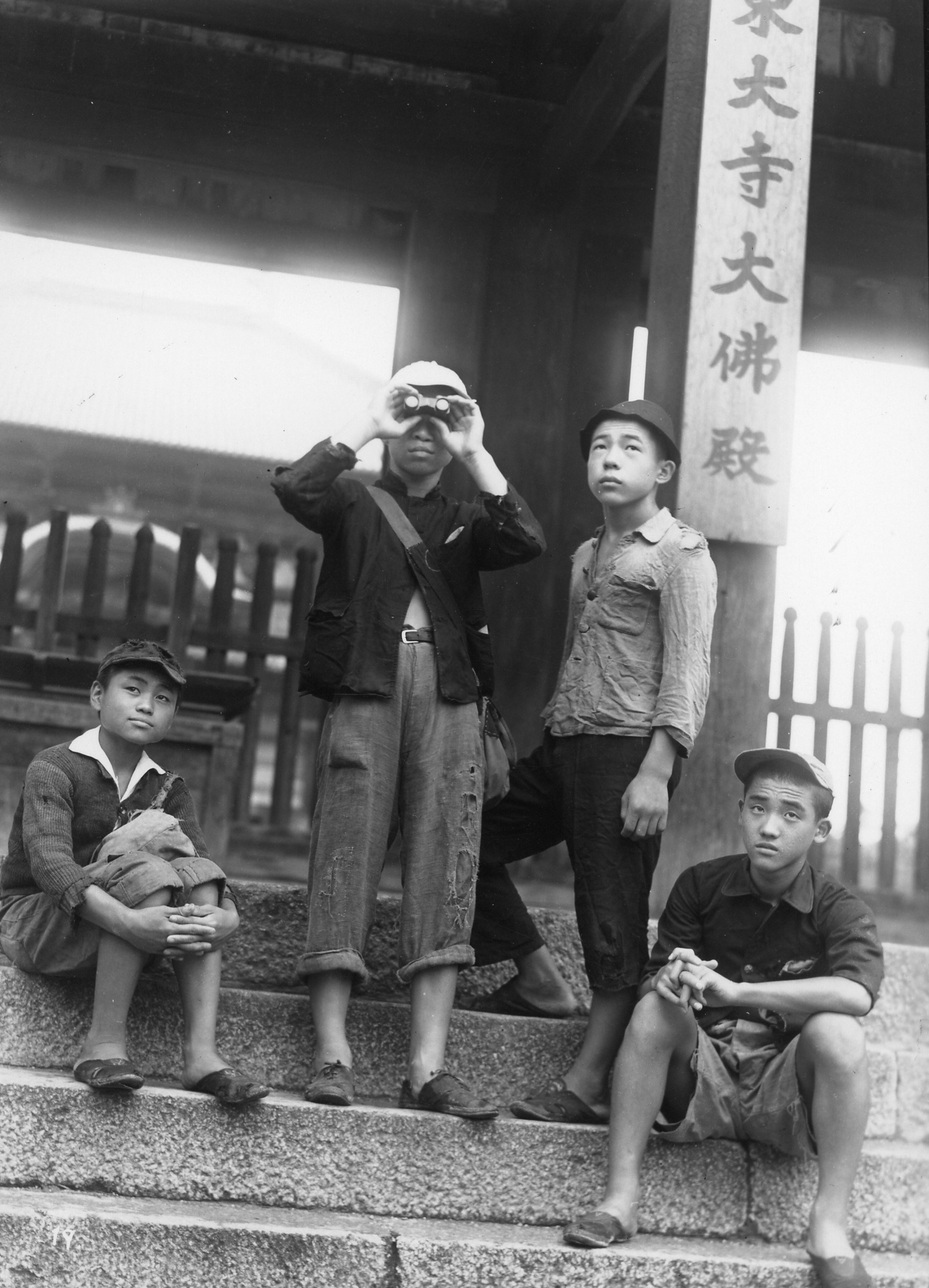
Children of the Great Buddha (大仏さまと子供たち, Hiroshi Shimizu, 1952)

Following Children of the Beehive, and Children of the Beehive What Happened Next, Hiroshi Shimizu completes the trilogy with Children of the Great Buddha (大仏さまと子供たち, Daibutsu-sama to Kodomotachi) this time taking place n Nara and focussing on war orphans who remained alone but are trying to make new lives for themselves as tour guides around the temples of the ancient capital. The existence of tour guides in itself implies a change in circumstances in a resurgent tourist industry while it’s also true that Nara is one of the few cities to have escaped the war largely unscathed and free from the destruction seen in industrial centres such as Tokyo or Osaka or that seen in Hiroshima or Nagasaki. 

There is indeed a particular contrast between the ragged children and the guests they escort who appear generally well dressed and seem to have employed them partly out of a sense of pity. The oldest of the boys, Ko, is later gifted some better clothing but doesn’t wear it explaining that he couldn’t get customers dressed like that so he’s put the nice clothes away in a box. The film never really makes it clear where the boys sleep though they can assumed be homeless or otherwise that the temples themselves are their home. Ko has been able to save up some vouchers and sent away for a pair of binoculars putting the Nio guardian statues down as the addressee. He takes his job very seriously and is slightly put out when he discovers part of his patter is inaccurate, made up by his mentor, Ichuin, who has since been adopted by a temple as a novice monk, to better entertain the customers. 

Ichiuin tells a sculptor the boys collectively refer to as “Mr Failure” that his superiors at the temple are quite upset about this new trend in tourism, that they fear people only come to admire the statues as pieces of art rather than to worship Buddha. The fact that people now have money and time for travel signals that the age of post-war privation is coming to an end though those who arrive from outside Nara also talk of destruction and a sense of displacement. A demobbed soldier remarks that it’s only in Nara that he feels he’s come “home” hinting at a concept of Japaneseness that’s survived in the ancient capital but not elsewhere. Meanwhile, Ko is charged with escorting a Japanese-American woman travelling alone in a rented car having returned to visit her grandparents’ graves. The woman, who the boys refer to as “Miss Second Generation,” treats them warmly and includes them in her picnic which itself is quite elaborate and made with rare and expensive foodstuffs. Later her purse goes “missing,” leading Ko to assume some of the other boys have taken it. He’s right, they have. But they were too frightened to spend any of the money because there was such a lot of it expressing this new idea of America as a land of plenty in contrast to Japan at the end of the Occupation.

When Ko takes the money back to her she buys him new clothes, leading the other boys to incorrectly assume she’s going to adopt him and he’ll be leaving for a better life in America. Despite the sense of solidarity that’s arisen between the orphans, they continue to long for more conventional families or at least to be adopted as Ichiuin has been by the temple. Genji, Ko’s friend, has longing for a small statue of Buddha from a local shop only to end up heartbroken on learning it’s been sold. But the woman who buys it unexpectedly offers to adopt him, aligning Genji himself with the statue and explaining that she had a son his age but he died. Genji originally seems reluctant, saying he will stay with Ko perhaps partly out of guilt but is later persuaded though Ko declares that he will always be at the temple. Caught in a kind of limbo, he religiously listens to the missing person programmes for news of his father whose whereabouts, like many even so many years after the war, are still unknown. 

This may be one reason behind the hope that the orphans of Japan could sleep in the lap of Buddha if in a more literal sense, that they maybe embraced by a more spiritual entity in a society that otherwise appears indifferent to their fate. In any case, Shimizu spends a lot of time with the statues capturing them in a documentary style as if we ourselves were receiving this tour and becoming acquainted with the picturesque environment of the ancient capital somehow free from the corruptions of the war itself or the post-war era and in its own way accepting of these orphaned children to whom it offers a home in Buddha’s palm if not quite so literally.


Children of the Great Buddha screens at Japan Society New York on 1st June as part of Hiroshi Shimizu Part 2: The Postwar and Independent Years.
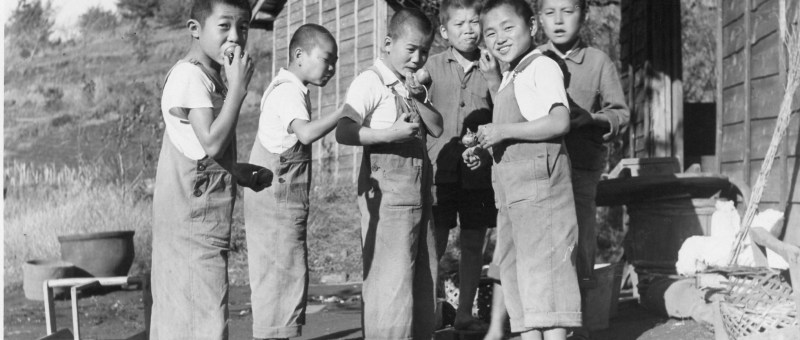
Children of the Beehive: What Happened Next (その後の蜂の巣の子供たち, Hiroshi Shimizu, 1951)

All things considered, Hiroshi Shimizu’s Children of the Beehive ended with the happiest ending it was possible to have to in the Japan of 1948 despite the tragedy that colours its final scenes. Yet for some reason, Shimizu returns three years later to ask what happened to the orphan boys afterwards having adopted several war orphans himself. What results is a strangely meta experience of documentary-style fiction focussing on the sense of community that has arisen at the Beehive. 

The excuse for this is a visit from a journalist for a magazine who wants to ask what’s happened to the boys since then. Yoshibo, who did not die, once again takes centre stage along with Shin who continues to be a leader among the boys while Ho also takes a prominent role as the facility’s cook. Echoing Introspection Tower, the key element is that the orphanage is dependent on the children’s labour which is seen as character-building and a means for them to develop a social conscience though the former soldier now looking after the kids reveals that there are no real rules, the children do as much as they want. They are given access to education through regular visits from tutors, the soldier explaining that it was awkward for the older children whose education had been interrupted to be in classes with kids much younger than them. Most of the boys are currently engaged in building a cabin to be used as a schoolroom and study base.

But the soldier also resents the journalist’s coming. In a meta touch, the journalist came because of the film and then several more kids turn up after seeing the magazine article along with one adult man who declares it’s his lifelong dream to cultivate the land while looking after orphans. A rather cynical Shin points out that’s what everybody says, while a sign on the chalkboard inside instructs the kids to ask visitors to leave politely rather than scaring them away. The soldier’s objections are easily understandable given that the magazine article also provokes the arrival of well-meaning people who want to help but generally end up creating more problems. Two young women turn up with the intention of spending their holiday helping out and get stuck in without even really asking but quickly upset the routines and rhythms that have been set up at the beehive. The soldier explains that the children value their work and enjoy it so a pair of adults doing their jobs for them isn’t helping, rather it makes them feel as if they’ve been deprived of something or haven’t been doing their work properly. The other problem with do-gooders is they obviously can’t stay longterm so there will be another period of adjustment to go through when they eventually leave. 

The presence of the two women also adds a note sexism that hadn’t been present before though this time around there are also female orphans who didn’t feature in the first film including Reiko who is Ho’s kitchen rival eventually kicking him out claiming it’s ”women’s work” with the approval of the two women. Ho later counters her by repeating the same thing but claiming that he told her what do as if trying to claim his right to superiority as a male. Meanwhile, the openness of the first film seems to have ben diluted in the unwillingness to accept newcomers given the scarcity of resources. Shin talks the others into accepting a pair of orphans who appear to have been bullying him only for them to run off with the other boys’ things leaving him feeling responsible in his decision to bring them into the group. 

In any case, the main thrust of the film is concerned with how the orphans live now and captures their cheerful industry through a series of episodes from working together to catch a racoon to being given a science lesson accompanied by a cute animated sequence of a butterfly. A strange subplot in which the mother of one of the boys long assumed to have died contacts the magazine but eventually decides against meeting her son on learning he is happy at the Beehive hints at post-war displacement and reinforces the idea that the children are completely dependent on this community and the mutual solidarity of their fellow orphans which might also in its way explain why some may later decide to leave. Shimizu’s lengthy tracking shots along with the misty rural landscape lend the Beehive an elegiac quality even while insisting that the war orphans are living happily in a kind of commune largely divorced from the chaotic and increasingly selfish post-war society. 


Children of the Beehive: What Happened Next screens at Japan Society New York on 31st May as part of Hiroshi Shimizu Part 2: The Postwar and Independent Years.

Children of the Beehive (蜂の巣の子供たち, Hiroshi Shimizu, 1948)

d0115515_1411145Hiroshi Shimizu is often remembered for his talent as a director of children, something which he brings to the fore with his melancholy meditation on the immediate post-war world in Children of the Beehive (蜂の巣の子供たち, Hachi no Su no Kodmotachi). This is a destroyed society, but one trying to make the best of things, surviving in any way possible. It’s fairly clear from Shimizu’s pre-war work that he did not entirely approve of the way his country was heading. Children of the Beehive seeks not to apportion blame, but merely to make plain that no one can get along alone here, in the post-war world there are only orphans and ruined cities but that itself is an opportunity to rebuild better and kinder than before.

The scene begins with a few street urchin kids plying their trade by pickpocketing at a railway station. A bewildered soldier lingers on the platform, uncertain of what to do next but decides not to board a train after all. Like these children, he himself is an orphan and has no real place to go back to, no family waiting to greet him. The children work for a Fagin-like street thief with one leg and no scruples who has them doing all sorts of not quite legit enterprises but after all he’s just trying to survive too. Outside, the gang run into another lady who’s been trying to get a telegram through to a distant friend but isn’t having much luck. Eventually the soldier decides to travel with the boys, leading them to the only place he has left to think of as “home”, an orphanage far out in the country.

Like many of Shimizu’s films, Children of the Beehive adopts a loose road trip format as he takes us along bumpy narrow roads and mountain passes. Occasionally we hit the cities though in a matter of fact way. Hiroshima crosses our eyes as a vista of devastation, a crater where a city used to be though this is just how it is there, no sadness or repudiation, just a resignation to the way the world now looks. The children rough and tumble their way through, quickly taking to the new “paternal” figure of the kindly soldier who, despite the obvious hardships he must have faced himself, is determined to teach them to be softer in a world which only wants to make them hard.

A poignant moment occurs when the children come across a school and one of them sits underneath an open window, wishing he could go to class like the other kids. The soldier doesn’t have much education himself but also laments that boys aren’t in school. At least one of them can read and write (to the level appropriate for his age) so presumably they received some kind of education during the war but have obviously not been receiving any tuition since being orphaned. The soldier does what he can but his lessons are generally more of the life variety as he teaches the children the importance of honest labour, working together and treating others with respect. When the children encounter another group of boys who run away from them, one boy gets upset and calls them “mean” but the soldier explains that it’s not their fault, they’re just afraid so the boys need to be extra nice to show them there’s no need to feel scared.

Similarly, when they meet other orphaned street kids who seem to be nervously hanging around, partly afraid but also wanting to make contact with a large group of other children, the soldier allows them to join the gang (so long as they’re prepared to earn their keep and work alongside everyone else). There is sadness here, and darkness lurking around the edges but Shimizu refuses to judge. The soldier accepts everyone as they are but tries to teach them by example. When the ragtag bag of displaced persons finally reaches its destination no one is left behind. Everyone is invited into this new family built out of the ruins of a defeated society.

Shimizu made good on his progressive ideals. The kids in the movie aren’t actors but actual war orphans whom Shimizu did indeed take in and educate later even going so far as to open an orphanage. Shimizu believes in the essential goodness of ordinary people and that small gestures of personal kindness elevate the world around them, provoking kindness in others and ultimately making the world a more bearable place even if they create no great social change. When the group finally arrives at the children’s home, the boys’ (and they do all seem to be boys, no word on what happens to female war orphans) voices throng like a swarm of busy bees, an apt metaphor because this is a place of intense industry where gentle flowers are pollinated with the simple power of love in the hope of growing a better, kinder society built on mutual support and acceptance.