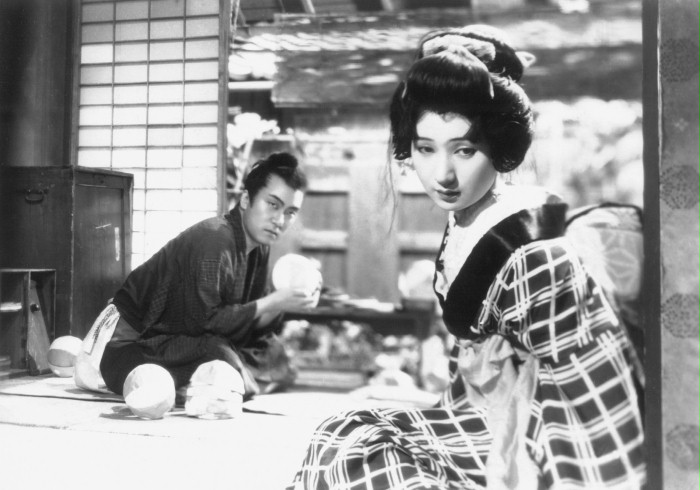
That Humanity and Paper Balloons (人情紙風船, Ninjo Kami Fusen) would turn out to be the final film of its director is just one of its cruel ironies. Sadao Yamanaka was one of the most promising young directors of the 1930s, but his career was ultimately cut short by historical circumstance as, despite his leftist views, he found himself drafted into the army and dispatched to the Manchurian front where he later died in a field hospital at only 28 years old. The film both begins and ends with suicide – an acknowledgement of the crushing hopelessness of the feudal society in which humanity itself is as fragile, transient, and often overlooked as a paper balloon. Necessarily bleak, but not absent of humour (at least of the gallows kind) Humanity and Paper Balloons neatly reframes the Edo era not as one of a glorious lost past where honourable men presided over a carefully controlled social order but one where the elites were absent, crime was rampant, and and promises were always “a series of possibilities”.
The scene opens with panic. A down on his luck samurai is dead by his own hand. So destitute was he, that he’s hanged himself – armed only with a bamboo sword he couldn’t even die in a manner befitting his social class. People are beginning to wonder if this is an “unlucky” street – this has been the third such suicide of recent times. Meanwhile, barber and upstart Shinzo has been conducting secret gambling sessions in local kingpin Yatagoro’s territory so his guys are out for blood. Neighbouring ronin Unno, whose wife manufactures the titular paper balloons, is convinced that a low level samurai who owes his status to the support of Unno’s now deceased father will help him as soon as he reads the letter his father wrote on his deathbed. Mori, however, is in no way interested and is currently in negotiations to “adopt” the daughter of a local merchant so she can be married to a noble samurai who otherwise would lose face in marrying down. Said daughter, Omoka, is not happy about this arrangement as she is in love with her father’s clerk, Chushichi. When Shinzo decides to kidnap Omoka, getting Unno involved by hiding her at his house, a series of unfortunate consequences ensue.
The world of the jidaigeki is often an idealised one. Centring on the higher echelons, they paint a picture of noble warriors bravely standing up for honour and justice whilst displaying fearsome loyalty to their feudal lords. This is no such idyll – this is a slum where the social classes mingle freely but with invisible barriers still dividing one from the other. The samurai were already in decline and so it was not unusual for the men who grew up in rarified halls to suddenly find themselves cast down into the lower orders without the means to support themselves. The former samurai who hangs himself at the beginning has had enough, evidently, having sold even his sword he finds himself unable to go on.
Unno is in a similarly desperate situation, reliant on the pittance his wife earns making the paper balloons. He still thinks Mori will obey ancient social codes and repay his father’s kindness by supporting him, but Mori has no use for him now and no inclination to follow the ideals of honour which underpin the samurai word. Unno is experiencing a rude awakening to Edo era hypocrisy. In making a rash decision to go along with Shinzo’s scheme, he damns himself in every conceivable way – by dishonouring himself as a samurai, by indulging in illegality, and in merely being a party to someone’s else’s underhanded scheme. “Samurai are wicked these days” say some of the neighbourhood women, not noticing Unno’s wife is just returning from a few days away, unaware of what her husband has been up to in her absence.
The verdict on the samurai class is damning. Honourable men without honour, they use and misuse each other but are entirely unwilling to help out even one of their own fallen on hard times. Yet men like Unno are also victims of their class, suddenly ejected from a life of comfort but with no skills to survive in world of “normal” people. Single men can become wandering ronin, drinking, fighting and whoring their way through life but married, mild mannered men like Unno are left with nothing to live on but resentment.
Yamanaka’s final feature is once again far ahead of its time more resembling the films of twenty years later than those of the mid 1930s. Aiming for a highly detailed approach closer to naturalism than the general trend of the time, Yamanka paints a vivd picture of a claustrophobic world, alive with the struggle of those desperately clawing over each other in order to survive while the landlords enjoy a life of ease in vast mansions surrounded by peace, quiet and open air. Pointedly a comment on the present more than the past, Yamanaka is getting away with much more than you would think possible in the highly pressured world of 1937 following the previous year’s failure of a complex military coup seeking to return power to the emperor in the hopes of a return to feudal style paternalistic socialism. Humanity here is a paper balloon – cheap, fragile, and often unnoticed. That it exists at all is something to be thankful for, but like a paper balloon, humanity requires careful construction and committed maintenance. The plea to the people of 1937 was clear but it is often hard to recognise the importance of so commonplace an object let alone ensure its survival.
Unsubbed clip:
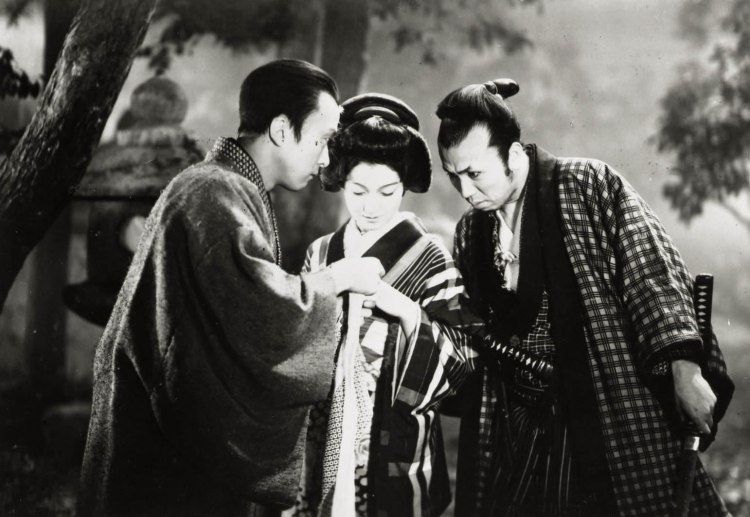 The second of the only three extant films directed by Sadao Yamanaka in his intense yet brief career, Kochiyama Soshun (河内山宗俊, oddly retitled “Preist of Darkness” in its English language release) is not as obviously comic or as desperately bleak as the other two but falls somewhere in between with its meandering tale of a stolen (ceremonial) knife which precedes to carve a deep wound into the lives of everyone connected with it. Once again taking place within the realm of the jidaigeki, Kochiyama Soshun focuses more tightly on the lives of the dispossessed, downtrodden, and criminal who invoke their own downfall by attempting to repurpose and misuse the samurai’s symbol of his power, only to find it hollow and void of protection.
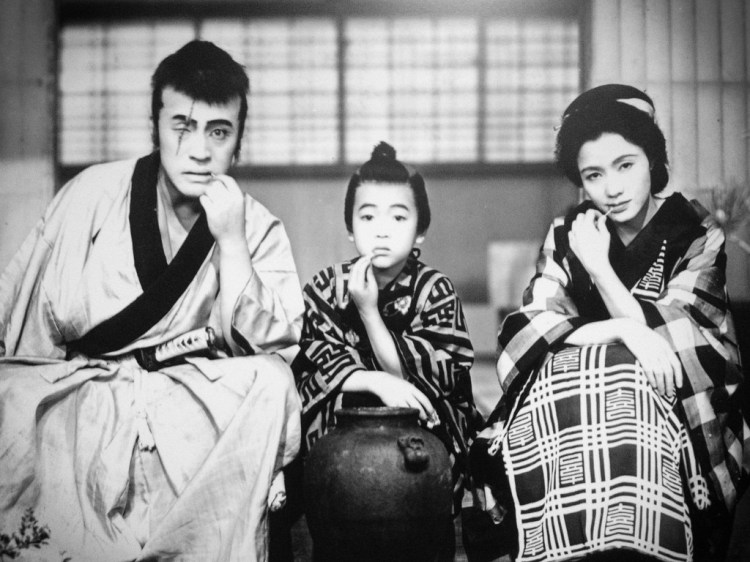 Sadao Yamanaka had a meteoric rise in the film industry completing 26 films between 1932 and 1938 after joining the Makino company at only 20 years old. Alongside such masters to be as Ozu, Naruse, and Mizoguchi, Yamanaka became one of the shining lights of the early Japanese cinematic world. Unfortunately, this light went out when Yamanaka was drafted into the army and sent on the Manchurian campaign where he unfortunately died in a field hospital at only 28 years old. Despite the vast respect of his peers, only three of Yamanaka’s 26 films have survived. Tange Sazen: The Million Ryo Pot (丹下左膳余話 百萬両の壺, Tange Sazen Yowa: Hyakuman Ryo no Tsubo) is the earliest of these and though a light hearted effort displays his trademark down to earth humanity.
 Windows on Worlds