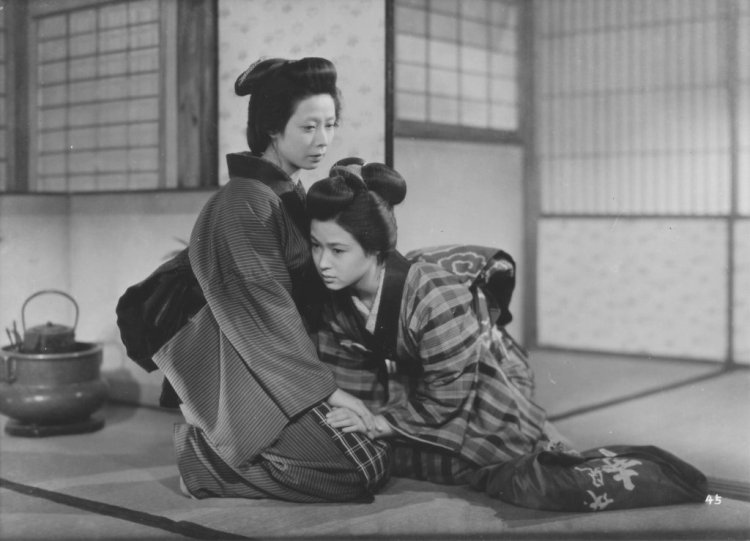
 History marches on, and humanity keeps pace with it. Life on the periphery is no less important than at the centre, but those on the edges are often eclipsed when “great” men and women come along. So it is for the long suffering Tose (Chikage Awashima), the put upon heroine of Heinosuke Gosho’s jidaigeki The Fireflies (螢火, Hotarubi). An inn keeper in the turbulent period marking the end of the Tokugawa shogunate and with it centuries of self imposed isolation, Tose is just one of the ordinary people living through extraordinary times but unlike most her independent spirit sparks brightly even through her continuing strife.
Beginning in the “present” – the late 1860s, Tose is the de facto manager of Teradaya, a successful inn in Kyoto. Japanese history buffs will instantly recognise the name of the establishment, as well as that of Tose’s 18 year old adopted daughter, Oryo (Ayako Wakao). Nevertheless, that story can wait as we flashback with Tose as she gazes blankly at a stretch of water, remembering the time she first came to Teradaya as a young bride. The daughter of peasant farmers, Tose was not welcomed by her mother-in-law, Sada, both because of the class differences, and because the man she’s married is not Sada’s son but that of a concubine and she would prefer her biological daughter, Sugi, to inherit. Tose’s husband Isuke, though by no means unpleasant towards her, is a feckless man obsessed with cleaning and singing folk songs, leaving the bulk of the work to his wife.
Tose bears all, taking on the running of Teradaya and making it the most popular inn in town thanks to her friendliness, efficiency, and discretion. However, her position is threatened when she is almost ruined by a bizarre scam involving dummies and ventriloquism. Vindicated, Tose’s position is strengthened but there is more trouble in store when Sugi runs off with the conman leaving her infant illegitimate daughter in Tose’s care. Becoming a mother as she’s always wanted, Tose begins to find a little more fulfilment in her life only to have her dreams cruelly dashed once again. In an act of kindness she later adopts another orphaned girl, Oryo, who arrives at the inn starving and in the care of an older man who’d been looking after her since her doctor father was murdered for supposedly collaborating with the rebel ronin trying to over throw the shogunate.
This is the first mention of the ongoing political instability present in the country at large but largely unseen in the peaceful world of a small inn in Kyoto. Of course, you can’t say Teradaya and Oryo without eventually saying Sakamoto Ryoma (Miki Mori). Ryoma does eventually arrive in all his revolutionary glory albeit in an appropriately humanised form and proceeds to turn Tose’s life upside down in more ways than one. Locked into her loveless, but far from cruel, marriage Tose’s spirited nature is reignited by Ryoma’s fervour. Falling in love with him for his commitment to creating a better world for all, Tose’s dreams drift a little but are dashed again when she realises he and Oryo are the more natural pair.
Though Tose reacts badly to the discovery that Oryo is also in love with Ryoma, she is later able to patch things up, entrusting the man she loves to her daughter in an act of maternal sacrifice. Tose talks about her admiration for those who sacrifice all of themselves for other people but this is exactly what she has done with her own life, only in a much quieter way. Where Ryoma was a father to a movement, Tose is a mother to the world. Denied a child of her own through her husband’s indifference, Tose first adopts her niece and then an orphaned girl but consistently acts in the best interests of others rather than herself. Hearing the cries of betrayed revolutionaries, she describes them as sounding like howling babies – an idea she repeats several times including when describing Oryo’s famous naked dash from the bath to warn Ryoma of the impending arrival of the Shinsengumi. Tose’s only instinct is to silence those cries through maternal warmth, even if it ultimately causes her pain.
Tose, for Gosho at least, is no less a heroic figure than Ryoma as her everyday acts of kindness and strength contribute to an ongoing social change. Where other inn owners turn in the rebels either for material gain, active opposition, or desire to avoid the hassle, Tose stands firm and allows Teradaya to become known as a safe haven for the revolutionary movement. Ryoma shone brighter but for a short time, whereas Tose’s life goes on and Teradaya continues to be the favourite stop for beleaguered travellers passing through the old capital in these difficult times. Reconciling with her husband who finally offers the possibility of having a child of their own to inherit the inn, there is a glimmer of hope for Tose once again even if it’s clear that Isuke hasn’t really changed. It may seem that Tose’s firefly has blinked out as she takes her dull and self centred husband back, vowing to spend less time on the inn as she does so, but there is a glint of light in her few final words which are followed by putting her apron straight back on to meet the first boat, shouting the virtues of her beloved Teradaya all the way.
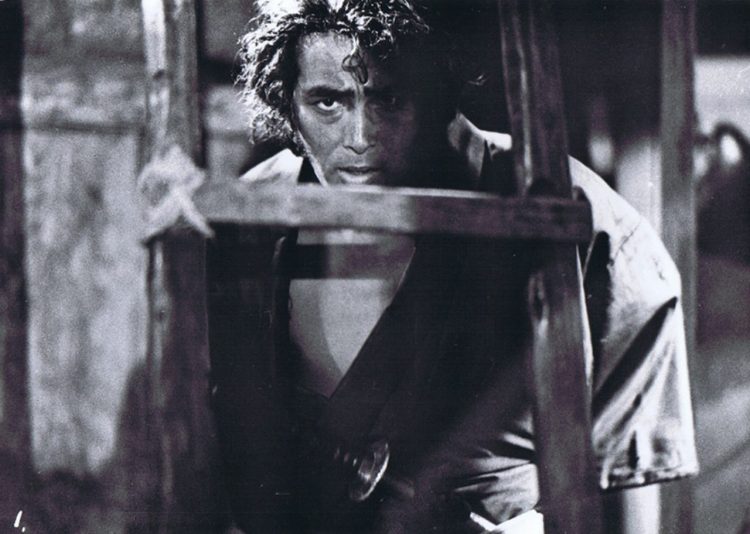 Sakamoto Ryoma is a legendary revolutionary of Japan’s Bakumatsu period which encompasses the chaos that ensued after Japan was forced open after centuries of self imposed isolation. Ryoma was a low level samurai from a small town who resented the unjust treated of the arrogant true samurai above him and skipped out on his clan without the proper permission to go study sword fighting in the city. After the arrival of the Americans and witnessing their far superior technologies, Ryoma was one of several men who became convinced that Japan needed to modernise quickly or become a slave to more advanced cultures. However, this was a turbulent era and there was general infighting among all factions and all sides and Ryoma was mysteriously assassinated in 1867 along with his friend and ally Nakaoka Shintaro.
 Windows on Worlds