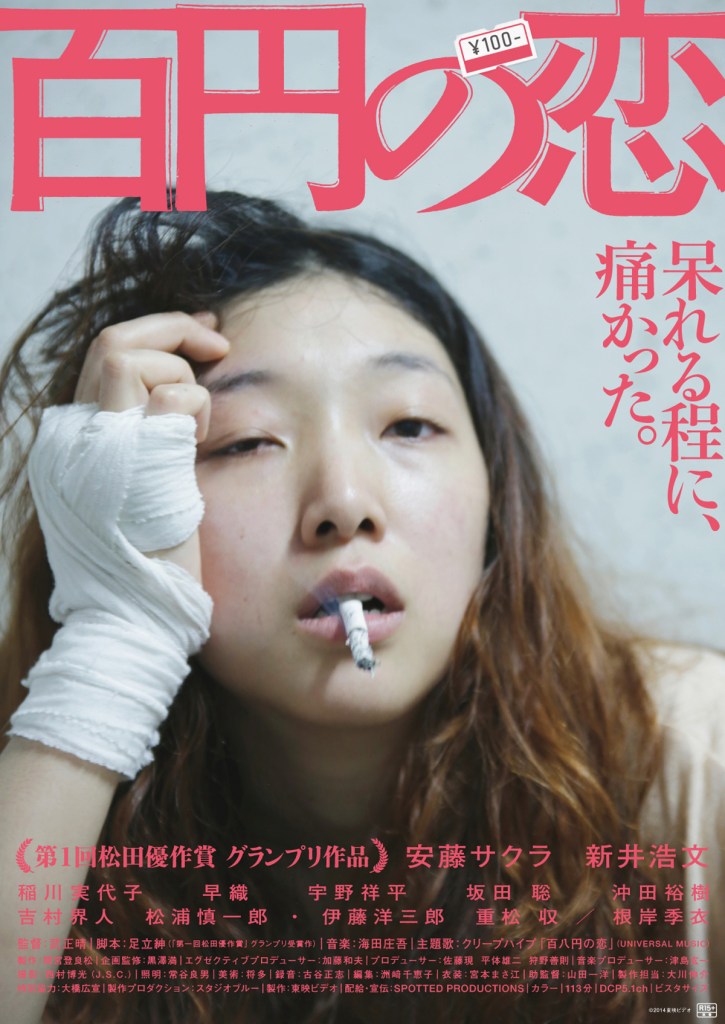
100 Yen Love (百円の恋, Masaharu Take, 2014)

165856_02Actress of the moment Sakura Ando steps into the ring, literally, for this tale of plucky underdog beating the odds in unexpected ways. It would be wrong to call 100 Yen Love (百円の恋, Hyaku Yen no Koi) a “boxing movie”, it’s more than half way through the film before the protagonist decides to embark on the surprising career herself and though there are the training sequences and match based set pieces they aren’t the focus of the film. Rather, the plucky underdog comes to the fore as we watch the virtual hikkikomori slacker Ichiko eventually become a force to be reckoned with both in the ring and out.

Ichiko Saito is a 32-year-old woman with no job who still lives at home in her parents’ bento store where she also refuses to help out. With unkempt hair, slobbish pyjamas and a bad attitude, she stays in all day playing video games with her nephew other than running out to the 100 yen store late at night for more cheap and nasty snacks. Her sister has recently moved home after a divorce and to put it plainly, the two do not get on. Finally the mother decides the sister is the one most in need and more or less throws Ichiko out onto the streets. She gets herself a little apartment and a job in the 100 yen store where she’s perved over by a sleazy colleague and amused by a crazy old lady who turns up each night to help herself to the leftover bento.

Ichiko also becomes enamoured with a frequent customer who they nickname “Banana Man” because he just comes in, buys a ridiculous number of bananas, and leaves without saying anything. He’s even more awkward than Ichiko though he seems to kind of like her too. Banana Man is an amateur boxer and eventually ends up staying in Ichiko’s apartment following a rather complicated chain of events. When this too goes wrong, Ichiko decides to try her hand at boxing herself, hoping to make the next set of matches before she passes the age threshold.

We aren’t really given much of a back story for Ichiko, other than that her polar opposite sister thinks she’s too much like their father who also seems to be a mildly depressed slacker only now in early old age. Her mother is at the end of her tether and her sister probably just has problems of her own but at any rate does not come across as a particularly sensitive or sympathetic person. Getting kicked out at this late stage might actually be the best thing for Ichiko though it’s undoubtedly a big adjustment with her family offering nothing more than possible financial support.

Working in the 100 yen store isn’t so bad but it doesn’t really suit Ichiko with her isolated shyness and lack of work experience. Mind you, it seems like it doesn’t suit anyone very well as her manager quits right away and her only co-worker is a lecherous criminal who literally will not stop talking or take no for an answer. Ichiko’s only real relationship is with Banana Man but even this is strange with Ichiko becoming infatuated and coming on too strong for the rather immature amateur boxer who’s just hit the end of his career. If Ichiko is going to get anywhere she’ll have to do it on her own and on her own terms, no one is going to help her or be on hand to offer any kind of life advice.

That is, until she starts boxing where she gets some coaching, if only inside the ring. The gloves give her a purpose, in getting to a real match before the age limit passes (it’s 32 and she is already 32) she finally has something concrete to work towards and strive for. She just wants to win, once, after all the awful and humiliating things that have happened to her, she just wants to hit back. Even if she falls at the final hurdle, these seemingly small elements have caused a sea change within her. No longer holed up at home, too fearful to engage with anything or anyone, Ichiko has her self respect back and can truly stand on her own two feet.

Indeed, the film might well be called sympathy for the loser – what attracts Ichiko to the sport to begin with is the mini shoulder hug at the end between the victorious and the defeated. With the idea that it’s OK to lose, there are no hard feelings between athletes and even a mutual respect for those who’ve done their best even if they didn’t quite make it, this moment of catharsis seems to give Ichiko the connection she’s been craving. However, the film’s ending is a little more ambiguous and where this rapid transformation of the “100 yen kind of girl” might take her may be harder to chart.


100 Yen Love is Japan’s submission for the 2016 Academy Awards.

Asleep (白河夜船, Shingo Wakagi, 2015)

asleep posterBased on the third of three short stories in Banana Yoshimoto’s novel of the same name, Asleep (白河夜船, Shirakawayofune) is an apt name for this tale of grief and listlessness. Starring actress of the moment Sakura Ando, the film proves that little has changed since the release of the book in 1989 when it comes to young lives disrupted by a traumatic event. Slow and meandering, Asleep’s gentle pace may frustrate some but its melancholic poetry is sure to leave its mark.
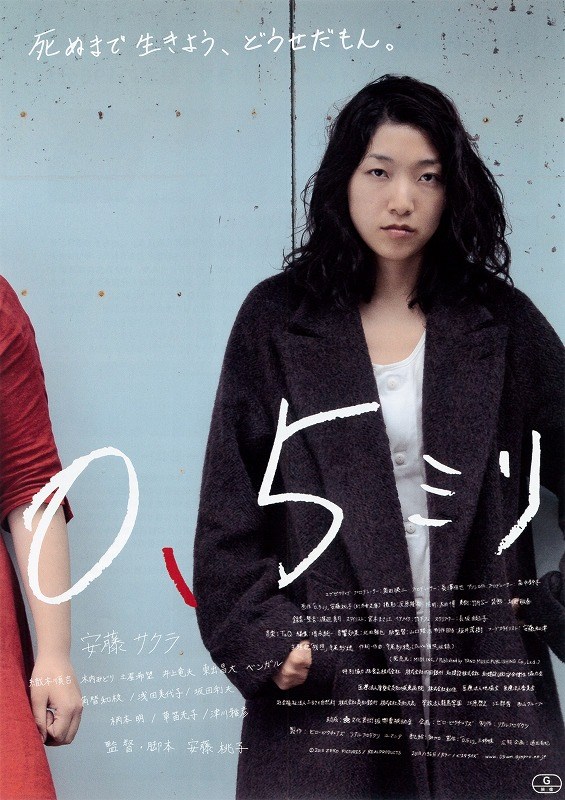
Terako (Sakura Ando) is a young woman who sleeps a lot. Almost all the time, in fact. The kept woman of a married man whose wife, oddly enough, is in a coma following a traffic accident, Terako has been in a kind of limbo since her former roommate and good friend committed suicide by taking an overdose of sleeping pills. Prior to her death, Shiori had taken up an unusual occupation – she lies next to lonely strangers who just want to know that someone is watching over them while they sleep and will be there when they awake. This also meant that she rarely had the opportunity to sleep herself as her occupation demanded keeping a watchful eye over her charges and falling asleep on the job seemed like a lapse of professionalism.

Mr. Iwanaga, Terako’s boyfriend, is an enabler of the first order. He prefers that Terako not work so that she’s available for him whenever he feels the need to call meaning that she’s always at home, sleeping. She sleeps and sleeps but finds no relief from her exhaustion. Even her dates with Iwanaga feel “like the shadow of a dream”. The constant flashbacks and meandering timelines perfectly reflect someone trying to think through the distorted reality of fractured sleep where the boundaries between dream and reality have become impossibly blurred.

There’s an odd sort of triumvirate of sleeping women here – Terako herself who does little but sleep but is still constantly exhausted, Shiori who denied herself sleep until ultimately deciding to take enough sleeping pills to go to sleep forever and Iwanaga’s wife who’s trapped in coma. At one point, in a conversation which either happened some time ago or not at all, Shiori remarks that Iwanaga has Terako “on pause” because he’s afraid to move on from his wife (the fact of his having an affair while his wife is lying in a hospital bed even has Terako labelling him a cold, unfeeling man but then she says she likes that kind of thing anyway). It’s as if she’s waiting for someone to hit the spacebar to wake her up again, though Iwanaga is “on pause” too – torn between the choice of abandoning his wife who will likely never wake up and being labeled heartless, or sacrificing the rest of his life in devotion to a memory.

Help does come, in a way, through the intervention of a either a dream or a kind of cosmic transference – an impossible conversation between two women equally in need of it. Shingo Wakagi’s adaptation is more interested in psychology and existential questioning than it is in hard realities or concrete solutions. A vignette of a moment in a young woman’s life, Asleep gives us little in the way of backstory or explanatory epiphanies, and finally ends in the characteristically ambiguous way many Japanese novellas often do though there is a hint at a possible shift in Terako’s life offered by the final images. A poetic meditation on dream, memory, grief and loneliness, Asleep is beautifully framed, if appropriately distant, look at modern life in limbo.


Reviewed at Raindance 2015

First Published on UK Anime Network in 2015.

0.5mm (Momoko Ando, 2014)

0.5mm-poster-20.5mm is only Momoko Ando’s second film following on from her lesbian love story manga adaptation, Kakera: A Piece of Our Life. Starring her real life sister Sakura Ando in the lead role, 0.5mm is undeniably more complex and epic in scope than her previous film but retains some of its whimsical atmosphere and benign objectivity. Encompassing such disparate themes as Japan’s rapidly ageing population, entrenched sexism, archaic ideas about gender, and what it’s like to find yourself at the bottom of the heap thanks to a series of unfortunate incidents, 0.5mm is a hugely impressive sophomore effort from Ando and one of the best Japanese indie movies for quite some time.

Sawa is a home care nurse and her current assignment is caring for an elderly, bedridden gentleman who lives with his daughter and grandson. One day, the old man’s daughter makes an extremely odd and inappropriate request of Sawa which she eventually agrees to. However, things go just about as wrong as they could possibly go and Sawa finds herself out of a job and, as she lived in nurse’s accommodation, out of a home too. That’s not the end of her troubles as she manages to leave her coat, in the pocket of which is an envelope containing her life savings, on a train. At this point she’s pretty much down and out when she notices an elderly gentlemen confusedly trying to find out if it’s OK to sleep all night at a 24 hour karaoke box. Pretending to be the old man’s date she hires a room for two and bamboozles him into it for a night of singing and snoozing. In the morning it turns out the old man quite enjoyed the mad adventure as he’s temporarily run away from home because all his son seemed to care about was the inheritance so he thought he might as well spend it all himself. This strange encounter begins Sawa’s odyssey into a series of similar episodes where she blackmails an elderly gentleman into letting her stay with him for a while until one final meeting brings things full circle.

Sawa is definitely a very unusual woman. Good at her job, she’s a caring person in more ways than one. Her new found method of survival is certainly a novel one, and not entirely ethical, but then all she’s doing is exploiting circumstances in the same way circumstances have had a way of exploiting her. Though she weaselled her way into these men’s lives, she did, at least, care for them. Yes, she did the cooking and the cleaning and assisted with healthcare too but she also helped them to realise a few things about themselves and move on with their lives. Whether it’s saving them from yakuza backed pyramid scams or listening to their traumatic memories of the war, Sawa has a knack for seeing people’s hidden pain and another for knowing how to make it better.

Yet, her various encounters with the older generation speak of a number of different social problems that cannot be repaired by one person alone. The first man she meets feels unwanted by his family and is looking for escape, a reassertion of his independence and perhaps a little revenge. The second is really quite mad – obsessively counting the trees in the park, stealing bicycles and letting people’s tires down but he too is alone with no one looking after him. The third man has a bedridden wife and, apparently, a taste for erotic school girl magazines but no children of his own to take care of him. The fourth man discovered a teenage child he’d never met though is incapable of forming a relationship with him. Society is full of lonely, elderly people who either have no close family or have become estranged from them. Some of them have become vulnerable and half mad through extreme isolation and others have become embittered, violent or trapped in the past.

In the way that these men react to Sawa there’s also a complex system of ideas at play as each of Sawa’s employers seem incapable of defining exactly what sort of “services” they expect of her. Nurse, housekeeper, mother, courtesan? From the original, perhaps innocent though far from appropriate, request each of the men Sawa encounters can’t help but view her as a some kind of sex object and react with various degrees of embarrassment about it. To them she is many things though never quite a “person” until, perhaps, their relationship begins to near its end and each reaches some kind of epiphany brought about by her presence. However, Sawa herself is perfectly aware of each of these complexities and perfectly willing to exploit them with a sort of amused ruefulness.

The 0.5mm of the title refers to a metaphor offered on a farewell cassette tape from the second of Sawa’s old gentlemen that one person may be only be able to move a mountain by 0.5mm but if everyone got together the mountain would move and you could start a revolution. At once he bemoans Japan’s military past but also laments that something of the community spirit from those days has been lost. That if we all just stopped living in wilful isolation and embraced the fact that we’re all here together at the same time we could make things better for everyone. Much of the film is about the distance between people – young/old, male/female it isn’t the distinction that matters but the series of invisible walls that exist to keep people apart.

Warm, enigmatic and surprisingly funny (if in a kind of dark way) 0.5mm is is a complex and thought provoking film that is also often very beautiful and immensely enjoyable. At 196 minutes, it’s undeniably a long film with an episodic structure though it largely manages to sustain its lengthy running time without outstaying its welcome. Rich and strange, 0.5mm is all the better for its unresolved mysteries and offers an impressively nuanced cross section of modern society made all the more detailed thanks to its epic scope.