Saga Saga (緑のざわめき-Saga Saga-, Aimi Natsuto, 2023)

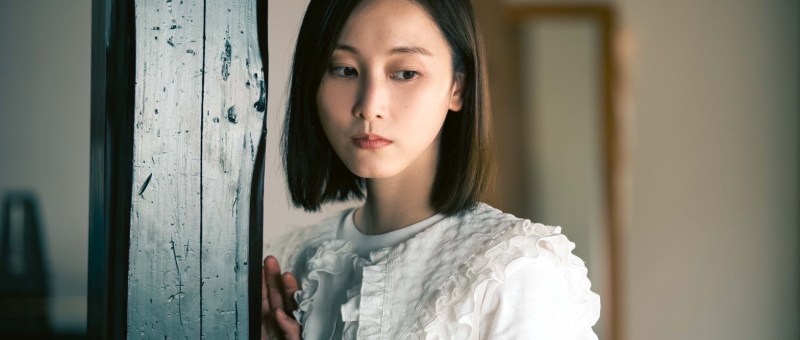
Three women contending with a legacy of patriarchal failure and male violence circle around each other in the picturesque hot springs resort of Ureshino in Aimi Natsuto’s etherial drama, Saga Saga (緑のざわめき, Midori no Zawameki – Saga Saga –). Less playful than Natsuto’s previous film Jeux de plage, the oscillating action takes on a poetic, mystical direction as the forces which bind the three women together eventually become clear while each in their own way tries to overcome a lingering sense of displacement and loneliness. 

The first of them, Kyoko (Rena Matsui), left Ureshino to become an actress in Tokyo but has given up performing and resettled in nearby Fukuoka where she runs into an old hometown boyfriend, Sotaro, who is currently sort of dating Eri, a woman he met on a dating app. Despite telling Kyoko he can’t stay long after reconnecting because he has a date with someone who is “not quite” his girlfriend, Sotaro ends up going to a love hotel with another woman, Naoko (Sae Okazaki), who frequents the bookstore where he works. Though it originally appears that Naoko is jealous of Kyoko and fears she’s missed her chance with Sotaro, we soon realise that she is in fact semi-stalking her for unclear reasons but actually wants to get in touch with someone else and eventually forms a telephone connection with Anna (Sara Kurashima), a high school girl currently living in Ureshino with her aunt, Fumiko (Asuka Kurosawa). 

In a way, they are all looking for something that seems to be missing in their lives. For Kyoko it seems to be something like the concept of home as she struggles with a series of sudden changes from the death of her mother two years previously to a brush with cancer in the form of an ovarian tumour she has recently had removed. Fumiko, who was a friend of her mother’s, tells her that she’s on a journey of self-reconciliation and there is indeed something in that as she works over the mysteries of her past while looking for new directions in her future. 

Meanwhile, she is plagued by strange dreams of being lost in a forest later telling a friend that she was once sexually assaulted in the woods when she was in high school and has the feeling the person who is chasing in her in her dream may be her father who left the family when she was a child. When she was receiving treatment for the tumour on her ovary, she began to ask herself why she had been born a woman forever subject to threat and patriarchal oppression. On her return to Fukuoka, she undergoes a very strange job interview in which she’s repeatedly assured that “being a woman” she won’t be asked to do anything “difficult” while it seems that being “attractive” is enough to get by in the beginning. Also they warn her that they don’t offer “great maternity leave or anything like that”. 

The lives of each of the women have been in one way or another overshadowed by male violence, but it’s Anna’s would-be-boyfriend Toru who is eventually victimised when he’s assaulted by a woman who wanted to bring back a problematic local festival cancelled because of a sexual assault. Toru had been in the forest to consult with some kind of mystic man trying to get him to conduct a ritual to get Anna to like him only to be told it doesn’t really work like that and you wouldn’t want it to anyway. After the assault it’s Toru’s life which spirals out of control when he’s blackmailed into acts of petty crime by the witch-like woman who forced herself on him, while Fumiko too is later forced to pay the price for having kept her secrets and for compassionate reasons attempted to hide the truth from those who most wanted to know.

Finally brought together on solving their individual mysteries, the three women settle on creating a home they can each return to, anchoring themselves as a family as a means of finding stability in a world which is so often in flux in defiance of the destructive forces which connect them. Even Eri admits that in reality she may have been looking for self-affirmation in her desire to find a dating app soulmate as her friends reflect on their terrible romantic experiences which, ironically, include being stalked. In the depths of its mysticism and eeriness, the film nevertheless ends on a note of serenity and the promise of moving forward if paradoxically by making a return. 


Saga Saga screened as part of this year’s JAPAN CUTS.

Original trailer (no subtitles)
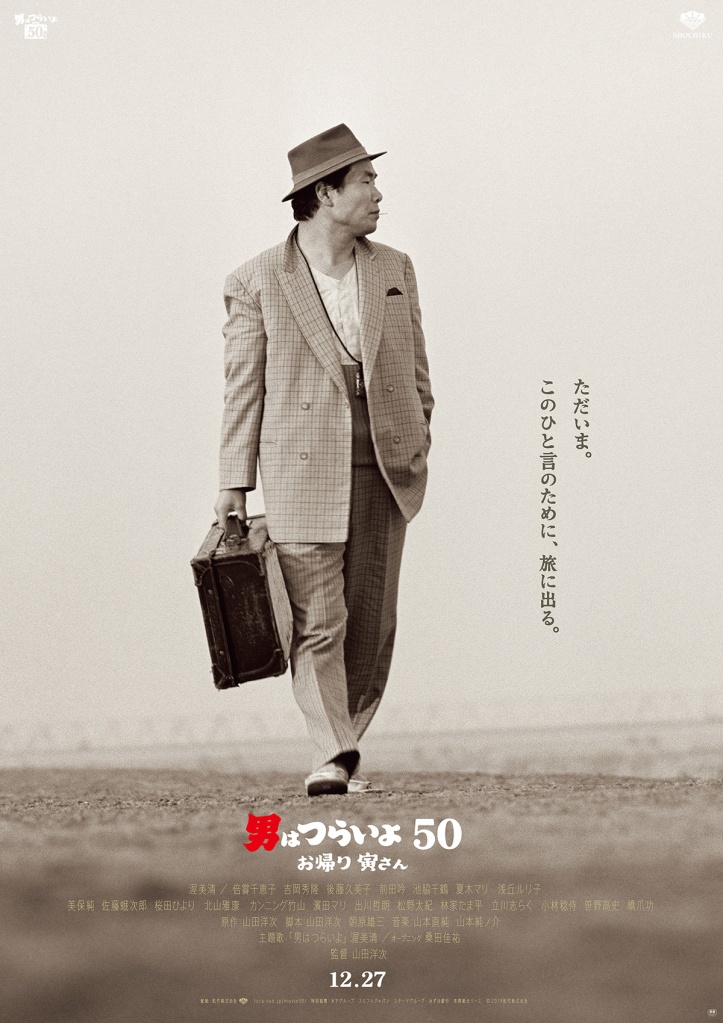
Tora-san, Wish You Were Here (男はつらいよ50 – お帰り 寅さん, Yoji Yamada, 2019)

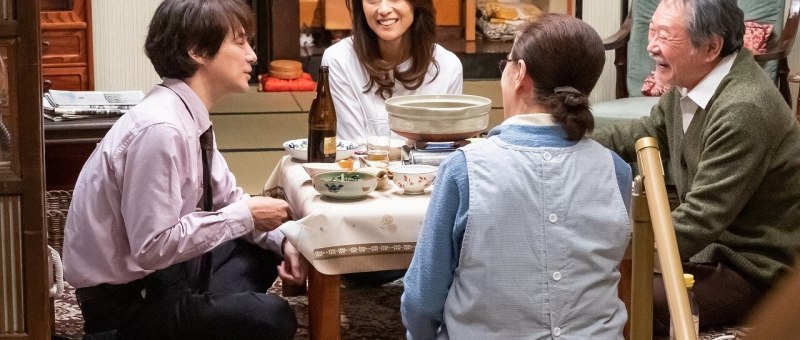
From 1969 to 1996, travelling salesman Tora-san appeared in 48 films, a 49th movie special appearing after star Kiyoshi Atsumi’s death brought an unavoidable end to the series. Tora-san, Wish You Were Here (男はつらいよ50 – お帰り 寅さん, Otoko wa Ysurai yo 50: Okaeri Tora-san) arrives to mark the 50th anniversary of the first film’s release, and as the series had done in its later stages, revolves around Tora’s neurotic nephew, Mitsuo (Hidetaka Yoshioka), who is now a middle-aged widower and father to a teenage daughter. Feeling somewhat wistful, Mitsuo’s thoughts turn to his now absent uncle, wishing he were still around to offer some of his trademark advice along with the gentle warmth and empathy which proved in such stark contrast with his otherwise anarchic and unpredictable personality.  

Yamada, who directed all but two of the series in its entirety, opens with another dream sequence this time of Mitsuo as he finds himself overcome with memories of his first love, Izumi (Kumiko Goto), who is now married with children and living abroad working for the UNCHR. Mitsuo’s wife passed away from an illness six years previously and he’s so far resisted prompts from his relatives to consider remarriage though it seems fairly obvious that his editor, Setsuko (Chizuru Ikewaki), has a bit of a crush on him. Having taken a gamble giving up the secure life of a salaryman to become a novelist, Mitsuo’s first book is about to be published and it’s at a signing that he serendipitously re-encounters Izumi who just happened to be in the store that day on a rare trip to Japan and spotted the poster. 

Like many Tora-san films, Wish You Were Here is about the bittersweet qualities of life, the roads not taken, the misdirections and misconnections, and the romanticisation of a past which can no longer be present. At a crossroads, Mitsuo ponders what might have been recalling the shattered dreams of his first love which seems to have ended without resolution because of the unfairness of life. He wishes that his crazy uncle was still around to make everything better, offering more of his often poetic advice but most of all a shoulder to cry on as he’d been for so many women throughout the series. But Mitsuo himself has always been more like Tora than he’d care to admit, if tempered by his father Hiroshi’s shyness. He too is a kind man whose bighearted gestures could sometimes cause unexpected trouble. What he’s learning is in a sense to find his inner Tora, embracing his free spirit through his art if not the road, but also coming to a poetic understanding that sometimes the moment passes and there’s nothing you can do to take it back, only treasure the memory as you continue moving forward. 

That’s a sentiment echoed by Lily (Ruriko Asaoka), one of Tora’s old flames, who now runs a stylish bar in Tokyo. The beauty of the Tora-san series was that it aged in real time. The actor playing Mitsuo played him as a child and we saw him grow up on screen just as we saw Shibamata change from post-war scrappiness to bubble-era prosperity and beyond. The family’s dango-shop has had an upscale refit and there is now a modern apartment complex behind it where the print shop once stood. Seamlessly splicing in clips from previous instalments as Mitsuo remembers another anecdote about his uncle, Yamada shows us how past and present co-exist in the way memory hangs over a landscape. Once or twice, the ghost of Tora even reappears hovering gently behind Mitsuo only to fade when he turns around to look while there’s an unavoidable sadness as we notice the Suwas’ living room is now much less full than it once was. 

Aside from his uncle, it’s the warm family atmosphere that Mitsuo recalls from his childhood, something which, like Tora, he might not have always fully appreciated. Driving Izumi to a potentially difficult reunion with her terminally ill estranged father (Isao Hashizume), he refers to his own parents as “annoying” in the “pushy” quality of their kindness, something which irritates Izumi who points out that she’d have loved to have such a warm and supportive family and if she had she might never have gone to Europe, implying perhaps that their fated romance would been fulfilled. The Shibamata house was Tora’s port, he could wander freely because he had somewhere to go back to where they’d always let him in no matter what kind of trouble he caused.

A fitting tribute to the Tora-san legacy, Wish You Were Here is also a joyful celebration of the Shitamachi spirit. Tora might be gone, but the anarchic kindness and empathy he embodied lives on, not least in the mild-mannered Mitsuo and his cheerful daughter who seems to be continuing the family tradition of meddling in her loved ones’ love lives as her lovelorn father prepares to move on in memory of Tora, the free spirited fool.


Tora-san, Wish You Were Here streamed as part of this year’s Japan Cuts.

International trailer (English subtitles)