In Her Room (ひとりぼっちじゃない, Chihiro Ito, 2022)

The hero of Chihiro Ito’s debut feature In Her Room ( ひとりぼっちじゃない, Hitori Bocchi ja nai) is so pathologically shy that he has become almost invisible, a ghost-like presence not fully of this world. Colleagues ignore him, taxis never stop, and restaurant staff continue their conversations as if he wasn’t even there. At one point he’s run over by a car and tells the police that the person probably didn’t see him or realise they’d hit someone. Only a mysterious woman he later describes as showing him a side of himself that even to him was unfamiliar pays him any attention but then there’s something a little bit sinister in her otherworldliness that causes us to wonder what it is she wants from him. 

Dr. Susume (Satoru Iguchi) is so awkward that he’s taken to practicing small talk with the skull he uses as a training tool at the dentist surgery where he works. He seems almost abstracted from himself, unable to relate to others because his emotions are distant from him. His mother keeps calling and asking him to come visit her because there’s something she wants to talk to him about but he brushes her off, telling her she should do whatever she likes as if disinterested in whatever it might be that she wants to say. In fact, she is the only person who seems to be able to see him, calling out to him from a car to offer him some homemade bread, but he still doesn’t really engage with her. We start to wonder if he has a problem with the other person in the car, Tomoko, a middle-aged woman who may be his mother’s partner though she too greets him warmly and is understanding of his reluctance to spend time with them.

Miyako (Fumika Baba), the mysterious woman who lives in a fantastic flat entirely covered in indoor greenery, asks Susume if he loves his mother but he deflects her question and simply says that he wants her to be happy for the rest of her life. For a time, we can’t be sure if Miyako and her wonderful apartment actually exist or are simply the manifestation of Susume’s headspace as he tries to talk through his loneliness and lack of self, only it later seems that other people see her too and in fact frequent her home much in the same way Susume does which causes him a degree of obsessive jealousy. He is particularly bothered by the presence of Yuko (Yuumi Kawai), a woman who works in a nearby grocery store and is also friendly with Miyako and similarly possessive. He later tells her that Miyako is guiding him towards the person he’s supposed to be, though Yuko isn’t so sure and suggests her existence is a little more sinister. Apparently she keeps a giant ball of hair taken from everyone she’s ever known in a hidden drawer, and then a man apparently took his own life in her apartment though Yuko refuses to share the contents of his note with him. 

Yuko’s words contribute to a growing sense of unease exacerbated by a video Susume watches from a man who sounds like a cult leader who suggests that misfortune may be caused by magic or sorcery, leading credence to the idea that Miyako is some kind of forest-dwelling witch gently luring Susume into her trap. Soon after their relationship becomes physical, a praying mantis is seen climbing on her plants. Susume’s uncertainty is reflected in the carving he is making of Miyako’s face which gradually starts to take shape though is also in its way a self-reflection in much the same way he said that Miyako was showing him a side of himself that only she could see. When he finally delivers it to her, it’s just as blank as her expression, a smooth sphere with a vague outline of personality. She places it quietly in a shed where her various friends sometimes hide to spy on each other. 

The trio attend a weird play together in which a giraffe-man allows his community to eat him because he is a terminal people pleaser of the kind we might assume Susume to be only the play seems to arouse a flash of resentment. He tells Miyako that he thought the giraffe-man’s actions were duplicitous, that he must have been secretly confident that he would taste good and was in a sense showing off. He isn’t sure who he’s most angry with, the people that decided to satiate not their hunger but their curiosity by eating him or the giraffe-man himself for letting them do it. But Miyako replies that to her it’s quite the opposite. The giraffe-man simply wanted to be of use to those around him. A grim image of the dismembered giraffe is later echoed in that of a squashed bug, suggesting that this is what Miyako is doing to her various callers, feeding on their insecurities and leaving nothing more than a bloody carcass behind. 

Even so, Susume begins to realise that he’s being presented with a choice and decides on change, finally facing his mother and embracing her happiness along with Tomoko while expressing a desire to uproot himself to see if he’s capable of change in a different place. Adapting her own novel, Ito allows an eerie sense of mystery to remain never quite explaining the true nature of Miyako or the surreal nightmare sequence in which Susume is chased by a glowing orange entity, but instead ends on an ambivalent note at once hopeful and maybe not as Miyako carefully stores her effigy perhaps just one more trophy in a treasure trove of lost souls. 


In Her Room screened as part of this year’s New York Asian Film Festival.

Original trailer (no subtitles)
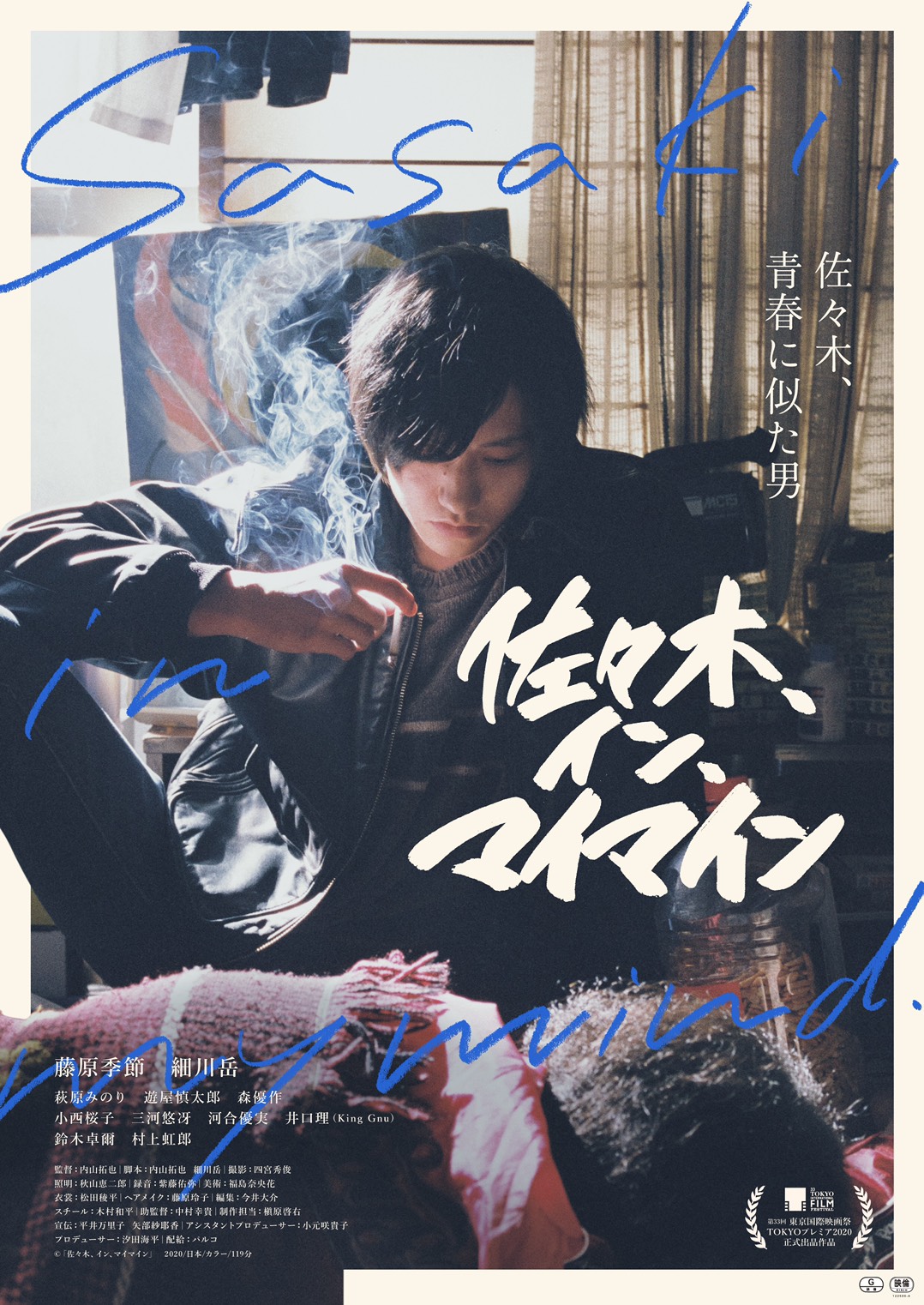
Sasaki in My Mind (佐々木、イン、マイマイン, Takuya Uchiyama, 2020)

A young man is forced to confront his quarter life malaise when presented with unexpected tragedy in Takuya Uchiyama’s heartfelt youth movie, Sasaki in My Mind (佐々木、イン、マイマイン). A study in inertia, Uchiyama’s moody drama finds its melancholy hero defeated by life, looking back to more hopeful high school days and the larger than life friend he has, by his own admission, failed convinced by his own rather solipsistic sense of personal inadequacy that he lacked the capacity to save him. 

An aspiring actor, Yuji (Kisetsu Fujiwara) lives in a small apartment with his ex-girlfriend (Minori Hagiwara) and makes ends meet with a factory job he seems to be embarrassed by. Approached by an actor friend (Nijiro Murakami) apparently doing a little a better with a series of bit parts in TV shows and commercials, Yuji is reluctant to take him up on his offer of a part in a play, while an accidental meeting with an old high school friend, Tada (Yuya Shintaro), pushes him into a defensive mindset after he’s rightly called on his passivity. “Watching life go by in terror” as his character in the play eventually puts it, Yuji is so defeated by life that it has rendered him entirely listless. Ironically taking up boxing, he gets into a random fight with a customer from the the next table at an izakaya, insisting that he doesn’t want to lose but otherwise refusing to fight for anything even the girlfriend he apparently still loves whose refusal to move on perhaps hints at the desire to be given a reason not to. 

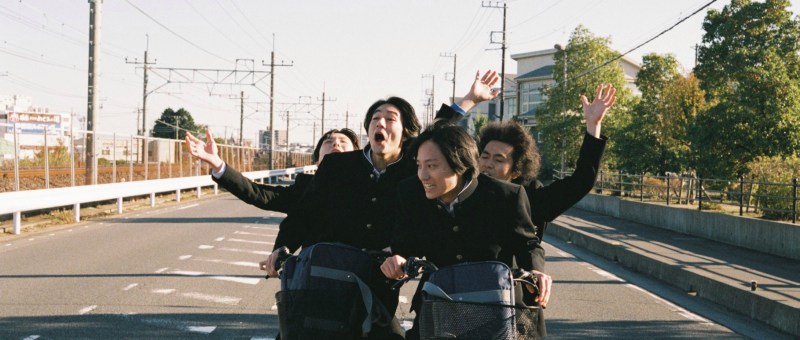
His meeting with Tada, now a moderately successful, married salaryman, reminds him of his high school friend, Sasaki (Gaku Hosokawa), a larger than life character who used to strip impromptu and dance in the nude when greeted by chants of his name. It was Sasaki who first convinced him to become an actor as they watched Kirk Douglas in Champion on TV, though after graduation and a move to Tokyo Yuji made no real effort to keep in touch with his friend seeing him only once and discovering he had become a lonely pachinko player equally consumed by a sense of personal hopelessness. As Sasaki once put it, elephants communicate with each other through low frequency sound imperceptible to humans, his own quiet distress call apparently missed by his old friends who perhaps tired of his outlandishness as they outgrew their teenage selves and became bogged down in their own lives leaving him behind as they strove forward alone. 

Left behind is something which Yuji cannot help but feel, further deepening his sense of personal failure in having achieved not much of anything in his Tokyo life. Sasaki aside, his high school friends, Tada and Kimura (Yusaku Mori), have each shifted into a conventional adulthood with regular salaryman jobs, homes, wives, and even children. He didn’t go to his last high school reunion, probably as Tada seems to have realised out of a sense of shame, for the same reason avoiding contact with his old friends while living in an awkward limbo with the ex who apparently grew bored with his lack of drive and continuing air of defeated ennui. Despite his own insecurity, Sasaki had encouraged him to live his life, assuring him that he’s got this, but when it came to it Yuji failed to do the same abandoning him in their old home town as a relic of the past he can’t quite accept. 

Admitting as much to his theatre director, Yuji is once again told to shine in his own spotlight and that lonely people aren’t necessarily lonely because they’re alone. Everyone keeps telling him to grow up, act like an adult, but Yuji doesn’t seem to know how hung up on high school immaturity and reflecting only too late that perhaps they never really understood their friend and in the end they simply left him behind. Only a confrontation with finality pushes him towards a break with his sense of inertia, acknowledging that what he feared was letting go and the eventual forgetting that comes with loss but the “world is rushing forward. We have to keep up”. Sasaki remains for him at least in his mind as he always was, the first of many goodbyes in an “empty elegy” that eventually becomes one’s own. A touching tale of quarter life crisis, Uchiyama’s moving drama eventually pushes its static hero towards an acceptance of his moral cowardice but finally gives him the courage to move forward taking his memories with him into a freer future. 


Sasaki in My Mind streamed as part of this year’s Nippon Connection.

Original trailer (no subtitles)

Theatre: A Love Story (劇場, Isao Yukisada, 2020)

The problem with tortured artists is that rather than be content with destroying themselves, they destroy someone else instead. Japanese cinema has a preoccupation with narcissistic heroes, and even if he does have a rare degree of self-awareness the protagonist of Isao Yukisada’s adaptation of the novel by comedian Naoki Matayoshi, Theatre: A Love Story (劇場, Gekijo), is among the most insufferable in the sheer depths of his resentful self-loathing. The “a love story” suffix is an addition for the English title though it proves true enough in that this is a story about a love of theatre which is really a love of life and possibility only our gloomy hero is still far too much in the shadows to be able to see it clearly. 

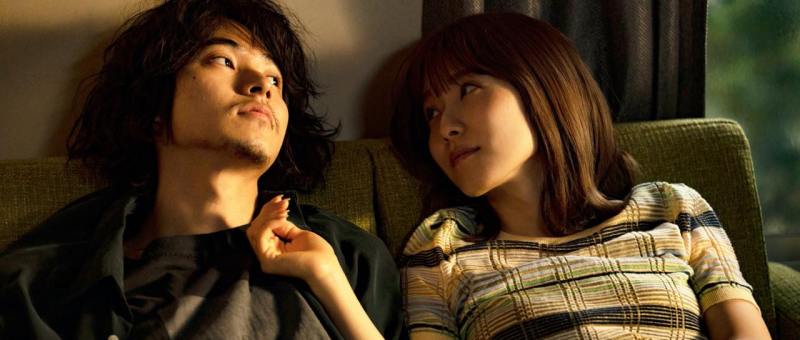
Nagata (Kento Yamazaki), whose fear of intimacy appears to be so great that he never gives away his first name, is first found wandering the streets like a zombie, muttering the words “How long will I last?” to himself before coming to a pause in front of a gallery window in which is displayed a painting of a monkey screaming under a full moon. The vision of existential despair appears to match his own and he’s obviously captivated by it, as is a young woman, Saki (Mayu Matsuoka), who quickly walks away after he creates awkwardness by intently staring at her. She tries to escape because, to be honest, not only is he a class A street creep, but he seems as if he might actually be disturbed. He asks her to go on a date the next day (today is too hot), later confessing he wanted to take her for a drink but is broke all of which makes it sound like he wants money as well as her phone number. Feeling sorry for him she gives in and is seemingly not even that bothered when he attempts to order her drink for her without asking what she wants at a nearby cafe. 

In many ways, the “meet cute” of Nagata and Saki typifies the entirety of their relationship which spans the better part of an ill-defined decade. The nicer she is to him, the more resentful he becomes. What the pair have in common is “theatre”. He’s a pretentious, avant-garde playwright, she’s a bubbly aspiring actress whose faith in the genius he keeps insisting he has only reinforces his sense of insecurity. The problem isn’t so much that lack of success is eating away at him, as it is that he actively resents the successes of others. He even becomes irritated when Saki praises Clint Eastwood, as if Clint Eastwood were his competition. Nagata simply can’t stand it when other people are praised as if the mere fact of someone else’s happiness actively depletes his own, has taken something from him, or is solely a reflection of his failures as an artist and a human being. It is really is all about him. He even refuses to take Saki to Disneyland because then he’d be in competition with Disney and if Saki said anything nice at all about the experience it would just piss him off. 

What seems impossible to understand is why Saki stays, especially after Nagata moves in with her and continues to bum around paying no rent while she works three jobs and tries to finish her uni degree. Eventually she asks him for a small contribution, maybe just something towards the utility bills, but he bizarrely replies that it’s her apartment and it’s irrational to pay for someone else’s utilities which is odd seeing as he’s just got out of the bath and has therefore clearly been using the facilities. In his voiceover, he confesses that he said that in order to avoid having a serious conversation and perhaps to mask a sense of internalised shame over essentially being a kept man, something which is only finally brought home to him by an old acting acquaintance, Aoyama (Sairi Ito), who offers him some freelance writing work but that only seems to deepen his artistic crisis as he battles a sense of selling out in neglecting his playwriting. 

If Saki is underwritten it is partly intentional in that we see her only through Nagata’s eyes and he barely looks, seeing in her only a source of a salvation he is too afraid to accept. He snaps at her and calls her stupid, causes her anxiety, embarrasses her in front of her friends and is, as Aoyama puts it, “a jerk”. His behaviour is in any case abusive, but he’s so blinkered that he never notices that she’s the same as him, anxious on an existential level and in search of mutual protection. By the time he’s done with her, she’s no longer so bright and cheerful, well on the way to alcoholism born of depression and sense of failure on reflecting that she’s a woman approaching 30 who has probably failed to make it as an actress in Tokyo, is exhausted by her city life, and has been slowly destroyed by Nagata’s mix of feigned indifference and possessiveness. Aoyama and his best friend from school Nohara (Kanichiro Sato) make a final desperate intervention to save Saki, pointing out that in his toxic narcissism he destroys her to save himself, unable to bear the idea of her awakening to that which he deeply believes but does not want to acknowledge, that really he’s just no good. 

“As long as we have theatre there’s no need to despair” Nagata finally exclaims, rediscovering a love for the form in its capacity to remake the world, to show him both what is and could be as he rewrites his tragic, delayed coming-of-age romance as an emotionally authentic stage play now convinced, like the old Saki, that he really does want everyone to be happy after all. Theatre: A Love Story is the age old tale of the curtain coming down on an arc of one’s life, accepting that something has ended and that it’s OK, it’s just the way life is. Saki, somewhat problematically declares she wouldn’t have it any other way because she loved Nagata for everything he was and if he’d changed he wouldn’t be the same. In a sense we’re left with Nagata’s artistic validation and a tacit condonation of his emotionally abusive behaviour, but then Yukisada undercuts the final message with a melancholy credits sequence in which he perhaps hands back to Saki even in her passivity as she finally looks for an exit.   


Currently available to stream via Amazon Prime Video in the UK (and possibly other territories).

Original trailer (no subtitles)