Kizumonogatari -Koyomi Vamp- (傷物語 -こよみヴァンプ-, Tatsuya Oishi, 2023) [Fantasia 2024]

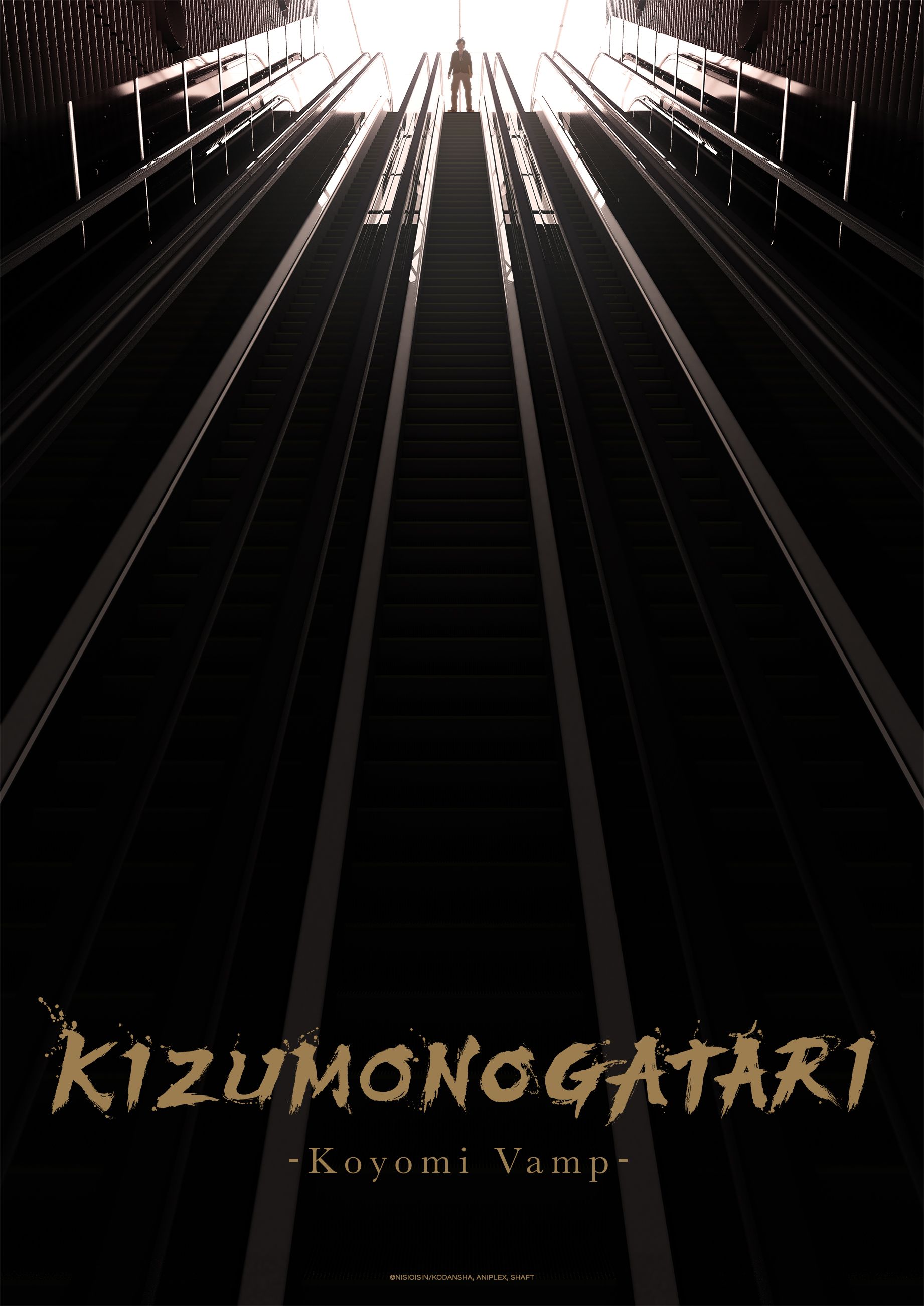
A young man walks into an empty subway station already ominously strewn with blood and finds there the corpse of a woman shorn of her limbs. The corpse rises and begs him to have her life by sacrificing his own in allowing her to suck his blood and surprisingly the young man agrees. He does not, however, die but is brought back as something else, not quite human and definitely subservient to the creature he has saved. 

Running 2.5 hours, Tatsuya Oishi’s Kizumonogatari -Koyomi Vamp- (傷物語 -こよみヴァンプ-) is in fact a compilation of three films released in 2016 and a part of the long running Kizumonogatari series which originated with Nisio Isin’s light novels and has gone to spawn an expansive universe of interconnecting spin-offs. This is technically a prequel, and in that sense begins with a black slate but also deliberately drops us into confusion with breakneck pace through the hero’s quest to recover himself and his place in the world after this rude awakening to the supernatural. 

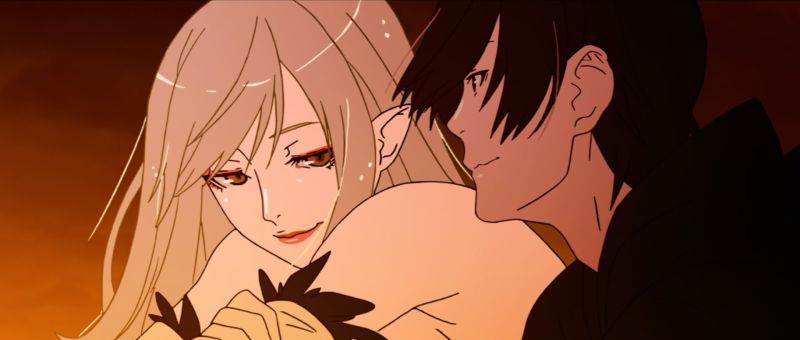
Rude is in many ways a defining characteristic of Kiss-shot, the 500-year old vampire Araragi finds bleeding in the subway station at that point a blonde and alluring figure of forbidden desire. Araragi is drawn to her in an unconscious death wish linked with the sexual desire he struggles to understand, running into the subway minutes after buying a pornographic magazine from a convenience store after striking up a friendship with fellow student Hanekawa. But once he saves her life, Kiss-shot is transformed into a cheeky little girl who now tells him that he is her minion and he must recover her severed limbs from a trio of vampire in order to be restored to humanity even as the power dynamic between them becomes confused and distorted.

In his vampire state, Araragi becomes immortal, powerful and free of mortal jeopardy yet he remains uncertain and insecure while reliant on the support of Hanekawa who encourages him to reject his desire for death and remain alive. But this also presents a problem to Araragi who sees himself as self-sacrificing and is unwilling to accept the what he sees as a self-sacrifice from Hanekawa for whom he feels unworthy and inadequate. In some senses it’s a typically self-centred, adolescent male perspective that rejects any idea of her own agency and assumes Hanekawa performs these actions for him rather than considering that she performs them for herself and is simply doing what she wants to do which in the end is not really about him at all. He declares it a burden he’s too weak to carry, which might in some senses be fair but also again a mischaracterisation that is further evidence of his lack of self-worth.

It’s this sense of inadequacy that lies behind his desire to reclaim his humanity along with the concurrent disgust he feels in the degradations of vampirism. It genuinely comes as a surprise to him that Kiss-shot feeds on human beings and lost her own humanity so long ago that she no longer gives it a second thought. She is after all only being what she is, but like Araragi is drawn to death partly out of frustrated longing and lingering boredom with a relentless yet apparently uneventful 500 years behind her in which the only other highlight was her previous minion who rejected this life much more quickly than she ever expected.

Even so, Oishi lends their mutual dilemma a degree of absurdity in the expectedly comic sight of severed heads littering a sports filed or launching themselves in toothy attacks. Heavily inspired by the French New Wave, he breaks the action with sometimes barely legible title cards often reading a single world while his composition has a kind of jauntiness that is also bleak and melancholy. The world surrounding Araragi veers between the pristine entrance to the high school, and post apocalyptic devastation littered with crows emblematised by the depilated cram school in which Kiss-shot keeps him. Backgrounds often have a photo realistic quality that further sets the world at a kilter when matched with the more conventional character designs of the central players. The conclusion that Araragi is presented with amounts a sharing of the misery which is also akin the burden he didn’t want to carry but also perhaps symbolic of his path towards adulthood in acceptance of compromise and selflessness in being willing to carry a small part of others’ pain and despair and allowing them to carry a part of his own.


Kizumonogatari -Koyomi Vamp- screened as part of this year’s Fantasia International Film Festival.

Original trailer (English subtitles)

Fireworks (打ち上げ花火、下から見るか? 横から見るか?, Akiyuki Shinbo & Nobuyuki Takeuchi, 2017) [Fantasia 2018]

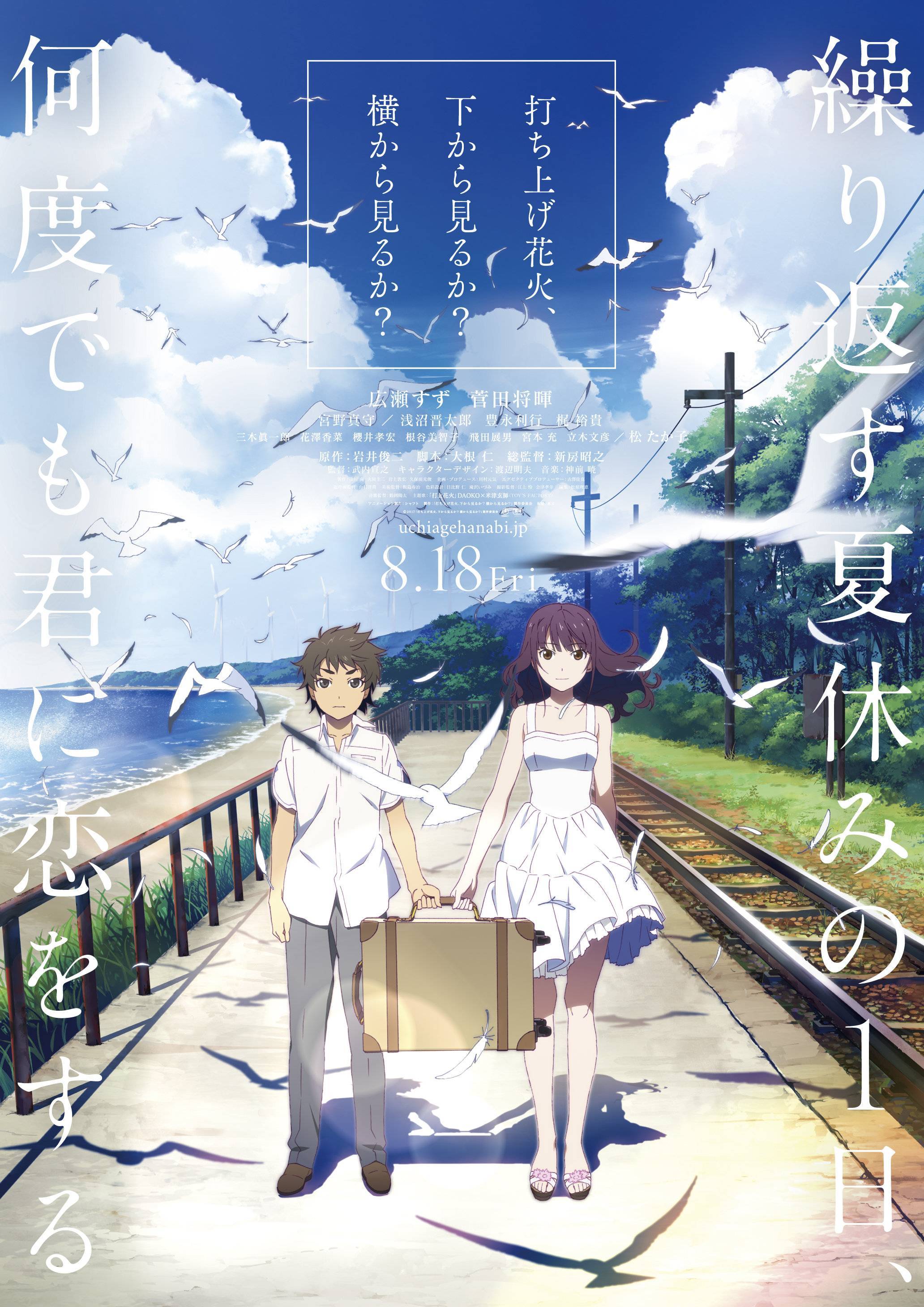
Fireworks posterBack in 1993, Fireworks, Should We See it From the Side or From the Bottom? (打ち上げ花火、下から見るか? 横から見るか?, Uchiage Hanabi, Shita kara Miru ka? Yoko kara Miru ka?), became something of a sliding doors moment for the young Shunji Iwai who received an award from the Directors Guild of Japan for what was in essence a single episode in an anthology TV series dedicated to the idea of “what if”. “What if” is, it has to be said, a constant theme in nostalgic Japanese cinema as slightly older protagonists look back on the hazy days of youth and wonder what might have been if they’d only known then what they know now. Scripted by Hitoshi One (Scoop!) and produced by Shaft, the anime adaption attempts to do something similar, floating in with a gentle summer breeze that could easily be from 30 years ago or yesterday while its conflicted hero ponders where it is he ought to stand to get the most beautiful view of life passing him by.

The central dilemma that seems to obsess the boys this particular summer is whether fireworks are flat or three dimensional and whether your perception of them changes depending on where you stand. Norimichi (Masaki Suda) risks falling out with his best friend Yusuke (Mamoru Miyano) and so has avoided revealing the fact that they both have a crush on the same girl – Nazuna (Suzu Hirose), who (neither of them have noticed) has a dilemma of her own. A chance meeting at the swimming pool seems primed to dictate the romantic fate of all concerned. Norimichi and Yusuke race for the affections of Nazuna who, in the original timeline, ends up asking Yusuke to see the summer fireworks with her even though it’s Norimichi she went there to meet.

Unfortunately Yusuke is a flake and nothing goes to plan. He stands Nazuna up to hang with his buddies and figure out the answer to their inane riddle leaving her to run into Norimichi who gets an unexpected glimpse at her inner turmoil. A mysterious orb salvaged by Nazuna from the nearby sea gives Norimichi a chance to start over, be braver, do things differently thanks to the benefit of hindsight, and so he begins a path to idealised romance by manipulating the events around him to finally “save” Nazuna from making a rash decision (or at least from making it alone).

In 1993, Nazuna’s dilemma was perhaps a little more unusual than it might seem now. Her twice married single-mother (Takako Matsu) is planning to marry again which requires the teenage Nazuna to leave her home behind to live with a strange man in a strange town. Though her new step-dad seems nice and is obviously trying his best, Nazuna is not of a mind to give in. She consents to accepting one of the ice-creams he’s bought to curry favour (after all, there’s no need to be “rude”), but is not about to go so far as to say thank you or to enjoy eating it together with the rest of the family when she could guzzle it sulkily in the comfort of her bedroom. Nazuna wants to escape, but her ideas of doing so are childishly naive even if she puts on a sophisticated front by joking about going to Tokyo to work on the fringes of the sex trade by lying about her age. Hence, she asks a boy she likes but barely knows to take her away from this place, but the boy is just a boy and not quite equipped for rescuing damsels in distress from suffering he doesn’t understand.

Like many Japanese teen dramas, Norimichi’s interior monologue takes on a rueful quality, as if he’s eulogising his youth while still inside it. He doesn’t know whether there’s a difference if you look at things from one angle or another because he’s not particularly used to thinking about things and his first few experiments with the orb are pure reactions to events rather than thought through decisions about effects and consequences. Nevertheless, use of the orb shifts him into a philosophical contemplation of what it is to live a life. Finally realising he should probably ask Nazuna what it is she really wants, the process the pair undergo is one of learning to live in the now rather than obsessing about the end of something that might never begin if you never find the courage to start.

In the end their beautiful dream world is ruptured by a drunken old man, shattering into a thousand shards of memory of things that never were. Fireworks wants to ask if you can have a more fulfilling life by simply changing your perspective, but its central messages never quite coalesce. There is something about Iwai’s original concept which inescapably of its time, sliding neatly into the melancholy world of early ‘90s teen drama drenched in nostalgia for an era not yet past. Reaching for poignant philosophising, Fireworks falls short through, ironically enough, focussing too heavily on a single point of view. An oddly “flat” exercise, Shinbo’s adaptation misses the mark in its climactic moments but perhaps manages to offer something to the lovelorn teens of today if only by yanking them back to a more innocent time.


Fireworks was screened as part of Fantasia International Film Festival 2018.

International trailer (English subtitles)

The original 1986 Seiko Matsuda song reprised by Nazuna at a climactic moment.

https://www.youtube.com/watch?v=87fAJ4jSxPM