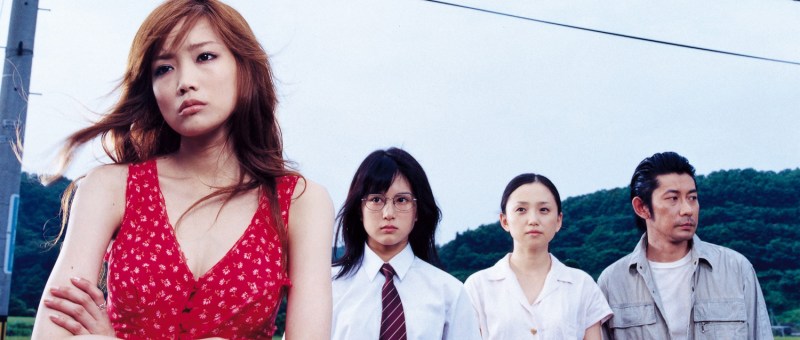
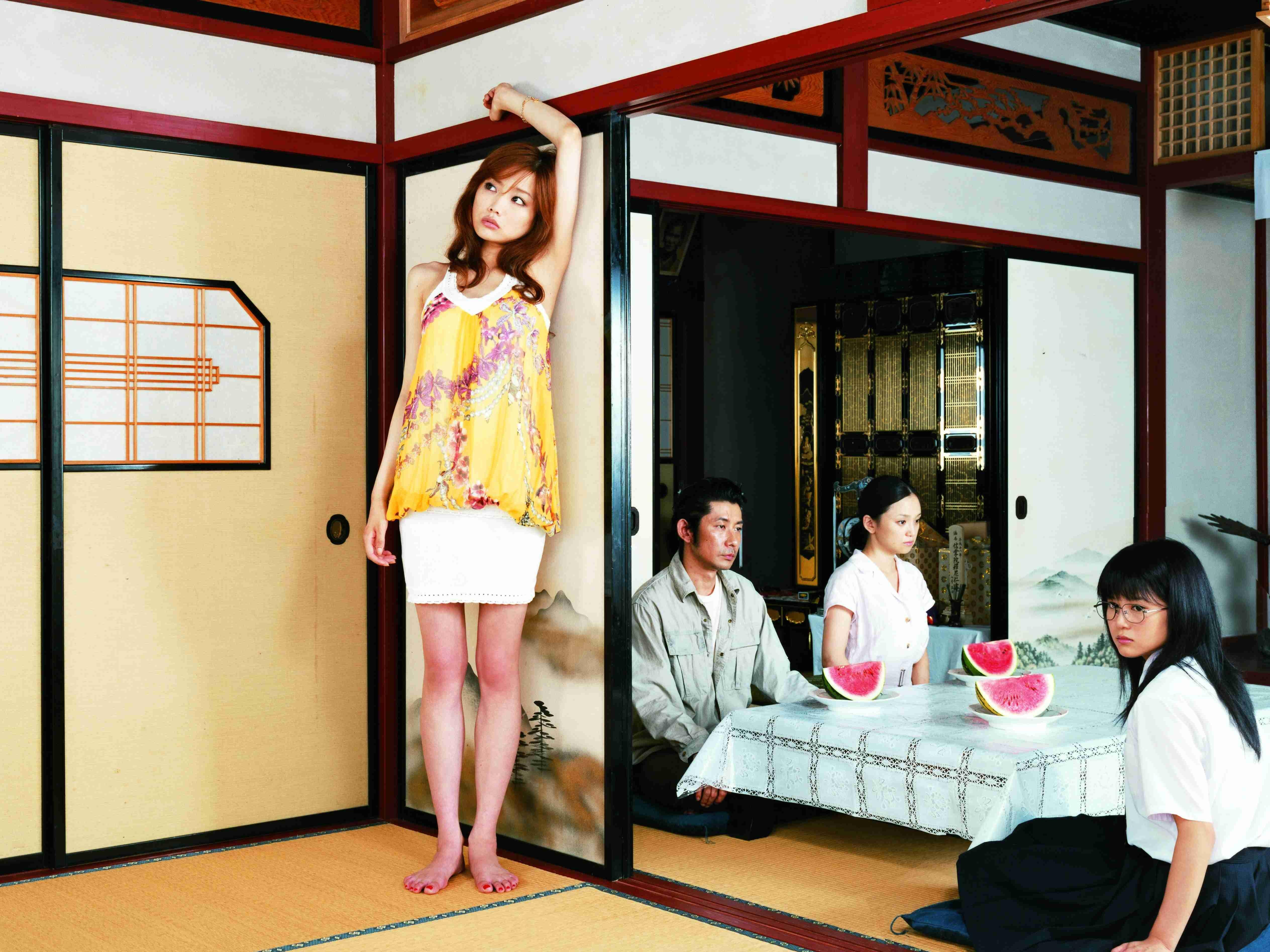
“We’re family, I’m sure we’ll understand each other” a conciliatory big brother tries to console, but family is it seems a much more complicated matter than one might assume it to be in Daihachi Yoshida’s debut feature, Funuke Show Some Love, You Losers! (腑抜けども、悲しみの愛を見せろ Funukedomo, Kanashimi no Ai wo Misero), adapted from the novel by Yukiko Motoya. Released in 2007, Yoshida’s film is one among a series of cynical reevaluations of the meaning of “family” in the contemporary society but eventually skews towards the uncomfortably conservative in its implicit suggestion that a family which is not bound by blood cannot succeed while even blood connection may prove inherently toxic.
Fittingly the film opens with a freak yet largely offscreen accident as Mrs & Mrs Wago are killed by a runaway bus while attempting to save a stray cat, an event witnessed by their 18-year-old daughter Kiyomi (Aimi Satsukawa). The Wagos were a blended household, Kazuko and Shutaro having married later in life and bringing with them their children from previous marriages in Kazuko’s daughters Sumika (Eriko Sato) and Kiyomi, and Shutaro’s son Shinji (Masatoshi Nagase). Four years previously, Sumika left home after a traumatic family incident with the aim of becoming an actress in Tokyo, while her place has perhaps been taken by Shinji’s new wife Machiko (Hiromi Nagasaku) whom he has only recently married. Yet Kiyomi seems more perturbed by the possibility of her sister’s return than she is grief-stricken by her parents’ death, while Sumika barely glances at the altar on her arrival immediately treating Machiko as a servant sent out to pay the taxi and collect her bags.
As we quickly gather, Sumika is an intensely narcissistic, self-absorbed sociopath intent on manipulating everyone around her in order to assume a position of dominance yet her resentment is perhaps the only thing glueing the family together. Her grudge against Kiyomi apparently stems back to her having used her for inspiration for a manga about a young woman driven to psychotic violence in her ambition to become an actress which later won a prize and was printed under her real name with the consequence that everyone in town quickly realised it was about her. Sumika repeatedly uses this excuse as to why she hasn’t been successful, that the manga forced her into a moment of introspection that destroyed her self-confidence, later saying something similar to an unresponsive audition panel bearing out her tendency to blame her failures on others. Yet Kiyomi apparently feels intensely guilty. “I never thought of myself as the kind of person who’d turn her family into manga for money” she laments shortly after Sumika attempted to boil her to death in the bath, “I want to transform into the kind of person who can sympathise with family members’ pain”.
“Family means supporting each other at times like this” the relentlessly cheerful Machiko had tried to comfort Kiyomi at the funeral, yet she is constantly reminded that she is not quite included as a family member. Shinji tells her to keep out of family business and later to avoid getting between the sisters, denying her an equal status within the home despite the reality of their marriage. Ironically enough, Machiko was abandoned at birth and raised in an orphanage apparently so desperate to belong to a family that she willingly puts up with Shinji’s abusive treatment while making creepy dolls as a hobby. Yet at the end of the film it’s she who is left on her own, inheriting the family home, while the two blood sisters are eventually forced out but bound to each other if only in unresolved and continual resentment.
Nevertheless there is also a degree of pathos in the series of frustrated dreams which prevent each of the siblings from escaping the otherwise perfectly nice if dull rural hometown where they were born. Sumika’s tragedy is her refusal to accept she has no talent and is unlikely to find career success because she is an unpleasant person, a meta plot strand seeing her writing letters to a director whose new movie is apparently about whether you can love someone you’ve only communicated with remotely and never met. Sumika seeks only dominance, manipulating her siblings through guilt and shame in order to encourage a sense of dependence while also dependent on them for financial support. Her need prevents either Kiyomi or Shinji finding happiness, their attempts to escape her control eventually leading in very different directions.
Unlike similarly themed familial dramas, Funuke situates the fault line in its dysfunctional family not in the changing society but in its lack of blood relation while eventually suggesting that even the blood bond between the two sisters is more grimly toxic than it is supportive. In an odd way, it leaves Machiko as the winner while uncomfortably implying that her orphanhood prevents her from becoming part of a conventional family, literally left home alone. A more literal translation of the title might be “show some miserable love, you cowards”, suggesting that these anxious siblings are too afraid of themselves and each other to embrace familial affection Kiyomi eventually affirming “In the end I couldn’t change either, sorry”. While the limitations of early digital photography may not stand up a decade and change later, Yoshida’s occasionally experimental flair including an entire sequence playing out as manga panels helps to overcome the unfortunate lifelessness of a typically 2000s low budget aesthetic while the universally strong performances do their best to gain our sympathy in an otherwise cruelly cynical, if darkly humorous, take on post-millennial family dynamics.
Funuke Show Some Love, You Losers! is available on blu-ray in the UK from Third Window Films.
Trailer (English subtitles)

 Windows on Worlds