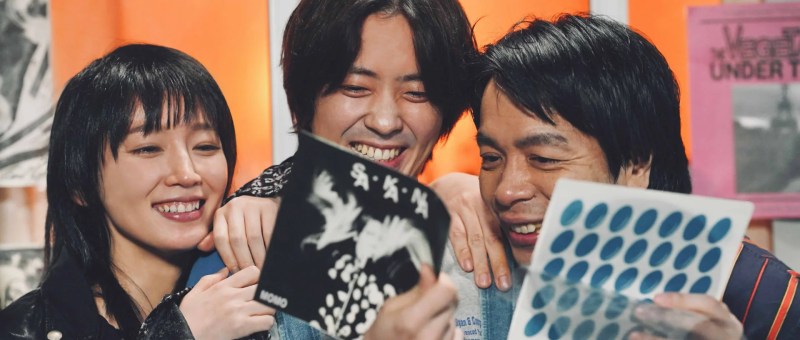
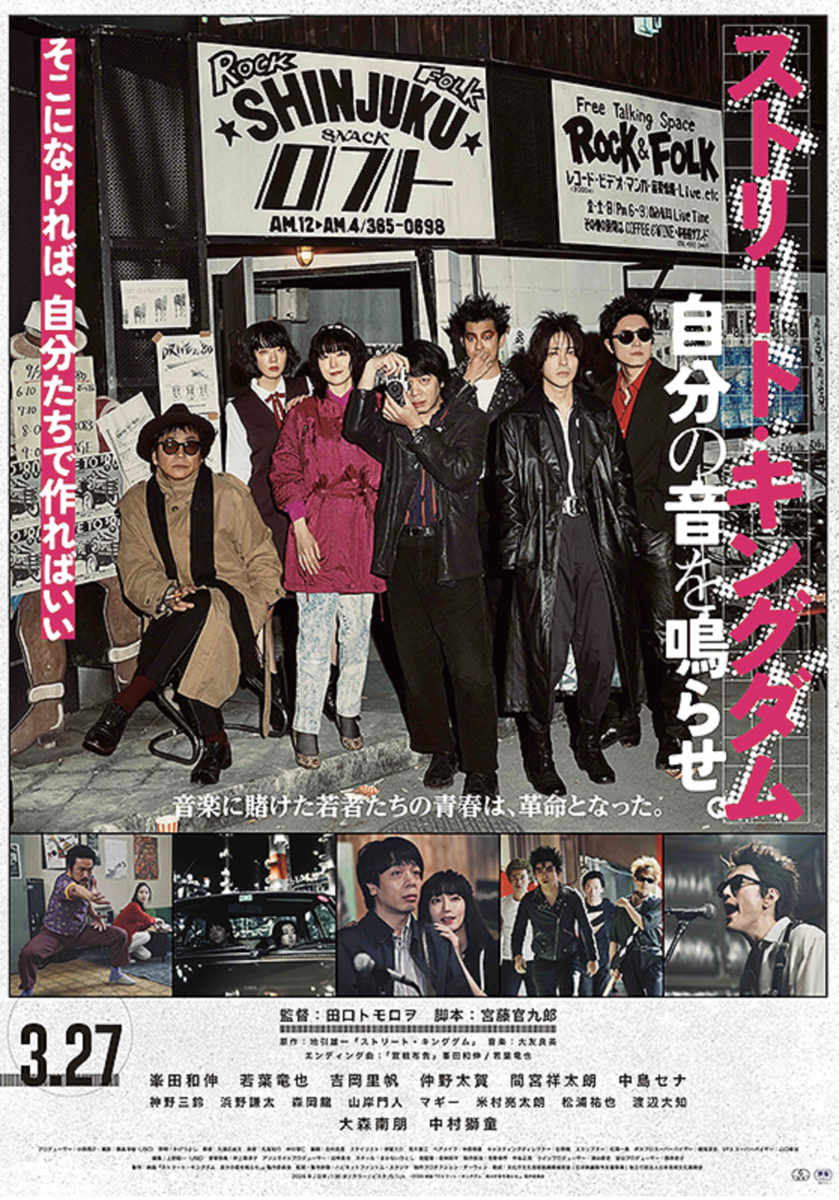
Street Kingdom (ストリート・キングダム 自分の音を鳴らせ, Tomorowo Taguchi, 2026)

Tomorowo Taguchi is probably best known to international audiences for his starring role in Tetsuo the Iron Man, but he started his career as an illustrator and theatre actor while also active in Japan’s underground punk music scene as a member of the band Bachikaburi. For the last few decades, he’s been a fairly ubiquitous presence in mainstream Japanese films as a jobbing actor turning up in small supporting roles in all sorts of unexpected places, but Street Kingdom (ストリート・キングダム 自分の音を鳴らせ, Street Kingdom: Jibun no Oto wo Narase) is a look back to the early years of the punk movement and the creation of Telegraph Records.

Scripted by Kankuro Kudo, most of the names in the film have been slightly altered to reflect the fictionalisation of the narrative and so we follow Yuichi Hibiki (based on Yuichi Jibiki and played by Kazunobu Mineta), a struggling photographer who feels lost in an increasingly consumerist Japan. Like many of his generation, he spent his formative years in the student movement and is looking for a way to fill that void following the movement’s collapse in the wake of the Asama-sanso Incident. Japan’s economy had improved quite markedly by then and many former student protesters simply moved on into more mainstream lives as regular salaryman men and women, much as Yuichi’s friend has done by joining a record label and becoming obsessed with Pink Lady, the epitome of the disposable contemporary pop music topping the charts and making them money. Inspired by Yuichi, the friend later also jacks in his corporate career and becomes a punk rocker because he too discovers he wants more than the emptiness of a salaryman existence.

After a trip back to his family pig farm, Yuichi’s epiphany comes after hearing the Sex Pistols on the radio, though he is dismayed to find out that they have already broken up. Nevertheless, he determines to go Tokyo and find the real Japanese punk as opposed to that imported from New York or London. It’s inside this world that finds freedom outside of the Japanese mainstream as an independent artist, vowing to create a Street Kingdom with Momo (Ryuya Wakaba), the lead singer of influential band Tokage, and zine publisher Sachi (Riho Yoshioka). An out-of-touch journalist at one point tries to offer them expensive champagne and shames the band members for still living at home with their parents, and there is something a little bit incongruous about Momo’s lovely mother asking him what he wants for his tea before he goes off to play one of his anarchic gigs. But in another way, this is exactly the essence of punk in the sense of domesticity, friendships and solidarity that existed between the members of this community.

It all only begins to go wrong when the music labels start getting involved and commercial decisions conflict with artistic ones. Yuichi becomes a de facto manger because he’s a “decent” sort, which is to say he’s a bit of a square existing to one side of the movement which is a designation he resents at times, but also allows him a more privileged position of guiding it. He’s the one who advises they quit on a high after their “Tokyo Rockers” multi-band tour threatens to get too big and provoke rivalries and discord in what had been a fairly non-competitive, collegiate scene. He also helps Momo overcome some of his artistic conflicts by starting a parallel indie label so they can release songs the label rejects, such a nonsense tune about fish and pollution that the suits deem “too political”. What he can’t fully help with, however, is Momo’s descent into depression and drug abuse when the label pushes the band into debt, refuses to help financially after their band members are involved in a crash while on tour, and finally suggests they were only really interested in Momo as a potential solo artist doing more mainstream pop. Nevertheless, it’s Yuich’s friendly intervention encouraging Momo to get his act together that finally convinces him that something has to change.

To that extent, the film may be a fairly sanitised and nostalgic exploration of the director’s youth, but it’s also an advocation for dancing to one’s own tune which, it argues, has not necessarily become any easier in an age when anyone has access to the tools to become an artist. The punk spirit lives on in those who are prepared to be fully themselves in a culture that can be oppressively conformist and as the film would have it, the greatest legacy of the punk rock era was the sense of community between young people who wanted to build their own utopia which is something that in itself will never die.


Street Kingdom screens as part of this year’s New York Asian Film Festival.

Trailer (English subtitles)
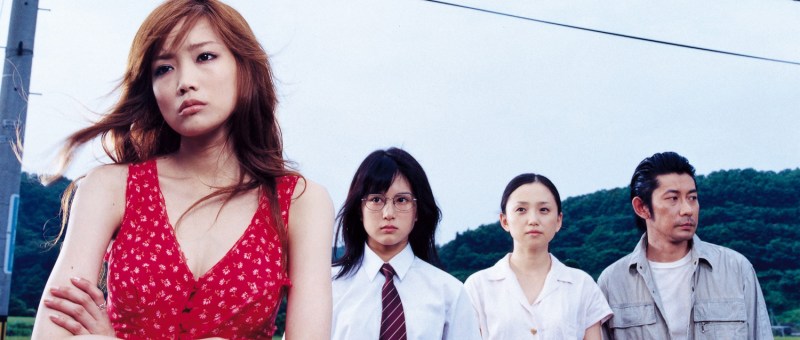
Funuke Show Some Love, You Losers! (腑抜けども、悲しみの愛を見せろ, Daihachi Yoshida, 2007)

“We’re family, I’m sure we’ll understand each other” a conciliatory big brother tries to console, but family is it seems a much more complicated matter than one might assume it to be in Daihachi Yoshida’s debut feature, Funuke Show Some Love, You Losers! (腑抜けども、悲しみの愛を見せろ Funukedomo, Kanashimi no Ai wo Misero), adapted from the novel by Yukiko Motoya. Released in 2007, Yoshida’s film is one among a series of cynical reevaluations of the meaning of “family” in the contemporary society but eventually skews towards the uncomfortably conservative in its implicit suggestion that a family which is not bound by blood cannot succeed while even blood connection may prove inherently toxic. 

Fittingly the film opens with a freak yet largely offscreen accident as Mrs & Mrs Wago are killed by a runaway bus while attempting to save a stray cat, an event witnessed by their 18-year-old daughter Kiyomi (Aimi Satsukawa). The Wagos were a blended household, Kazuko and Shutaro having married later in life and bringing with them their children from previous marriages in Kazuko’s daughters Sumika (Eriko Sato) and Kiyomi, and Shutaro’s son Shinji (Masatoshi Nagase). Four years previously, Sumika left home after a traumatic family incident with the aim of becoming an actress in Tokyo, while her place has perhaps been taken by Shinji’s new wife Machiko (Hiromi Nagasaku) whom he has only recently married. Yet Kiyomi seems more perturbed by the possibility of her sister’s return than she is grief-stricken by her parents’ death, while Sumika barely glances at the altar on her arrival immediately treating Machiko as a servant sent out to pay the taxi and collect her bags. 

As we quickly gather, Sumika is an intensely narcissistic, self-absorbed sociopath intent on manipulating everyone around her in order to assume a position of dominance yet her resentment is perhaps the only thing glueing the family together. Her grudge against Kiyomi apparently stems back to her having used her for inspiration for a manga about a young woman driven to psychotic violence in her ambition to become an actress which later won a prize and was printed under her real name with the consequence that everyone in town quickly realised it was about her. Sumika repeatedly uses this excuse as to why she hasn’t been successful, that the manga forced her into a moment of introspection that destroyed her self-confidence, later saying something similar to an unresponsive audition panel bearing out her tendency to blame her failures on others. Yet Kiyomi apparently feels intensely guilty. “I never thought of myself as the kind of person who’d turn her family into manga for money” she laments shortly after Sumika attempted to boil her to death in the bath, “I want to transform into the kind of person who can sympathise with family members’ pain”. 

“Family means supporting each other at times like this” the relentlessly cheerful Machiko had tried to comfort Kiyomi at the funeral, yet she is constantly reminded that she is not quite included as a family member. Shinji tells her to keep out of family business and later to avoid getting between the sisters, denying her an equal status within the home despite the reality of their marriage. Ironically enough, Machiko was abandoned at birth and raised in an orphanage apparently so desperate to belong to a family that she willingly puts up with Shinji’s abusive treatment while making creepy dolls as a hobby. Yet at the end of the film it’s she who is left on her own, inheriting the family home, while the two blood sisters are eventually forced out but bound to each other if only in unresolved and continual resentment. 

Nevertheless there is also a degree of pathos in the series of frustrated dreams which prevent each of the siblings from escaping the otherwise perfectly nice if dull rural hometown where they were born. Sumika’s tragedy is her refusal to accept she has no talent and is unlikely to find career success because she is an unpleasant person, a meta plot strand seeing her writing letters to a director whose new movie is apparently about whether you can love someone you’ve only communicated with remotely and never met. Sumika seeks only dominance, manipulating her siblings through guilt and shame in order to encourage a sense of dependence while also dependent on them for financial support. Her need prevents either Kiyomi or Shinji finding happiness, their attempts to escape her control eventually leading in very different directions. 

Unlike similarly themed familial dramas, Funuke situates the fault line in its dysfunctional family not in the changing society but in its lack of blood relation while eventually suggesting that even the blood bond between the two sisters is more grimly toxic than it is supportive. In an odd way, it leaves Machiko as the winner while uncomfortably implying that her orphanhood prevents her from becoming part of a conventional family, literally left home alone. A more literal translation of the title might be “show some miserable love, you cowards”, suggesting that these anxious siblings are too afraid of themselves and each other to embrace familial affection Kiyomi eventually affirming “In the end I couldn’t change either, sorry”. While the limitations of early digital photography may not stand up a decade and change later, Yoshida’s occasionally experimental flair including an entire sequence playing out as manga panels helps to overcome the unfortunate lifelessness of a typically 2000s low budget aesthetic while the universally strong performances do their best to gain our sympathy in an otherwise cruelly cynical, if darkly humorous, take on post-millennial family dynamics. 


Funuke Show Some Love, You Losers! is available on blu-ray in the UK from Third Window Films.

Trailer (English subtitles)

Girl in the Sunny Place (陽だまりの彼女, Takahiro Miki, 2013)

girl in the sunny placeThe “jun-ai” boom might have been well and truly over by the time Takahiro Miki’s Girl in the Sunny Place (陽だまりの彼女, Hidamari no Kanojo) hit the screen, but tales of true love doomed are unlikely to go out of fashion any time soon. Based on a novel by Osamu Koshigaya, Girl in the Sunny Place is another genial romance in which teenage friends are separated, find each other again, become happy and then have that happiness threatened, but it’s also one that hinges on a strange magical realism born of the affinity between humans and cats.
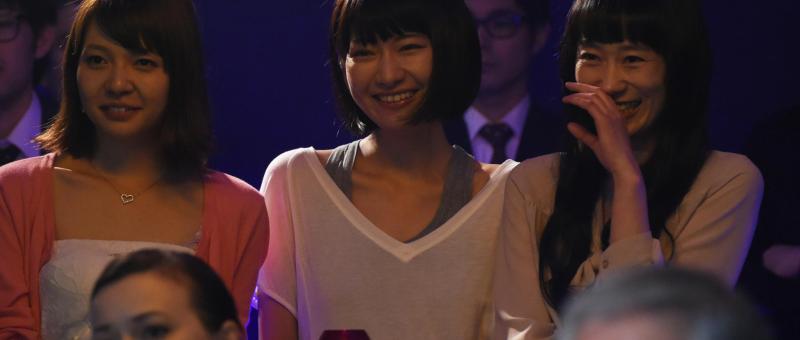
25 year old Kosuke (Jun Matsumoto) is a diffident advertising executive living a dull if not unhappy life. Discovering he’s left it too late to ask out a colleague, Kousuke is feeling depressed but an unexpected meeting with a client brightens his day. The pretty woman standing in the doorway with the afternoon sun neatly lighting her from behind is an old middle school classmate – Mao (Juri Ueno), whom Kosuke has not seen in over ten years since he moved away from his from town and the pair were separated. Eventually the two get to know each other again, fall in love, and get married but Mao is hiding an unusual secret which may bring an end to their fairytale romance.

Filmed with a breezy sunniness, Girl in the Sunny Place straddles the line between quirky romance and the heartrending tragedy which defines jun-ai, though, more fairytale than melodrama, there is still room for bittersweet happy endings even in the inevitability of tragedy. Following the pattern of many a tragic love story, Miki moves between the present day and the middle school past in which Kosuke became Mao’s only protector when she was mercilessly bullied for being “weird”. Mao’s past is necessarily mysterious – adopted by a policeman (Sansei Shiomi) who found her wandering alone at night, Mao has no memory of her life before the age of 13 and lacks the self awareness of many of the other girls, turning up with messy hair and dressed idiosyncratically. When Kousuke stands up to the popular/delinquent kids making her life a misery, the pair become inseparable and embark on their first romance only to be separated when Kosuke’s family moves away from their hometown of Enoshima.

“Miraculously” meeting again they enjoy a typically cute love story as they work on the ad campaign for a new brassiere collection which everyone else seems to find quite embarrassing. As time moves on it becomes apparent that there’s something more than kookiness in Mao’s strange energy and sure enough, the signs become clear as Mao’s energy fades and her behaviour becomes less and less normal.

The final twist, well signposted as it is, may leave some baffled but is in the best fairytale tradition. Maki films with a well placed warmth, finding the sun wherever it hides and bathing everything in the fuzzy glow of a late summer evening in which all is destined go on pleasantly just as before. Though the (first) ending may seem cruel, the tone is one of happiness and possibility, of partings and reunions, and of the transformative powers of love which endure even if everything else has been forgotten. Beautifully shot and anchored by strong performances from Juri Ueno and Jun Matsumoto, Girl in the Sunny Place neatly sidesteps its melodramatic premise for a cheerfully affecting love story even if it’s the kind that may float away on the breeze.


Original trailer (no subtitles)

Dawn of the Felines (牝猫たち, Kazuya Shiraishi, 2017)

dawn of the felines poster largerTowards the end of the 60s and faced with the same problems as any other studio of the day – namely declining receipts as cinema audiences embraced television, Nikkatsu decided to spice up their already racy youth orientated output with a steady stream of sex and violence. The Roman Porno line took a loftier approach to the “pink film” – mainstream softcore pornography played in dedicated cinemas and created to a specific formula, by putting the resources of a bigger studio behind it with greater production values and acting talent. 40 years on Roman Porno is back. Kazuya Shiraishi’s Dawn of the Felines (牝猫たち, Mesunekotachi) takes inspiration from Night of the Felines by the Roman Porno master Noboru Tanaka but where Tanaka’s film is a raucous comedy following the humorous adventures of its three working girl protagonists, Shiraishi’s is a much less joyous affair as he casts his three lonely heroines adrift in Tokyo’s red light district.

Masako (Juri Ihata), Rie (Michie), and Yui (Satsuki Maue) are best friends, though they don’t even know each other’s real names. They each work for a shady escort agency in Tokyo’s red light district where they’re ordered and dispatched by their two-bit hustler of a manager Nonaka (Takuma Otoo) and driven around by the assistant who it turns out has been secretly filming them and posting the videos on YouTube as a kind of exposé on the sex trade.

Each of the women “has their tale to tell” as one puts it but none of them are particularly unhappy in their work, prostitution is simply their way of life and to that extent completely normalised. It does, however, interfere with their ability to form relationships, not just practically but emotionally. For unclear reasons possibly connected to debt collection Masako is technically homeless despite the large amounts of money she can earn, sleeping in cheap motels or all night manga cafes and carting all of her worldly possessions around with her in a tiny carry on size suitcase on wheels. One of her regulars, a millionaire shut in (Tomohiro Kaku), offers to let her stay with him but their relationship is strange and strained – somewhere between business and pleasure with the lines permanently unclear.

Rei, by contrast, is saddled with an elderly client who usually just wants to talk but eventually takes things in an extreme direction. Her path into prostitution is in a sense more positive even if it stems from a kind of vengeance in that the feeling of being needed and providing a valuable service gives her life meaning.

Yui looks for meaning through romance but rarely finds it thanks to the various potential mates she meets through her work. Yui’s young son Kenta has worrying bruises on his face, arms and torso, rarely speaks, and is frequently abandoned by his mother who pays a shady guy to look after him while she spends her time looking for love.

Working for a lenient agency the girls are more or less free agents rather than abused street walkers trapped by debt-bondage and could quit any time they wanted. Yui and Masako may be looking for an escape from this dead-end world – Yui at least is conscious of her age and the declining bookings, but neither names that as something that they are actively pursuing. Rei, by contrast, has made her escape already but has travelled in the opposite direction – from stifling bourgeois life to Belle du Jour liberation, but her eventual destination may be a much darker one than she’d anticipated.

This darkness hovers round the edges as the threat of violence is only ever indirectly expressed or fetishised as in a sequence led by Yui’s possible new partner and the bondage club he works at as one half of a warmup manzai act. Only towards the end does its reality finally surface, making plain how vulnerable and unprotected the women remain whilst on the job. Far from the liberated laughter of Night of the Felines, Shiraishi’s film traps its women with their own despairs as they wallow in an inescapable well of loneliness, satisfying the needs of others but unable to satisfy their own. Bleak but subtly ironic, Dawn of the Felines finds no joy in the sun rising, only the relief of the end of a working day as its three stray cats wander the streets looking for their place to belong.


Dawn of the Felines was screened at the 17th Nippon Connection Japanese Film Festival.

Original trailer (English subtitles)