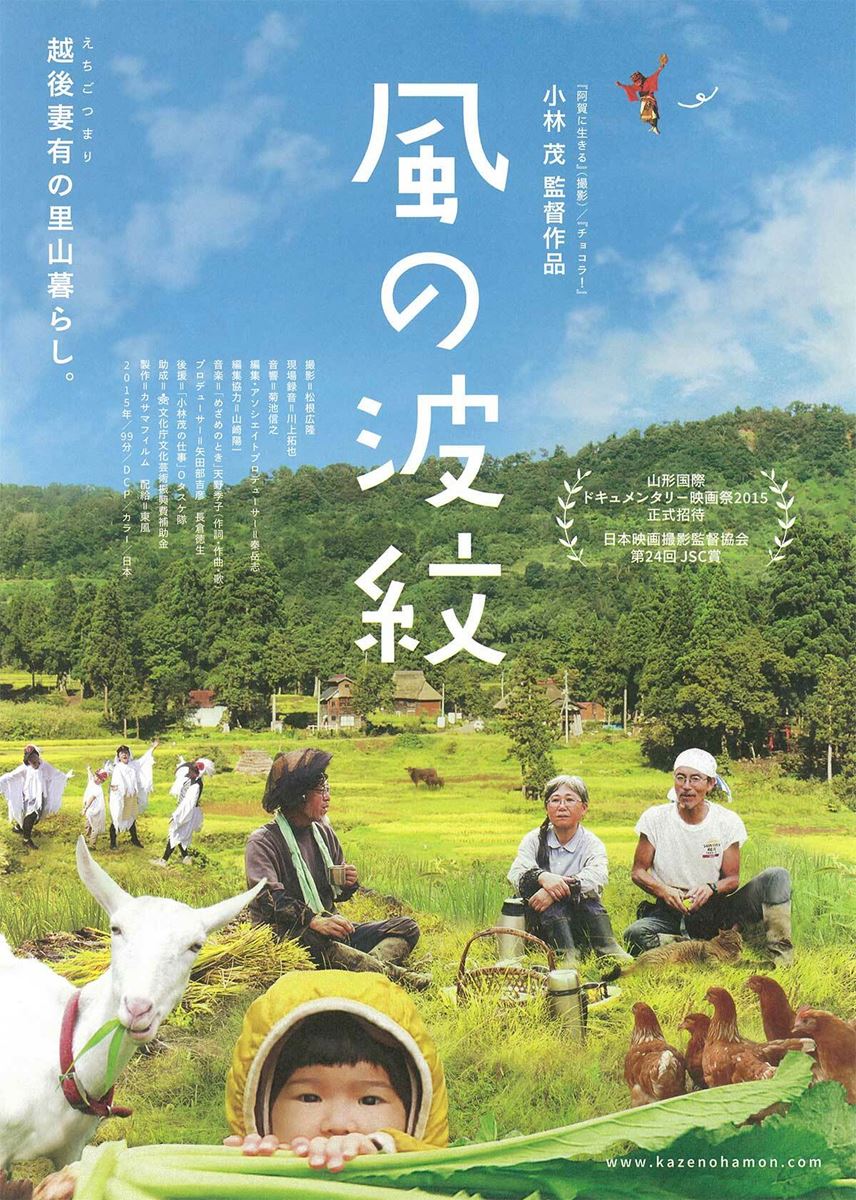
Dryads in a Snow Valley (風の波紋, Shigeru Kobayashi, 2015)

“You can’t live here alone” a older woman admits having long left the village and returning only to visit her parents’ graves to be shocked by its ongoing decline. Shigeru Kobayashi’s mostly observational documentary loosely follows the life of a middle-aged man who left Tokyo for a life in the mountains only to be frustrated by the March 2011 earthquake. Undeterred, he ignores the advice of a local builder that his 117-year-old home is damaged beyond repair and forges on together with the support of the surrounding villagers to rebuild and restore.

It could in a way be a metaphor for the nation’s determination to do the same in the way of the 2011 earthquake and tsunami, but it’s also for Kogure a personal mission to fulfil his dreams of country living. Indeed, he gleefully tends to his rice paddies which he says he’s kept chemical free rather than allow them to be polluted by the modern society. Then again, perhaps this is easy for Kogure to say given that he describes his farming to a fellow farmer as a “hobby” and it’s otherwise clear that he’s not using it as a means to support himself. For these reasons he takes pleasure in the simple though arduous acts of planting and harvesting, pushing a wooden plow through the field and revealing that he discovered the traces of those before him in the remnants of an old irrigation tunnel now buried by mud. For him, this sense of continuity seems to be central as if he’s preserving something of an older Japan and a simpler, more fulfilling way of life. 

Kogure had said he wanted to save the house because it was like the pillars cried out to him. A local dye artist says something similar in that he almost feels the wood he harvests is alive though if it were he wouldn’t be able to cut it. There is a sense of the forest as an almost sentient entity with which the villagers live in harmony, but also a less wholesome vision of nature red in tooth and claw as Kogure offers up one of his goats to have its buds removed with hot iron by a local goat expert. The poor thing cries in pain but is ignored, the expert simply stating that it’s only natural and what is always done though it seems if it really is necessary there must be a less cruel way to do it. Kobayashi later wisely cuts away as we realise a goat is about to be slaughtered, cutting straight to the “meat carnival” it provides for the villagers. 

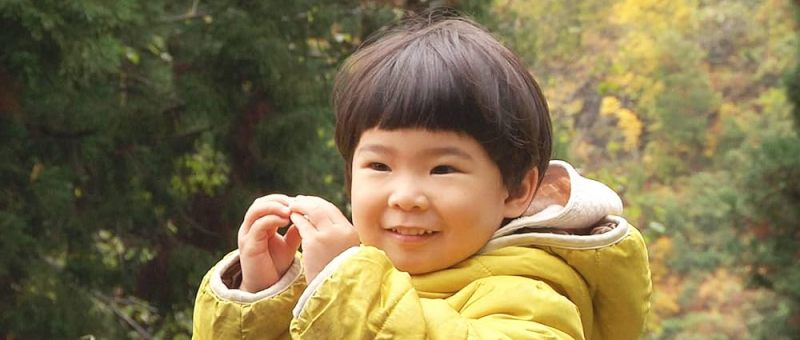
Most of those interviewed are themselves transplants like Kogure who moved to the mountains 20 or 25 years previously usually from the cities and have largely adapted to a simpler way of life, though it’s also true that there are few young people besides a young woman and her daughter who cheerfully exclaims that rice is her favourite food. The woman is grateful for the unconditional support and acceptance she’s received from the villagers whom she says smile in the face of hardship, keen to help each other and make sure that no one is excluded. Yet this way of life is often hard and it’s true enough that no one can survive here alone amid the heavy winter snows. One old man decides that it isn’t worth trying to repair his home after the earthquake and it’s better to demolish it instead while his wife reflects on her life explaining that she was more or less forced to marry him by her family who lured her back from Tokyo on a ruse that her mother was seriously ill. 

Nevertheless, Kobayashi demonstrates the closeness of the remaining villagers as they bond together through shared feasts, laserdisc karaoke, and a general sense of community. “Breaks are a big part of shovelling snow” one man jokes, focussing not so much on the unending labour as the pleasure taken in rest and friendship. Another later suggests the snow will become “a memory of a trial I survived” echoing the harshness of this village life in winter, even as the camera cuts to a glorious spring filled with bright sunshine and verdant green. Kogure continues to plant his rice while a goat runs about in the field behind him in a timeless vision of pastoral life despite itself persisting. 


Trailer (no subtitles)
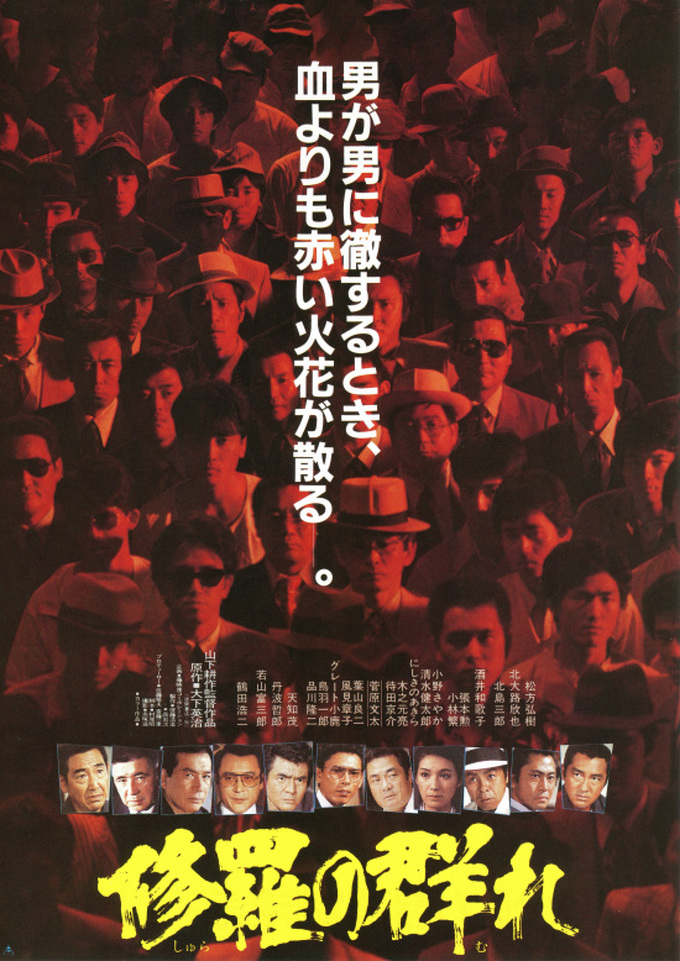
The Story of a Man Among Men (修羅の群れ, Kosaku Yamashita, 1984)

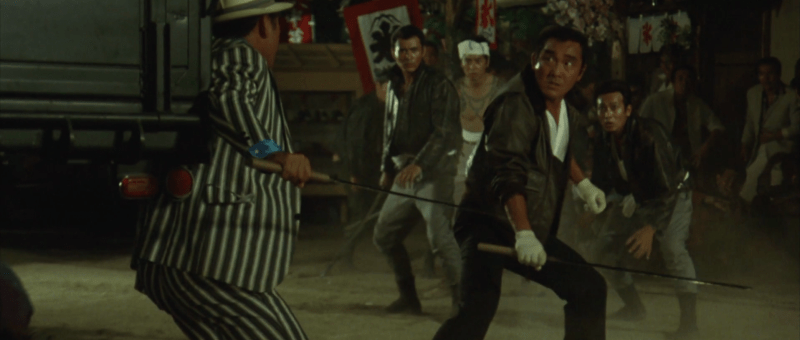
The ninkyo eiga, chivalrous tales of noble gangsters standing up for the little guy with decency and honour, had been Toei’s mainstay throughout the 1960s but a decade later the image of righteous yakuza had been well and truly imploded by the advent of the jitsuroku or “true account” movie which drew inspiration from real life tales of post-war gangsterdom using voiceover narration and onscreen text for added authenticity as it proved once and for all that there was no “honour and humanity” to be found in the gangster life only nihilism and futility. Still, the ninkyo, like many of its heroes, proved hard to kill as 1984’s Story of a Man Among Men (修羅の群れ, Shura no Mure) perhaps proves. A throwback to an earlier era with its infinitely noble hero and unexpectedly if not quite happy then defiantly positive ending, Kosaku Yamashita’s manly drama nevertheless adopts some of the trappings of the jitsuroku in its infrequent use of voiceover and emphasis on concrete historical events. 

The hero, Ryuji Inahara (Hiroki Matsukata), is like many heroes of post-war gangsterdom an orphan though his story begins in the mid-1930s as he’s recruited by a friendly yakuza at a karate dojo. As his teacher explains, Ryuji has already been offered a job with the police but given the chance to join the other side instead immediately agrees, explaining that his life’s ambition has been to gain revenge against the force that ruined his father and destroyed his family, gambling. He chooses to do this, however, not by destroying gambling dens everywhere but by becoming a gambler himself determined to be a winner which is, it seems, a textbook example of having learned the wrong lesson. Still, his noble gangster cool stands him in good stead in the yakuza world where he quickly earns the loyalty of other men, rapidly advancing up the ranks to head his own gang by the crime heyday of the mid-1950s. 

As the title implies, this is a story of a man, a very manly man, among other men. The gangster world is intensely homosocial and founded on ideas of brotherhood and loyalty. Thus, Ryuji finds a surrogate father figure in fellow gangster Yokoyama (Koji Tsuruta) who constantly gives him advice on what it is to be a proper man. “Don’t be a fool, don’t be too smart, and most of all don’t be half-hearted” he advises, later adding “you can’t be a man if you’re dirty about money”, and “taking action isn’t the only way to be a man. It takes a man to have patience.” (this last one as Ryuji hotheadedly discharges himself from hospital to get revenge on a punk who got the jump on him outside a shrine). To be a man, Ryuji intervenes when he sees some less than honourable young toughs hassling an old couple running a dango stand at the beach and the young woman from the caramel stall next-door, throwing his entire wallet on their counter to make up for the damage in what will become something of a repeated motif. His manliness earns him the eternal devotion of the young woman, Yukiko (Wakako Sakai), who eventually becomes his devoted wife against the will of her concerned mother who is nevertheless brought round on realising the love she has for him because of his intense nobility. 

Indeed, Ryuji lives in a noble world. He’s a gambler by trade but only because he hates gambling and is trying to best it. He doesn’t participate in the seedier sides of the yakuza life such as drugs or prostitution and is also in contrast to jitsuroku norms a humanist who defiantly stands up against racism and xenophobia, taking another gambler to task for using a racial slur against a Korean opponent while opting to befriend the “foreign” gangs of Atami when eventually put in charge of the lucrative area rather than divide and conquer. This is apparently a lesson he learned from his flawed but goodhearted father who hid a Korean man and his daughter from the pogroms after the 1923 earthquake because “we’re all the same human beings”. Spared the war because of an injury to his trigger finger, Ryuji kicks off against an entitled son of a gang boss for acting like a slavedriver while working at a quarry but earns only the respect of his superiors further enhancing his underworld ties because of his reputation as a standup guy willing to stand up to oppression. 

Such an intense sense of uncomplicated righteousness had perhaps been unseen since the ninkyo eiga days, and Ryuji’s rise and rise does in that sense seem improbable as his goodness only aids his success earning him the respect of over 1000 foot soldiers even as he finds himself in the awkward position of having to exile one of his most trusted associates for getting too big for his boots and disrespecting the yakuza code. His children also suffer for their connection to the gangster underworld, but are reassured that their father is a good man if with the subtle implication that he has damned them as his father did him. Shot with occasional expressionist flourishes such as crashing waves or a midnight sky, A Story of a Man among Men is not free from manly sadness and indeed ends on the sense of a baton passing from one era to another but does so with an unexpected sense of moral victory for its righteous hero who vows to bring his manly ideas with him into a new age of gangsterdom. 


Original trailer (no subtitles)