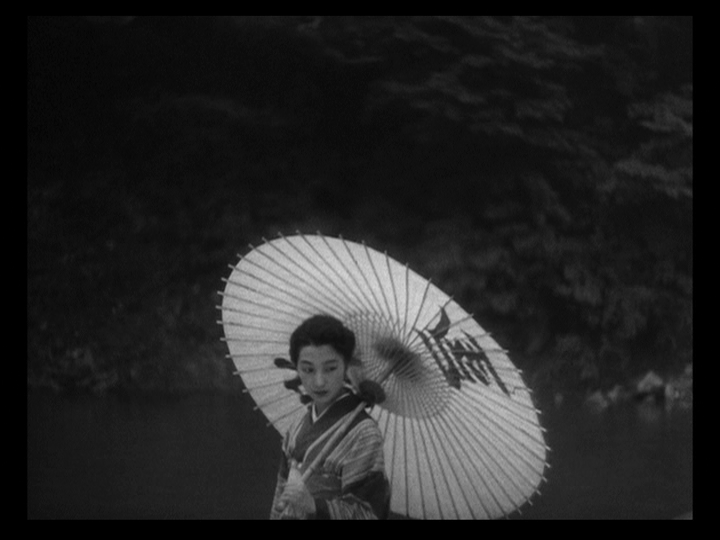
 Hiroshi Shimizu takes another relaxing sojourn in 1938’s The Masseurs and a Woman (按摩と女, Anma to Onna), this time in a small mountain resort populated by runaways and bullish student hikers. Once again Shimizu follows an atypical narrative structure which begins with the two blind masseurs of the title and the elegant lady from Tokyo but quickly broadens out to investigate the transient hotel environment with even a little crime based intrigue added to the mix.
We arrive at the resort town at the same time as the masseurs themselves who’ve walked all the way passing the time playing games with each other over who can guess how many children are in a group travelling the same way or counting how many people they manage to overtake on the road. Comically, their efforts to pass a group of students actually frighten them a little bit so they take off at speed meaning Fuku and Toku miss their daily target.
As well as the group of male students and another group of female ones, the town is also host to a mysterious and beautiful woman from Tokyo who seems both a little sad and a little scared with a tendency to overreact to small sounds and unusual situations. The other main group is a little boy and his uncle with whom he seems to have something of a troubled relationship.
Toku becomes fascinated with Michiho, the mysterious woman from Tokyo, whom he recognises because of her distinctive perfume. Though he is blind, he “watches” her – sensing where she goes and reading her emotional state. He seems to realise there’s very little possibility that she will return his interest, though he allows her to play on the obvious feelings he has for her, and the pair strike up a melancholic friendship. However, Michiho is only interested in making a play for the good looking uncle of the little boy who she has also befriended but the boy eventually goes cold on her, feeling a little rejected because she spends so long talking to his uncle. The two neglected guys, Toku and the boy, form their own kind of friendship as the blind masseur is the only person who is willing to have some fun with him in this slightly less than child friendly resort in which he’s unspeakably bored.
This being a holiday town, it’s a place that only exists for a small amount of time before sinking back into the mists like Brigadoon when the season ends. All things are transient here and everyone is just passing through. The friends you make are just for now and this brief respite from everyday life will fade from the memory like a pleasant dream. Toku ought to know this as he spends his life in such places, providing additional relief for the weary traveller, yet he still has a yearning to connect which is only exacerbated by the feeling that his blindness cuts him off from everyday society.
When a spate of bath house thefts occur and it turns out Michiho has been seen at each of the crime scenes, Toku comes to the obvious conclusion even though his feelings make him reluctant to suspect her. He tries to help Michiho evade punishment for what he believes are her crimes only to find out a very different sort of truth that sees her eventually decide to continue her journey onward to an uncertain future (though at least one that is 100% of her own devising).
Again, Shimizu opts for a lot of location shooting emphasising the beauty of the scenery and the tranquility of the atmosphere. Mostly he sticks to static camera shots, aside from one lengthly tracking sequence and the hand held finale walking after a departing cart, but when he tries to show us the vision of a blind man it’s a striking moment – a whirling chaos where we too can almost smell the elusive perfume of a woman we know is “beautiful” though we cannot see her, and also know is deliberately toying with us. A melancholy look at the transience of human relationships and the impossibility of true connection, The Masseurs and a Woman is a genre melding tragicomedy filled with innovative directorial flourishes that are once again far in advance of their time.
The Masseurs and a Woman is the third of four films in Criterion’s Eclipse Series 15: Travels with Hiroshi Shimizu box set.
This is the only video clip I can find but it’s not subtitled and it has quite a long speech about Hiroshi Shimizu’s career at the beginning so skip to 2:17 for the film itself:
 Feelings can creep up just like that, to quote another movie. Like Wong Kar-Wai’s In the Mood for Love, Temptation (誘惑, Yuwaku) also echoes Lean’s Brief Encounter with its strains of accidental romance between unavailable people even if only one of the pair is already married. However, this time there’s much less deliberate moralising though the environment itself is a fertile breeding ground for the judgemental.
 Windows on Worlds