Popran (ポプラン, Shinichiro Ueda, 2022)

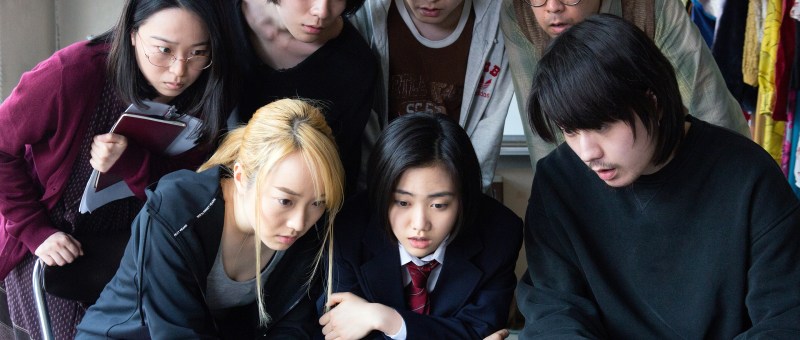
“Wieners are stuck to the body, they can’t go flying!” a confused father attempts to convince his toddler son, but as the young boy had said that isn’t quite the case. The hero of Shinichiro Ueda’s Popran (ポプラン) has been, well, to put it bluntly, a bit of a dick to just about everyone in his life but when even his bits seem to have become tired of his schtick it can’t help but provide something of a wakeup call. More surrealist morality drama than scatological comedy, Popran’s heart at least is in the right place as its hero attempts to, literally, piece himself back together to repair his fractured integrity. 

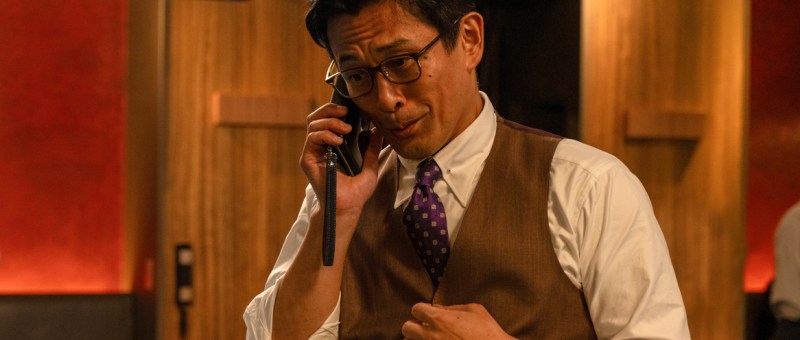
As we first meet 30-ish entrepreneur Tagami (Yoji Minagawa ), he’s being interviewed for a documentary that wants to explore the real lives of well-known people. As might be expected, the opening questions are fawning, pointing out his vast success at such a young age as the developer of app and manga publishing platform but the atmosphere soon changes when they stray into less positive territory. It seems Tagami’s success might have come as a result of betraying his old friend and business partner, while he also abandoned his wife and child to chase success in Tokyo and apparently has become estranged from his parents. His well-meaning PR shuts down the interviewer’s attempts to ask anything remotely challenging, yet it’s obvious that something inside Tagami is dying even as he reads out a cheesy speech he’d written about the importance of following the compass of your heart from a cue card held up by his assistant. 

We can see what kind of man he is or has been when an excited employee approaches him in the corridor about an exciting project but, feigning politeness, he has to ask his assistant who the guy was once he’s gone. At a birthday party for one of their writers, he leers over a woman sitting behind him and offers to introduce her to their editing department when she tells him she’s interested in writing something herself despite his clearly stated policy of not running original material only buying rights to distribute perennially popular series. It’s after taking her to bed with false promises that he discovers his penis is missing. 

More than a symbol of his masculinity, the errant penis is an indictor of his misplaced desires and lack of both moral fibre and impulse control. To achieve success he’s screwed over countless people besides the young woman who seems to have been the last straw for his literally alienated genitalia leaving a trail emotional chaos in his wake. After discovering that he is not the only one to fall victim to the “Popran” phenomenon he is forced to face himself, his moral cowardice, anxieties, and fears, and reckon with his sense of inadequacy and disappointment. Just as in the message he’d delivered to the youngsters watching the documentary, he too needs to take a look at the compass of his heart and realise he’s been reading it wrong chasing down his penis with a butterfly net before realising he knew where it was all along he just needed to go back to where it all started and remember who he really is. 

Then again, there is perhaps something of frustrated masculinity in Tagami’s quest. As his friend point out, he makes all his money exploiting other people’s labour while offering nothing new of his own. In the interview, he’d said he wanted to be a mangaka but felt he wasn’t good enough so decided to become a distributor instead setting up the company with a colleague from the manga cafe where he was working. But they parted ways because his friend wanted to publish original material and with his eye on the bottom line Tagami forced him out. Where his friend is now running a small studio from his apartment and even while not wealthy creatively fulfilled, Tagami has become rich but empty. Obviously that’s not to say there’s no value in the kind of work he does, but he’s begun to appropriate others’ success as his own with no real thought for their well-being. Chasing his dick around is also in its way a desire to regain his creative mojo as symbolised in his re-energised commitment to publishing original material rather than simply raking in royalties from safe and stable classics.  

As is often pointed out to him, his fantastical tale sounds like something out of a manga though Popran is certainly less reflexive than Ueda’s previous efforts telling a story which is much smaller in scale though also in its way heartwarming as the hero is pulled around by the penises of past and present if not future before reaching a moment of emotional maturity that allows him to exercise a more healthy control over his desires knocking his dickish behaviour on the head to wise up and realise being a man’s about treating others with respect and dignity. Some things you can’t just stick back on if they fall off, but you can at least acknowledge that you should have treated them better and resolve to be happy that they have at least found better futures as you might yourself if only you can figure out which compass to follow. 


Popran streams in Germany until 6th June as part of this year’s Nippon Connection.

Original trailer (English subtitles)

Images: Ⓒ ”Popran” Film Partners

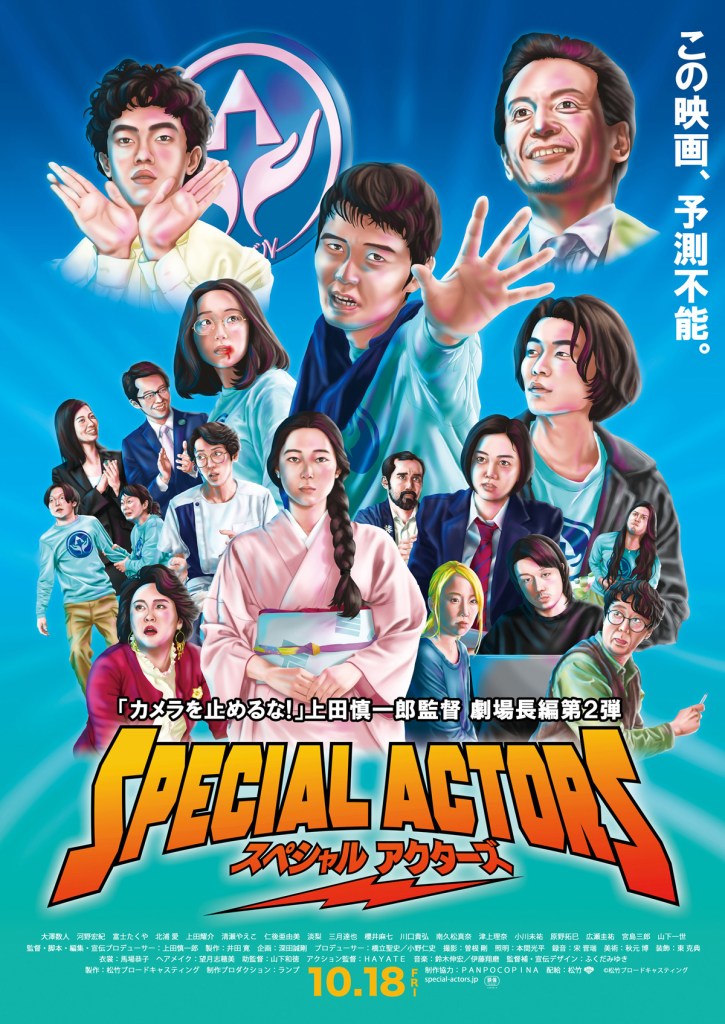
Special Actors (スペシャル アクターズ, Shinichiro Ueda, 2019)

When your made on a shoestring indie debut becomes an accidental international phenomenon, no one could really blame you for succumbing to imposter syndrome. Shinichiro Ueda’s One Cut of the Dead, a meta comedy with high concept conceit, delighted fans around the world but rather than slide into summer tentpole territory Ueda remains true to his roots with follow up feature Special Actors (スペシャル アクターズ) once again developed through actors’ workshops and owing a significant debt to contemporary stage comedy.

Our dejected hero, Kazuto (Kazuto Osawa), is an anxious young man burdened with PTSD from childhood trauma that causes him to faint when he becomes overly stressed or is confronted by an overbearing, if not actually violent, male authority figure. He dreams of becoming a hero who can protect people like Rescue Man, the star of an American tokusatsu-style show he’s obsessively watched dubbed into Japanese since childhood, and is determined to become an actor only his habit of fainting mid-audition constantly frustrates his ambitions. Already behind on his rent and about to be fired from his part-time job as a security guard on the grounds that he didn’t disclose his “illness” when he applied, Kazuto is reunited with his estranged younger brother Hiroki (Hiroki Kono), also an actor, who offers to introduce him to his agency, “Special Actors”. In addition to the usual TV and advertising work, Special Actors speciality is renting out talent for “real” as in providing professional mourners, bulking out theatre audiences with laughing stooges, and engineering long queues outside previously empty restaurants. 

Kazuto isn’t quite convinced, not only because it seems like anxiety central, but because it’s more than a little bit shady. The lead “scenario” writer was once a conman, and you can’t get away from the fact this is all quite manipulative and essentially unethical. Forced to take the job because of his financial predicament, he finds himself involved in various plots to change problematic behaviour at the request of well-meaning relatives such as a mother desperate to rescue her daughter from frittering all her money away at host bars. But are the Special Actors really any different than a host at a host bar who is after all only playing a role, as the young woman must know even if she has for some reason been taken in by it? Perhaps they’d be better to find out what is fuelling her obsession rather than coming up with some hokum involving a fake shaman to convince her that her behaviour is dangerous on a cosmic level. 

The moral ambiguity only deepens when the team take on their biggest challenge yet, taking down a shady cult at the request of an orphaned teenage girl whose sister seems primed to give away the family inn. Abruptly shifting into the realms of the espionage thriller reimagined as theatre, Ueda concocts an elaborate heist as the Special Actors infiltrate with the intention to expose. The central irony is of course that in practical terms there isn’t so much difference between them. They are both “lying”, manipulating vulnerable people and doing it for financial gain. “Acting is a big lie” the irate director had screamed in Kazuto’s face, “you have to mean it”. Is the shady cult merely “theatre” taken to an extreme, and if so who if anyone should be held responsible?

Ueda isn’t so much interested in these themes as the ironic potential of their latent comedy, stitching together a series of theatre skit set pieces working towards the epic finale in which the hero, Kazuto, learns to put on his cape and save the day by overcoming his internal “villain” in the shape of his abusive father. Like the cult, the Special Actors are also promising salvation or at least liberation from behaviours which others find problematic regardless of the target’s own wishes or desires even if in the case of some it may be for their own good, a more elaborate form of role play than that enacted in a therapy session. We are indeed all “acting” to one extent or another and you can never be sure that anyone is who they say they are because life itself is theatre. Shot with a perhaps thematically appropriate TV drama aesthetic, Kazuto’s zero to hero journey is pure wish fulfilment fantasy, but even if never reaching the perfectly constructed heights of One Cut of the Dead is undeniably entertaining. 


Special Actors is available to stream in the US until July 30 as part of this year’s Japan Cuts. Tune in for the live Q&A (available worldwide) after the movie on July 17 (also available afterwards on demand)!

Original trailer (English subtitles)

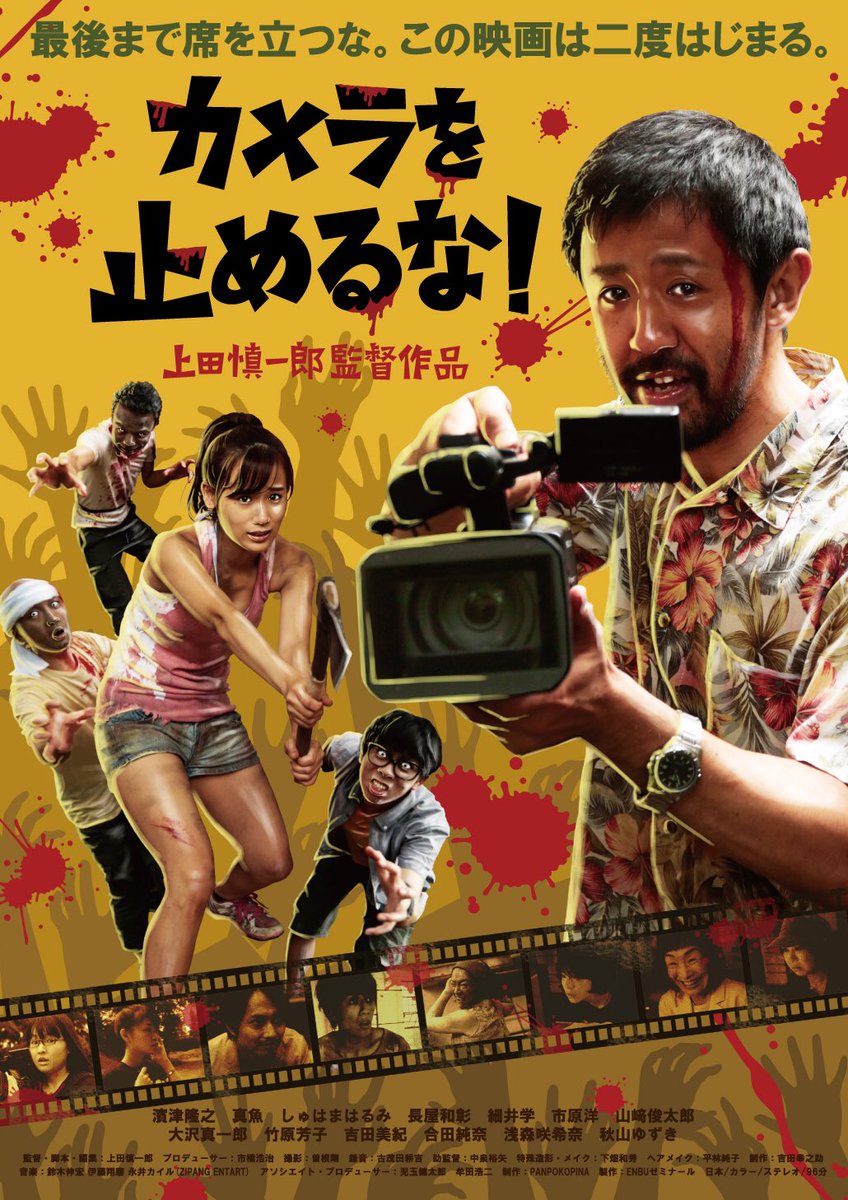
One Cut of the Dead (カメラを止めるな!, Shinichiro Ueda, 2017)

One Cut of the DeadYou know how it is – you turn up to make a low budget zombie movie in a disused water filtration plant apparently once used by the military for dodgy human experimentation and a load of real zombies suddenly turn up to join the fun. Then again, at least zombies don’t have over protective managers hovering on the sidelines or require catering services so in some ways they are the perfect extras. The debut feature from Shinichiro Ueda, One Cut of the Dead (カメラを止めるな!, Camera wo Tomeru na!) is a clever bait and switch, opening with a frenetic low budget zombie chase sequence before cutting to behind the scenes where just about everything is going hilariously wrong.

As the film opens, an actress is in the middle of the 42nd take of a scene in which she is attacked by her zombified boyfriend when the director yells “cut” and begins berating her for her non-existent acting skills before storming off in a huff. The actress, the boyfriend, and the makeup artist whose many hobbies include women’s self defence are enjoying a cup of coffee when a bunch of real zombies suddenly show up with murderous intent. All shot in one cut, the 40 minute chase sequence is a celebration of all things zombie with appendages flying off with gay abandon as blood soaks the screen and our plucky heroine ends up somehow in the middle of a pentagram painted on a rooftop.

Viewers who aren’t paying attention and attempt to leave after “credits” roll will be doing themselves a huge disservice – this high impact opening has been something of a ruse to take us into the real meat of the drama in the zany backstage antics in which just about everything is going just about as wrong as it could possibly go. It turns out “One Cut of the Dead” is a one camera one cut TV special made to launch a brand new zombie channel. Our director, Higurashi, who played “The Director” in One Cut, has found himself at the helm because no one else would take on such an outrageous proposal and, unlike his onscreen counterpart, is too kind and mild mannered to say no.

Higurashi’s career has perhaps become zombified in itself. The producers have chosen him for his ironic slogan – “Fast, cheap, but…average”, and he’s made his way in the minor TV film biz by keeping his head down and just getting on with the job even when it’s as “inconsequential” as a reconstruction sequence for cheesy TV news item. The chance to direct a drama is then an exciting one even if it’s for an equally cheesy TV horror show with a gimmick that’s doomed to fail.

Thus he finds himself on set with a pair of idols – she constantly worrying about what her agency will say to the various problems presented by being in a zombie movie, and he constantly rude and arrogant. Meanwhile, a previous acquaintance of Higurashi’s set to play the cameraman has a serious drink problem, the actor playing the boom operator has a series of digestive issues, and the woman playing the makeup artist is in a car accident with the man playing the director just a couple of hours before the camera rolls. Improvising wildly and making fantastic use of a set of cue cards, Higurashi manages to keep it all together despite the ensuing chaos.

The real genius of the film lies in the cleverness of the original bait and switch. The aesthetic of the zombie sequence is pure low budget horror with noticeably low grade camera quality and deliberately iffy special effects. On the first pass through there are several moments that look like shoddy direction – Higurashi talks to the cameraman who isn’t supposed to be there, the three actors witter on about nothing, the actress continues screaming for way too long etc but each of these mini moments loops back perfectly into the second half farce in which the crew is desperately trying to overcome several obstacles at once and keep the camera rolling to get through the 30-minute live broadcast without anyone noticing.

In the background, Higurashi is also facing some minor family drama with his grown up daughter who wants to direct but needs to work on her people skills. Her keen eye for detail and youthful ingenuity eventually helps the crew figure out a way to keep going, but in the end it’s teamwork that sees them through as they learn to overcome their differences and work together to get what they need. Hilarious, self aware, and filled with homages to classic horror, One Cut of the Dead is an oddly warmhearted comedy in which the zombies are the least of anyone’s worries.


One Cut of the Dead received its international premiere at the 20th Udine Far East Film Festival and will be released in the UK by Third Window Films later in the year.

Original trailer (English subtitles)