
Angry Rice Wives (大コメ騒動, Katsuhide Motoki, 2021)

“Even if women try to do something, nothing will change” a condescending husband insists cautioning his wife not to take part in any more protests lest he lose his protected status and the family its source of income. Set in the middle of the Taisho era, Angry Rice Wives (大コメ騒動, Dai Kome Soudo) dramatises a small moment of revolution in which the resistance movement organised by a community of women towards the spiralling cost of rice sent shock waves through a changing society and in its own way provoked a change of course in an increasingly capitalistic society. 

Beginning in April 1918, the small fishing village of Toyama sees an exodus of its young men who must spend the off-season when the catch is low working other jobs in order to make ends meet, This necessarily means their wives and families are left behind and must make do with what they themselves can earn in doing menial jobs such as transporting rice and the little their husbands might be able to send before their return. A farmer’s daughter who married into the fishing community, Ito (Mao Inoue) is one of the few literate women in the village and looked to as a kind of oracle reporting the contents of the morning paper to the other wives who are keenly interested in the continually fluctuating price rice which seems set to rise still more with news that Japan plans to send troops to Siberia. 

As the voiceover relates, with the catch so low rice is the only form of sustenance available but prices have already exceeded what most of the women can earn in a day leaving them unable to feed their feed their families and giving rise to increasing discontent with the inequalities of the contemporary social order. Taking drastic action and led by eccentric old woman Kiyonsa (Shigeru Muroi), they stage a rebellion by intercepting their locally grown rice in order to stop it being sent to Hokkaido which is reported in the newspapers as an “uprising”. The term is indeed a little grand for what actually took place, but it does at least seem to spark a spirit of rebellion echoing around the country even if nothing much as changes in Toyama. Buoyed by a sense of wider support, the women continue their protests merely asking for the rice merchants to sell at a more reasonable rate (which they are perfectly capable of doing) while decrying the immorality of the obvious profiteering by corrupt authorities including local bigwig Kuroiwa (Renji Ishibashi) who are deliberately stockpiling rice to push the price up while planning to sell it to the government for a hefty price to feed their troops. 

Kuroiwa is entirely unsympathetic to the women’s predicament while the local police chief Kumazawa (Junichi Uchiura) believes himself indebted to him and is therefore entirely under his thumb. Neither of them think the women are much of a threat, Kumazawa randomly arresting a middle-aged man close to several of the women the rationale being as the husband of one puts it that women can never achieve anything no matter how hard they try but a man’s involvement in such rebellious activity would be cause for concern. Similarly, Ito is often told that her education is of no use, partly because the other women feel inferior for not having any, but struggles to find the self-confidence to standup to the corruptions of lingering feudalism owing to her liminal status as a non-native villager despite having given birth to three children there. Even so she is often looked to as a local problem solver and potential successor to Kiyonasa as leader of the village women if only she could learn to embrace the courage of her convictions. 

The children, by contrast have no such qualms, Ito’s young son Soichiro directly telling the profiteering proprietress of the rice store Mrs Washida (Tokie Hidari) that it’s her own fault another child stole food because if she hadn’t insisted in pricing her customers out to the point that they were starving she would never have needed to steal. “What exactly has capitalism done for us?” an opportunistic visitor from the workers party asks but receives short shrift from the cynical Kiyonsa who agrees they should rebel but is non-plussed by the flummoxed canvasser’s admission that he has no real plan for what do afterwards. Washida plays divide and conquer, pitting the women against each other and tempting even Ito with offers of under the table rice deals to feed their starving families if only they back down but though the solidarity of the women is temporarily ruptured it is never truly broken as they stand together to fight for fairness in the face of the Kuroiwas and Washidas of the increasingly capitalistic society. Their resistance eventually forces the government to backdown, realising they can’t simply ignore the plight of society’s poor or take their complicity for granted while attempting to starve them into submission. 


International trailer (English subtitles)

Dreaming of the Meridian Arc (大河への道, Kenji Nakanishi, 2022)

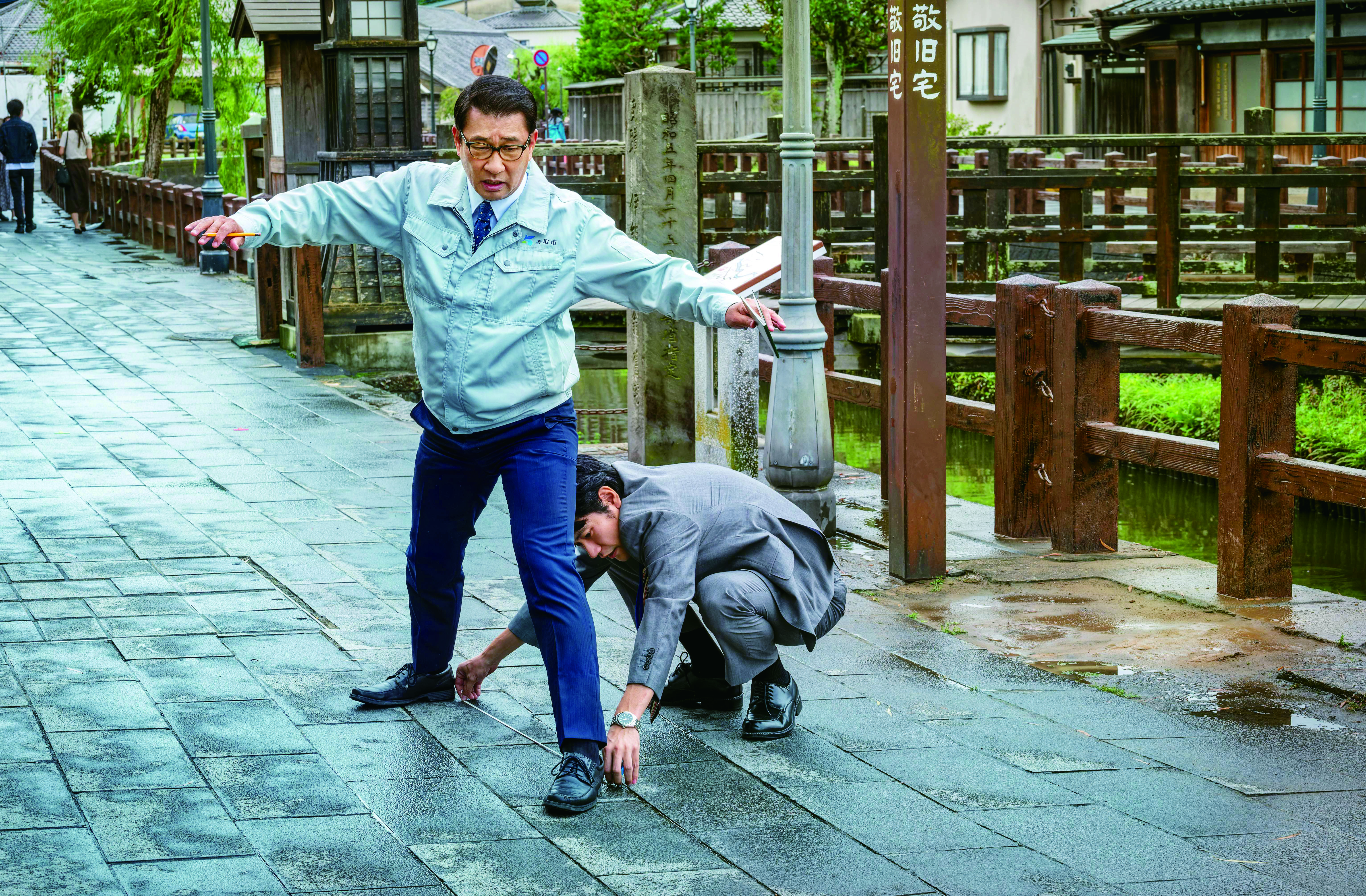
As it turns out, the modern world is not so different from the feudal after all. After realising that their friend and mentor has passed away, a team working together to create an accurate map of Japan in the early 19th century are immediately worried that their project will be axed as a part of a cost cutting exercise at the hands of the penny-pinching Shogun. Inspired by Shinosuke Tatekawa’s rakugo story, Kenji Nakanishi’s heartwarming dramedy Dreaming of the Meridian Arc (大河への道, Taiga e no Michi) tells parallel tales of hardworking civil servants trying to put their town on the map and Edo-era officials trying to avoid incurring the Shogun’s displeasure so they can ensure their late friend’s life’s work will eventually be finished. 

In the present day, the small town of Katori is trying to think of ways to raise its profile but according to junior civil servant Kinoshita (Kenichi Matsuyama) the programme proposed by the tourist board has little to offer in simply imitating the initiatives of other better known cities. As he points out, if tourists want to experience life in olden times there are lots of places they can do that already. Chief of General Affairs Ikemoto (Kiichi Nakai) idly suggests that they try and get local historical personannage Chukei-san, better known as Ino Tadataka the man who completed the first accurate map of the Japanese islands, featured as the subject of a year-long historical TV drama. Of course, Kobayashi from the tourist board (Keiko Kitagawa) thinks it’s a silly idea, but the governor likes it so Ikemoto now has a very difficult job not least because the governor wants him to convince a grumpy writer who hasn’t written anything in 20 years to handle the script. 

The reason Kato (Isao Hashizume) retired from screenwriting is that he too was fed up with placating commercially-minded executives and isn’t prepared to work on anything in which he doesn’t have full creative control which might be a problem a civil servant like Ikemoto could sympathise with if he wasn’t so desperate to bring him on board. It can’t be denied that the story of the map’s creation is itself fascinating if only in its technical detail of how these men were able to complete a map which almost perfectly aligns with modern aerial photography using only the technology of the early 19th century. As Kato points out, Tadataka was already in his 70s and the bulk of the work is simply walking all around Japan measuring it step by step. He’d only begun the project because he wanted to figure out the size of the earth by charting the Meridian Arc, but figured that out right away and still went on to work on the map for reasons largely unknown though later hinting a sense of anxiety in the late Edo society in believing that understanding the shape of the nation’s coastlines was the key to national defence in the wake of a Russian attack that had cost two of Tadataka’s local helpers their lives. 

Yet the drama idea is pretty much dead in the water after realising that Tadataka “died” three years before the map was completed. Fearing they’d lose their funding, Tadataka’s team buried him in secret and told people he was simply out on location while trying to finish the map before anyone found out knowing that their lives were at risk if the Shogun discovered they’d been lying to him and assumed they’d been doing it to continue claiming Tadataka’s stipend. To ram his point home, Nakanishi has the civil servants taking on the role of the mapmakers in Kato’s putative version of the story as they come together as a team to finish their mentor’s project but are eventually forgotten by history in much the same way as Ikemoto and his team will eventually be even as they too work for their betterment of their nation by taking care of the community. Ikemoto becomes something of a Tadataka figure, deciding to pickup a new skill in middle-age and aiming high in perfecting it (while slightly misleading the boss as he does so). A heartwarming tale of the value of teamwork and the perils of bureaucratic cost cutting, Nakanishi’s historical dramedy implies that not so much as changed in 200 years but that’s not entirely a bad thing as the dedicated team of civil servants do their best to put their city on the map.


Dreaming of the Meridian Arc screens at Japan Society New York on Nov. 12 as part of The Female Gaze: Women Filmmakers from JAPAN CUTS and Beyond.

Original trailer (no subtitles)

Images: ©2022 “Dreaming of the Meridian Arc” Film Partners

The Island of Cats (ねことじいちゃん, Mitsuaki Iwago, 2019)

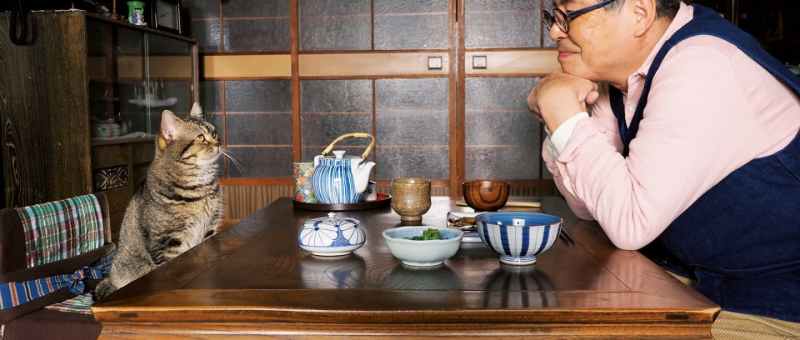
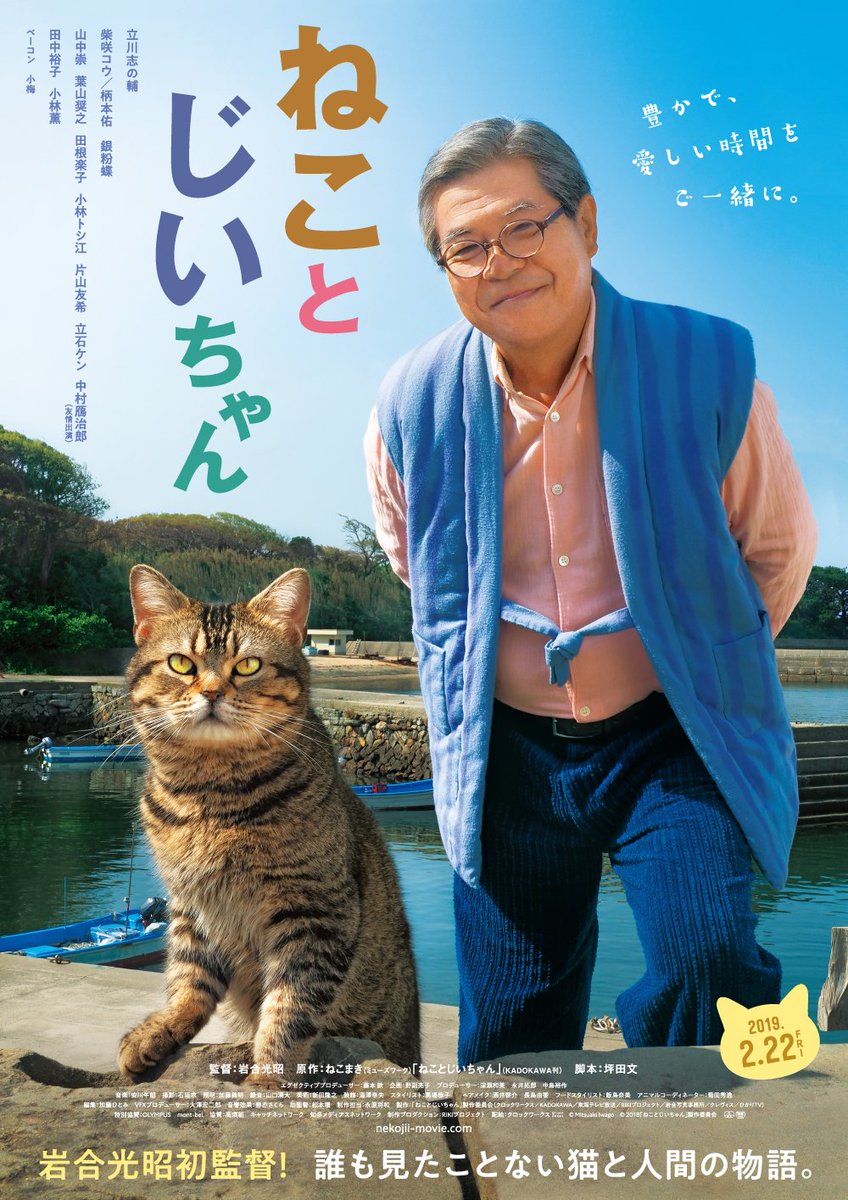
Island of Cats Poster“The best is yet to come” resolves 70-year-old Daikichi (Shinosuke Tatekawa) at the conclusion of The Island of Cats (ねことじいちゃん, Neko to Jiichan). Inspired by the manga by the appropriately named Nekomaki, the debut feature from wildlife photographer Mitsuaki Iwago is a decidedly laidback affair, neatly fusing two genres of Japanese comfort cinema – cats and cuisine. It’s also another in the recent run of films deliberately targeting the older generation in its quiet celebration of community and late life serenity, but it’s very existence is also perhaps a mild dig at cold and frenetic Tokyo which can’t help but pale next to the island’s inherent charms.

Daikichi has lived alone with his cat, Tama (who neatly introduces himself using the exalted “Wagahai” in a reference to Soseki’s famous novel), since his wife Yoshie (Yuko Tanaka) passed away two years previously. He has a grown-up son (Takashi Yamanaka) who is married with a teenage daughter of his own in Tokyo, but mostly spends his life hanging out with his old friends and playing with the island’s many cats. His peaceful days begin to change, however, when a pretty middle-aged (“young” to Daikichi and his friends) woman, Michiko (Kou Shibasaki), arrives from Tokyo and opens a cafe – the island’s first. In fact, the older generation find the cafe slightly intimidating, thinking such modern innovations are only for the youngsters, but are finally tempted in when directly invited by Michiko herself who serves up a selection of cream sodas and tasty ice creams in addition to slightly more rarefied treats like fish carpaccio.

In contrast to many an island drama, though the bulk of the population is older there are a fair few youngsters around and plenty of children too – at least enough to keep the local school open and the ferries running frequently. It is true however that most leave when they come of age either heading off to university on the mainland or seeking their fortunes in the cities. Nevertheless, the despite the absence of family the elderly are well cared for by the recently arrived young doctor (Tasuku Emoto) who takes his responsibility extremely seriously and is grateful for the opportunity to come to the island because it’s enabled him to become the kind of doctor he always wanted to be.

Michiko, meanwhile, has come to the island in search of relief from city life which she felt was gradually crushing her. An instant hit with the local cats as well as Daikichi and his friends, her presence adds a new energy to the island as the older generation start to enjoy both trying new things they thought perhaps were “inappropriate” when you’re old, and revisiting those they missed out on in their youth. Friends reconnect, bickering is exposed as an odd kind of affection, and cats just generally make everything better. The island may be dull compared to the bright lights of Tokyo, but it has its charms and those that live there are one big family taking care of each other and enjoying the laidback rhythms of coastal life.

Daikichi’s son, visiting when he can, is keen for him to come and live with the family in Tokyo but he and Tama are happy enough on the island just muddling through the way they always have surrounded by friends and happy memories. Reconnecting with his late wife through the recipe book she left behind, he resolves to learn a few dishes of his own – filling the rest of the pages with recipes learned from Michiko, his friends, newspapers and TV, determined to go on learning as long as he can. Sharing his life with others on the island, Daikichi too finds a new zest for living even as his days pass much as before, resolving that there is still plenty more to enjoy as he enters his twilight years. Gentle and mellow in the extreme, The Island of Cats is not promising much more than living up to its name but does its best to sell the charms of serene island life as Daikichi and his friends rejoice in the simple pleasures of shared cuisine and admiring “everybody’s” cats as they continue to do pretty much whatever they please while warming the hearts of the kindly islanders as they enjoy their days of fun and sunshine with nary a care in the world.


The Island of Cats screens in New York on July 20 as part of Japan Cuts 2019. It will also screen in Montreal as part of the 2019 Fantasia International Film Festival on July 28.

Original trailer (English subtitles)