Strangers (Kenta Ikeda, 2024)

Naoko, the heroine of Kenta Ikeda’s Strangers, says she’s been pretending all her life. She’s been pretending to be what everyone wanted her to without really knowing or thinking about what it was she wanted to be or who she really is. On a baseline level, Ikeda suggests that we are and remain strangers to ourselves while equally confused about those around us, seeing what we want or expect to see rather than who they really are.

In part that may explain why Naoko has stayed with her unfaithful fiancé Takeo who got a colleague pregnant and then seemingly abandoned her. Shimizu then began harassing Naoko, stalking her and making silent calls. To make matters worse, Takeo is often away on “business trips”. He’s not currently responding to her phone calls or messages and has just embarrassed her by not turning up to a family event. Naoko’s sister thinks she should leave him and doesn’t understand why she hasn’t already. But Naoko just sighs that she’s decided not to expect too much from life and seems prepared to put up with this degradation because she doesn’t think she deserves anything better. 

That might be why she’s so drawn to her enigmatic colleague Yamaguchi who waltzes in past noon wearing a distinctive blue dress that floats in the air behind her. The other ladies at work gossip that their bullying boss Satome, who is married with two children, got her the job after picking her up on a dating app and the reason why she can get away with such unprofessional behaviour is because she’s sleeping with him. But Naoko later discovers that Yamaguchi’s dating app activities are a kind of side hustle in which she participates in idealised dating scenarios pretending to be the lover of lonely men who pay her handsomely for a few hours of fantasy romance.

Or as Yamaguchi describes it, the opportunity to experience only the good parts of love before you get sick of each other and run out of things to say. It sounds more than a little like the logic of someone who’s decided not to expect too much from life, and while it seems Yamaguchi may be trying to avoid her own grief and loneliness, it’s true that she otherwise remains a cypher. After losing contact with Yamaguchi and being left with her smartphone, Naoko receives a call from her handler who tells her that it doesn’t matter who she is or why she has “Yamaguchi’s” phone, all that matters is turning up at the appointment and never letting it slip that it’s all just role-play.

On her dating app profile, Yamaguchi’s face is blurred so that you only really see the image of her in her distinctive blue dress which Naoko too later starts wearing. The people around Naoko are often shot in soft focus so that we can’t really be sure of their identity beyond using their clothing to infer who they are. Men in particular are often shot from behind or with their faces out of frame as if they were all just a much of a muchness. We never even meet Takeo, who apparently does not return from his “business trip”. In any case, in agreeing to the fantasy date, Naoko is gradually taken over by the Yamaguchi persona. The spread of the graze she sustained at the beginning of the film seems to indicate the gradual erasure of her identity, yet in another sense becoming Yamaguchi also gives Naoko an excuse to stop pretending and accept herself or at least to start expecting more from life. She becomes more assertive, flirtatious, and confident in confronting Shimizu only to realise that she may not have been the mysterious force she felt watching her after all. 

In her Yamaguchi persona, Shimizu describes Naoko as a like a colourless and doorless detergent, but she replies she’s been hiding all her life. She ran ran away from her problems, refused confronting Takeo or Shimizu, avoided being honest with her family and simply played up to the image they had of her of a shy and obedient woman. There might be something in the fact that Yamaguchi kisses her suggesting that Naoko may have been running away from her sexuality, but equally it could just be that this is how the Yamaguchi curse is passed from woman to woman. Having once assumed it, Naoko now must try to shake it off but that too might not be as easy as she might assume. Meanwhile, those around her also have their own secret lives and faces they keep hidden from others. Ikeda creates a atmosphere of eeriness and hovering violence amid the faceless city where it doesn’t matter who you are so long as you show up and everyone is to some extent participating in a temporary fantasy in order to overcome the disappointment of life in which as Naoko had told herself it seems better not to expect too much.
Funuke Show Some Love, You Losers! (腑抜けども、悲しみの愛を見せろ, Daihachi Yoshida, 2007)

“We’re family, I’m sure we’ll understand each other” a conciliatory big brother tries to console, but family is it seems a much more complicated matter than one might assume it to be in Daihachi Yoshida’s debut feature, Funuke Show Some Love, You Losers! (腑抜けども、悲しみの愛を見せろ Funukedomo, Kanashimi no Ai wo Misero), adapted from the novel by Yukiko Motoya. Released in 2007, Yoshida’s film is one among a series of cynical reevaluations of the meaning of “family” in the contemporary society but eventually skews towards the uncomfortably conservative in its implicit suggestion that a family which is not bound by blood cannot succeed while even blood connection may prove inherently toxic. 

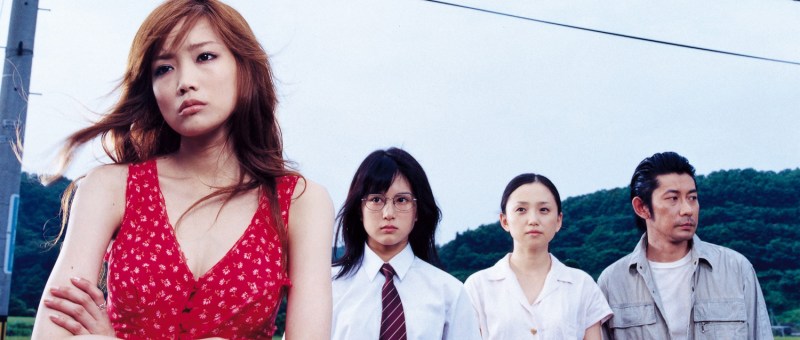
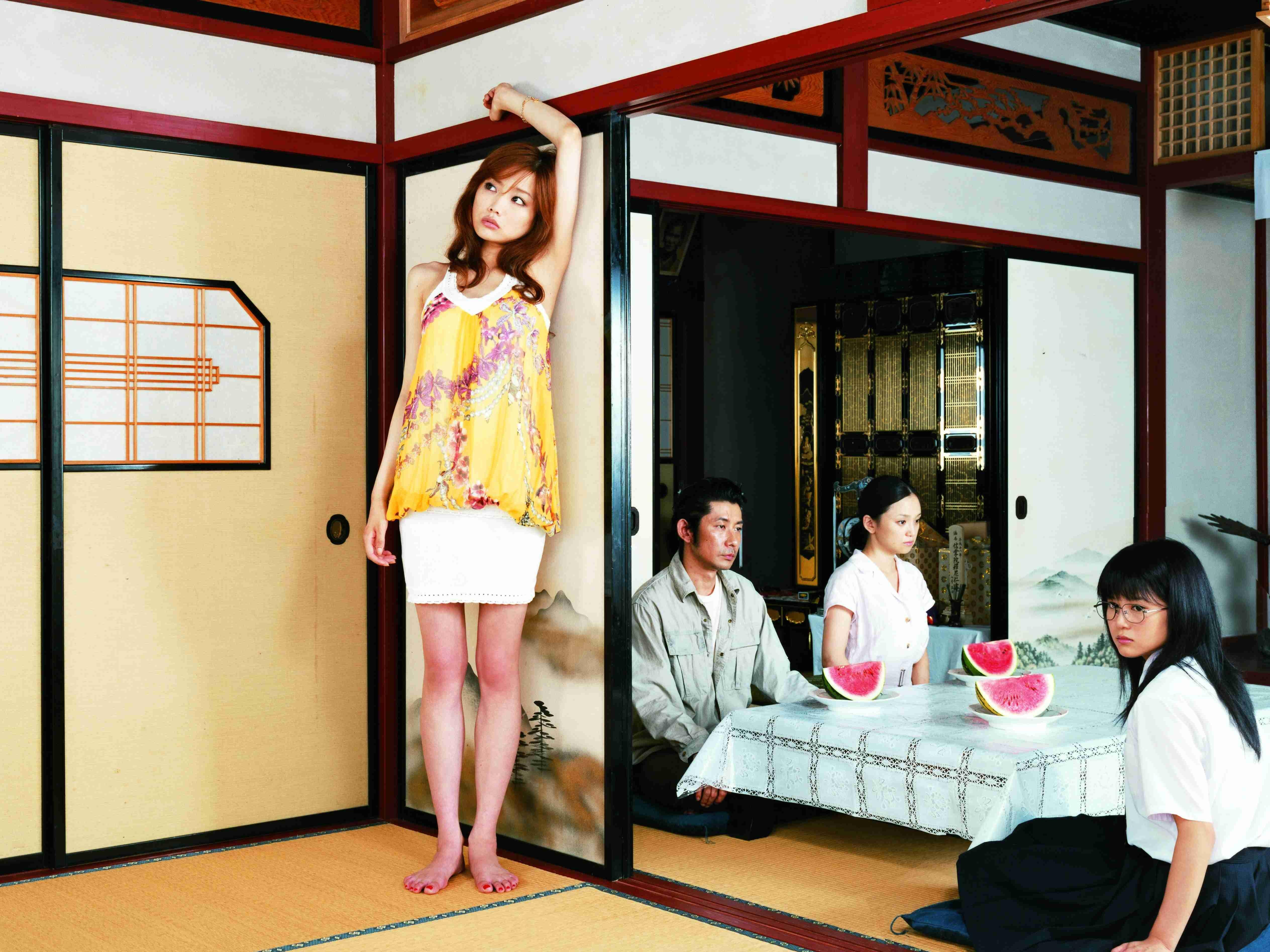
Fittingly the film opens with a freak yet largely offscreen accident as Mrs & Mrs Wago are killed by a runaway bus while attempting to save a stray cat, an event witnessed by their 18-year-old daughter Kiyomi (Aimi Satsukawa). The Wagos were a blended household, Kazuko and Shutaro having married later in life and bringing with them their children from previous marriages in Kazuko’s daughters Sumika (Eriko Sato) and Kiyomi, and Shutaro’s son Shinji (Masatoshi Nagase). Four years previously, Sumika left home after a traumatic family incident with the aim of becoming an actress in Tokyo, while her place has perhaps been taken by Shinji’s new wife Machiko (Hiromi Nagasaku) whom he has only recently married. Yet Kiyomi seems more perturbed by the possibility of her sister’s return than she is grief-stricken by her parents’ death, while Sumika barely glances at the altar on her arrival immediately treating Machiko as a servant sent out to pay the taxi and collect her bags. 

As we quickly gather, Sumika is an intensely narcissistic, self-absorbed sociopath intent on manipulating everyone around her in order to assume a position of dominance yet her resentment is perhaps the only thing glueing the family together. Her grudge against Kiyomi apparently stems back to her having used her for inspiration for a manga about a young woman driven to psychotic violence in her ambition to become an actress which later won a prize and was printed under her real name with the consequence that everyone in town quickly realised it was about her. Sumika repeatedly uses this excuse as to why she hasn’t been successful, that the manga forced her into a moment of introspection that destroyed her self-confidence, later saying something similar to an unresponsive audition panel bearing out her tendency to blame her failures on others. Yet Kiyomi apparently feels intensely guilty. “I never thought of myself as the kind of person who’d turn her family into manga for money” she laments shortly after Sumika attempted to boil her to death in the bath, “I want to transform into the kind of person who can sympathise with family members’ pain”. 

“Family means supporting each other at times like this” the relentlessly cheerful Machiko had tried to comfort Kiyomi at the funeral, yet she is constantly reminded that she is not quite included as a family member. Shinji tells her to keep out of family business and later to avoid getting between the sisters, denying her an equal status within the home despite the reality of their marriage. Ironically enough, Machiko was abandoned at birth and raised in an orphanage apparently so desperate to belong to a family that she willingly puts up with Shinji’s abusive treatment while making creepy dolls as a hobby. Yet at the end of the film it’s she who is left on her own, inheriting the family home, while the two blood sisters are eventually forced out but bound to each other if only in unresolved and continual resentment. 

Nevertheless there is also a degree of pathos in the series of frustrated dreams which prevent each of the siblings from escaping the otherwise perfectly nice if dull rural hometown where they were born. Sumika’s tragedy is her refusal to accept she has no talent and is unlikely to find career success because she is an unpleasant person, a meta plot strand seeing her writing letters to a director whose new movie is apparently about whether you can love someone you’ve only communicated with remotely and never met. Sumika seeks only dominance, manipulating her siblings through guilt and shame in order to encourage a sense of dependence while also dependent on them for financial support. Her need prevents either Kiyomi or Shinji finding happiness, their attempts to escape her control eventually leading in very different directions. 

Unlike similarly themed familial dramas, Funuke situates the fault line in its dysfunctional family not in the changing society but in its lack of blood relation while eventually suggesting that even the blood bond between the two sisters is more grimly toxic than it is supportive. In an odd way, it leaves Machiko as the winner while uncomfortably implying that her orphanhood prevents her from becoming part of a conventional family, literally left home alone. A more literal translation of the title might be “show some miserable love, you cowards”, suggesting that these anxious siblings are too afraid of themselves and each other to embrace familial affection Kiyomi eventually affirming “In the end I couldn’t change either, sorry”. While the limitations of early digital photography may not stand up a decade and change later, Yoshida’s occasionally experimental flair including an entire sequence playing out as manga panels helps to overcome the unfortunate lifelessness of a typically 2000s low budget aesthetic while the universally strong performances do their best to gain our sympathy in an otherwise cruelly cynical, if darkly humorous, take on post-millennial family dynamics. 


Funuke Show Some Love, You Losers! is available on blu-ray in the UK from Third Window Films.

Trailer (English subtitles)

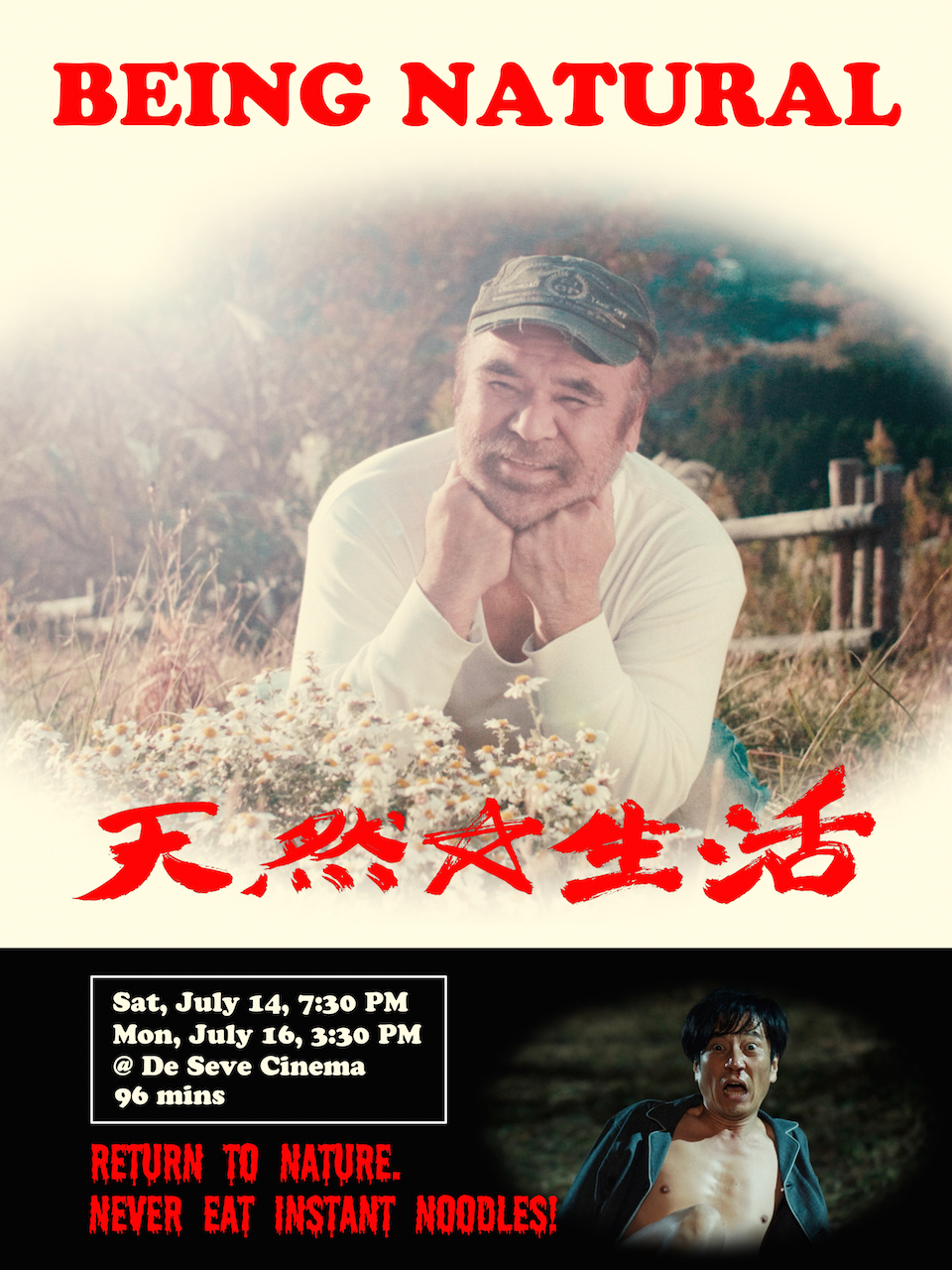
Being Natural (天然☆生活, Tadashi Nagayama, 2018) [Fantasia 2018]

Being Natural posterModern life is stressful and perhaps does not offer the kinds of material rewards that previous generations took for granted. Moving back to the country to experience a simpler, more sincere kind of life has become a mini trope in contemporary Japanese cinema as the young men and women of Japan become disillusioned with a stagnating economy and, feeling trapped within a conformist society, decide to embark on a life of self sufficiency free of material burdens. What such stories have not yet asked is if the influx of outsiders from the city amounts to a colonisation of so far untouched land as the newcomers bring with them their newfangled desires and attitudes. Tadashi Nagayama’s gentle satire Being Natural (天然☆生活, Tennen Seikatsu) is partly an attack on rampart xenophobia and small scale colonialism but also a mild condemnation of corporatised hippiedom and its tendency to destroy the thing it claims to honour in remaking it to fit a city dweller’s ideal of idyllic country life.

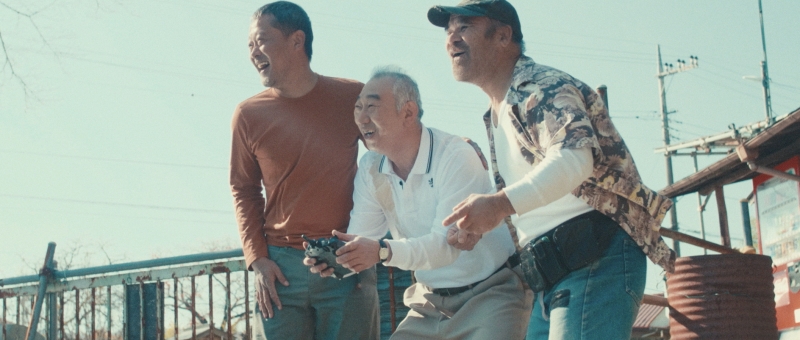
Shy and awkward, Taka (Yota Kawase) is an unemployed middle-aged man who lives with his elderly uncle in the ancestral family home. Taka’s uncle suffers from dementia and, it seems, was always a “difficult” person even in his youth which is perhaps why the rest of the family have abandoned him with only the gentle Taka prepared to stay behind and look after the ageing patriarch. When his uncle dies, Taka’s world threatens to collapse but thankfully his embittered cousin Mitsuaki (Shoichiro Tanigawa) is talked round by his sister and decides to let Taka stay in the family home as a thank you for taking care of everything for so long. Not only that, Mitsuaki also gets Taka a job working at the local fishing pool alongside another old friend, Sho (Tadahiro Tsuru).

Reverting to childhood, the three men generate an easy camaraderie, looking after turtles, having barbecues, and making music together under the moonlight. The idyllic days are not to last, however. The harbingers of doom are a hippyish family from Tokyo who moved into the village with the intention of opening a coffee shop. The Kuriharas – Keigo (Kanji Tsuda), his wife Satomi (Natsuki Mieda), and daughter Itsumi (Kazua Akieda), are into the “natural” way of life and have moved from Tokyo for the benefit of their health. Rather than shop at the supermarket like everyone else, they’re keen to buy from Sho’s grocery store even when he explains to them that all his veg is old and shrivelled rather than freshly plucked from local fields. Still, the family are determined even if it means projecting their vision of “rural life” onto the evident reality.

The Kuriharas are literally intrusive – rudely opening the sliding doors of Taka’s house without permission and waking him up, offering the excuse that they were unable to find the “intercom” on this traditional Japanese house that they claim to admire so much. The original site having fallen through, they’ve set their sights on setting up shop in Taka’s home, exploiting the “traditional” architecture for their warm and welcoming cafe. This is all very well but it does of course mean displacing Taka from his natural habitat. As shy and mild mannered as he is, there’s only so much a man can take and Taka resents being evicted from his family home by a bunch of invading interlopers with commercial concerns.

While Satomi natters on about organic veg, Itsumi skips the English classes her controlling mother makes he go to and guzzles additive loaded instant ramen when she thinks no one’s looking. Wanting to preserve the “natural beauty of glorious Japan”, Keigo goes slightly nuts when he realises Taka’s pet turtles are a non-native breed, exploding with xenophobic fury over the dangerous presence of a disease laden predator whose presence threatens the safety of the true Japanese amphibian. Wondering exactly who or what is the “non native” threat, Taka launches a full scale resistance movement, papering the house in giant graffiti posters reminiscent of the student protest era reminding all that turtles, no matter where they’re from, have a right to life too and must be defended. Yet the corporately minded hippies will stop at nothing to get what they want – manipulating Mitsuaki with a new girlfriend and then turning the town against Taka by means of a heinous, life ruining rumour. 

Forced out and heading to the city, Taka is reminded that he is now the hostile foreign element – that the park is not his “home” but belongs to “everyone”. When his beloved bongos are ruptured, Taka’s rage turns radioactive and sends him off on a quest of vengeance only to recede as his better nature regains control and he commits himself to using his new found powers to improve the lives of those around him in small but important ways. A satirical take on the romanticisation of country life by self-interested city dwellers, Being Natural eventually takes a turn for the macabre that possibly undercuts rather than reinforces some of its central concerns but makes a case for according the proper respect to the natural world as well as the people who live within it rather than attempting to exploit it for oneself whilst wilfully ruining it for others.


Being Natural received its international premiere at Fantasia International Film Festival 2018.

Original trailer (English subtitles)