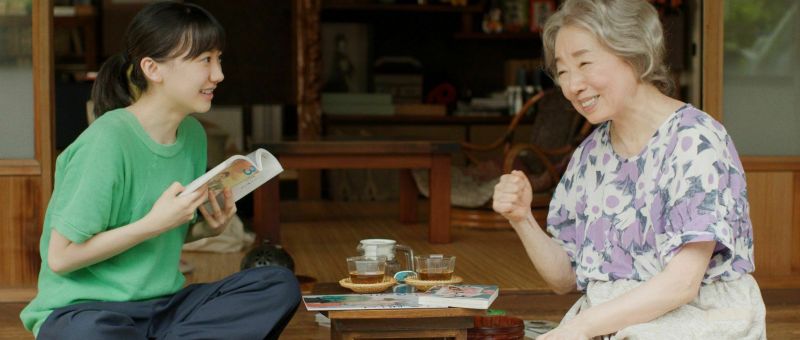

As the heroines of Shunsuke Kariyama’s charmingly heartwarming dramedy BL Metamorphosis (メタモルフォーゼの縁側, Metamorphosis no Engawa) introduce themselves to each other, the older, Yuki (Nobuko Miyamoto), reflects that their names mean “snow” and “sunshine” respectively though for much of the film their roles are reversed. 17-year-old Urara (Mana Ashida) is gloomy and introverted, diffident to the point of inertia and in danger of becoming resentful while the widowed 75-year-old Yuki is relentlessly cheerful despite her loneliness and the increasing effects of age.
What brings about their serendipitous meeting is, strangely enough, BL manga which a curious Yuki picks up on a whim struck by the beauty of its artwork much to the embarrassment of secret BL fanatic and part-time bookshop girl, Urara. “BL” or “Boys’ Love” manga is a genre which focusses on romance between men but is largely written by and for a straight female audience. Readers have been termed or may term themselves fujoshi, which literally means “rotten girl” and hints at the disdain with which the genre is sometimes held explaining Urara’s intense sense of shame about her secret hobby. She keeps her substantial collection of BL manga in a cardboard box hidden behind several other boxes under the desk in her room where no one will find it, and when an enthusiastic Yuki takes her to a cafe for a few primers, Urara snatches the book from the table before the waitress can see it while two women snigger from behind struck by the incongruity of hearing an elderly lady speak so enthusiastically about a love story between teenage boys.
Yuki is more open-minded than many might assume even if the lovely suburban house where she holds calligraphy classes is the peak of refined elegance. She’s exactly the sort of person you wouldn’t think would be into BL, but unlike Urara and perhaps because of her age she feels no embarrassment at all and asks her questions straightforwardly without shame. Her cheerfulness and positivity begin to rub off Urara who begins to wonder what it is she’s so ashamed of, why she resents the popular girlfriend of the childhood friend she may or may not have a crush on, and what it is she’s really afraid of pursuing in the course of her life. As the two women bond over over their shared interest a new connection develops that brings sunshine back into each of their lives along with a new sense of strength and possibility in a true tribute to intergenerational friendship.
Yet the nature of their connection leads Urara, who had considerately brought out a stool for Yuki while searching for a book she wanted at the store, to forget that Yuki is not as young as she was and cannot necessarily accompany her as a friend of her own age might. She invites her to come to a large convention for self-published manga, but then begins to rethink on seeing pictures of the queues realising it might not be much fun for a 75-year-old woman with a couple of mobility problems to stand in line for hours on end just to walk around inside. Her sense of embarrassment in her thoughtlessness causes her to pull away from Yuki, only to come to regret it on returning to her home and finding it a little emptier as if a part of Yuki had already disappeared.
Nevertheless, it’s Yuki’s encouragement that finally gives Urara the courage to write a manga of her own which is part fan fiction based on the BL manga they’d read together and a tribute to their friendship retold as a BL love story in which two people find each other and bring joy and happiness back into each other’s lives. Yuki ended up becoming a calligraphy tutor because she’d wanted to write a fan letter to the author of a manga she liked as a child but was ashamed of her handwriting and never sent it. The author stopped publishing a while later and she regretted not having told her how much the manga had meant to her. Similarly the author of the manga the pair read (Kotone Furukawa) is mired in creative difficulties and artistic doubt only to unexpectedly rediscover her confidence on coming across Urara’s fan fiction and realise that her work had touched someone and held meaning in their life. The film’s Japanese title translates more literally as “the engawa of metamorphosis” which refers to the small deck area looking on to Yuki’s beautiful garden where the pair often sit together sharing their love of manga, each somehow blossoming under the warm summer sunshine transformed by their friendship and ready to embrace the future.
BL Metamorphosis screened as part of this year’s Japan Foundation Touring Film Programme.
Original trailer (English subtitles)

 Windows on Worlds