How Dare You? (ふつうの子ども, Mipo O, 2025)

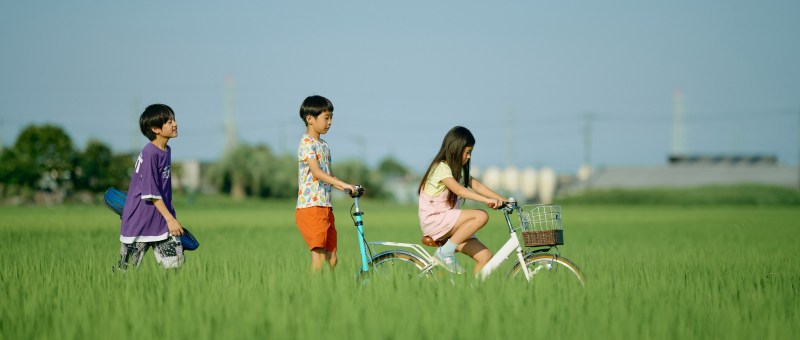
“I told you to shut up about that,” Kokoa’s mother (Kumi Takiuchi) tells her after she gets caught with two other children trying to start an environmental revolution by releasing cows from their paddock. It’s not difficult to see why Kokoa (Ruri) feels so strongly about global warming even if it’s probably her home environment that she most wants to change given adult indifference to climate issues, though Mipo O’s charming family dramedy How Dare You? (ふつうの子ども, Futsu no Kodomo) is less about the issues themselves than the relationships between the children and the adults around them.

The point being that Kokoa hates adults for trashing the world and creating an environment in which she feels it’s impossible to live. Fellow student Yuishi (Tetta Shimada) is drawn to her Greta Thunberg-style speech in class having just embarrassed himself with an essay about his toilet habits and suddenly develops an interest in the environment as a means of getting close to her. Which isn’t to say that he didn’t really care before. In this semi-rural area, he and his friends still go outside every day to catch woodlice to feed his friend Soma’s lizards, and Yuishi is also very keen on animals in general. He’s sympathetic to the cause, but on the other hand, is only really into this because of Kokoa who pretty much ignores him in favour of class bad boy Haruto (Yota Mimoto) who tells her that they need to take “action” to wake the adults up or no one’s going to listen to a bunch of kids whining about methane emissions. 

There is something pleasantly old-fashioned about their tactics which include cutting letters out of magazines to make protest signs they hang up all over town telling people not buy so much stuff, eat meat, or drive cars. But while the other two are increasingly emboldened their actions and their revolutionary activities begin to get out of hand, Yuishi finds himself conflicted. When they spot similar signs springing up made by other kids they don’t know, Kokoa and Haruto are annoyed rather than pleased that more people are joining the cause. Yuishi agrees with a sign saying people should catch the bus because it’s better than driving a car even if buses also pollute while Haruto opposes it. But he also points out that the firework rockets Haruto has bought for another action give off CO2, so perhaps they shouldn’t use them. He tries to deescalate and avoids becoming radicalised, but is eventually bullied into going along with the other two and suggests releasing the local farmer’s cows as their next protest assuming it’s a “nice” thing to do and less aggressive than some of Haruto’s ideas.

But they’re still just children and don’t really understand the consequences of their actions. After all, what’s a wild cow supposed to do? It doesn’t occur to them that the cows could get hurt or end up causing accidents and damage, let alone that they may alienate the local community who are already fed up with their stunts because it’s affecting their livelihoods. Of course, this is also part of the problem. The adults ignore the children because what they’re saying is inconvenient for the way they live their lives under capitalism which isn’t something they think they could change even if they wanted to which they likely don’t. Yuishi’s sympathetic mother is forever reading books about how to raise children well, and so she tries to listen to Yuishi but also “corrects” him in subtle ways like hiding meat in his spring roll after he tells he wants to give up eating it for the environment. Though she may have correctly assumed that he’s not really serious about it and tells him what she’s done after his first bite of the spring roll, there’s no getting around the fact that just as Kokoa said she’s not really listening. Nor does she sort her rubbish and recycling responsibly. When Yuishi looks up global warming on his tablet, his mother remembers being told about this at school too, which just goes to show how long this has been going on and how easily everyone forgot about the ozone layer panic of 1980s and 90s.

Nevertheless, the gradual escalation of the children’s activities towards something akin to ecoterrorism echoing the student protest movement on the 1960s satirises the dangers of radicalisation especially as neither of the boys are really invested in the cause and are only there because they’re each drawn to Kokoa who remains intense and implacable. Their true natures are exposed when they’re caught with only Yuishi stoic and remorseful, admitting it was his idea to release the cows and that he did it because he liked Kokoa and wanted her to like him back, while Haruto spends the entire time crying in his mother’s arms and Kokoa glares at everyone while reciting environmental statistics. Maybe she isn’t overly invested either so much as trying to regain control over her life and using cold hard facts as an escape from her overbearing mother who liked her better when she was “sweet” and ‘cute” and never asked any inconvenient questions. Even so, there is something very charming about the children’s earnestness that’s largely lost on the well-meaning adults around them who may be trying their best in lots of other ways but have already given in to the idea that the world can’t be changed and nothing they do makes a difference so there’s no point doing anything. Yuishi at least has learned some valuable lessons, if only that things go better when you’re straightforward and honest your feelings even if it might be embarrassing in the moment.


How Dare You? screens 20th July as part of this year’s New York Asian Film Festival.

Original trailer (English subtitles)
Every Trick In The Book (鳩の撃退法, Hideta Takahata, 2021)

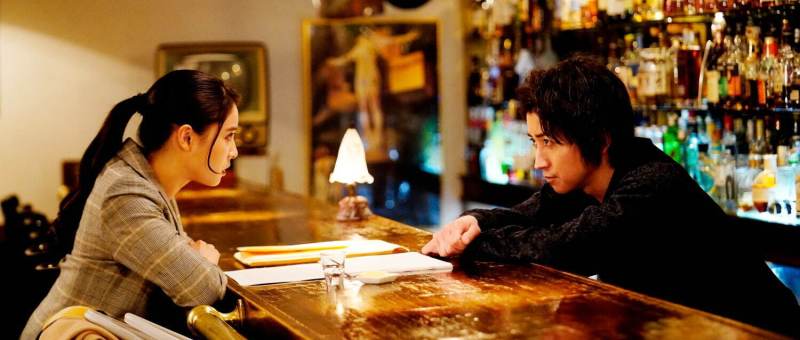
A down on his luck writer finds himself at the centre of a mystery only how much is truth and how much “fiction”? Based on the novel by Shogo Sato, Hideta Takahata’s Every Trick in the Book (鳩の撃退法, Hato no gekitai-ho) ponders the possibilities of literature as the hero seems to create a fictional world around him in which it is largely unclear whether he is solving a real world mystery or simply imagining one based on his impressions of the strange characters he encounters through the course of his everyday life.

That everyday life is however eventful just in itself. Tsuda (Tatsuya Fujiwara) once won a prestigious literary prize and was destined to become a popular author but hasn’t written anything of note for some time and in fact now largely works as a driver ferrying sex workers around on behalf of his shady boss. The mystery begins when he approaches a man, a rare solo reader in an overnight cafe, and promises to lend him a copy of Peter and Wendy by JM Barrie only to later discover that the man went missing along with his wife and the daughter he had explained was fathered by another man. 

Like many of his subsequent encounters it isn’t entirely clear if this meeting really took place or at least as Tsuda said it did or is only part of the novel he is beginning to write. The man, Hideyoshi (Shunsuke Kazama), asks him if it’s a novelist’s habit to begin imagining backstories for everyone he sets eyes on and there may well be some of that even as Tsuda is fond of claiming that amazing things happen around us every day to which we are mostly oblivious. Still, Tsuda probably didn’t expect to be pulled into the orbit of local gangster Kurata (Etsushi Toyokawa) after accidentally passing on counterfeit currency he found by chance. It’s true that most of what’s happening to him is the result of a series of bizarre coincidences or cosmic confluence which has accidentally united this collection of people in an unintended mystery which Tsuda intends to solve in either literal or literary terms. 

“It’s all a novelist can do” he later claims in trying to write a better ending for “characters” he has come to like than the one he assumes they “actually” met. But then his editor Nahomi (Tao Tsuchiya) chief worry is that, like his previous novel, Tsuda’s story will contain too much of the “literal” truth which could cause his publishers some legal problems. Part of the reason Tsuda left the industry is apparently because his last book was inspired by a real life affair which was then considered somewhat hurtful and defamatory. For that reason it comes as quite a blow to Nahomi as she begins to investigate and discovers that much of Tsuda’s story lines up with “real” places and events, but then again as he says if you can draw connections between known facts then you begin to see a “hidden” truth which may in its own way be merely his invention. 

The film’s Japanese title translates more literally as something like “how to fend off a dove” which does indeed have its share of irony especially considering the meaning the dove symbolism turns out to have in the film but perhaps also hints at the essential absurdity of trying to fight back against something that is otherwise harmless and in fact represents peace. Tsuda may be onto something and nothing, embracing the bizarre serendipity of a writer’s life while trying to recover his creative mojo but embellishing it with more danger and strangeness than it actually has to offer. Then again as his editor discovers, there really is an incinerator it seems anyone can just walk up and use to burn whatever they want including dead bodies, while people in general are full of duplicities all of which keeps the “fake” money circulating as people use it to try to buy things that can’t really be bought. Hideyoshi calls them “miracles”, embracing the strange serendipity of his life as an orphan longing for a family to call his own and unexpectedly finding one which is “real” in someways and “fiction” and in others. Then again, if you believe in something does it really matter if it’s “real” or not? Hideyoshi and Tsuda might say it doesn’t, the publishing company’s lawyers might feel differently, but it seems there really are amazing things going on around us every day if only you stop to look. 


Original trailer (English subtitles)

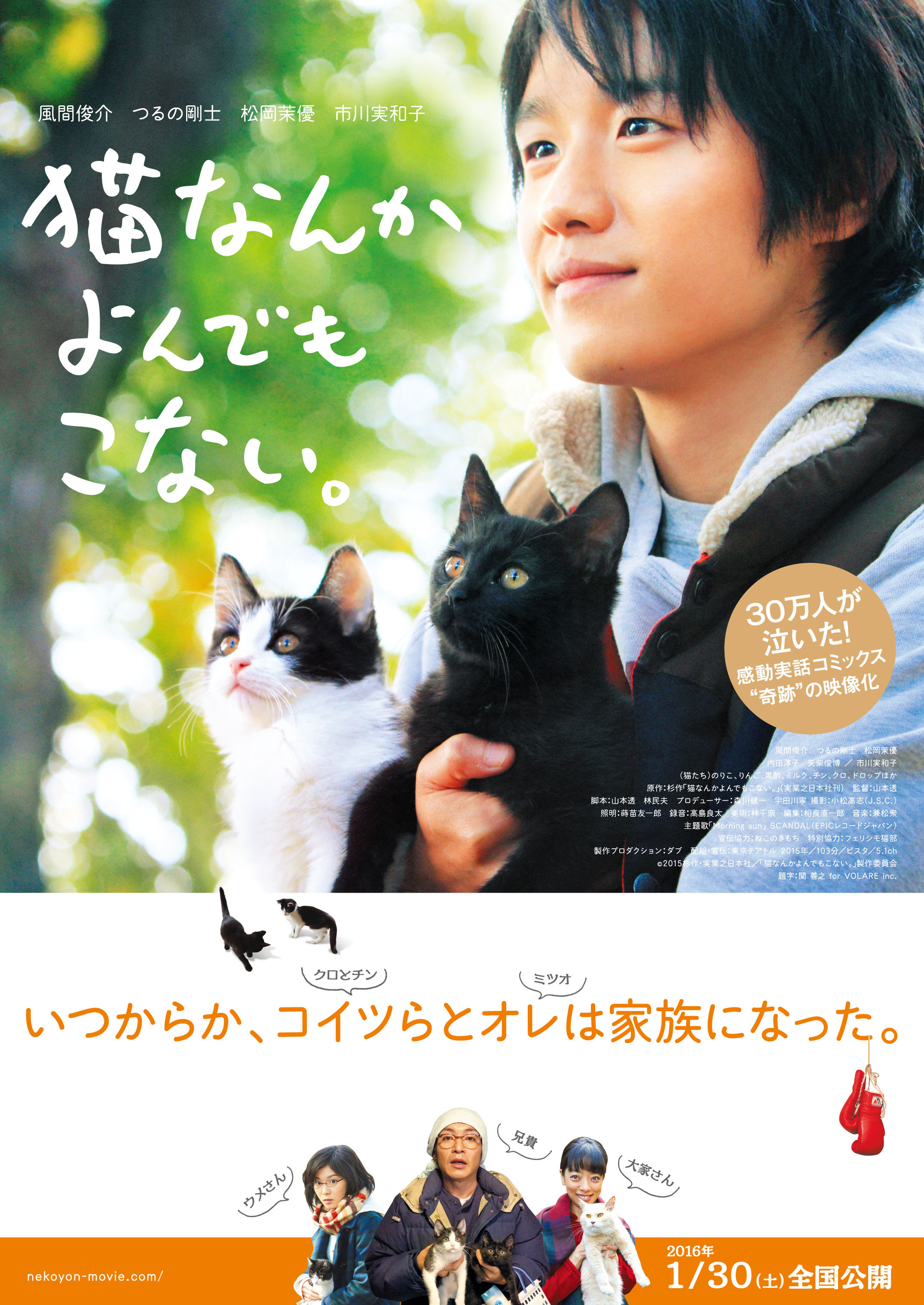
Cats Don’t Come When You Call (猫なんかよんでもこない。, Toru Yamamoto, 2016)

How do you keep going after all your dreams have died? For the hero of manga adaptation Cats Don’t Come When You Call (猫なんかよんでもこない。, Neko Nanka Yondemo Konai.), a pair of adorable kittens eventually point the way towards a more positive future. After all, it’s easier to convince yourself to look after something else than it is to look after yourself. As the title suggests, however, cats like the future can be elusive and confusing, both needy and indifferent. In caring for them you’ll inevitably make mistakes, but those mistakes will perhaps teach you something about the business of being alive. 

The hero, Mitsuo (Shunsuke Kazama), is a dog person, which is why he walks on by when he sees a cardboard box with two abandoned kittens inside by the railway line. An aspiring boxer, he’s moved in with his mangaka brother (Takeshi Tsuruno) and given up all his part-time jobs in the hope of winning enough fights to achieve A-rank status and get a license to turn pro. He’s quite annoyed, therefore, to discover that his brother decided to adopt the cats, naming them Tiny and Blackie, and is expecting him to look after them seeing as he’s not contributing in any other way. 

Despite his original animosity (he claims to hate cats because of their “malicious, warped personalities”), Mitsuo ends up taking to the kittens who quickly take to him, though mostly because he is providing them food and warmth. He even starts to think that these must be “special”, “genius” cats, especially after he wins his big fight and is all set to turn pro believing that the cats are his good luck charm. But all at once his dreams crumble. He receives an eye injury that requires surgery and is advised not to box again in case he goes blind. Feeling sorry for him, his brother keeps giving him money to get out of the house, something which makes Mitsuo feel loved and appreciated. Only later does he realise that he had an ulterior motive when his brother announces he’s decided to get married and will be moving back to the country. “You’re good at taking care of others” he tells him, dropping the bombshell he’s leaving the cats behind too. 

It’s tempting to believe that Mitsuo’s brother picked the cats up with just this purpose in mind, to give Mitsuo another outlet outside of boxing that encouraged him to nurture a more caring side that wasn’t all about solitary, singleminded athletic pursuit. For a man in his early 20s who’s thrown everything at his boxing dream, Mitsuo has few life skills and is perhaps not particularly used to taking care of himself even if he lived alone before surviving on part-time jobs alongside training. He quickly realises that the money his brother left won’t last long, and not only that he can’t really afford to be a cat dad on his meagre savings. An attempt to cut costs by buying cheaper cat food (which he at some points shares) backfires when the offended felines decide to stage a protest by temporarily leaving home. Cats don’t come when you call after all, and Mitsuo wonders if there’s anything more in their decision to stay with him than the fact he feeds them. 

For all that, however, they exemplify the contradictory qualities of his personality. The male cat, Blackie, is timid and shy, while his sister Tiny is outgoing and adventurous, quickly joining a local cat gang and taking up with its boss. Fuelled by a vicarious toxic masculinity, Mitsuo becomes preoccupied with Blackie’s lack of manly energy, obsessed with him becoming the boss of the local cats. A young woman in the park who found the pair after they ran away advises Mitsuo to get the cats spayed and neutered, something he probably should have thought about earlier but doesn’t really have the money for. Worried about Tiny’s “promiscuity”, he eventually decides she should have the surgery but later worries he did the wrong thing when the neighbourhood cats shun her and she becomes a depressed shut-in. Conversely he decides against Blackie getting the snip, glad to discover him going out on the prowl and challenging the local toms even when he is seriously injured in a fight. Projecting his own boxing struggles and the desire to be a champion onto his cat, Mitsuo decides his responsibility as a cat dad is to support from the sidelines as Blackie assumes his masculinity by becoming top cat. 

Because of his underdog boxer past, Mitsuo doesn’t stop to worry that it’s not good his cat keeps getting hurt, believing all these scars are badges of manliness especially after Ume (Mayu Matsuoka), the woman from the park, explains that the male cats fight over the females which is why he should have had him neutered. She also explains that Blackie’s delivering him dead lizards probably isn’t a thank you for not giving him the snip, but a minor insult in implying he thinks he’s a bit helpless and doesn’t know how to hunt. Spurred on by Blackie’s contempt he decides to forge ahead in the new frontier of manga, no longer content with his steady life working part-time in a school kitchen, to prove that he too is a “champion” even if not in the ring. Only too late does he realise he may have let Blackie down in not properly protecting him in projecting his own toxic masculinity onto his cat, and that he may have let himself down too with his all encompassing need to be the champion when maybe it’s better to just enjoy life while doing your best. Nevertheless as Ume points out, cats choose their carers and if they aren’t happy they leave. It’s better to look back on all the happy times you’ve spent together and take note of everything they’ve taught you. Cats don’t come when you call, but they come when you need them, and, as Mitsuo discovers, being needed by them when everything else seems to have rejected you might just be the push you need to finally start taking care of yourself.


Hong Kong release trailer (English / Traditional Chinese subtitles)

Midori: The Camellia Girl (少女椿, TORICO, 2016)

camelia-girlPicking up on the well entrenched penny dreadful trope of the tragic flower seller the Shoujo Tsubaki or “Camellia Girl” became a stock character in the early Showa era rival of the Kamishibai street theatre movement. Like her European equivalent, the Shoujo Tsubaki was typically a lower class innocent who finds herself first thrown into the degrading profession of selling flowers on the street and then cast down even further by being sold to a travelling freakshow revue. This particular version of the story is best known thanks to the infamous 1984 ero-guro manga by Suehiro Maruo, Mr. Arashi’s Amazing Freak Show. Very definitely living up to its name, Maruo’s manga is beautifully drawn evocation of its 1930s counterculture genesis – something which the creator of the book’s anime adaptation took to heart when screening his indie animation. Midori, an indie animation project by Hiroshi Harada, was screened only as part of a wider avant-garde event encompassing a freak show circus and cabaret revue worthy of any ‘30s underground scene.
The 2016 live action adaptation from fashion designer TORICO, Midori: The Camellia Girl (少女椿, Shojo Tsubaki) doesn’t quite take things so far but does its best to put a modern spin on the original work’s decidedly Weimar aesthetic. Fourteen year old Midori (Risa Nakamura) narrates the tale as she suffers at the hands of the freaks and performers who form the community she has become a less than willing member of. After her father ran off and her mother died, Midori’s activities as a seller of paper camellias came to an end when she joined a circus troupe but rather than a warm community of outcasts Midori finds herself amongst a bitchy collection of kinky sex obsessed perverts who force her to become their personal domestic servant. Enduring cruel and frightening behaviour culminating in a rape by a performer with a bandaged face, Midori has begun to consider suicide as her only means of escape but when the circus receives a new employee in the form of “Western” style magician Mr. Wonder (Shunsuke Kazama), Midori’s fortunes begin to brighten.

Thankfully, given some of the things she’s forced to endure, Midori is played by 27 year old model Risa Nakamura in her first film role. The world of the freak show is undoubtedly a hellish one as Midori’s compatriots view her as the company kicking bag. Her biggest problem is the effeminate gay showman, Kanabun (Takeru), who actively enjoys tormenting her even going so far as to kick her pet puppies to death and feed them to her in a stew. This being a fairly incestuous environment, everyone is having sex with everyone else all the time which is not an ideal environment for a dreamy and sheltered fourteen year old. After witnessing a number of strange sexual practices including eyeball licking and an odd ménage à trois, Midori is unceremoniously raped by the bandaged man whose wrappings wind up around her own face. Mr. Wonder is the only one to show her any kind of kindness and perhaps begins to earn her love but his attentions have a possessive and controlling dimension which make this far from an uncomplicated romance even aside from Midori’s relative youth.

TORICO takes a page from Mina Ninagawa’s book in painting her tale in bright, kaleidoscopic colours. Not a naturalistic recreation of early Showa decadence, Midori: The Camelia Girl evokes the spirit of the period with its surreal atmosphere and outlandish costuming. Midori dresses in the bright and innocent clothes of a little girl making her look something like a cartoon heroine though her sunniness contrasts nicely with the sometimes muted dinginess of the street performer world. Accompanied by jaunty, accordion led gypsy jazz, TORICO also makes use of animated sequences and occasional effects to capture the bizarre goings on at the heart of the story and Midori’s frequent retreats into fantasy to escape them. Every bit as strange and surreal as might be hoped, Midori: The Cameila Girl only infrequently allows the encroaching darkness of militarism to penetrate its kitschy world but the threat is ever present as this collection of misfits attempts to survive outside of the mainstream, even if their attempts to do so reject the idea of community in favour of a constant series of betrayals and manipulations.


Original trailer (no subtitles, NSFW)

Beautiful World (任侠ヘルパー, Hiroshi Nishitani, 2012)

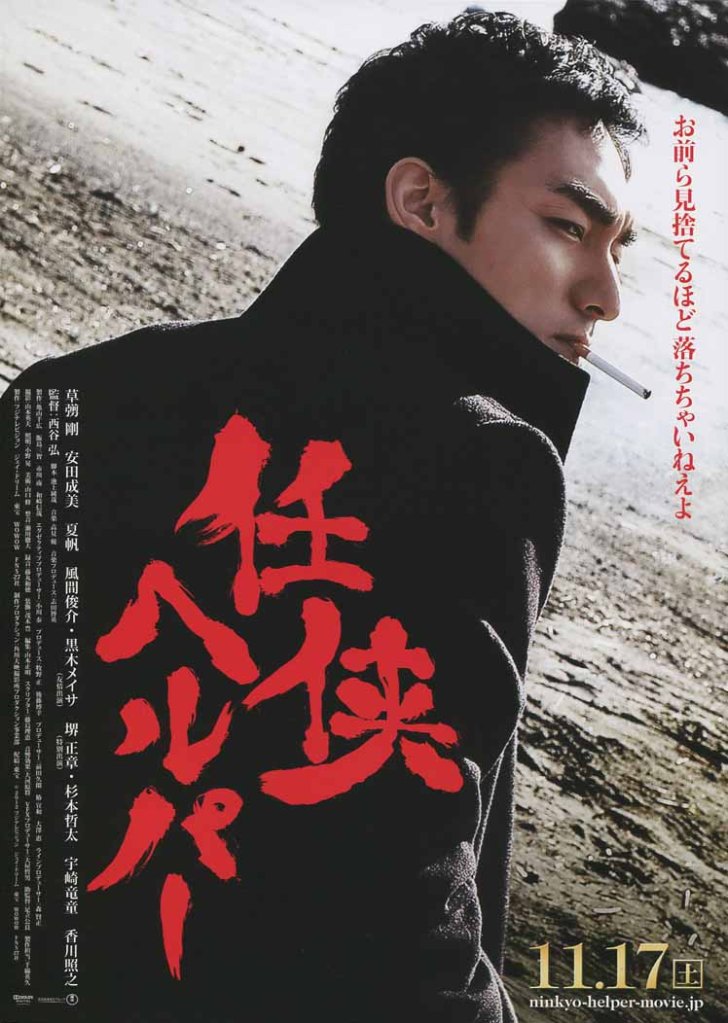
ninkyo helperIn old yakuza lore, the “ninkyo” way, the outlaw stands as guardian to the people. Defend the weak, crush the strong. Of course, these are just words and in truth most yakuza’s aims are focussed in quite a different direction and no longer extend to protecting the peasantry from bandits or overbearing feudal lords (quite the reverse, in fact). However, some idealistic young men nevertheless end up joining the yakuza ranks in the mistaken belief that they’re somehow going to be able to help people, however wrongheaded and naive that might be.

The hero of Hiroshi Nishitani’s Beautiful World (任侠ヘルパー, Ninkyo Helper) is just one of these world weary idealists turned cynics. We find him working a low rent convenience store job where he fills the shop with the kind of intensity that only a disappointed former yakuza can generate. Hikoichi (Tsuyoshi Kusanagi) was trying to make a go of things in the regular world, but when a sad little old man comes in with armed robbery on his to do list, Hikoichi shows his yakuza stripes by easily beating him down in front of his stunned colleague.

This might have earned him some brownie points at work, but overcome by pity for this pathetic old man reduced to robbing corner shops for petty change, he gives him the cash and tells him to run. The police soon turn up and arrest them both – during the robbery Hikochi’s colourful tattoos were caught on security camera and no one wants a yakuza working here, even if he did volunteer to pay back the tiny sum of money the old guy got from his own wages.

Meeting up in prison, Hikoichi and the armed robber eventually become friends and after his release, Hikoichi ends up in the old guy’s home town where he joins his former clan as an enforcer. Extremely bitter by this point, Hikoichi has decided to play the modern yakuza game to the max so when he finds out his assignment is running a dodgy “care” home which gets its residents by extorting old people through outrageous loans which send them bankrupt, he only briefly pauses.

The idea of a yakuza running a care home is a strange one. The Uminoneko residential care facility is far from what one would want from a old people’s home – there are no doctors, or even carers, the entire home is run by one nurse, herself an elderly woman who got her nurse’s certification and eldercare qualifications back in 1943!

With a rapidly ageing population, eldercare is a big topic in Japan as the birth rate has progressively fallen while lifespans have increased leaving many older people without family to look after them. With the nature of the family unit also changing, it’s become much harder to care for elderly relatives at home especially if they need around the clock attention. There are simply not enough facilities available to cope with the increasing needs of the older generation leaving families struggling to cope and social services overwhelmed. It’s not surprising that the yakuza have picked up on this as a growth area.

When Hikoichi arrives at the Uminoneko facility, which is just really a prefab shed with some futons in it, he finds a hellish place filled with unstimulated old people left on their beds to die. The place is filthy, and about the only attention the guests receive is the occasional offering of food to keep them alive so that the clan can keep claiming their pensions and welfare payments. Though Hikoichi goes along with this to begin with, it’s not long before his idealism rears its ugly head and he hits on the idea of reforming Uminoneko by turning it into a kind of old person’s commune in which the residents themselves will help out with the running of the place. What was a sad and gloomy prison of exploitation suddenly transforms as the older generation rediscover a place that they can belong, working together to build their own community. However, this of course means less money for the clan and more trouble for Hikoichi.

The clan aren’t his only problems as the town also has a progressive mayor who made a commitment to wipe out organised crime and turn the area into a tourist hotspot with a special focus on caring for the older generation. Teruo (Teruyuki Kagawa) has is own stuff going on which again causes a problem for Hikioichi as he also has a long standing crush on the older yakuza’s daughter, now a single mother with two young children and a mother of her own with senile dementia who needs expensive medical care. Yoko (Narumi Yasuda) has a grudge against yakuza after enduring decades of stigma and eventual abandonment by her father but is willing to deal with them if it will enable her to help her mother. Predictably she begins to develop a better understanding of her father as she bonds with Hikochi and warms to his noble tough guy ways.

Directed by Hiroshi Nishitani and inspired by a TV show (though functioning as a standalone movie), Beautiful World is a finely plotted drama which explores both the roles of the ageing population and eldercare explosion in Japan, and the conflicting role of the yakuza who seek to exploit those who are arguably the weakest in society. Hikoichi makes for a very Takakura-like, brooding presence as his innate idealism and desire to help those around him conflict with his experiences as a yakuza which teach him to distrust everyone and expect betrayal and exploitation at every turn. Resolving in an unconventional and unexpected way, this otherwise mainstream, if  beautifully photographed, drama develops into one of the more interesting character driven pieces of recent times.


Unsubbed trailer:

https://www.youtube.com/watch?v=Xyqd3v_-2oQ