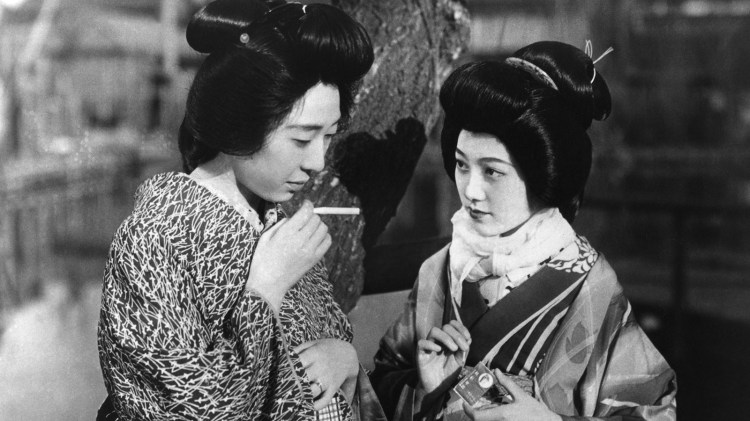
Apart From You (君と別れて, Mikio Naruse, 1933)

Apart From YouNaruse’s critical breakthrough came in 1933 with the intriguingly titled Apart From You (君と別れて, Kimi to Wakarete) which made it into the top ten list of the prestigious film magazine Kinema Junpo at the end of the year. The themes are undoubtedly familiar and would come dominate much of Naruse’s later output as he sets out to detail the lives of two ordinary geisha and their struggles with their often unpleasant line of work, society at large, and with their own families.

The older woman, Kikue, begins the film by asking her much younger friend and almost daughter figure, Terugiku, to pluck a grey hair from her head. Kikue also has a teenage son, Yoshio, who is becoming progressively rebellious, filled with anger and resentment over his mother’s line of work. Ignoring Kikue’s many sacrifices for him, Yoshio drinks, skips school and messes around with a gang of delinquents.

Feeling sorry for her mentor, Terugiku makes use of her good relationship with Yoshio to convince him that he should be more grateful for the kindness his mother shows him. Taking him on a trip to visit her impoverished family, Terugiku shows him the oppressive environment in which she grew up. Resenting having been sold to a geisha house to finance her drunken father’s violent outbursts, she is even more outraged that they now want to force her sister to undergo the same treatment. Terugiku is not prepared to allow this to happen and has decided to do whatever it takes to save her sister from suffering in the same way as she has had to.

Naruse highlights both the problems of the ageing geisha who sees her ability to support herself declining in conjunction with her looks, and the young one who only looks ahead to the same fate she knows will come to be her own. Both women are subjected to the humiliating treatment of their drunken clients who horse around and occasionally pull violent stunts with little to no regard for those who may even have been their wives, sisters, or daughters with a different twist of fate.

Kikue does at least have Yoshio, though their relationship is currently strained, but Terugiku has no one else to rely on. Her greatest fear is that her sister will also be sold off and have to endure the same kind of suffering as she has. In order to avoid this turn of events she agrees to undergo something far worse than even the unpleasantness of the geisha house to earn double the money in her sister’s place. She faces a future even bleaker than Kikue’s, yet in some sense it is a choice that she herself has made, actively, in sacrificing herself to save her sister.

Apart from You is much less formally experimental than either Flunky, Work Hard or No Blood Relation with its elegant, beautifully composed mise en scène. That said Naruse frames with a symbolist’s eye such as in a late scene where he shoots through the cast iron footboard of a sick bed to show the two women divided yet each imprisoned. This is a world filled with subtle violence, flashes of knives from clients and delinquents alike, raining blows from drunken fathers, and innocents wounded by misdirected arrows. Maternal love is both a force for salvation and of endless suffering but romantic love is always frustrated, ruined by practical concerns. Naruse rejects the kind of fairytale ending he succumbed to in No Blood Relation for something altogether more complex and ambiguous where there is both hope and no hope at the same time as a train departs in an atmosphere of permanent anxiety.


Apart From You is the third of five films included in Criterion’s Eclipse Series 26: Silent Naruse box set.

Clip featuring Terugiku’s visit to her family (with English subtitles)
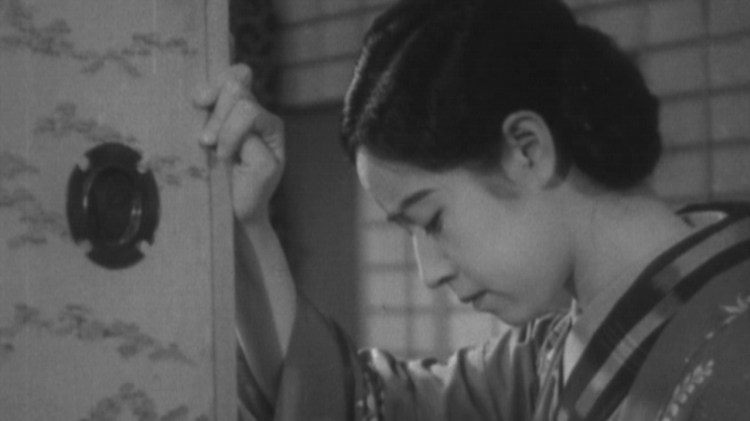
No Blood Relation (生さぬ仲, Mikio Naruse, 1932)

No blood relationNaruse apparently directed six other films in-between Flunky, Work Hard and No Blood Relation (生さぬ仲, Nasanunaka) but we’ll likely never see any of them again. Adapting a “Shinpa” play (a new kind of Western style melodrama focusing on the real lives of everyday people), Naruse addresses a theme which later becomes central to his cinematic output – the trials and tribulations of women in contemporary society. This time we have two fully grown women tussling over the affections of a little girl who herself seems to have little input into the situation.
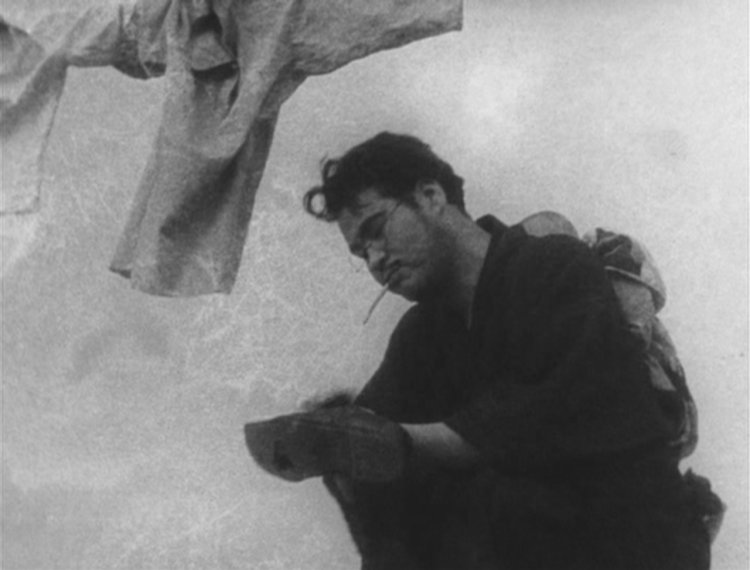
After a brief introductory sequence in which we witness the accidentally humorous escapades of a pair of petty crooks, we meet the sister of one of them who happens to be returning ex-pat and successful Hollywood actress, Tamae. It turns out that Tamae has come back to Japan after making her fortune in the movies hoping to reunite with the daughter she left behind six years ago.

However, her ex-husband, Atsumi, has remarried and the daughter, Shigeko, believes the second wife, Masako, is her real mother. Although the family are very happy together there is tension in the air as Atsumi’s company is running into trouble in this period of economic instability and he’s about to reveal he’s gone bankrupt. Atsumi’s mother does not take this well as she’s used to the upper middle class lifestyle and throws something of a hissy fit at being shamed in this way. Masako, by contrast, remains stoic and says she can bear the worst of what comes only she doesn’t want Atsumi to do anything illegal to try and solve their money problems and she doesn’t want to see Shigeko suffer. Her maternal feelings are further borne out when she is injured diving in front of an oncoming car which threatens to hit her daughter as she stops to pick up her doll in the middle of the road.

The problems continue pile up and Tamae uses her money as a lever to try and prise Shigeko away from her step-mother via the greedy grandma but the little girl was an infant when her birth mother left so she simply doesn’t remember Tamae and repeatedly asks to be allowed to go home to her “mother”. It’s understandable how much this would hurt Tamae who claims she’s only returned to Japan because she’s been unable to forget her daughter, yet her daughter never even knew her. If she was expecting some kind of cosmic connection it does not occur and if she truly wanted to rebuild a relationship with her child, what amounts to a virtual kidnapping was probably not the best way to go about it.

At heart it’s a tug of love between two women – the one who gave birth to a child and then abandoned it (perhaps harsh words, but no concrete reason other than a man and America are ever revealed), and the one who later raised it and came to love it as her own though shares no blood connection. Masako is the faithful Japanese wife, devoted to her family and just a very good, decent person which contrasts nicely with the ferocity of her rival – a modern woman, adulteress and movie star who thinks her money can enable her to take back what she previously gave up. For all that, it’s difficult to not to feel sorry for Tamae as her daughter continues to reject her. Even if the way she’s going about things is not sensible, her maternal emotions and the passion, desperation and even in part grief and regret are all too real.

Of course, what gets forgotten here is the plight of little Shigeko who never had any reason to believe Masako, who obviously loves her dearly, was not her real mother. Extremely confused and probably frightened, she just doesn’t understand why she’s being separated from her mum and being forced to hang out with this strange woman. Masako can’t get to see Shigeko after grandma has removed her from the house, but no one else stops to think about what sort of effect this is all having on a confused little girl who just wants to go home.

The depression is more of a backdrop here and even if Atsumi ultimately ends up feeling the brunt of it, money troubles are only a small part of the question at hand. Naruse doesn’t experiment as much as in Flunky, Work Hard but throws in a few impressive tracking sequences across open rooms and adds some rapid zooms as the two women have silent arguments over their relationships to Shigeko. Without giving too much away, the ending undercuts the degree of nuance Naruse had been trying add in ensuring that both women were drawn in a suitably complex manner, provoking sympathy and understanding for everyone caught up in this complicated situation (well, except perhaps for the bumbling crooks who are a little surplus to requirements).

The finale itself almost feels tacked on from an entirely different film with its sudden cheerfulness and abrupt closure as the original family is repaired thanks to a sudden monetary atonement and subsequent self-exile from the originally corrupting influence of the first wife. In many ways a standard melodrama of the time, No Blood Relation perhaps doesn’t have much more to recommend it than as an early example of Naruse’s development but does offer strong performances from its leading ladies and an interesting take on an age old question.


No Blood Relation is the second of five films included in Criterion’s Eclipse Series 26: Silent Naruse box set.

Flunky, Work Hard (腰弁頑張れ, Mikio Naruse, 1931)

flunky work hardMikio Naruse is often remembered for his female focussed stories of ordinary women trying to do they best they can in often difficult circumstances, but the earliest extant example of his work (actually his ninth film), Flunky, Work Hard (腰弁頑張れ, Koshiben Ganbare), is the sometimes comic but ultimately poignant tale of a lowly insurance salesman struggling to get ahead in depression era Japan.

Okabe is the lowly insurance agent of the title. He works hard for his money, but there are slim pickings round here to begin with and a lot of competition from rival agents so Okabe struggles to provide for his wife and his little boy, Susumu, in the way that he would like. Okabe subjects himself any sort of humiliating behaviour on offer to try and get a contract including engaging in leap frog with a well to do lady’s children to try and seem more “friendly” than his rival broker.

Susumu, by contrast is a rebellious little boy and is aways getting into scraps with the neighbourhood kids who tease him because of his parents’ money problems. This wouldn’t usually be too much of a problem and Okabe even tells him it’s OK to defend himself when the other kids start in on him. Only this time Susumu has been fighting with the well to do lady’s sons which is going to make Okabe look bad and make it more difficult to convince her to take out a policy with his firm over another.

Okabe loses his temper and scolds the boy who runs off in anger and confusion only to get into a serious accident. His father, not knowing it’s his son that’s been injured, uses the news of a little boy getting hurt to try and convince the other mothers to take out insurance policies on their children. Later he feels bad about shouting at Susumu and decides to buy him a present, only he might already be too late…

Flunky, Work Hard starts out like the nonsense comedies Shochiku were known for at the time with a little of their common man approach thrown in, but quickly heads into melodrama territory as Susumu meets with his unfortunate destiny. This sequence is the most notable in the film as it’s far more experimental in nature than anything found in Naruse’s later work. Dipping into a montage of kaleidoscopic images, diagonal splits and the awful momentum of a train hurtling along a predetermined track only to meet with a horrifying, unexpected obstacle, this extremely complex sequence is the perfect cinematic expression of the blood draining from a father’s face as he contemplates the fact that he might have just lost his son through having lost his temper over something as trivial as a few shiny coins. Okabe is not a bad man, or even a bad father, but just another ordinary guy trying to make it through the depression. Even so, he may be about to pay a terrible price for failing to side with his son in favour of businesses prospects.

Like many silent films from this era, almost all of Naruse’s early work appears to be lost. Flunky, Work Hard is somewhat atypical when considered alongside his later career which had a strong female focus and leant more towards social commentary than the slapstick humour seen here. However, its tale of a father desperately trying to find a way to support his son in difficult economic circumstances only to find that his efforts may cost him the very thing that he was trying to protect all along is one which is instantly recognisable in any era.


Flunky, Work Hard is the first and earliest of the five films included in Criterion’s Eclipse Series 26: Silent Naruse box set.

Japanese Girls at the Harbor (港の日本娘, Hiroshi Shimizu, 1933)

japanese girls at the harbourHiroshi Shimizu made over 160 films during his relatively short career but though many of them are hugely influential critically acclaimed movies, his name has never quite reached the levels of international renown acheived by his contemporaries Ozu, Naruse, or Mizoguchi. Early silent effort Japanese Girls at the Harbor (港の日本娘, Minato no Nihon Musume) displays his trademark interest in the lives of everyday people but also demonstrates a directing style and international interest that were each way ahead of their time.

A classic melodrama at heart, Japanese Girls at the Harbor begins with two school girls living their humdrum lives of commuting back and for to school in early 1930s Yokohama. Dora and Sunako attend a Catholic school in the “foreign quarter” of the city and are devoted best friends who swear they’ll stick together for ever. However, motorcycle riding bad boy Henry rips right through their friendship in the way that only a bad boy can. Sunako abandons Dora at the harbour to ride off with Henry (later apologising to her understanding friend) but it turns out that Henry likes hanging round with gangsters and also has something going with an older lady called Yoko.

Dora tells Sunako if she really loves Henry she’ll just have to accept him for what he is before going off to find the cheating louse herself and give him a piece of her mind. However, when Sunako catches Henry and Yoko together she loses the plot entirely and ends up running off out of the city. Time passes and Sunako returns but in shame as she’s become a prostitute living with a painter whom she doesn’t seem to care for very much at all. Can she repair the damage with the now married Dora and Henry and get herself out of the hell her existence has become, or is she forever doomed to the life of a fallen woman?

Made in 1933 just as Japan was heading into its militarist era, Japanese Girls at the Harbour has an oddly international mindset with its Western houses, names and a Christianising atmosphere. An international port, there’s plenty of the outside world to be found in Yokohama where things seem to leave much more often then they arrive. Sunako says watching the boats leave makes her feel sad, but it’s she who will go off on one of Shimizu’s trademark travels, running from a crime of passion and the ache of a breaking heart.

A true friend, Dora has not abandoned Sunako and is willing to welcome her back into her home. Henry, the first to meet Sunako (at her place of employ) is torn between the old attraction, feelings of guilt over what’s happened to her, and his responsibility to Dora as her husband. Shimizu introduces an interesting metaphorical device as Henry and Dora wind a ball of wool whilst sitting together in their Western style house but as soon as Sunako arrives it falls onto the floor and begins to unravel, eventually becoming tangled up around the feet of Henry and Sunako who dance in the living room while Dora prepares a meal. Suddenly seeing her married life unravel just like this shaggy ball of wool, Dora, though still devoted to her friend, begins to feel a little afraid that Sunako may be about to jump back on the bike with Henry, just as she did all those years ago.

Shimizu’s interest is much more with the two young women than it is with Henry who remains very much a prize not worth winning. This is Sunako’s fallen woman story – eventually she comes to feel that she’s bringing too much disruption into the lives of her old friends who were getting on so well before. Henry and Dora were her last lifeline to her old self, the only old friends she could still count on, but if she wants to save them (and herself) she will have to stay away and lose them forever. Her redemption lies in self sacrifice, in giving up something that made her profoundly happy for its own good despite the immense amount of suffering she will incur in doing so.

Shimizu was one of the earliest proponents of location shooting and he does make good use of the atmospheric Yokohama streets before heading indoors for the seedy, smoky clubs and cheap tenement housing. He also introduces a series of strange jump zooms at two moments of unusually high emotion which add a degree of panic to the scene as well as heightening the nuanced reactions of the characters in question. This, coupled with his use of dissolves which often sees characters simply evaporate from the frame like unwelcome ghosts of memory, lends to the almost noir-ish, melancholic tone with its dream-like blurring of the real and the merely recalled.

An interesting example of international cross pollination in the early 1930s before hard line militarism became entrenched, Japanese Girls at the Harbor is a pregnantly titled story of a wronged woman abandoned on the shore and left with the choice to board a boat to fairer climes or remain behind and risk destroying what she most loved. The past becomes something to be absorbed and then put to rest. Ghosts cannot travel by water, and so you must leave them behind, like girls at the harbour staring sadly at departing ships.


Japanese Girls at the Harbor is the first of four films in Criterion’s Eclipse Series 15: Travels with Hiroshi Shimizu box set.

Video clip of a climactic scene which showcases Shimuzu’s jump zoom technique (presented without musical score but does have subtitles for the really quite amazing intertitles which are a definite highlight of the film).

(Video clip courtesy of Mubi)

Crossroads of Youth – Barbican centre 2nd August 2012

London was treated to something very special today as Korea’s oldest surviving silent film was screened at the barbican exactly the way its original 1934 audience would have seen it.

Young-bok has been adopted into Bong-Sun’s family as her intended husband. For seven long years he’s done everything that’s been asked of him, no matter how tedious or demanding, without complaint. Now 21, Bong-sun’s father is beginning to think the time for Young-bok’s marriage is near seeing as Bong-sun is now sixteen. However, tragedy strikes as Bong-sun is seduced by another man from the village. Heartbroken, Young-bok takes off for the city to make something of himself there, leaving his mother and sister behind in his home village.

Although Yong-bok is a good and kind young man, his heartbreak leads him to waste his life in drink. When working at the station one day he catches sight of the man who crushed all his young hopes in the village – little does he know of the havoc he is still to wreak on Young-bok’s city life.

Unbeknownst to Young-bok, his younger sister has come to the city to look for him following the death of their mother. Unable to find him she takes a job as hostess in a bar where she falls prey to the same man that ruined Bong-sun and an even worse friend of his. Young-bok also begins a tentative romance with a girl, Ge-soon, who pumps petrol but she has her own problems as her father’s ill health and rising debts have decreed she is to become the third wife of a money lender to satisfy them. Can these three young people find each other and happiness despite the poverty and hardship to which they’ve been subjected?

In contrast to the way silent films were usually seen in the west, in Korea rather than the intertitles we use to give crucial information of the story a live narrator (byeonsa) would interpret the action and/or act some of it out. As I understand it director Ahn’s original script is lost (though fortunately a brief synopsis had survived) and a new version had to be put together by closely watching the film and filling in the gaps.  Kim Tae-yong director of Late Autumn and Family Ties effectively re-directed the piece for for the stage along with Cho Hee-bong who fills the role of the narrator. The new script is obviously not afraid to embrace the melodrama of the film’s storyline in a self aware way, even throwing in a few knowing jokes at its own expense.

The performance began with a song by two young actors portraying Ge-soon and Young-bok, both of whom had absolutely wonderful voices and interpretation. Even though there were no subtitles for this first part it didn’t matter as the heartfelt intention of the song came across perfectly. Once this finished the film started playing with English subtitles for what the narrator was saying. Occasionally the subtitles didn’t cover the length of the narrator’s speech or perhaps missed some of the nuances of his humour but there was never a problem knowing what was going on. There was then another song about half way through covering a particularly intense scene between Ge-soon and Young-bok with the narrator adding occasional dialogue in the middle and a final song song functioning as an epilogue. The film was accompanied throughout by a band of four musicians playing an energetic and lively score which worked extremely well with the film and atmosphere.

All in all it was a fascinating and extremely enjoyable experience which deserves to be seen as widely as possible.