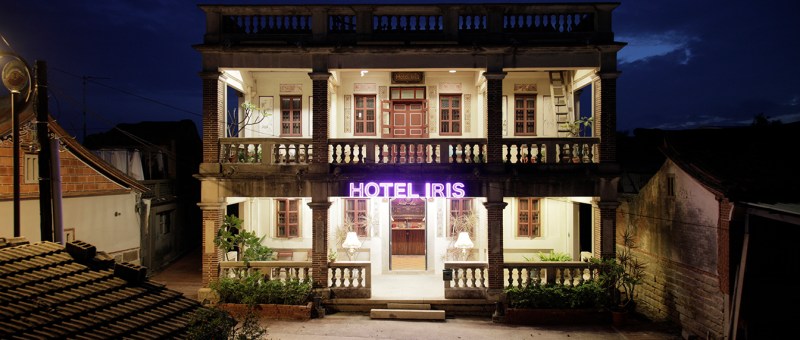

You can check out any time you like, but you can never really leave the titular Hotel Iris (艾莉絲旅館) at the centre of centre of Hiroshi Okuhara’s Taiwan-set erotic mystery drama adapted from the novel by Yoko Ogawa. At least, so it seems to be for heroine Mari (Lucia), a youngish woman stultified by a dull existence and controlling, possessive mother while haunted by the memory of her late father murdered when she was still a child. The goddess Iris, so we’re told, could fly to any place she wanted on her rainbow wings as perhaps does Mari, in a sense, in her circular, sado-masochistic, and largely epistolary romance with a middle-aged Japanese translator of Russian literature (Masatoshi Nagase).
On an otherwise dull if stormy night, Mari is alerted by the sound of a woman screaming while manning the front desk. On investigation she finds an older gentleman violently beating a sex worker who manages to escape down the stairs while he calmly walks his way out. Despite this violent, dangerous episode Mari is intrigued rather than frightened, handed a crumpled note and drawn to the malevolent presence. Spotting him in the town she follows him to the beach where he explains he lives on a near by island across a makeshift bridge cut off at high tide which he likens to that of Iris’ rainbow connecting the worlds of the living and the dead.
Mari may in a sense be chasing death in the figure of the middle-aged man who also obviously recalls the image of her absent father, she taking him on a kind of date to ice cream (which he does not appear to enjoy) by the sea as her father had done when she was a child. Yet the relationship that develops between them is erotic rather than romantic, Mari discovering a sense of empowerment in submission to the older man’s sexualised violence as he strips and binds her, tearing her clothes while watching himself in the mirror.
The presence of mirrors is central to their relationship, or perhaps to Mari’s fantasy as she reflects on the multiplicities of self it offers her along with a sense of endlessness as if she and the middle-aged man had begun to inhabit a world of two behind the glass. When she questions his true identity he replies only “I am You” which she later returns to him, “You are me”, signalling the selflessness which now exists between them if also leading us to question how much of this is happening merely in Mari’s mind bored behind the counter of the Iris and longing for escape. She borrows the name of an absent childhood friend, “Mary”, for her correspondence with the middle-aged man in order to keep her relationship with him secret from her mother while the main character in his book is also co-incidentally named “Mari” giving her at least three mirrored personas in this already complicated relationship one of which actively controlled by the middle-aged man and another by her mother.
Meanwhile Mari begins to doubt him, witnessing a display of irrational violence and later hearing that the body of another sex worker has been discovered in the town. He told her he had no family since his wife passed away but turns out to have a mute nephew who later claims to be his stepson said to have lost his tongue to cancer though we later wonder if that is really case. In seducing the nephew/stepson she takes on a more dominant, masculinised role while he is later feminised by the middle-aged man if also becoming an embodiment of the triangular griefs that bind them, the boy for his mother, Mari for her father, and the middle-aged man for the wife is rumoured to have killed.
Okuhara is not so much interested in solving the literal mystery of the middle-aged man’s potential as a covert serial killer as exposing Mari’s inner psychodrama as she attempts to process the unanswered questions of her father’s death, literally haunted by the image of him wondering whether or not she as loved as a child while straining to break free of her mother’s controlling impulses but otherwise trapped within the oppressive atmosphere of the Hotel Iris. Caught between Taiwan and Japan, Mari occupies a liminal state of constant inertia while spreading her rainbow wings in search of danger and excitement. Shot with a moody ethereality, Okuhara’s poetic psychodrama captures an almost gothic sense of intensity as the heroine investigates the mystery of herself through transgressive relationships with the living and the dead on permanently shifting sands.
Original trailer (no subtitles)
 Windows on Worlds