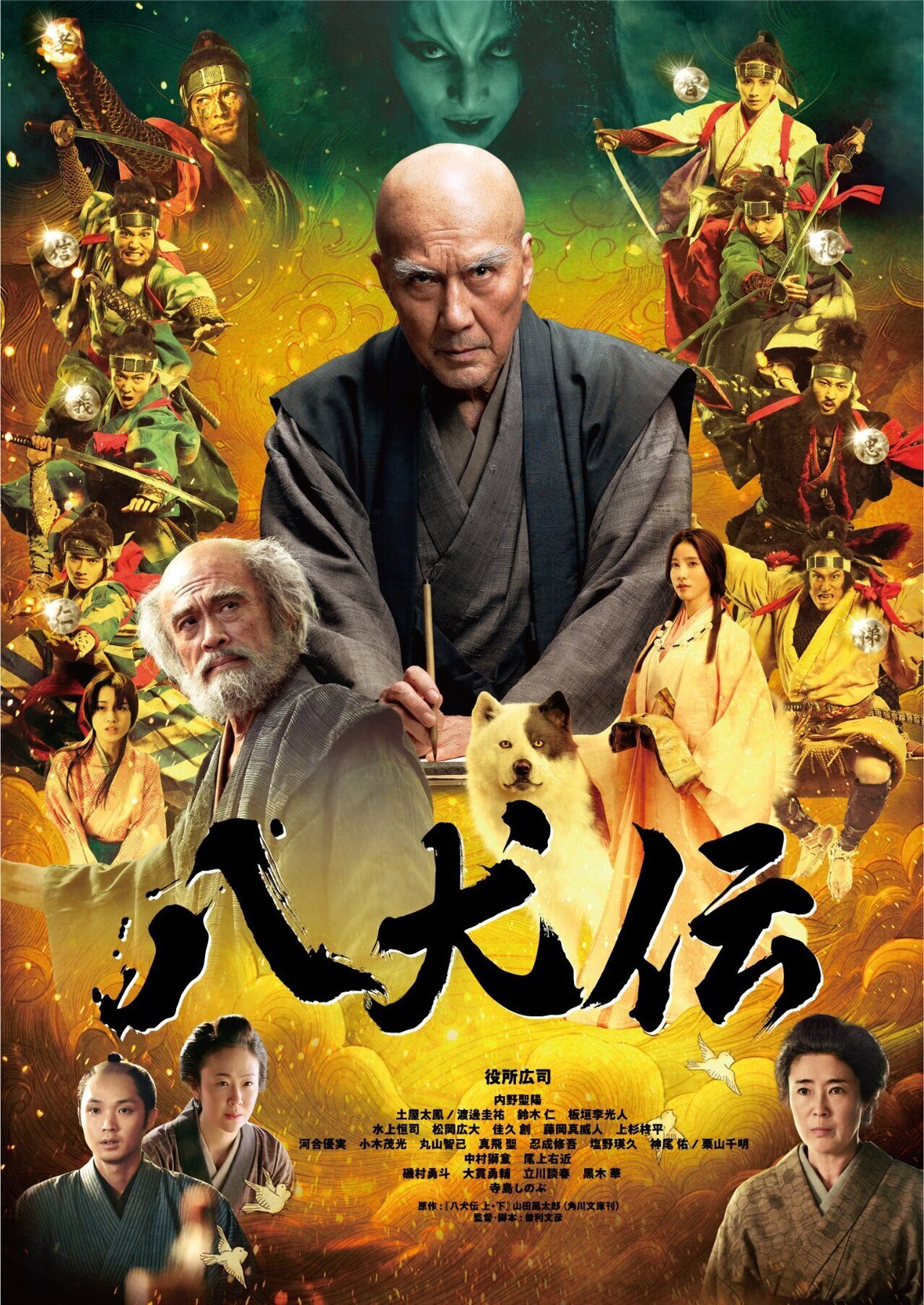

Revolver LILY (リボルバー・リリー, Isao Yukisada, 2023)

A former assassin is drawn back into the light when an old colleague is framed for the murder of a small family in Isao Yukisada’s adaptation of Kyo Nagaura’s pulp novel, Revolver Lily (リボルバー・リリー). Set in the Taisho era, the film finds Japan at a crossroads amid an atmosphere of rising militarism in what is still a very poor country trying to change its fortunes through imperialism while those like Yuri (Haruka Ayase) attempt to stave off the oncoming apocalypse of war.

Though Yuri (whose name means “lily” in Japanese) had been part of a spy ring in Taiwan and trained to further Japan’s interest through political assassinations, she evidently came to see the error of her ways when the group was betrayed and an attack on their hideout led to personal tragedy. Since then, she’s lived as a well-to-do owner of a geisha house apparently under her own name which somewhat conflicts with the idea that she is simultaneously on an international most wanted list. In any case, she’s swept back into action when one of her former comrades, Kunimatsu, is accused of murdering the family of a man named Hosomi who is apparently on the run while militarists also seem to be intent on finding his teenage son Shinta (Jinsei Hamura).

Shinta, who was born with a lame leg which would presumably rule him out for military service, later becomes a kind of symbol of Japan as a more enlightened nation that no longer sees the need to use violence in order to advance its own interests. His father, Hosomi, had apparently done a series of dodgy deals with the military and then run off with all the money which is why they want to find him. It later turns out that he took the money not so much out of greed as that he was trying to turn the tide by growing the country economically in the hope that there would no longer be the need for imperialistic conquest.

Yet the money becomes a means of setting the army and the navy against each other in an increasingly straitened Japan in which neither feels they have the proper finding to pursue their ambitions. Constant references are made to the devastating economic impact of the 1923 earthquake, yet the authorities spend increasing amounts of money on waging war and there seem to be increasing numbers of soldiers on the streets. The army, in general, are depicted as loutish thugs with little on their side except brute force, while the navy in their pristine white uniforms are backroom plotters and always one step ahead.

But there is obviously a giant irony at the heart of the film in that as Yuri declares at the end, “fighting protest nothing,” having just taken out most of the Tokyo garrison in an effort to protect Shinta so that he can be preserved as a symbol of a new pacifist Japan. Though she tries to avoid mortally wounding anyone, Yuri is still prepared to use violence in order to combat it while the fact that merely fight on the side of capitalism suggests that there is, in fact, already a war going on between competing visions of the nation’s future which are both destined to come to pass. Capitalism, too, however, has its rough edges as symbolised by the grinning yakuza boss (Jiro Sato) who boasts of being “a man you can trust” but is only really ever on the side of greed and power.

Yuri, meanwhile, seems to be reawakened by her latest mission. She tells her assailant who accuses her of living in a state of nihilistic limbo, that she has made a choice a live which also symbolically aligns her with the new future opposed to the death cult that is militarism. Nevertheless, history tells us that whatever promises are made the militarists will win and the people will suffer. Yuri, however, continues fighting for peace with the film making full use of Haruka Ayase’s growing stature as an action star following on from franchises such as Caution, Hazardous Wife as Yuri effortlessly takes out huge numbers of army goons assisted by her female comrades. The closing scenes hint at further adventures for Yuri amid the vibrant Taisho-era setting taking on the forces of militarism with impeccable style and elegance.


Revolver LILY is available digitally in US from 27th January courtesy of Well Go USA.
Hakkenden (八犬伝, Fumihiko Sori, 2024)

Kyokutei Bakin thinks he’s a hack who writes inconsequential pulp that will be forgotten faster than yesterday’s headlines. He’d never believe that people hundreds of years later would still be talking about his work. Yet he may have a point in his conviction that people crave simple stories where good triumphs over evil specifically because the real world is not really like that and a lot of the time the bad guys end up winning. But does that mean then that all his stories are “lies” and he’s irresponsible for depicting the world not the way that it is but the way he wants it to be? 

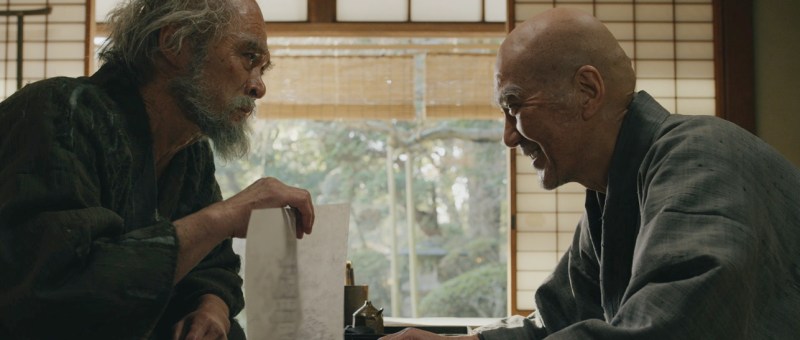
Fumihiko Sori’s Hakkenden (八犬伝) is on one level an adaptation of the famous tale probably most familiar to international audiences as The Legend of the Eight Samurai, and also a story of its writing and the private doubts and fears of its author. In dramatising the tale, Sori plays fantasy to the max and revels in Bakin’s outlandishness. An unusually picky Hokusai (Seiyo Uchino), Bakin’s best and he claims only friend and unwilling collaborator, points out that his use of guns is anachronistic because they didn’t come to Japan until 60 or 70 years after the story takes place but Bakin doesn’t care. He says people don’t notice things like that and all they really care about is that good triumphs in the end, so he’ll throw in whatever he feels like to make a better story. In any case, the tale revolves around magical orbs, evil witches, dog gods and good fairies, so if you’re worrying about there being guns before there should be, this isn’t the story for you. 

Hokusai is also shocked that Bakin has never been to the place where the story is set, but as he tells him it all happened long ago and far away so going there now would be pointless. Even so, Hokusai needs to see what he draws which is why he spends half his life on the road costing him relationships with his family. Whatever else anyone might say about him, and he admits himself to being a “difficult” person, Bakin is very close to his family even if his wife yells at him all the time for being rude to influential people and not making any money when he could have just taken over her family’s clog-making business rather than carry on with this writing malarkey. His biggest ambition is that his son become a doctor to a feudal lord and thereby restore their samurai status which on one level points to a kind of conservatism that doesn’t matter to Hokusai and singles Bakin out as a tragic figure because the age of the samurai is nearing its end anyway. 

In his fantasy, however, he hints at and undoes, up to a point, injustices inflicted on women in the romance between Shino (Keisuke Watanabe) and Hamaji (Yuumi Kawai) who is almost forced into a marriage with a wealthy man because of her adoptive parents’ greed but is finally revealed to be a displaced princess and returned to her father who is thereby redeemed for having accidentally killing his other daughter in a mistaken attempt to control her after accidentally promising her in marriage to a dog god without really thinking about what he was saying. A neat parallel is drawn in a brief mention of Hokusai’s artist daughter Oi and Bakin’s daughter-in-law Omichi (Haru Kuroki) who did not receive an education and is almost illiterate but finally helps him to complete the story by transcribing it in Chinese characters he teaches her as they go after he loses his sight.

As his literary success increases, Bakin’s own fortunes both improve and decline. He becomes wealthier and moves to nicer houses in samurai neighbourhoods, but his son Shizugoro’s (Hayato Isomura) health declines and he never opens his own clinic like he planned while remaining committed to the idea that his father is actually a great, unappreciated artist. In a way, completing the story gives Bakin a way to say the world could be kind and just even if it has not always been so to him. He needs to maintain the belief in a better world in order to go living even if he feels it to be inauthentic while his life itself is a kind of fiction. On a trip to the theatre, he ends up seeing Yotsuya Kaidan and is at once hugely impressed and incredibly angry. The world that Nanboku sees is the opposite of his own. People are selfish and greedy. The bad are rewarded and the innocent are punished. Yet perhaps this is the “reality” of the way the world really is, where as his work is a wishful fantasy. All he’s doing is running away from the truth. But then, as his son’s friend tells him, if a man devotes himself to the ideal of justice and believes in it all his life, then it becomes a reality and ceases to be fiction. There is something quite poignant about the dog soldiers coming to take Bakin to the better world he dreamed of where bad things happen but good always triumphs in the end, which has now indeed become a reality if only for him.


Hakkenden screens 13th June as part of this year’s Toronto Japanese Film Festival.

Original trailer (no subtitles)