
Wild Sing (와일드 씽, Son Jae-gon, 2026)

A once-famous K-pop trio reunite for one last performance 20 years after their careers imploded in a plagiarism scandal in Son Jae-gon’s zany comedy Wild Sing (와일드 씽). Exploring the Wild West days of the turn of the century popular music industry, the film ultimately seems to say that it’s never too late to follow your dreams while success is perhaps not quite as important as the personal fulfilment found in performing if only for a small audience.

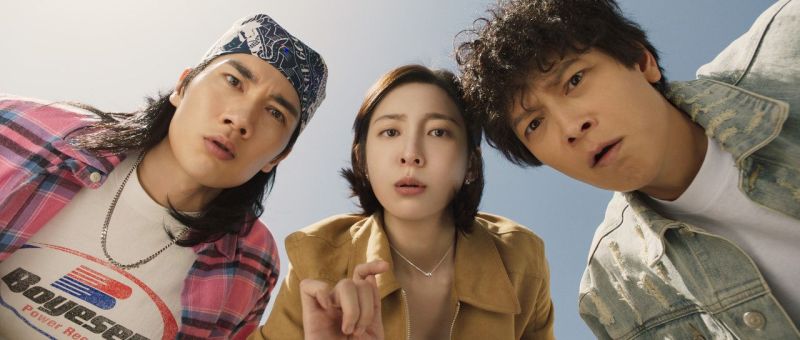
In the early 2000s, street dancer Hyun-woo (Gang Dong-won) thinks he has all the moves and is thrilled to be recruited by A&R man Park Yong-gu (Shin Ha-kyun) only to discover he works out of a tiny basement office in a rundown building and has no other artists signed to his label. Forming a trio with rapper Sang-gu (Um Tae-goo) and singer Do-mi (Park Ji-hyun), Triangle becomes one of the biggest acts of the day. But this kind of industry doesn’t really like it when you get too big, and the band is eventually brought low by its hubris and naivety. Like many pop stars of their time, they were excited to join the music industry and didn’t pay too much attention to their contracts. 

Yong-gu is effectively a conman who withholds their pay and forces them into exploitative working practices. He also fosters discord within the group by pushing Hyun-woo as the leader while falsely claiming that he writes and composes all their songs. In reality, Yong-gu is buying in tracks from outside for the band to perform leading to a plagiarism scandal when it turns out their latest track is actually a cover of a hit Bulgarian pop song. After Yong-gu skips town with their money, Sang-gu and Do-mi quickly sign with other labels while Hyun-woo is left to carry the can alone. 

At the same time, the band’s rival, ballad singer Seong-gon (Oh Jung-se) is frustrated by his inability to take the top spot while his brand of sentimental pop is losing out to the kind of dance-inspired tracks performed by bands like Triangle. When he’s offered drugs, apparently for the first time, at an industry party and begins behaving strangely, it causes a major scandal than puts an end to his career and to an extent his personal life as he’s made an example of and sent to prison for an extended period of time highlighting the hypocritical unfairness of Korea’s hardline stance against drug use especially as regards those with a public profile. Seong-gon is cast so far out of the mainstream, that he becomes an effective exile hunting wild animals in the mountains in a total reversal of his sensitive, feminine image as an idol star specialising in sappy love songs.

In the present day, Hyun-woo has fallen on hard times as his stint as a radio DJ comes to an ignominious end. Not particularly good at the job, he no longer has any cachet as Triangle has faded into the past now that younger people no longer recognise the name. A producer advises him he should have made a move into variety television to keep his celebrity active as another boy band star they used to mock, Tae-poong, seems to have done. Though Hyun-woo looked down on Tae-poong and never even bothered to learn his name correctly, he seems to be the one who worked out how to ride the waves of fame through changing times as TV star with a current profile. Sang-gu, by contrast, is in huge debts to loan sharks who financed his failed solo projects and is currently selling insurance that promises huge payouts if the policy holder is diagnosed with cancer. Do-mi has married into a chaebol family, but is effectively a prisoner of her overbearing mother-in-law and barely allowed to leave the house.

There are then reasons why they would all agree to join Hyun-woo for a comeback performance as part of a retro concert to promote a local bid to host an expo even if they parted on bad terms and have not been in touch since. For various reasons, the gang unexpectedly ends up in a police chase after a road trip goes awry that forces them into a reckoning with their desire to perform. Meanwhile, the producer on the other threatens to cancel their perforce in fear of the negative effect on his own career after convincing himself the only possible reason they could be late is because they must have been involved in a hit and run. The ironic conclusion might paradoxically suggest that the only true freedom comes from access to limitless and unconditional access to money as Do-mi harnesses her new status to support the group, but that does at least suggest that conventional success might not be the be all and end all of performing which offers a kind of liberation just in itself.


Trailer (English subtitles)
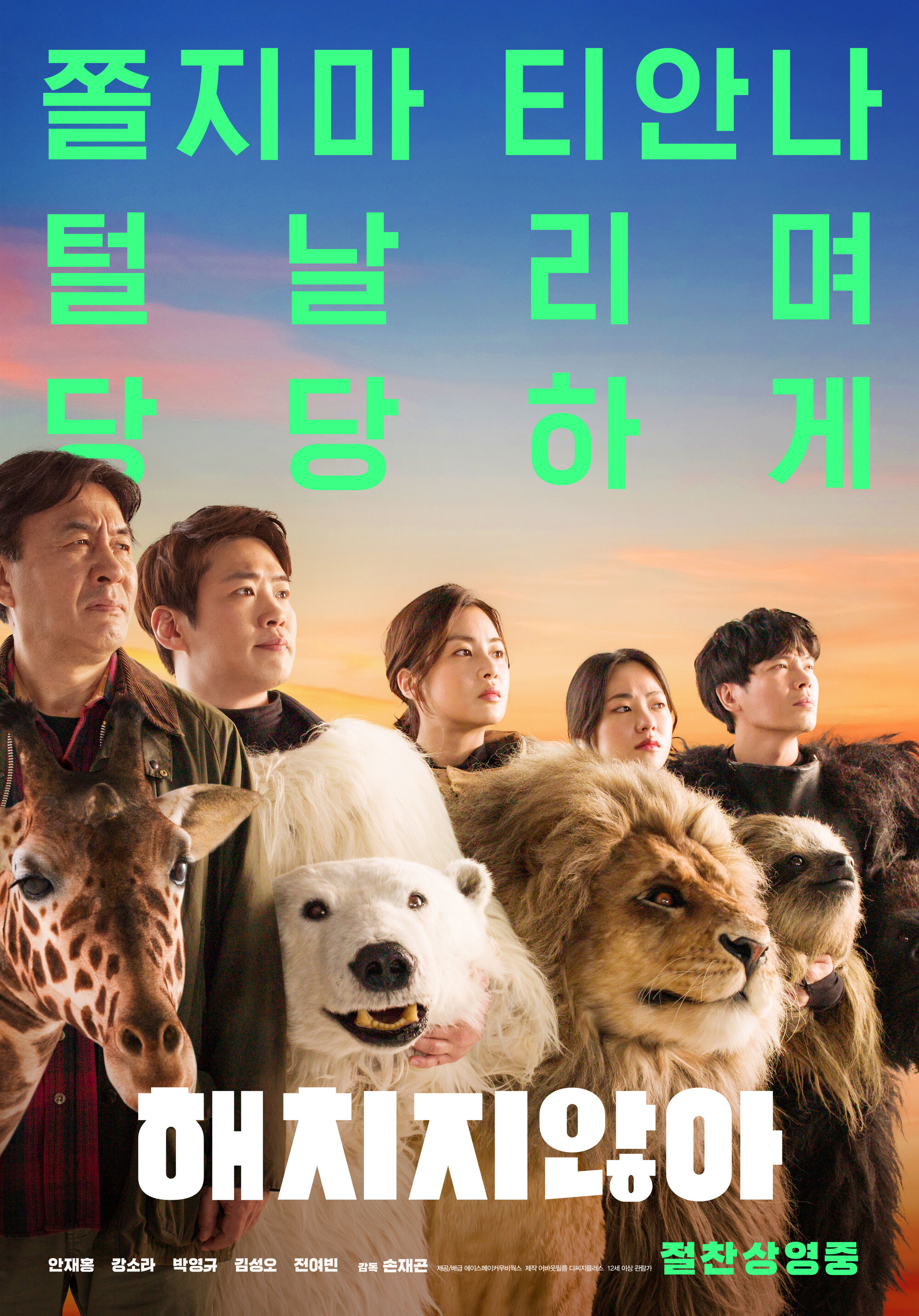
Secret Zoo (해치지않아, Son Jae-gon, 2020)

A corporate stooge begins to reassess his life choices in Son Jae-gon’s capitalist satire, Secret Zoo (해치지않아, Haechijianha). As someone belatedly points out, no matter how nice you make the enclosure, you can’t get away from the fact you’re in jail and aspiring lawyer Tae-soo (Ahn Jae-hong) might have to admit that he’s no more free than the animals he’s sent to oversee (or not, as we’ll find out) when he’s randomly sent to take over a failed wildlife park at the behest of his shady boss. 

Currently a temp working out his probation at top three legal firm JH Law, Tae-soo is desperate to be taken on as a full-time employee but as he explains to his sister who wants to sue some thugs bullying her son, that largely means he’s basically just an errand boy taking care of the unreasonable demands of their incarcerated clients who are in the main chaebol sons accused of fraud and embezzlement. JH Law is under siege from protestors angry at their role in perpetuating chaebol influence and siding with large conglomerates to frustrate workers’ rights and enable exploitative working practices. Yet it’s not squeamishness that he’s wound up working for such an awful company that has Tae-soo too embarrassed to attend the reunion for the “third rate” uni he graduated from, but shame that he is only a temp not a full-time employee. That’s part of the reason he instantly accepts a strange offer from his boss to head up Dongsan Park with the promise that he’ll be taken on as a regular employee in Mergers and Acquisitions if he can turn it around in three months. 

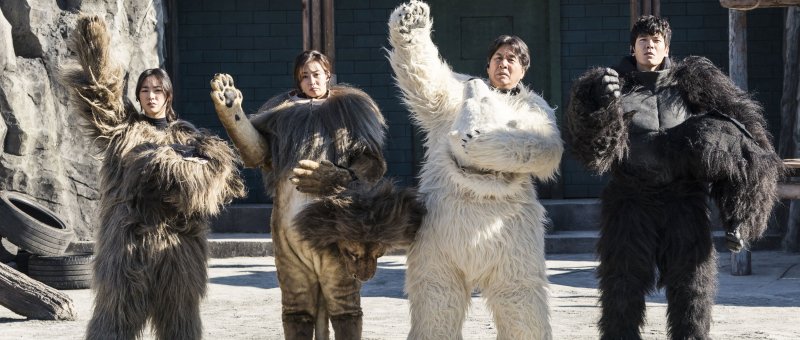
When he arrives, however, Tae-soo gets something of a shock. Most of the park’s most valuable animals have already been seized by its creditors, and international safeguards regarding the trafficking of live animals ensure that he cannot simply buy more within the three month time limit. After being surprised by a stuffed tiger while drunk after the welcome party and catching sight of some photos from a mascot day Tae-soo has a bright idea. They’ll simply have hyperrealistic costumes made and sit in the enclosures themselves keeping far enough away that the customers hopefully won’t know the difference. After all, when someone tells you’re visiting a zoo it probably doesn’t occur to you to question whether the animals are “real”.

Secret Zoo, or more accurately a zoo with a secret, is on one level a mild satire on public perception and fake news. You hear the word zoo and have a set of expectations. Unless something happens to convince you otherwise, your brain naturally smoothes over any minor issues you might have because it would be ridiculous for someone to “fake” a zoo. Despite the evidence of his eyes, the only thing the corporate stooge sent to inspect finds suspicious is the animals’ “funny” names which all end in the same syllable. The zoo becomes an unexpected viral phenomenon when Tae-soo, wearing the polar bear suit, is snapped drinking Coca-Cola just like the advert but even then no one questions the idea that he’s not a real polar bear, or that it’s perhaps not ethical for a polar bear to be drinking Coca-Cola in the first place or for guests to be throwing objects into the enclosures and especially not with the intention of harming the animals. 

Only conflicted doctor So-won (Kang So-ra) questions the zoo ideology, pointing out that however nice they make the enclosures it’s still a prison for animals that they are in essence exploiting. Secret Zoo is at pains to make a direct comparison between Tae-soo caught in the corporate cage of modern-day capitalism and the animals he’s impersonating as prisoners of the world in which they live. Tae-soo’s shady boss is, as might be expected, essentially corrupt. As Tae-soo begins to figure out, if this job were important he wouldn’t be doing it, he’s been sent because he’s desperate and expendable while his boss snidely remarks that it’s not a job to be done by someone “brought up soft” hinting at the class snobbery that further oppresses him as a “weed” coming up from a “third class” university. 

So desperate to achieve conventional success by becoming a member of the elitist club, Tae-soo doesn’t really question what it takes to get there until bonding with the employees and becoming invested in the idea of saving the zoo only to discover that his shady boss never really meant to “save” it anyway. Yet the only solution on offer is it seems merely a nicer cage which in power rests firmly with the same corrupt chaebols only now persuaded that it’s in their interest to be more socially responsible as a means of improving their personal brand which of course merely enables them to continue their exploitative business practices even if implying that Tae-soo too has a modicum of power in the ability to manipulate them. Black Nose, the polar bear driven mad by confinement, cannot be returned to the wild but regains his “freedom” in a polar bear sanctuary in frosty Canada, Dr. So-won too freeing herself of her problematic need to protect him by keeping him close. Tae-soo getting a dose of his own medicine in being observed by a young couple who press him for a selfie as the director of that “fake zoo” seems to have gained a little more awareness of what it’s like to live in the enclosure of an inherently corrupt social system akin to corporate feudalism but like Black Nose has perhaps at least improved the quality of his captivity. 


International trailer (English subtitles)