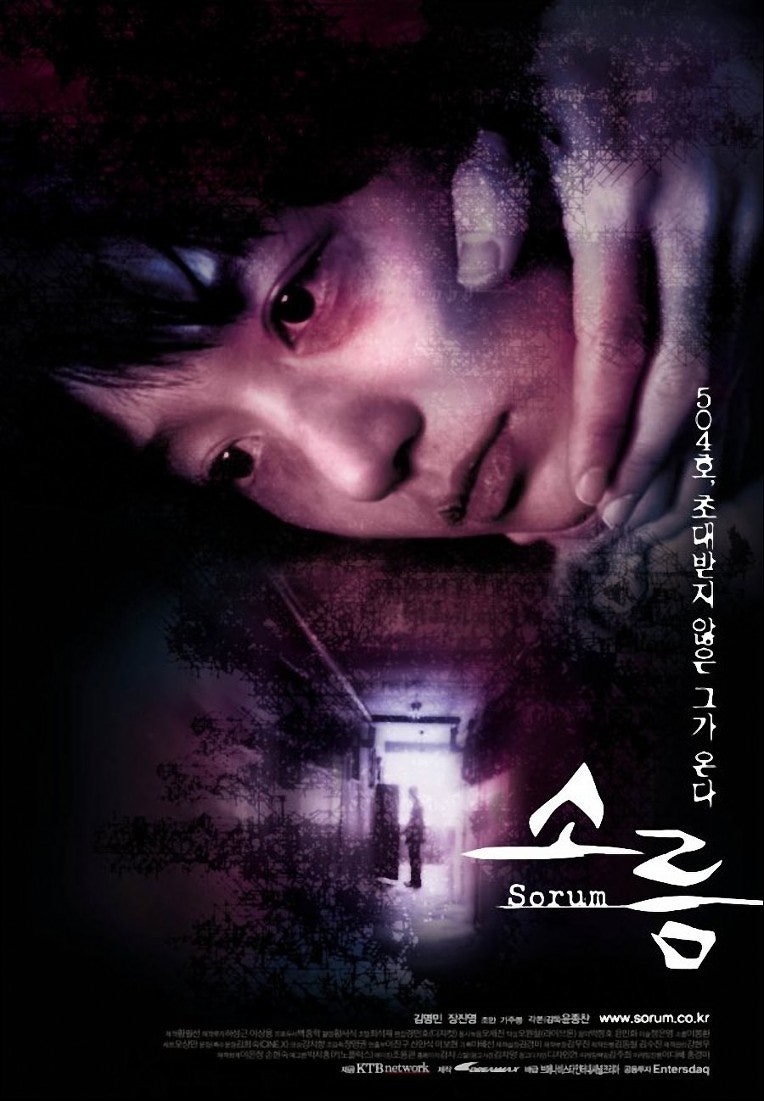
Sorum (소름, Yoon Jong-chan, 2001)

There are different types of ghosts, according to frustrated novelist Lee (Gi Ju-bong) in Yoon Jong-chan’s supernaturally tinged noir, Sorum (소름). Some don’t know they’re dead yet, others possess the bodies of living people. In their own way, the residents of the Migum apartment block all seem to be wandering ghosts themselves, stuck in this place that’s somewhere between life and death that they otherwise seem unable to escape while the building saps the life out of them with its depressing decor and flickering lights.

One might ask themselves why it is that taxi driver Yong-hyeon (Kim Myung-min) has chosen to move in here given that the building is scheduled for demolition. Obviously, the rent is cheap, not least because the previous tenant died in mysterious circumstances, though Yong-hyeon appears to have been unaware of that. Not that it bothers him. For all intents and purposes, he is our hero, a newcomer to this strange and lonely building meeting its ghostly inhabitants for the time. But gradually, we start to wonder about him. Police start sniffing round in connection with the disappearance of a woman said to have embezzled money and borrowed signifiant amounts from friends for no clear purpose. Suspiciously, Yong-hyeon has a bag of women’s jewellery including a ring hidden in his fridge, which would at least have paid a deposit on a nicer apartment if he were able to sell them. 

It’s the ring that attracts the attention of his neighbour, Seon-yeong (Jang Jin-young), who is trapped in an abusive relationship with a man who has a gambling problem. Whether driven or drawn here, Yong-hyeon develops a fascination with Seon-yeong that he later finds difficult to categorise. When she appears before him covered in blood, he helps her bury her husband’s body and then enters a sexual relationship with her that is equally ill-defined. Hearing her say that anyone would have done while arguing with her friend and neighbour Eun-soo (Jo An) causes him to doubt her motivations. Perhaps she’d been waiting for an opportunity to kill her husband and merely made use of his attraction to her to help her do it.

But at the same time, there’s a curiously incestuous quality to their relationship in that Seon-yeong is trapped in the inertia of grief having “lost” her son. Yong-hyeon is an orphan who has no place to call home and on some level is in search of a mother, latching on the maternal quality he sees in Seon-yeong. She buys a scarf for him, as a mother might for a son, while he is touched by her bending down to tie his shoelaces, wondering if his mother would have been kind like her had he had one. Their connection is also echoed in the mysterious history of the apartment in which a woman is said to have been murdered by her husband 30 years previously. The couple had a baby who was left alone there and likely would have starved to death if it had not been for a fire which led to his rescue by other residents. 

The apartment’s previous tenant, aspiring novelist Gwang-tae, had been investigating the murder as material for a book before he died in mysterious circumstances, apparently the victim of a hyper-localised fire which occurred only in the centre of the room. Gwang-tae had claimed that the apartment was haunted by the ghost of a woman singing a lullaby who insisted her son would soon return. Gwang-tae told his girlfriend Eun-soo, pregnant with their child, that he needed to leave this building or something bad would happen to him, but like everyone else, he found himself unable to. His story then becomes fodder Lee, whose latest attempt to make a literary comeback may not all be his work though he continues to try to write the story we are currently watching by constructing a fanciful narrative around Yong-hyeon and the apartment and then convincing himself that what he’s writing is coming true. 

In that sense, he may have an authorial god complex or extreme main character syndrome, while for Yeong-hyeon it’s the opposite. He’s learned to live a carefree life by acting on his impulses and then giving them no more thought. The last thing he wanted to be was the protagonist of this story, though he begins to discover strange and unexpected connections with the building and the tragedy that occurred there 30 years previously. This is the “invisible fear” that Lee proclaims as the high point of his novel, a noirish sense of dread that suddenly reorders an ordinary person’s existence. Yeong-hyeon is no longer someone who exists within the world. The world now exists around him. Lee suggests the ghost in 504 is trying to trap her adult son within this purgatorial space in order to escape her loneliness, just as everyone else is trapped in this building by irresolvable despair. Yeong-hyeon knows he has to get out, but at the same time, where else is there to go? All he can see is the building blinking back at him, refusing to give up its ghosts.

Bear Man (웅남이, Park Sung-kwang, 2023)

According to an ancient legend, bears who eat garlic and mugwort can become human though it’s not exactly clear why they’d want to. The debut film from Park Sung-kwang, Bear Man (웅남이, Woongnami) as its name suggests follows a pair of bear cubs who decide to give things a go in the human world but with wildly differing results as one is adopted by the researcher who allowed them to escape and the other by a vicious gangster who exploits him for his violent capabilities and shows him little love. 

Love is something Woongnam (Park Sung-woong) got a lot of thanks to his devoted mother and though not exactly the sharpest knife in the drawer had forged a promising career as a local policeman before he was let go after falling into a kind of funk on overhearing his father on the phone suggesting that the life expectancy for a regular bear is only 25 so he might not have much time left. Thanks to his nature as a bear man, Woongnam ages much faster than everyone else and already appears to be middle-aged though he is also blessed with immense strength and agility. After agreeing to bend the law by helping his feckless friend Malbong (Lee Yi-kyung) win in at illegal gambling Woognam comes to the attention of a group of police detectives investigating a shady gangster who notice a man looking just like Woongnam taking out a host of bad guys at the harbour. 

There is something quite poignant in the puppy-like existence of Woongbok (also Park Sung-woong) who keeps looking up to his boss as a father figure with a mixture of fear and longing. He gazes enviously at a family crossing the road in front of him and later visits Woognam’s home where Woongnam’s mother thinks that he’s Woognam and tries to feed him his favourite foods while he just looks on silently without expression. Where Woongnam is basically good, not too bright but heart in the right place, Woongbok has been raised as creature of violence by his intimidating father figure and carries a threatening aura with his slick haircut and tailored suit. 

The police want Woongnam to pose as Woongbok so they can take down the gangsters who have not only been trafficking drugs but also dabble in scientific research into viruses and their cures apparently about to unleash an epidemic in China to profit off the drug sales. It’s not all that clear what the scientists who released the bears were actually researching though there is a kind of parallel in the fact the other pair seemingly settled down, adjusted to their new environment and had a few cubs while Woongnam and Woongbok ended up becoming humans with bear-like abilities. Woongnam has to be prevented from entering hibernation and sleeps flat out like a bear but otherwise keeps his true nature secret even while covertly helping the townspeople out getting rid of beehives and freeing trucks stuck in the mud. 

That would be about the extent of “policing” in this kind of small-town where there’s nothing much to do but catch fish in the river and chat to wild boar. Park builds on the surreality of everyday rural life with mounting absurdities such as the parade of teenagers who troop through the convenience store where Woongnam’s live-streaming friend Malbong works each of whom he is largely able to unmask thanks to his keen sense of smell, and the polytunnel that doubles as a gambling den for down on their luck farmers. Woongnam’s biggest regret is losing his position as a police officer and it’s his desire to get it back to make things up to the people who raised him that encourages him to go along with the detectives’ crazy plan even if means he has to undergo weird martial arts training inspired by Drunken Master and take lessons from a strange movement coach in how to walk like a gangster. Yet in the end it’s Woongbok’s innocent desire for familial love that becomes a source of salvation, turning against his gangster brethren to protect the warmth of Woongnam’s family home. Quirky in the extreme and defiantly absurd, the film nevertheless has genuine heart in otherwise strange tale of wandering sons and bears of men.


Bear Man screened as part of this year’s New York Asian Film Festival

Images: © 2023 KIMCHI PICTURES PRODUCTION. ALL Rights Reserved.

Secret Zoo (해치지않아, Son Jae-gon, 2020)

A corporate stooge begins to reassess his life choices in Son Jae-gon’s capitalist satire, Secret Zoo (해치지않아, Haechijianha). As someone belatedly points out, no matter how nice you make the enclosure, you can’t get away from the fact you’re in jail and aspiring lawyer Tae-soo (Ahn Jae-hong) might have to admit that he’s no more free than the animals he’s sent to oversee (or not, as we’ll find out) when he’s randomly sent to take over a failed wildlife park at the behest of his shady boss. 

Currently a temp working out his probation at top three legal firm JH Law, Tae-soo is desperate to be taken on as a full-time employee but as he explains to his sister who wants to sue some thugs bullying her son, that largely means he’s basically just an errand boy taking care of the unreasonable demands of their incarcerated clients who are in the main chaebol sons accused of fraud and embezzlement. JH Law is under siege from protestors angry at their role in perpetuating chaebol influence and siding with large conglomerates to frustrate workers’ rights and enable exploitative working practices. Yet it’s not squeamishness that he’s wound up working for such an awful company that has Tae-soo too embarrassed to attend the reunion for the “third rate” uni he graduated from, but shame that he is only a temp not a full-time employee. That’s part of the reason he instantly accepts a strange offer from his boss to head up Dongsan Park with the promise that he’ll be taken on as a regular employee in Mergers and Acquisitions if he can turn it around in three months. 

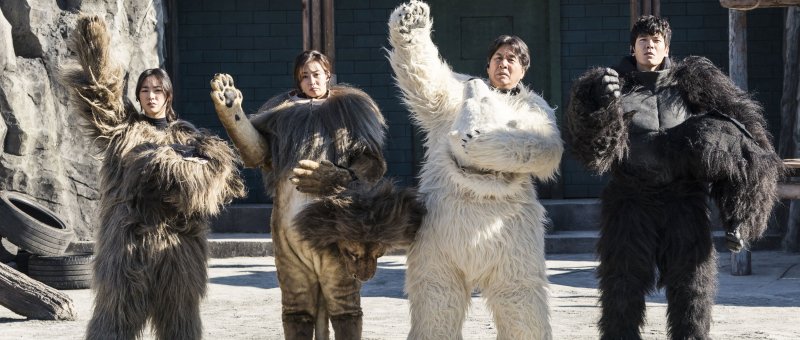
When he arrives, however, Tae-soo gets something of a shock. Most of the park’s most valuable animals have already been seized by its creditors, and international safeguards regarding the trafficking of live animals ensure that he cannot simply buy more within the three month time limit. After being surprised by a stuffed tiger while drunk after the welcome party and catching sight of some photos from a mascot day Tae-soo has a bright idea. They’ll simply have hyperrealistic costumes made and sit in the enclosures themselves keeping far enough away that the customers hopefully won’t know the difference. After all, when someone tells you’re visiting a zoo it probably doesn’t occur to you to question whether the animals are “real”.

Secret Zoo, or more accurately a zoo with a secret, is on one level a mild satire on public perception and fake news. You hear the word zoo and have a set of expectations. Unless something happens to convince you otherwise, your brain naturally smoothes over any minor issues you might have because it would be ridiculous for someone to “fake” a zoo. Despite the evidence of his eyes, the only thing the corporate stooge sent to inspect finds suspicious is the animals’ “funny” names which all end in the same syllable. The zoo becomes an unexpected viral phenomenon when Tae-soo, wearing the polar bear suit, is snapped drinking Coca-Cola just like the advert but even then no one questions the idea that he’s not a real polar bear, or that it’s perhaps not ethical for a polar bear to be drinking Coca-Cola in the first place or for guests to be throwing objects into the enclosures and especially not with the intention of harming the animals. 

Only conflicted doctor So-won (Kang So-ra) questions the zoo ideology, pointing out that however nice they make the enclosures it’s still a prison for animals that they are in essence exploiting. Secret Zoo is at pains to make a direct comparison between Tae-soo caught in the corporate cage of modern-day capitalism and the animals he’s impersonating as prisoners of the world in which they live. Tae-soo’s shady boss is, as might be expected, essentially corrupt. As Tae-soo begins to figure out, if this job were important he wouldn’t be doing it, he’s been sent because he’s desperate and expendable while his boss snidely remarks that it’s not a job to be done by someone “brought up soft” hinting at the class snobbery that further oppresses him as a “weed” coming up from a “third class” university. 

So desperate to achieve conventional success by becoming a member of the elitist club, Tae-soo doesn’t really question what it takes to get there until bonding with the employees and becoming invested in the idea of saving the zoo only to discover that his shady boss never really meant to “save” it anyway. Yet the only solution on offer is it seems merely a nicer cage which in power rests firmly with the same corrupt chaebols only now persuaded that it’s in their interest to be more socially responsible as a means of improving their personal brand which of course merely enables them to continue their exploitative business practices even if implying that Tae-soo too has a modicum of power in the ability to manipulate them. Black Nose, the polar bear driven mad by confinement, cannot be returned to the wild but regains his “freedom” in a polar bear sanctuary in frosty Canada, Dr. So-won too freeing herself of her problematic need to protect him by keeping him close. Tae-soo getting a dose of his own medicine in being observed by a young couple who press him for a selfie as the director of that “fake zoo” seems to have gained a little more awareness of what it’s like to live in the enclosure of an inherently corrupt social system akin to corporate feudalism but like Black Nose has perhaps at least improved the quality of his captivity. 


International trailer (English subtitles)