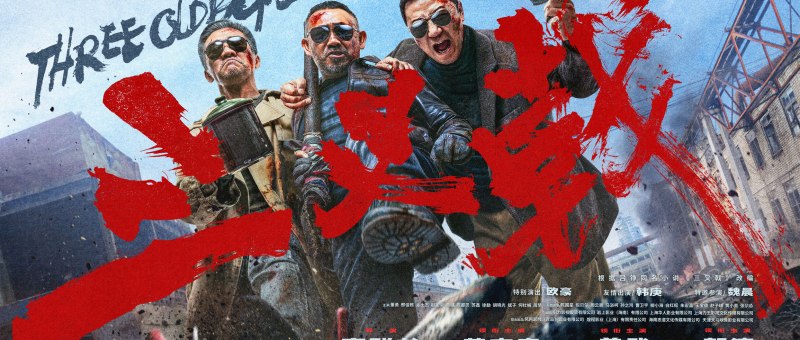
Three Old Boys (三叉戟, Gao Qunshu, 2024)

In a surprising development of Chinese propaganda cinema, the once untouchable subject of police corruption has become a prominent feature albeit often in tales of righteous cops who stand up for real justice against the few bad apples who’ve allowed themselves to be corrupted by contemporary capitalism. Then again, its subject matter might explain why TV police procedural veteran Gao Qunshu’s Three Old Boys (三叉戟, sānchājǐ) has been languishing on the shelf since at least 2020 if it were not also for the inevitable effects of the pandemic. 

In any case, Gao’s film has a distinctly retro vibe with use of classic Chinese pop and very ‘70s soundtrack while its maverick cop heroes all dress in the fashions of 40 years previously. All born in the late 1960s, they are products of an even more authoritarian era and began their careers in the late 1980s. Like any other old cop movie, they bemoan the restrictions of the contemporary society and suggest modern notions of appropriate police behaviour prevent them from doing their jobs which has its degree of awkwardness on the one hand implying the modern police force is now not so hardline but also that it should be because that’s what gets the job done. 

As they contemplate retirement, the trio are offered positions as part of a new squad set up to tackle economic crimes and specifically international money laundering, the chief problem with being that the criminals had the effrontery to move the money out of China which is stealing from honest, hardworking, Chinese citizens aside from having already ripped them off with fraudulent investment schemes and good old-fashioned blackmail operations. Of course, as it turns out, the case has a connection to something that happened 20 years earlier and police officer Cui’s (Huang Zhizhong) desire for revenge on the gangster king pin, Huang Youfa (Jin Shijie), who caused the death of his younger brother murdered by gangster Donzgi who was then shot dead by fellow officer Big G (Jiang Wu). 

The convoluted narrative is heralded by a homeless man who takes the police chief hostage and mutters something about a sword of justice that sounds like something right out of a wuxia serial before being updated to the present day. The sword does actually make a reappearance and is wielded by Big G against a young whippersnapper out for revenge and to take care of what he sees as corruption in the earlier generation. When the trio are first put on the case, they are given a young rookie to help them because he’ll be able to do the tech stuff which the old guys probably can’t because their idea of policing was largely rooted in their fists and a capacity for intimidation. But this doesn’t really work with the youth of today who are for some reason fond of reminding them they aren’t their fathers so they don’t have to do what they say. This is particularly true of young thug Blondie who is caught between Ghost, the old gangster king, and Qing an upstart who is actually working for Huang but in pursuit of his own particular goals. 

Huang has his claws well and truly embedded in the modern society and has it seems manoeuvred favourable people into the police force ensuring that Cui and his team are neutered before they get the chance to do anything. Then again, Big G seems to have a very co-dependent relationship with Ghost who tells Blondie off for getting into a fight with him because cops are off limits. Nevertheless, the point is to dismantle Huang’s networks of influence to restore the integrity of the police force so they can enforce the law which exists for the protection of the people. It’s all rather confusing, but generally lightened by the intense action sequences designed by Yoo Sang-Seob which are also suitably retro but make good use of sword play along with a motorcycle chase. Perhaps ironically inspired by Hollywood hero cop dramas, the film ends with a regime change and a new photo being taken of the guys in their more modern uniforms receiving a commendation with the clear indication that something has been put to rest and the rebellion suggested by Qing’s attempt to steal power from the old quelled while the old boys seemingly decide that justice requires they put off their retirement just a little longer.


International trailer (English subtitles)
Deep Sea (深海, Tian Xiaopeng, 2023) [Fantasia 2023]

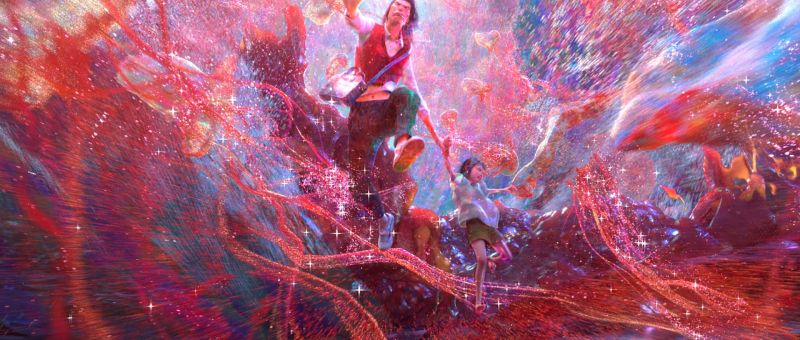
“For you who passed through the darkness” runs a dedicatory title card at the conclusion of Tian Xiaopeng’s stunning animated drama, Deep Sea (深海, Shēn Hǎi). Aimed squarely at younger audiences, the film is an exploration of depression and despair as the young heroine is plunged into a dark sea feeling that her life has no value but there encounters a fantastical world of colour and light while chasing the ghost of the mother who abandoned her.

As if to signify her loneliness, the film opens in a blizzard in which Shenxiu (Wang Tingwen) desperately searches for her mother only for her shadow to turn into a strange, many eyed monster. Back in the “real” world, she’s off on a family holiday with her father, his new wife, and their baby son, the family of three sitting in front while she remains behind on her own wearing the red hoodie that once belonged to her mother. About to get on a boat for a six-day cruise, she drafts a message to her mother about how excited she is to see the ocean but then scrolls back up and remembers all the times her mother didn’t reply and the times she did to tell her she’s busy and wishes Shenxiu wouldn’t contact her if it isn’t urgent. She deletes the message and rejoins her family but they’re so busy fussing over the baby that they don’t have time for her either and in fact seem to have forgotten that today is her birthday.

Venturing out on the deck in a storm, Shenxiu is sucked into a tornado in which she sees the outline of her mother and meets a strange sea creature, Hijinx, from a story her mother had told her believing that it has come to guide her to where her mother is living. Before too long she arrives at a bizarre floating restaurant where aquatic creatures go to eat run by “avant-garde” chef Nanhe (Su Xin). In some ways, Nanhe comes to represent her mother in that he first rejects her, insisting that she’s bad luck and kicking her out but later takes her back and tries to make her happy in an effort to stave off the “Red Phantom” that threatens to consume her, taking on the form of her mother’s red hoodie in which she attempts to bury herself as a symbol of her loneliness and despair. 

Beautifully animated, the world of the restaurant is a silkpunk paradise of chaotic action, part pirate ship and part fantastical submarine powered by walruses on stationery bicycles. Tian Xiaopeng makes fantastic use of the projector screen to illuminate Shenxiu’s fantasies, neatly including a cartoon within the cartoon in a more traditional 2D style while otherwise reflecting Nanhe’s broken dreams for a homeland he says he can never return to. Shenxiu too shifts between alternate “realities”, experiencing brief flashbacks to happy memories of her mother and others of less happy times as she’s sent for counselling by a school concerned she seems withdrawn only to be told the solution is to smile more so she’ll fit in better encouraging her to bury herself and her feelings under an affected facade of cheerfulness for the comfort of others.  

Nanhe’s final acceptance of her comes when he tells he that he hopes all her future smiles will be from the heart unlike the clown face he sometimes wears with its eerie, false grin intended to ward off other people’s discomfort but largely masking pain in himself. He also tells her that though the “real” world may seem grey and miserable in comparison to the dazzling colour of her dreams, there will bright moments waiting for her that no matter how small are worth living for. It might seem a heavy message to deliver to small children, but also one that some may sadly need to hear. Tian opts for a more realistic conclusion than many might expect in which Shenxiu but nevertheless allows her to punch through her loneliness and despair into a happier existence bonding with her stepmother and seemingly better integrated into her family no longer feeling excluded or alone. Absolutely breathtaking in its execution, Tian’s incredibly rich fantasy world is a riot of whimsy but also tempered by a deep empathy and compassion for anyone who’s battled their way through a dark sea. 


Deep Sea screened as part of this year’s Fantasia International Film Festival.

Original trailer (English subtitles)

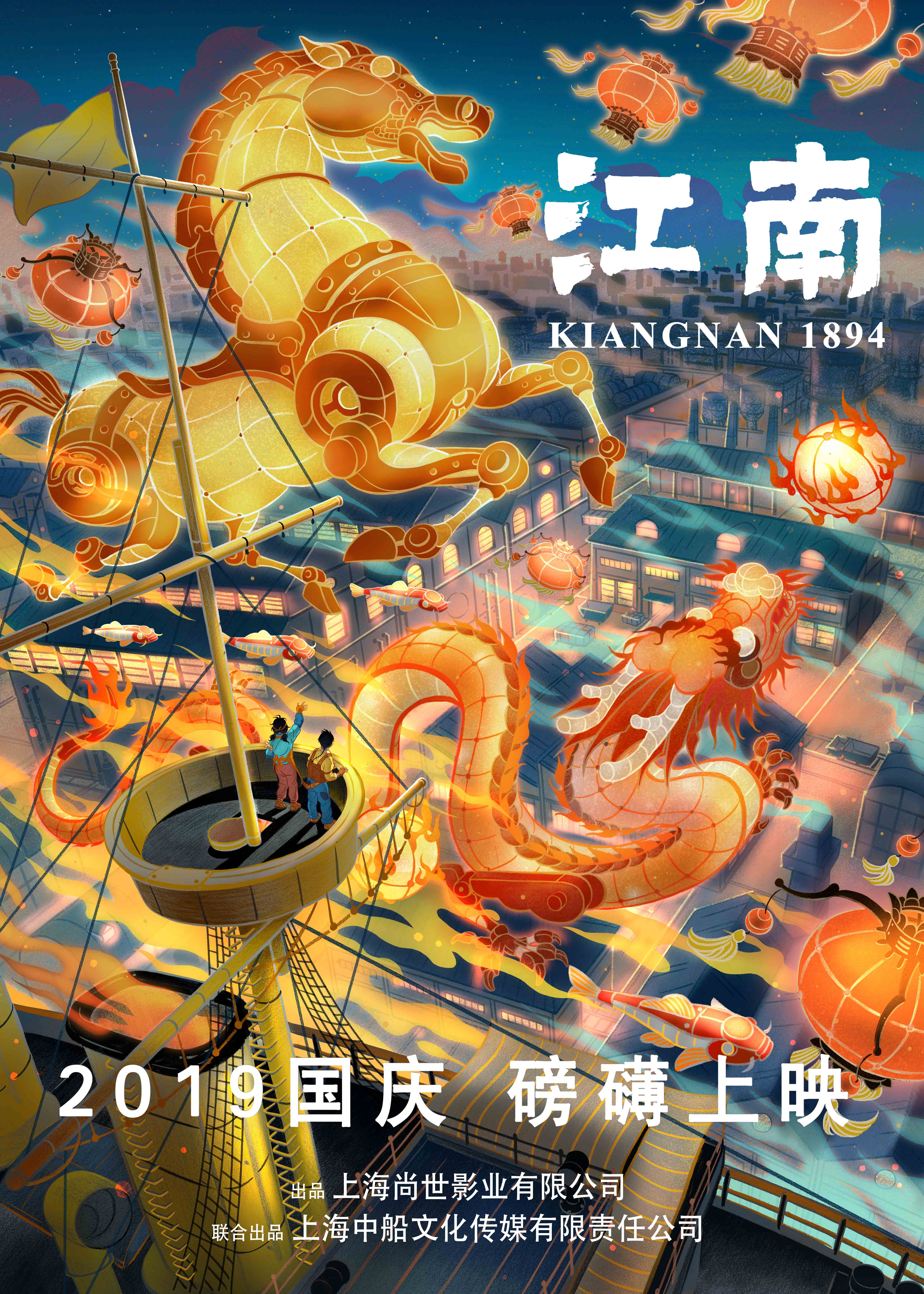
Kiangnan 1894 (江南, Wu Xiaogang, 2019)

“Remain true to our original aspirations. In honour of China’s military industry” runs the dedication card at the end of the thrilling animated adventure Kiangnan 1984 (江南, Jiāngnán). Sponsored by Shanghai’s Jiangnan Shipyard (Group) Co Ltd, the modern successor of the Kiangnan Arsenal, the film is both an unabashed love letter to the city of Shanghai and a celebration of Chinese engineering that, albeit subtly, reinforces China’s status as a powerful, technologically advanced nation fully prepared to defend itself militarily if threatened. 

Set in the late 19th century at the close of Qing dynasty, the film opens in fantasy as mechanical engineering enthusiast Lang (Ma Yang) dreams himself a king in a steampunk land daringly flying a celestial aircraft above a platoon of walking houses. Of course, he soon wakes up in a less fantastical world but is fascinated by the iron warships in the harbour and gets himself into trouble sneaking into the Manufacturing Bureau to show his friends a cool steamboat he’s found in a warehouse. Challenged by a young girl, Yulan (Zhang Qi), whose dog he ends up accidentally kidnapping as he escapes, Lang knocks over a candle and burns the whole place down, earning himself massive debts for the warehouse’s repair. To help pay them off, Yulan suggests he join the Manufacturing Bureau as an apprentice but the master, Chen (Zhou Yemang), who turns out to be her father, is a hard taskmaster offending Lang’s pride in refusing to take him on as anything other than a lowly assistant. 

All of that is somewhat secondary to the main plot which begins two years later as a cohort of Japanese spies desperately attempt to prevent a set of blueprints for a gatling gun reaching the Manufacturing Bureau. The historical Kiangnan Arsenal was founded as part of the Self Strengthening Movement which aimed to bolster the nation’s defensive capabilities, producing both firearms and warships at the beginning of the first Sino-Japanese war. This Kiangnan is however slightly more fantastical in its steampunk futurism which sees the workers wearing biomechanical aids extending to metallic gloves on their hands. The “Flying Fish” which captured Lang’s imagination was a high tech steamboat unbeknownst to him piloted by Chen’s late son who fell in battle, bravely making use of his experimental technology to serve his country. “Ordinance is essential for the greatness of our nation” Chen avows when agreeing to attempt to build the gun even without the plans, “faced with a great war we should do our best in duty bound”. 

Yet Chen’s grief-stricken rejection of Lang despite realising his genius, along with his rather sexist sidelining of his talented daughter, perhaps undermines his statement in allowing his personal feelings to holdback progress. Lang, meanwhile, patiently hones his craft while continuing to hope that Chen will one day allow him to become a real mechanic as his true apprentice, eventually building on the legacy of the Flying Fish to craft his own high tech steamboat complete with gatling gun and sailing it into the heart of danger carrying fresh supplies. A dreamer, Lang’s vision of a more technologically advanced future is fulfilled in a coda taking place 60 years later in which Communist China launches its first submarine at the Jiangnan Shipyard, the scene then shifting to an image of the modern Shanghai with its distinctive towers and high-rise cityscape. 

Patriotic concerns aside, the film also provides several opportunities for Lang to show off his equally proficient skills in martial arts, sparring with Yulan, fighting off gangsters, and efficiently dispatching the Japanese spies one of whom actually dies by his hand in quite a calculated manner which though not violent or gory is perhaps out of keeping with the family friendly flavour even as it once again demonstrates his cool-headedness, ingenuity, and heroism, while the persistent militarism has an uncomfortable quality given that the target audience is younger children. Nevertheless, such concerns are likely to fly over their heads thanks to the frequently exciting fight scenes and derring-do as Lang and Yulan take on spies and conspirators while working hard to achieve their dreams, “stubbornly” as the closing suggests refusing to give up on their future. Featuring bold steampunk design and painterly backgrounds showcasing major Shanghai landmarks, Kiangnan 1894 is an action-packed historical drama which aside from a slightly unpalatable militaristic fervour is also an impassioned defence of the right to dream as a path towards technological innovation.


Kiangnan 1894 screens at Vue cinemas across the UK from 23rd October courtesy of The Media Pioneers.

UK release trailer (Mandarin with English subtitles)