Shiro – Hero of Heroes (諸葛四郎 – 英雄的英雄, Lin Yu-chun & Chuang Yung-hsin & Liu Yu-shu, 2022)

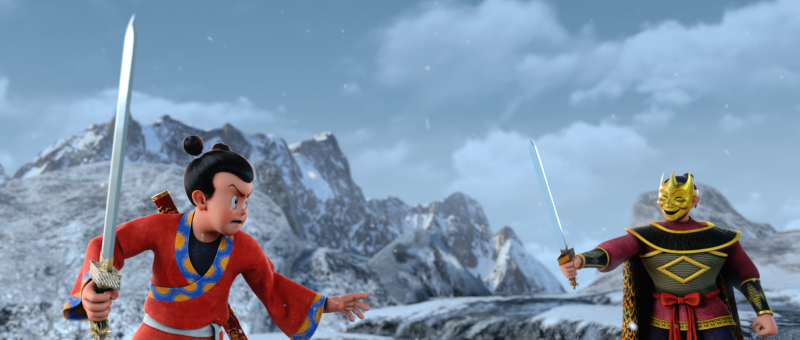
An earnest young man, grieving son, and feisty princess team up to stop the evil Demon Society from becoming all-powerful rulers of their land in an adaptation of classic Taiwanese comic book Shiro – Hero of Heroes (諸葛四郎 – 英雄的英雄, Zhūgě Sìláng – yīngxióng de yīngxióng). Created by Yeh Hong-Chia in the late 1950s, the series has become a nostalgic touchstone for generations of children and is about to reach new ones with a feature-length 3D CGI animation following Zhuge Shiro (Wang Chen-hua) on another exciting adventure to reunite the magical Dragon and Phoenix swords and stop their awesome power from falling into the wrong hands. 

Unfortunately the Dragon Sword has already been lost, much to the king’s regret. When Demon Society raid the palace during a festival and place a mask over the princess’ face, the king puts the land on lockdown and summons the nation’s locksmiths to try and free her only to realise there’s no way to unpick Demon Society’s diabolical locks without giving in to their demands to surrender the Phoenix Sword. Luckily hero of heroes Zhuge Shiro just happens to be in town on the invitation of his locksmith uncle and pledges to help the king salvage his fracturing relationship with his daughter who resents his hesitation to exchange the sword for her wellbeing and make sure Demon Society doesn’t get its hands on the swords’ unleashed power. 

Though this is in many ways a tale aimed at younger audiences, the incredibly witty script moving to the rhythms of traditional opera includes a series of meta jokes for grownups from a silly reference to a limited edition dart and workplace exploitation to subtle digs at societal authoritarianism along with a small cameo from a wandering cartoonist whose work is censored by the powers that be. Having faced Demon Society several times before, Zhuge Shiro is a pure hearted young man wise beyond his years with a strong sense of justice. His first act of goodness is standing up to an officious guard, General Shan, who won’t let a worried father with a sick child enter the town to find a doctor, while he soon earns the respect of the king through his compassion and emotional intelligence in trying to explain the king’s dilemma to the princess. He does however engage in a little sexism which the princess herself is quick to push back against, pointng out that she’s a skilled fighter herself and does not need protecting but will be joining him on this mission whether he likes it or not. 

Similarly, Zhuge Shiro gains another comrade in Zhen Ping (Chiang Tieh-Cheng) who is originally under the misapprehension that Zhuge Shiro is responsible for his father’s death only to later realise it was all the fault of Demon Society. To reunite the swords and save the kingdom, the trio find themselves battling through the villain’s booby trapped lair and discovering that the swords’ power lies in a different place than they first might have assumed, one Demon Society is largely unable to appreciate and therefore to benefit from even if they had managed to hold both swords in tandem. In other words, it’s brotherhood and justice which eventually enable the trio to prosper while the bumbling masked demons only make fools of themselves in their intense greed and villainy. 

Staying close to the aesthetic of the comic book, the film’s highly stylised designs closely match those of the original characters from back in the late 1950s if perhaps a little cuter and rounder in keeping with contemporary CGI animation while it moves to a comic beat inspired by traditional opera interspersed with a few song and dance numbers and exciting martial arts fight scenes as the trio face off against the minions of Demon Society while standing up for justice. Just as the king learns the real meaning of treasure, the trio discover a brotherly bond and a new mission to rid the land of the evils of Demon Society while accepting that even villains can change their ways and should be allowed a chance to redeem themselves, and those who may seem obviously villainous might be alright on the inside. In any case, Zhuge Shiro embarks on what could be the first of many adventures in charming style taking down the bad guys with good humour and righteousness fuelled by the power of friendship.


Shiro – Hero of Heroes screens in Chicago on Oct. 23 as part of the 15th season of Asian Pop-Up Cinema.

Original trailer (English subtitles)
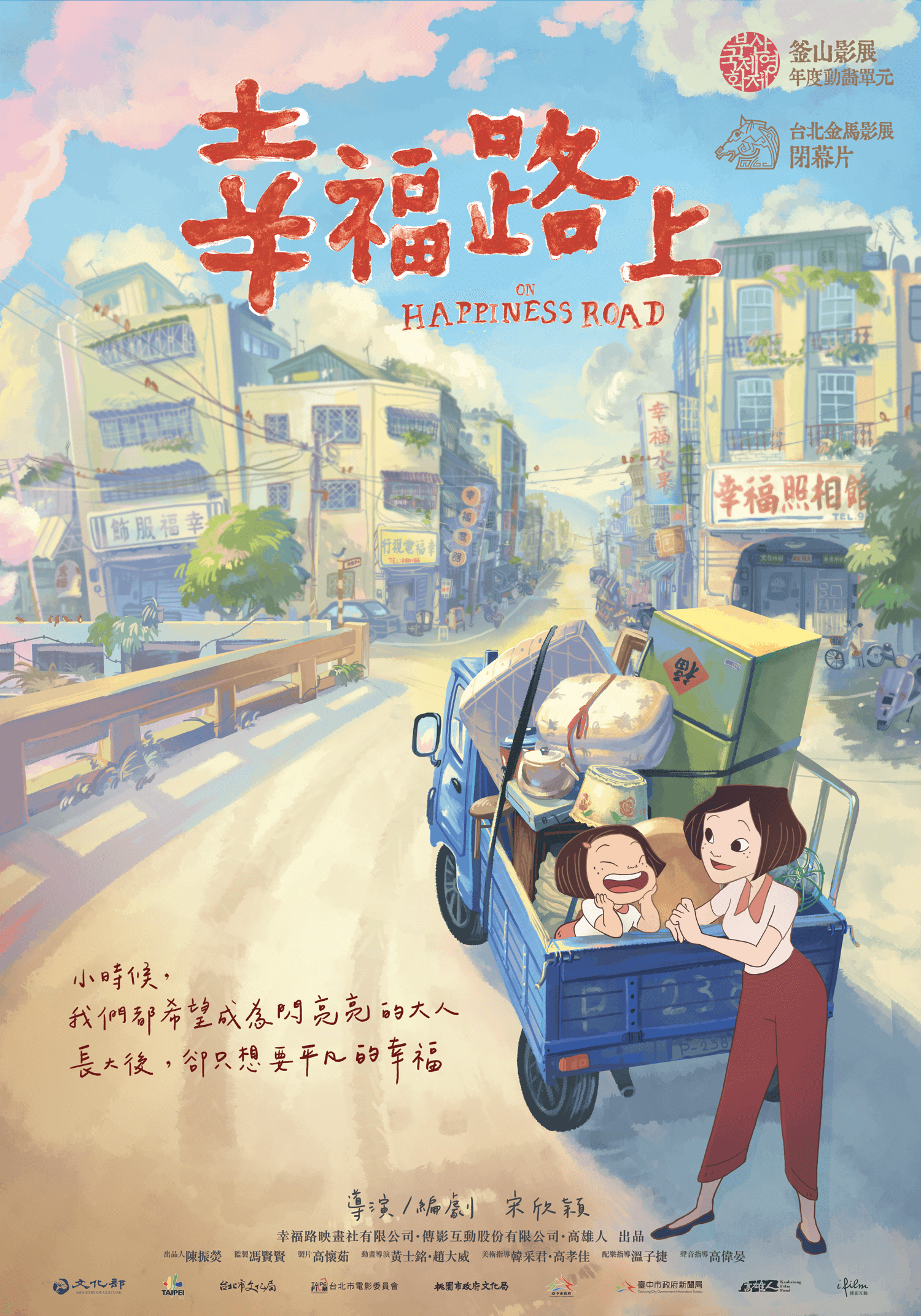
On Happiness Road (幸福路上, Sung Hsin-yin, 2017)

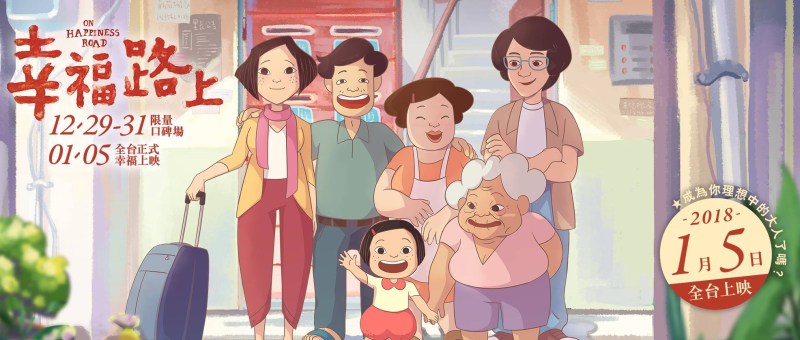
On happiness road posterSung Hsin-yin attempts a series of impossibles with her debut feature, On Happiness Road (幸福路上, Xìngfú Lùshang). In a bold move she has crafted what is possibly the last Taiwanese animated feature while attempting to pack 40 years of turbulent political history into the story of a lost middle-aged women ruminating on her cheerful, uncomplicated childhood on the distinctly humble Happiness Road. Battling the weight of parental expectation and the false promises of a better life overseas, her heroine, Chi, makes an enforced return to source on hearing that her beloved, part-aboriginal grandmother has passed away.

Chi (Gwei Lun-mei), an unhappy 30-something woman, receives the call in America where she has been living with her American husband. Unbeknownst to her family, Chi’s marriage is all but over and she finds herself at something of a crossroads, half wondering if it’s time to come home to Taiwan and half humiliated in being seen to have returned with her tail between her legs. She comes home, alone, to mourn her grandmother but finds herself wandering back through the streets of memory and fantasy recalling all the small details and minor incidents that brought her to his point in the hope of figuring out where it is she needs to go next.

Chi was born in 1975 on the very day that Chang Kai-shek died. Chang was by then a brutal dictator but the brainwashed little Chi who still sees his picture everywhere and has been taught to respect his many virtues idolises him all the same. Her family, uneducated ordinary working people, speak Taiwanese Hokkien at home but at school she has to speak Mandarin – the “official” language, all dialects are banned. Thus little Chi finds her parents’ language backward and embarrassing, their failure to adapt to “modernity” a hurdle in her own forward development.

As time moves on, Chi’s “Taiwaneseness” becomes something she feels she must sacrifice in order to purse the conventional success expected by her parents and the society at large. Little Chi, riding in the back of a pickup truck with her parents on the way to Happiness Road, asks them one of the biggest questions of all – what does “happiness” mean. Her parents, unable to answer, shush her, but her father (Chen Po-cheng) seems pleases his daughter has such big thoughts and wonders if she might become a philosopher one day. Oh no, replies her mother (Jane Liao). There’s no money in that – she’ll be a doctor! Her parents want for her all the material comforts of the settled middle classes, but her society tells her to attain them she must leave her nativeness behind – speak Mandarin, forget about granny’s ancient wisdom, and eventually go abroad leaving the “old fashioned” island far behind.

Chi has done everything she was supposed to do. She studied hard, got a good degree, got an OK job, and then ended up going to America almost on a whim. She reached the destination expected of her, but still she isn’t happy. Her marriage is failing as she and her American husband want very different things out of life and Chi wonders if she really belongs in this insincere culture which, at the end of the day, has never quite accepted her. In America she experienced mild forms of racism but then didn’t her half-American friend, Betty (Li Chia-hsiu) – blonde with blue eyes but speaking only Mandarin, experience exactly the same thing in Taiwan? Pregnant but seeking an escape from an unhappy marriage, Chi also worries what the future will be if she chooses to come home and raise her half-American child alone in a perhaps unforgiving society.

Yet reuniting with Betty she discovers that even if her life has not quite turned out the way she planned, she is blissfully happy as a single mother to two children, blonde like her but with brown eyes. Chatting with the ghost of her late grandmother who still has a few lessons to impart, Chi learns to see with the eyes of her heart and comes to realise that sometimes the road to happiness passes through a few uncertain turns but that that’s OK. Her parents, whom she feared would judge her for a failed marriage and a child born after divorce, are predictably enough only too happy at the prospect of their only daughter coming home for good and finally making them grandparents no matter the circumstances surrounding the origin of both those events. Chi may not have wanted the “road” her parents and her society had attempted to lay down before her, but discovers that departing from it is not failure and that “happiness” is a concept you are free to define for yourself. Beautifully animated and filled with whimsical flights of fancy, On Happiness Road is a sometimes melancholy but heartwarming tale of life in modern Taiwan as one lost woman finally discovers the road home and realises it has been waiting for her all along.


Screened at the 20th Udine Far East Film Festival.

International trailer (English subtitles)