Don’t Look Up (女優霊, Hideo Nakata, 1996)

“Have you ever seen an old movie and not been able to get it out of your head?” For those of us who grew up in the pre-internet age, daytime television was a treasure trove of classic cinema where unexpected discoveries were made. Maybe you only caught a few minutes of a film whose title you never knew, but the images are burned into your brain like nothing before or since. It’s tempting, then, to wonder if it isn’t Muroi (Yurei Yanagi), the nascent director, who’s projecting the darkest corners of his mind onto this haunted celluloid, though as it turns out this film was never actually aired.

If Muroi saw the haunted film as a child, it was because the ghost within it chose to broadcast herself by hijacking the airwaves. As his friend points out, however, perhaps he just saw a newspaper report about an actress dying in an on-set fall and saw it in his mind, creating a movie of his own or perhaps a waking nightmare that continues to plague him into adulthood. In any case, the film he’s trying to make is a wartime melodrama rather than a ghost story, but it’s one that’s clearly built around dark secrets and hidden desires. Hitomi (Yasuyo Shirashima) reveals that her character killed her mother in the film to take her place and later kills a deserting soldier with whom she’s been in some kind of relationship that the younger sister threatens to reveal in fear that should the villagers find out they’ve been hindering the war effort by hiding a man who’s shirked his duty to the nation they’ll be ostracised and people will stop sharing their food with them.

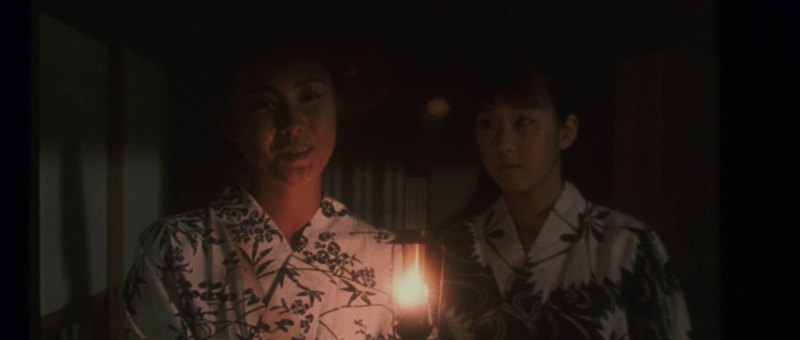
But Hitomi has real-world issues too. There’s something going on with her overbearing manager who seemingly didn’t want her to do this film which is why she’s not on set with her. When she eventually turns up, she seems to have some psychic powers. After handing Hitomi an amulet, she runs from the studio screaming. Hitomi agrees there’s something eerie about this place. As the projectionist remarks, this studio is 50 years old, built during the post-war relaunch of the cinema industry. Many things have happened here. But Nikkatsu is now a ghost itself and these disused production facilities are a haunted spaced. The floorboards creak and the rigging may give way any moment, bringing down with it the dream of cinema.

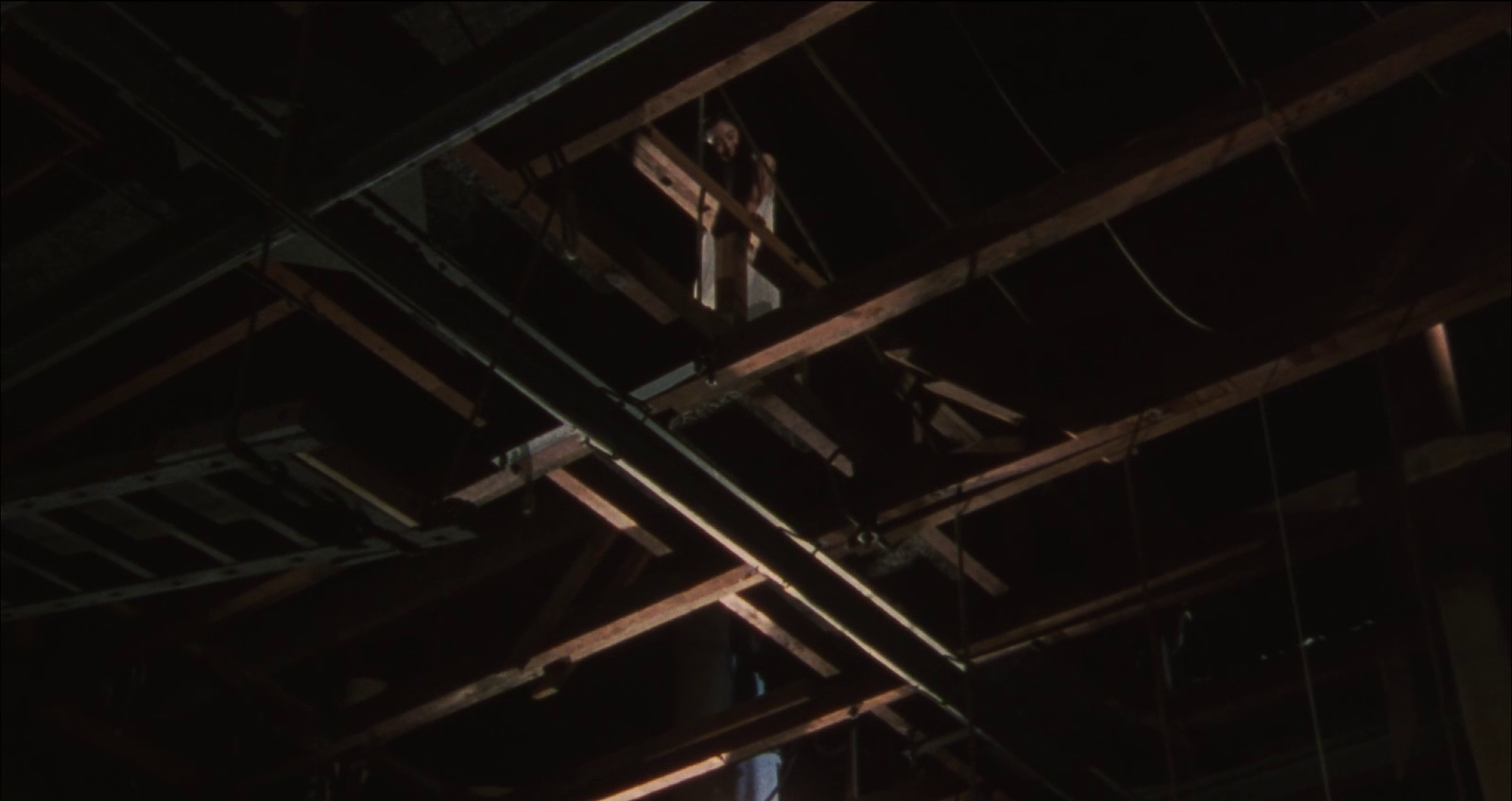
That’s one reason Muroi is advised not to look up and break this sense of allusion, along with recalling the more recent tragedy of an actress’ accidental fall. As much as Hitomi and Saori (Kei Ishibashi) begin to overlap with the image of the ghostly actress, it’s Muroi who is eventually swallowed by his dream of cinema in his determination to climb the stairs and find out what horrors are lurking in the attic before being dragged away to some other world. Nevertheless, this is a film that could only be made with celluloid. Nakata slips back and fore between the film that we’re watching and the cursed negative with its ghost images from previous exposure. This is evidently a low-budget production too, made using end cuts from other reels. As someone points out, this unused footage would usually be thrown out but has somehow mysteriously ended up infecting their film and releasing its ghosts. The projectionist burns it, describing the film as “evil” and suggesting that it’s better to let sleeping dogs lie.

But Muroi seems unable to let it go, chasing his childhood nightmare in trying to explain the mystery behind the footage. Hitomi describes herself as being haunted by a role long after the film as ended. It’s the same when someone dies, she says. They hang on for a while. The actor too remarks that he feels like the camera hates him, as if he were feeling the ghost’s wrath directly but otherwise unable to see her. Yet we have this sense of history repeating and a curse that’s sure to recur while this film too will remain unfinished and linger in the realm of the unrealised. Nakata too only undertook this film after losing his job to Nikkatsu’s collapse and trying to finance a documentary about Joseph Losey as if captivated by his own dream of the cinematic past and the haunting images of a bygone world.
Sasori in U.S.A. (Daisuke Goto, 1997)

An attempt to reboot the Female Prisoner Scorpion series for V-cinema had stalled in the early ‘90s when the then star of Death Threat abruptly pulled out of a sequel that was to be a production with Hong Kong’s Golden Harvest. In 1997, however, Nami Matsushima was once again resurrected only this time as a US co-production with most of the film shot in Los Angeles and in a mix of Japanese and English. 

Relocating the franchise overseas is in some ways surprising given that the first film of the original series opened with the national anthem and shots of the Japanese flag. It was explicitly clear that they were talking primarily about the social conditions of Japan in the 1970s. Likewise, Sasori in U.S.A. seems to walk back on some of the themes of patriarchal oppression that informed the previous instalments preferring instead to refocus on themes such as racism, the failure of the American Dream, and the powerlessness of living under a cruel and arbitrary foreign power, which is an entirely contrary perspective to the earlier film’s attempts at critiquing corruption with Japan itself. 

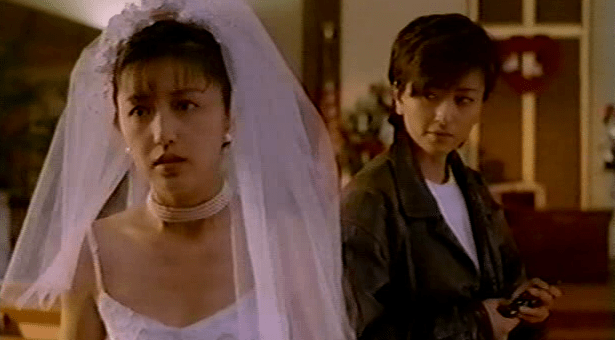
It’s never really made clear why Jiro (Tetta Sugimoto) and Nami (Yoko Saito) are in the US in the first place, though Nami’s sympathetic journalist friend implies that Jiro came there to make his fortune only to become frustrated with the limits of the American Dream. This Nami is a well-paid interior designer, at least according to her prison file, if one completely in thrall to Jiro whom she met in the US an unspecified amount of time previously. When Jiro is killed by a car bomb, Nami ends up being arrested for his murder because she stood to gain 1.2 million dollars by his death (though they appeared to have a very comfortable life to begin with, so it’s not clear why she’d take such drastic action). Apparently too traumatised to defend herself, Nami failed to hire a proper lawyer or fight her case and has not launched an appeal but spends all her time vowing revenge, which of course means she has to escape from prison. 

That might be a minor problem for the film, which is to some extent in its marketing selling itself as a women in prison picture. This is indeed the most exploitative of the films so far with a salacious shower scene and titivating moments of touching and kissing each other, while Nami is also harassed by an obnoxious blonde prisoner who seems to be running the cell block while in cahoots with the sadistic warden who, as this is America, is incredibly religious and forever quoting from the Bible while raping his inmates. Nami eventually stabs him in the eye in what may be an homage to the original series. 

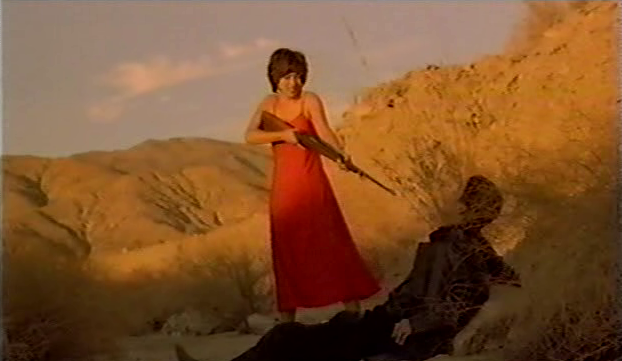
Nevertheless, Nami soon escapes in the company of another prisoner who is second generation Japanese-American and has been blind since birth. Like Nami, Yukiko (Shizuka Ochi) also has a mission of revenge against the American hoodlums who raped her and shot her Dominican boyfriend Dino to death. Though the narrative actually has almost nothing to do with Female Prisoner Scorpion, the twist will be very obvious to anyone familiar with the series as Nami has indeed been betrayed by a man she thought loved her. Discovering Jiro may have been embezzling money and in fact knocking off the lawyers who tried to sue the car company he worked for for making defective cars rather than being knocked off by them, Nami is forced to reckon with the illusionary quality of her American success story. Jiro meanwhile rails about entrenched racism and unfairness, decrying the police and justice system as “insane” which they well might be or at least in their treatment of Nami. Broken by the failure of his American Dream, he becomes a pitiful and tragic figure.

Even so, Nami’s revenge remains a personal affair rather than an all out attack on a corrupt and oppressive social order ruled by misogyny and male failure. Though the production values are perhaps a little higher than one might expect and the direction leaning towards the artier side with its blue-tinted eroticism, shower scenes aside, the film remains very much of its time and has very little in common with the Female Prisoner Scorpion franchise save its women in prison elements and a late allusion to an actual scorpion. It is though interesting for its perspective on the American Dream and America in general as a place of greed, violence, and intensely hypocritical religious fanaticism.