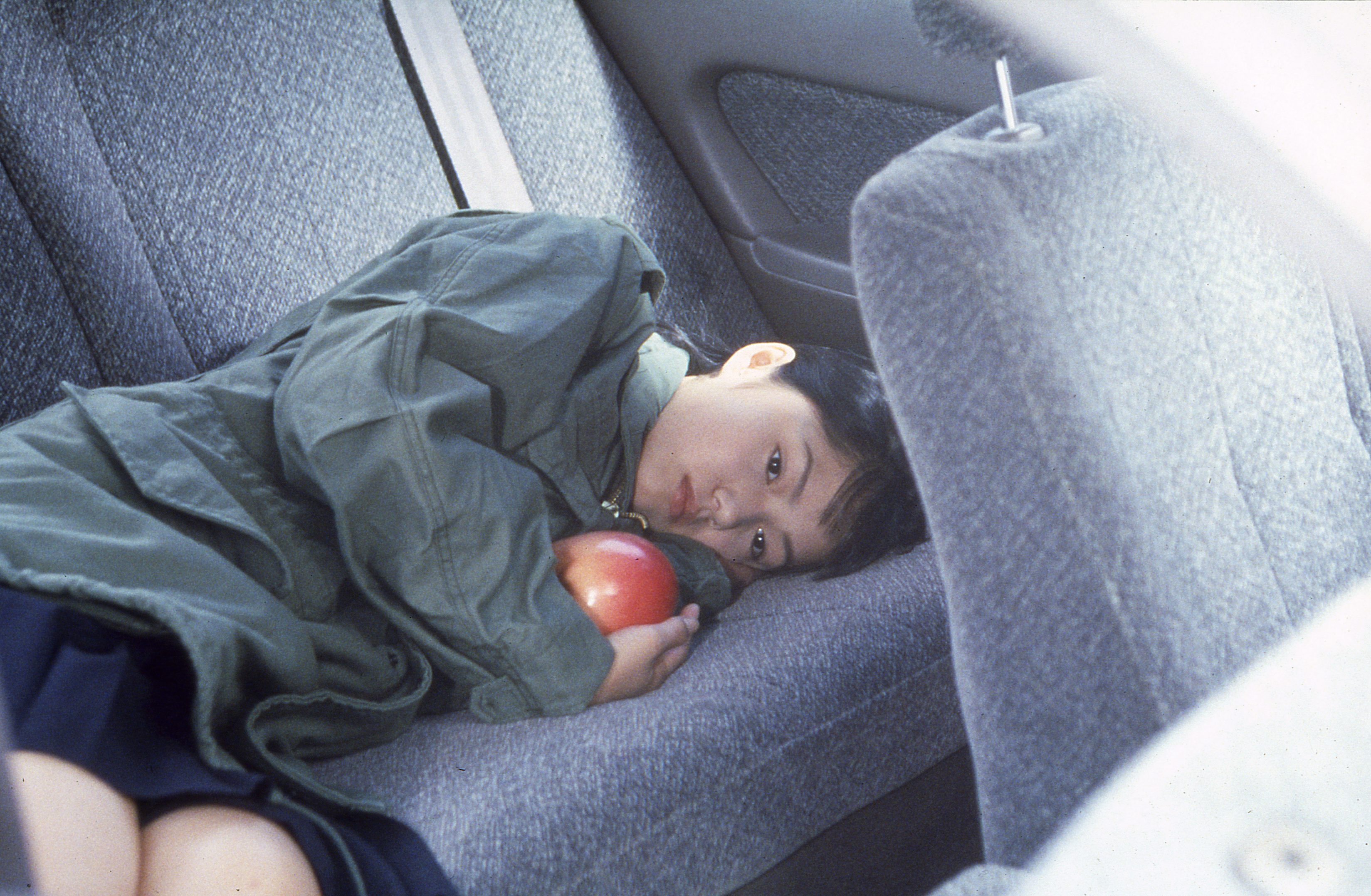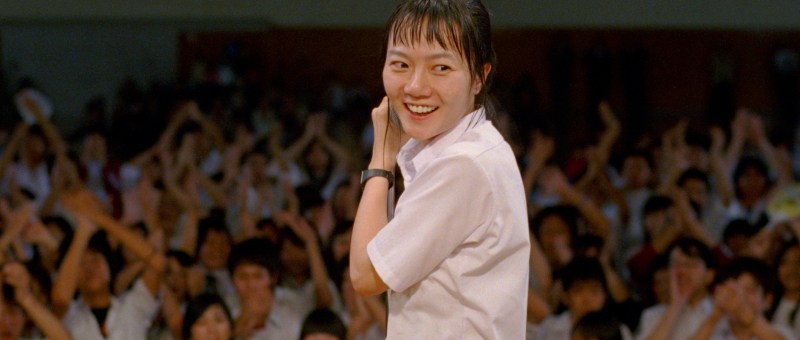
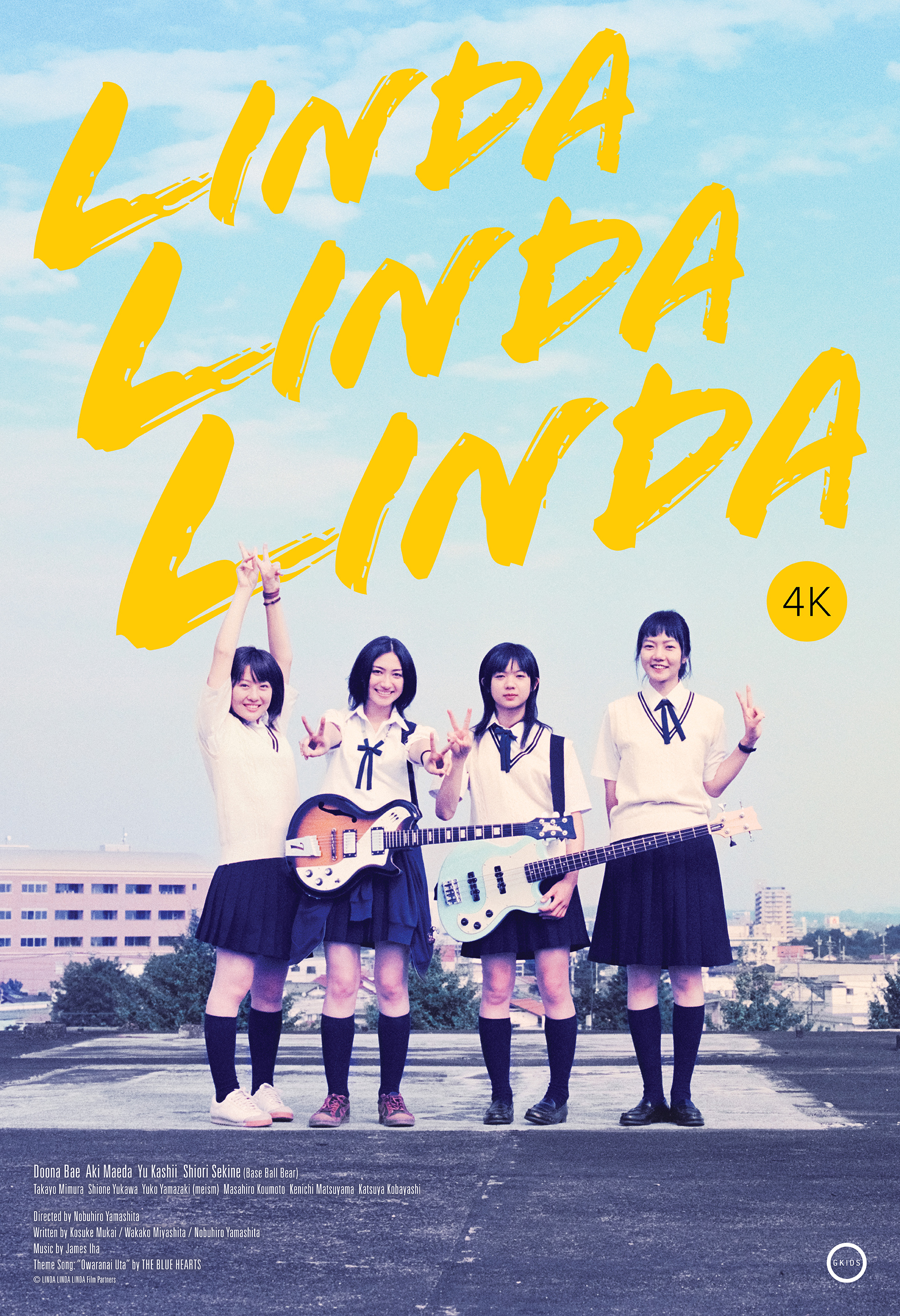
Linda Linda Linda (リンダ リンダ リンダ, Nobuhiro Yamashita, 2005)

“We’ve only got a little more time to be the real us,” according to a young woman making a promo video for the upcoming school festival, but who really is the “real us”? Now celebrating its 20th anniversary, Nobuhiro Yamashita’s wistful high school dramedy Linda, Linda, Linda (リンダ リンダ リンダ) is in many ways about the process of coming into being along with the anxieties of what comes next. “We won’t end here,” the girl later adds, “We won’t let our high school days become a memory,” yet they already are in a kind of contemporaneous nostalgia and elegy for idealised youth.

Or at least, there’s already a kind of reaching back taking place as the tracks the girls pick for a replacement act are by The Blue Hearts, a 1980s punk band that has become a kind of cultural touchstone echoing a sense of youthful alienation and rebellion. “Linda Linda” is the kind of song everyone knows, and even if for some reason they don’t or don’t even speak Japanese, can at least join in with the riotous chorus. It’s this sense of universality that eventually gives it its power as torrential rain brings the entire school inside just in time to see the girls’ belated act and find themselves captivated by its infectious energy and an identification with their own sense of insecure anxiety.

It’s also the serendipitous rain that allows lonely songstress Takako an opportunity to perform having previously declined to do because it’s no fun playing on your own and all her former bandmates graduated the previous year. Moe, the girl who broke her fingers playing basketball in PE leaving the original band members unable to take the to the stage, also gets an opportunity to sing having otherwise been denied a moment of closure in being prevented from taking part in her final school festival. While Moe feels intensely guilty about rendering all their time spent rehearsing somewhat pointless, it’s really the drama between founding members Kei and Rinko that leads to the band’s demise in Rinko’s conviction that it’s “meaningless” to continue while the others decide to go ahead anyway asking Korean exchange student Son (Bae Doona) to be their vocalist because she just happened to come down the stairs at the right moment and said yes because she didn’t really understand what they were saying.

Prior to her involvement with the band, Son had been a rather isolated figure trapped in the “Japan-Korea Culture Exchange Exhibit” which seems to have been more her teacher’s idea than her own and in any case gets no actual visitors. Her Japanese is a bit limited and most of her interactions are with a little girl who lends her manga to help her learn quickly, but becoming part of the band allows her to find her voice both literally and figuratively in taking the lead as the vocalist. A boy who claims to have fallen in love with her (Kenichi Matsuyama) goes to the trouble of learning a long speech in Korean to convey his feelings, yet a bemused Son replies to him in Japanese that she’s pretty indifferent to his existence before switching to Korean to explain that she’s leaving because she’d rather be hanging out with her friends with an expression that implies she’s only just realised that’s what they are. By contrast, she has a bilingual conversation with guitarist Kei (Yu Kashii) in which they seem to understand each other perfectly and each express how glad they are that they got to be in the band together. 

Similarly, it’s the concert itself that seems to heal rifts with a simple “Are you alright?” from Rinko (Takayo Mimura) to Kei whose friendship might, as someone says, essentially be too close for them to really get along. Drummer Kyoko (Aki Maeda) decides to declare her feelings for a longstanding crush before the concert. In the end she doesn’t manage it, but it doesn’t quite matter somehow because their performance is itself a kind of coming into being in which “the real us” comes into focus if also in a moment that itself becomes romanticised or idealised as an encapsulation of youth. Yamashita travels through the school festival as if it were a passage from one state of being to another, from the noodle stalls and crepe stands to haunted houses and the boy creating his own moment through encapsulating them on film, before ending with an unending song “so we can laugh tomorrow,” and the “real us” lives on.


Linda Linda Linda opens in US cinemas 5th September courtesy of GKIDS.

Trailer (English subtitles)
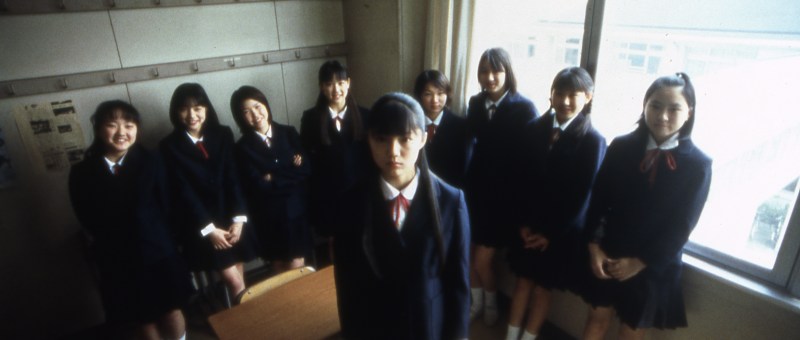
Harmful Insect (害虫, Akihiko Shiota, 2001)

“We’re only in seventh grade, why does Sachi have to suffer so much?” a well-meaning friend eventually asks as she comforts the heroine of Akihiko Shiota’s Harmful Insect (害虫, Gaichu), even as her mother turns away from her too fragile herself to be of much use. Sachiko (Aoi Miyazaki) does indeed suffer, continually victimised by the world in which she lives and having that victimisation used against her, rejected by her peers and almost blamed for the misfortunes which befall her as if she were the one at fault simply for existing. 

Shortly after the opening scene in which 13-year-old Sachiko’s mother (Ryo) attempts to take her own life, we see the girls at school gossiping about her while she’s still in earshot not entirely sympathetic as they remark on the fact her father left the family while implying that her mother is some kind of broken-hearted love fool driven to suicide over the loss of a man. Sachiko quickly becomes the woman of rumour, but in a motif which will be repeated the teens talk but never listen swapping stories between themselves and embellishing them as they go. It’s uncertain how much truth there is in the legend of Sachiko but it’s clear that they disapprove of her, adopting a puritanical moralising mindset in which they simply shun her for being something other. Only Natsuko (Yu Aoi) tries to stop them, reaching out to Sachiko even as Sachiko rejects her but is ultimately able to offer little help when even Sachiko’s mother is ill-equipped to protect her. 

The truth is that Sachiko is never safe anywhere. Everywhere she goes, she becomes a target for predatory men of all ages. A schoolboy on a bike harasses her by asking childish questions about her period, while sleazy salarymen repeatedly proposition her for sex, and even her mother’s new boyfriend in a doubly destructive act of betrayal cannot be trusted. She says little and keeps to herself, her silence and her isolation a kind of defiance and defence mechanism. After dropping out of school, she starts hanging around with a drop out 20-something (Tetsu Sawaki) and his homeless friend (Koji Ishikawa) who seems to have learning difficulties, discovering that they support themselves through staging accidents for compensation money. She considers doing the same thing, not for the money but craving the thrill of a near death experience only to find herself unable to go through with it. 

Meanwhile, she continues a letter-based correspondence with her former teacher with whom she is rumoured to have had an affair. Mr. Ogata (Seiichi Tanabe) later resigned for obvious reasons and now has a low-grade job at a nuclear plant. He answers her letters when he can, mostly offering paternalistic platitudes but like her absent parents is unable to provide her with the guidance she is seeking. What she seems to be looking for is the kind of parental input that would allow her to feel protected, safe, but no one is really there for her. She resents her mother’s emotional dependency and tendency to involve herself with unsuitable men, but worries she’s becoming the same striking out for an early independence but discovering only danger and futility. 

She asks herself if vice is the essence of human existence, then is goodness only the quality of not being entirely bad? Her view of the world already coloured with nihilistic despair. The men who misuse her feel they have no real need to justify their actions, but simultaneously blame her for tempting them though she does nothing other than exist remaining silent in order to avoid attracting attention. Then again even she doesn’t quite understand, asking her teacher why it is he can’t forgive himself simultaneously accepting that what happened between them, whatever that was, was wrong enough to warrant forgiveness but unable to grasp why he cannot let go of his guilt, continuing with this half-hearted correspondence unable to grant her the care that she is seeking. Wandering between flashbacks and brief vignettes of her life, Shiota captures Sachiko’s sense of total aloneness as even her sole source of sanctuary is taken from her leading to an explosive act of partially self-destructive violence that sends her forever on the run. The choice she makes at the film’s conclusion, be it in submission or defiance, is hers alone but in its own way a tragedy dragging her deeper into dangerous despair with escape an ever distant possibility.


Harmful Insect streams in the US until Dec. 23 as part of Japan Society New York’s Flash Forward series.

Original trailer (no subtitles)

Images: ©2002 NIKKATSU / TBS / SONY PCL