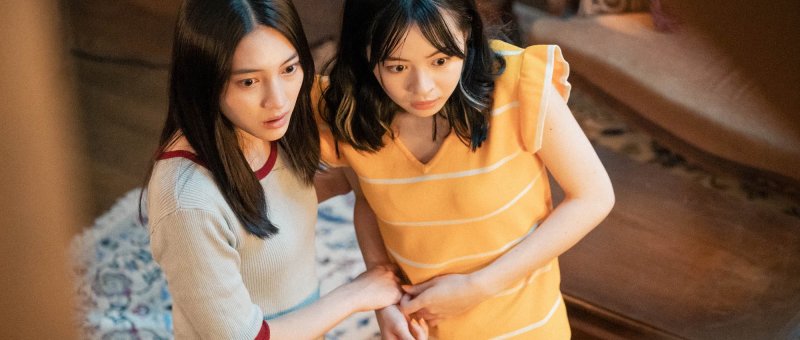
Love Will Tear Us Apart (ラヴ・ウィル・テア・アス・アパート, Kenichi Ugana, 2023)

“This film depicts a pure and genuine love between an awkward boy and a girl with a pure heart,” according to a pop idol starring in a film called “garbage love”, but it’s a true enough description of Kenichi Ugana’s genre-crossing slasher romance, Love Will Tear Us Apart (ラヴ・ウィル・テア・アス・アパート). Co-scripted by Hirobumi Watanabe, the film has a deadpan, surreal sensibility but has a lot to say about entrenched patriarchy and a bullying culture. 

As the film begins, Wakaba is a cheerful little girl who has an all encompassing obsession with a handsome pop idol, but is secretly enduring an oppressive atmosphere of domestic violence in her family home at the hands of her cruel and violent father. In this she might have found a kindred spirit in classmate Koki who is enduring physical abuse at the hands of his mother who openly tells him how much happier she’d be if only he’d never been born. Koki is also being bullied by a pair of mean kids at school and meekly takes it, unable to stand up for himself. When Wakaba steps up and tries to help him, the bullies turn on her too and their teacher (Atsuko Maeda) seemingly does nothing. After the pair bond through a screaming session at a local river, the bullies mysteriously fall out of a window which Koki is then seen ominously staring out of. 

The film jumps on seven years to a teenage Wakaba (Sayu Kubota) who discovers the world is not a safe place for women, repeatedly encountering a series of skeevy guys beginning with her favourite pop band who lure her to a cabin in the woods where they openly talk about getting her drunk to take advantage of her or spiking her drinks. One of the chief victimisers is another woman, Moeka, whose apparent “job” it is to recruit girls for the guys to have fun with. Wakaba’s friend Kanna (Riko) wants to leave, sensing that there’s something not quite right but Wakaba is naive and unable to see the danger. A similar thing happens when she visits Tokyo alone and has a meet cute with a guy who spills coffee on her shirt and offers to buy her a new one, then to show her around, takes her for sushi, declares his love and makes a proposal of marriage. 

As might be expected, many of these men end up dead at the hands of a vicious, chainsaw-wielding serial killer in a white hazmat suit, gas mask, and goggles. You can’t quite blame him for his crimes because everyone he kills is so irrediambly awful while it really does seem that he might be trying to protect Wakaba in some way from the hidden dangers she remains unable to see because of her pure heartedness. While her own father had been cruel and violent, she discovers that Moeka’s, police detective Kamiyama (Mitsuru Fukikoshi), is the opposite but worse in his unsettling obsession with his daughter, whom he believed to “pure and earnest” little knowing that she had been procuring young girls to serve up to the sleazy band members.

In a strange way, the serial killer turns out to be Wakaba’s healthiest relationship even if he’s basically stalking her not to mention murdering people with chainsaws because they threatened her happiness. The film runs through a series of genres from the cute childhood romance that soon turns ominous and the cabin in the woods slasher movie complete with creepy monkey and trainset, to martial arts epic as Wakaba abandons her life to train with a YouTube serial killer catching guru in a tropical resort town but retains its sense of anarchic innocence and internal integrity. As the pop star had implied, it really is a tale of genuine love between an awkward boy and a pure hearted girl in which they gradually realise that they each have a right to be happy and can be so together despite all violence and mayhem around them which includes killing a guy by shoving a grapefruit blender on his head. Strange and absurd the film nevertheless has a heartwarming romantic sensibility along with a desire for a less destructive world defined more by kindness and compassion than bullying and violence. 


Love Will Tear Us Apart screened as part of this year’s Camera Japan.

International trailer (English subtitles)
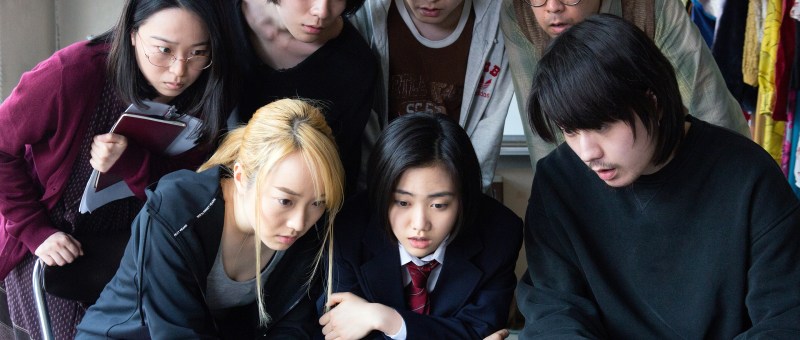
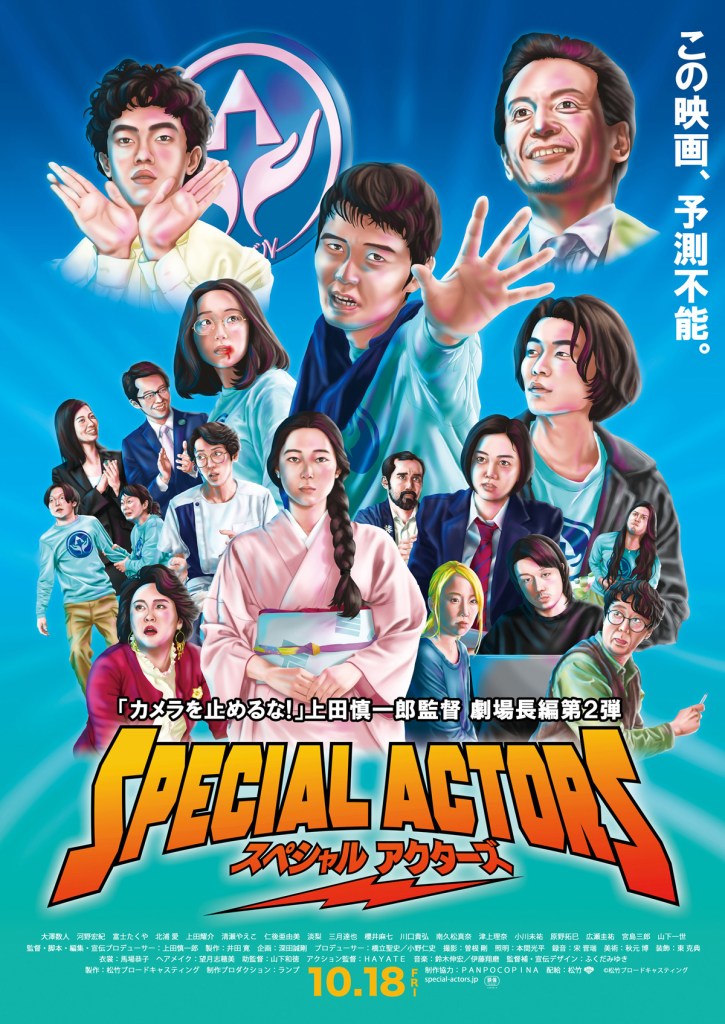
Special Actors (スペシャル アクターズ, Shinichiro Ueda, 2019)

When your made on a shoestring indie debut becomes an accidental international phenomenon, no one could really blame you for succumbing to imposter syndrome. Shinichiro Ueda’s One Cut of the Dead, a meta comedy with high concept conceit, delighted fans around the world but rather than slide into summer tentpole territory Ueda remains true to his roots with follow up feature Special Actors (スペシャル アクターズ) once again developed through actors’ workshops and owing a significant debt to contemporary stage comedy.

Our dejected hero, Kazuto (Kazuto Osawa), is an anxious young man burdened with PTSD from childhood trauma that causes him to faint when he becomes overly stressed or is confronted by an overbearing, if not actually violent, male authority figure. He dreams of becoming a hero who can protect people like Rescue Man, the star of an American tokusatsu-style show he’s obsessively watched dubbed into Japanese since childhood, and is determined to become an actor only his habit of fainting mid-audition constantly frustrates his ambitions. Already behind on his rent and about to be fired from his part-time job as a security guard on the grounds that he didn’t disclose his “illness” when he applied, Kazuto is reunited with his estranged younger brother Hiroki (Hiroki Kono), also an actor, who offers to introduce him to his agency, “Special Actors”. In addition to the usual TV and advertising work, Special Actors speciality is renting out talent for “real” as in providing professional mourners, bulking out theatre audiences with laughing stooges, and engineering long queues outside previously empty restaurants. 

Kazuto isn’t quite convinced, not only because it seems like anxiety central, but because it’s more than a little bit shady. The lead “scenario” writer was once a conman, and you can’t get away from the fact this is all quite manipulative and essentially unethical. Forced to take the job because of his financial predicament, he finds himself involved in various plots to change problematic behaviour at the request of well-meaning relatives such as a mother desperate to rescue her daughter from frittering all her money away at host bars. But are the Special Actors really any different than a host at a host bar who is after all only playing a role, as the young woman must know even if she has for some reason been taken in by it? Perhaps they’d be better to find out what is fuelling her obsession rather than coming up with some hokum involving a fake shaman to convince her that her behaviour is dangerous on a cosmic level. 

The moral ambiguity only deepens when the team take on their biggest challenge yet, taking down a shady cult at the request of an orphaned teenage girl whose sister seems primed to give away the family inn. Abruptly shifting into the realms of the espionage thriller reimagined as theatre, Ueda concocts an elaborate heist as the Special Actors infiltrate with the intention to expose. The central irony is of course that in practical terms there isn’t so much difference between them. They are both “lying”, manipulating vulnerable people and doing it for financial gain. “Acting is a big lie” the irate director had screamed in Kazuto’s face, “you have to mean it”. Is the shady cult merely “theatre” taken to an extreme, and if so who if anyone should be held responsible?

Ueda isn’t so much interested in these themes as the ironic potential of their latent comedy, stitching together a series of theatre skit set pieces working towards the epic finale in which the hero, Kazuto, learns to put on his cape and save the day by overcoming his internal “villain” in the shape of his abusive father. Like the cult, the Special Actors are also promising salvation or at least liberation from behaviours which others find problematic regardless of the target’s own wishes or desires even if in the case of some it may be for their own good, a more elaborate form of role play than that enacted in a therapy session. We are indeed all “acting” to one extent or another and you can never be sure that anyone is who they say they are because life itself is theatre. Shot with a perhaps thematically appropriate TV drama aesthetic, Kazuto’s zero to hero journey is pure wish fulfilment fantasy, but even if never reaching the perfectly constructed heights of One Cut of the Dead is undeniably entertaining. 


Special Actors is available to stream in the US until July 30 as part of this year’s Japan Cuts. Tune in for the live Q&A (available worldwide) after the movie on July 17 (also available afterwards on demand)!

Original trailer (English subtitles)