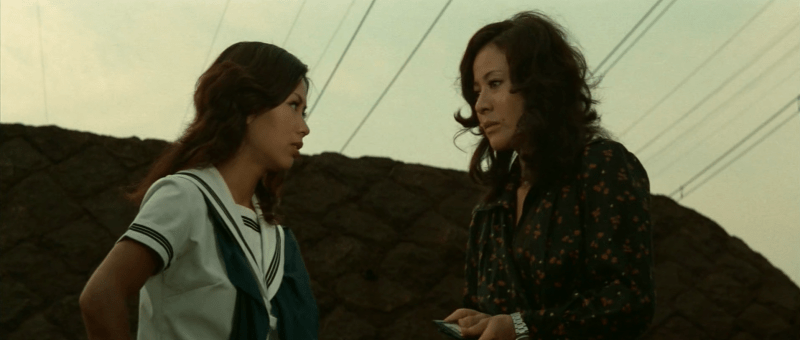

“Society fucking sucks” according to the delinquent teens at the centre of Terrifying Girls’ High School: Women’s Violent Classroom (恐怖女子高校 女暴力教室, Kyofu joshikoko: Onna boryoku kyoshitsu). The first of four in a Toei pinky violence series, the film presents a feminine rebellion against the societal tenets of womanhood, if doing so largely within the realms of male fantasy, but nevertheless kicks back against the corruption and hypocrisy of the older generation otherwise hellbent on controlling them.
Seiko Girls’ High School is, we’re told, both a private institution and a “trash bin” established to handle the “trash” transferred from “normal” schools. Nevertheless, the sign which hangs outside proclaims conservative values playing on the “good wife, wise mother” truism of traditional femininity in insisting the girls must become wise wives and kind mothers. Needless to say, most of the young women are quite uninterested in becoming any such thing. The unruliness of the school is signalled in the opening sequence as an older male teacher gives a boring lesson about curves while the girls all ignore him. Some are putting on makeup, others are eating or talking amongst themselves. After all, what’s the point of their education if the expectation is they’ll all become obedient housewives dependent on their husbands for support and allowed little in the way of free thought or interest?
A teacher later ironically suggests that the school’s reputation will later reflect badly on them when it comes to getting jobs or getting married only for one of the girls to snap back no one here is going to university and their reputations are all ruined anyway. It might be tempting to assume the problem is mostly generational, but the arrival of a young male teacher who has himself been transferred for violent conduct suggests a kind of backlash to the increasing freedoms of the contemporary society. He tells the girls that he won’t be soft on enforcing his three rules for education which are surprisingly gentle, being friendship, companionship, and harmony, but they simply laugh at him. Not only do they pelt the new teacher with pants and condoms but insist that it they who make the rules here and he will have to follow them.
Then again there don’t seem to be any rules of any sort other than the absurdity of social hierarchy as they girls square off in various factions vying for dominance of the school, The implication is that gang leader Michiko (Miki Sugimoto) turned rebellious after being raped by strangers on her way home and witnessing her father, a politician, actively cover it up while she continues to feel shamed by her family. Another girl, Yoko (Natsuko Miura), otherwise not involved in the school violence, is working as a hostess to support herself as an orphan living with her grandmother but is lusted after by lecherous teacher who eventually forces her into a sexual relationship and then drops her when she becomes pregnant despite giving the implication he would marry her. Takeo tries to force her to have an abortion though she is determined to have the child despite the scandal causing him to hire another delinquent faction to beat her into a miscarriage. When she takes her own life, the school is most concerned about its reputation despite having done nothing when it was discovered the headmistress’ own daughter, the leader of the other gang, was also engaging in sex work.
Takeo is also the target of a revenge plot at the hands of mysterious transfer student Yuki who avoids taking any categorical side until pulled into the conflict because of her friendship with Yoko and the growing sense of solidarity between the young women oppressed by a corrupt social system that uses shame to control them. “The rapists win in our society,” one sighs in an oddly contemporary moment. To celebrate their liberation, they burn their sailor suits having stripped and bound their teachers before posing before a sign announcing that they have enacted justice on the “three pigs” who financially exploited them through abusing the educational system. Full of ironic details such as the girls introducing themselves through the classic gambler’s pose, Suzuki films with a punkish irony quite clearly fetishising female violence yet also poking fun at lecherous middle-aged men, youthful hard cases, and matronly older women while in the end handing agency back to the girls even if society continues to suck.
 Windows on Worlds