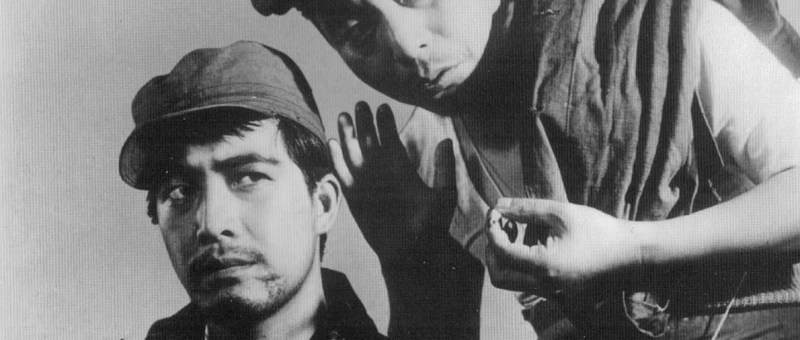
Passing Fancy (出来ごころ, Yasujiro Ozu, 1933)

“We have to help one another” a sympathetic soul insists towards the conclusion of Yasujiro Ozu’s Passing Fancy (出来ごころ, Dekigoroko). Ozu’s depression-era silents are not as devoid of hope as it might at first seem, but it is a much more positive statement and perhaps surprisingly the central messages lie more in the necessity or otherwise of repaying kindness and the kinds of forms that action may finally take. It is also, however, the first in a loose trilogy of films revolving around a single father named “Kihachi” and the only one in which he is not (at least potentially) exiled from the family he has been trying to protect. 

This Kihachi (Takeshi Sakamoto) has one young son, Tomio (Tokkan Kozo, AKA Tomio Aoki), and casual job working in a brewery though he is hardly a model employee and is often late due to oversleeping after a night of heavy drinking. A roguish womaniser, he is also a kinder soul than he seems which is why he stops to talk to a pretty young woman, Harue (Nobuko Fushimi), wandering around in distress late in the evening. His first approach is slightly crass, responding to her question about lodging for the night by explaining that he has a kid and no wife but then he takes her to a local cafe he frequents and persuades the owner, Otome (Choko Iida), to take her in. Otome takes a liking to her, and decides to offer her a job as a waitress. 

Kihachi develops a hopeless crush, comically dolling himself up in his fanciest kimono and getting an advance from work to buy a pretty comb, an unmistakably romantic gift, to present himself to Harue. Of course, she’s grateful but sees him as a nice older gentleman rather than a potential husband. In fact and somewhat surprisingly she develops a crush of her own on the brooding Jiro (Den Obinata) despite the fact he is constantly rude to her and more or less implies she’s an untrustworthy woman out to take advantage of “vulnerable” men like himself. There is something quite touching and unusual in the brotherly friendship between the two men that occasionally comes off as something more in Jiro’s deep antipathy to Harue, which is to say she isn’t going to come between them but the situation is indeed complicated. 

Harue is, in that sense, a distraction that takes Kihachi’s eyes off his proper role as responsible father. He and Tomio have a close, interdependent relationship and it’s clear that it’s often little Tomio, older than his years, who finds himself managing Dad. Kihachi is immensely proud of his son, fond of saying he’d be top of his class if only he had better manners. Like any father what he most wants for him is that he escape their life of poverty which is why he’s so glad that the boy does well at school. But little Tomio finds himself bullied precisely because of Kihachi’s lack of standing. The other boys mock his illiteracy, unable to believe a man could reach adulthood without being able to read. When his son is taken ill, Kihachi laments circumstances even more. “It’s horrible not having an education”, he tells Jiro, “I got my son sick and I can’t even pay the doctor’s bill”.

The depression may be less visible than in Ozu’s other ‘30s films, but its evidence is everywhere. Harue ends up on the streets after losing her job at a silk mill and having no family to fall back on. At the naniwabushi performance which opens the show, a series of spectators hopefully open a lost wallet but find it empty. Kihachi notices the discarded purse is slightly bigger than his own and makes a swap as a hopeful investment for the future. Just before the performance ends, several of the guests seem to be plagued by fleas. Kihachi is forever asking for advances for frivolous reasons but assumes he’ll be able to manage hand to mouth only to enter a moment of crisis when hit by the unexpected expenses of his son’s illness for which he feels responsible in attributing it to an excess of luxury after giving a him a pocket money bonus which he unwisely blew in one go on sweets (like father, like son after all). 

Yet what shines through is compassion and camaraderie. A friendly barber loans Jiro the money for a doctor, which is one reason he intends to leave for Hokkaido even after realising his feelings for Harue. As with the other Kihachis, this Kihachi rediscovers a sense of fatherly duty in feeling as if this debt must be his, that he should be the one to go to Hokkaido to repay it even if that means leaving his son behind. The barber tells him not to bother, the sentiment is enough for him and he doesn’t mind missing the money knowing it saved a boy’s life. “We have to help one another”, kindness doesn’t necessarily have to be repaid directly but can be paid forward in becoming a way of life. The Kihachis of A Story of Floating Weeds and An Inn in Tokyo are exiled from their families and serve their sons only by abandoning them, but this Kihachi turns back, his sense of “responsibility” perhaps a “passing fancy” but one that’s taught him the true meaning of fatherhood and what it is to live in a society.
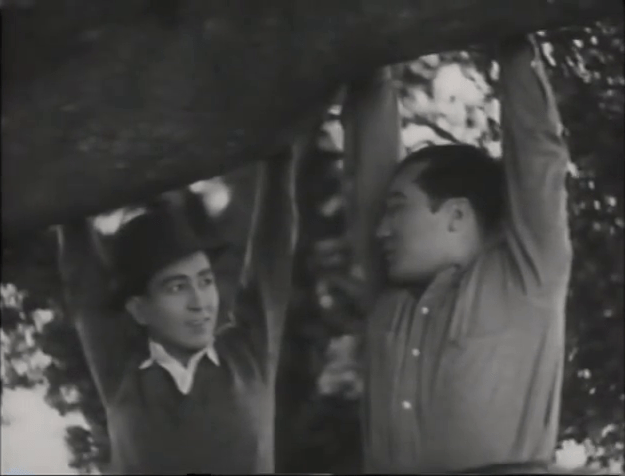
Eclipse (金環蝕, Hiroshi Shimizu, 1934)

Shimizu Eclipse 1

Though most often remembered for his contribution to the cinema of children, Hiroshi Shimizu was also a practiced chronicler of his difficult times. 1934’s Eclipse (金環蝕, Kinkanshoku), unlike much of his other work from the period, avoids direct reference to Japan’s increasingly global or imperialist ambitions but paints its rapid shift towards “modernity” as dangerous and potentially tragic for the unlucky few who for one reason or another are unable to secure their passage towards a harmonious and prosperous future. Adopting the form of a classic romantic melodrama, Eclipse is a bittersweet exploration of corrupted social virtues which ends on an ironic note of defeated victory.

Shimizu begins in a traditional rural village which is all abuzz because prodigal son Seiji Kanda (Shiro Kanemitsu) – now a big shot lawyer in the city, is set to return and, rumour has it, is on the look out for a good country wife. Regarding a marriage to a promising young man like Seiji as the highest of prizes, the village women gossip about whom he might choose and correctly conclude Kinue Nishimura (Hiroko Kawasaki) is likely to be the front runner given her comparatively high education level, beauty, poise, and kindness. Kinue, however, has long been in love with her diffident cousin, Shukichi Osaki (Mitsugu Fujii), who now finds himself in a difficult position as Seiji’s best friend and the go-between charged with communicating his intention to marry. Called to a secret meeting by an old watermill, Kinue is shocked and offended when Shukichi proposes on behalf of someone else, strongly refusing the proposal and reminding him of all the times they had spent together during which she believed an attachment had been formed. Shukichi, whose family is impoverished, does not reject her affections but claims not to want to stand in the way of his friend’s romantic dreams.

Kinue, perhaps unwittingly setting up the ongoing drama, asks if she is to sacrifice her heart and marry a man she does not love and believes would ultimately be unhappy with a woman who yearns for someone else, in order that Shuikichi may continue to feel noble. In the end, Shukichi tries to make her decision for her by running away to the city in the hope of making a life for himself in the same way that Seiji has done. Kinue, brokenhearted, rejects the idea of marrying Seiji and runs off after him only to end up working as a bar girl under the bright lights of Tokyo. Meanwhile, Shukichi discovers that the bonds of obligation which carry so much weight the village are all but worthless in the city when his various contacts refuse to see him and he finds it impossible to gain promising employment. His big break comes when he is knocked over by the chauffeur of the man who just offered to pay his train fare back to the country and thereafter is taken into the family home as a tutor for the youngest son on the insistence of the forthright “modern girl” daughter, Tomone (Michiko Kuwano). Needless to say, the romantic drama isn’t over as Tomone also has a “cousin” who is in love with her and is also sought by Seiji who was her tutor while he was in college and she in school.

The values of the old world and the new are in constant conflict with each other though ultimately it is the failure to act decisively on one’s emotions which causes the greatest harm. Shukichi, knowing his family is poor and a marriage to Seiji the “better” social and financial option for Kinue, insists on nobly sacrificing himself in what he sees as her interest but in doing so rejects her own agency or right to choose her future, assuming she will simply passively pass into the arms of Seiji with no resistance. Kinue, however, resists by following him to Tokyo but, unable to find him, is forced into the sex trade to support herself. Meanwhile, Shukichi continues to break hearts in the city – firstly that of Tomone who has apparently fallen in love with him despite their class difference, but also that of Kayo (Yoshiko Tsubouchi) – the sister of the chauffeur who knocked him over. Still in love with Kinue he diffidently (but not categorically) rejects the affections of the two women but also refuses to act on his feelings for Kinue until he tries a last ditch attempt to “rescue” her from a fall into a life of prostitution through a worrying act of frustrated physical violence (something which ultimately fails).   

The final resolution is brought about by Seiji who, unlike Shukichi, has been able to reconcile his essential nobility with the forward moving nature of the times. Seiji, figuring out that he’d come between a loose arrangement between Kinue and her cousin, is full of remorse and steps back without a second thought, desiring only happiness for all rather than victory or conquest. Again, at the end, becoming the second choice match for Tomone, he returns to fix what he half feels he has broken by “rescuing” Kinue himself through an act of gentleman’s diplomacy and then giving his friend a good talking to. The problem becomes less of one of East and West, town and country, past and future, but personal integrity. Tomone laments that her “selfishness” has caused pain to others – something for which she is trying to make amends in becoming a “good wife” to Seiji, but this is a lesson Shukichi has been slow to learn. His failure to integrate his conflicting desires coupled with a feeling of social inferiority due to his family’s reduced circumstances and standing in the village has effectively created this web of broken hearts and ruined futures, all of which might have been avoided if he had been braver and chosen to stay at home with the woman he loved at his side, living a life of simplicity but with emotional integrity.

These twin destinies are reinforced by the final scenes which find Seiji and Tomone boarding a boat to the West to immense fanfare and celebration, while Kinue and Shukichi are perched aboard a baggage train, he standing and she sitting dejectedly, silent and apart as the rails speed away behind them. The city recedes and the chance of future happiness for our reunited lovers seems slim despite the conventionally romantic nature of their togetherness as they return home drenched in defeat. Seduced and betrayed by the bright lights of Tokyo, Kinue and Shukichi seem bound for the life they should have lived if they’d only been brave enough to fight for happiness at home rather than succumbing to the false promises of modernity but it remains to be seen if their time in the city can be “eclipsed” by a new hope for a traditional future or will continue to overshadow their simple and honest lives in the days to come.


I Was Born, But… ( 大人の見る絵本 生れてはみたけれど, Yasujiro Ozu, 1932)

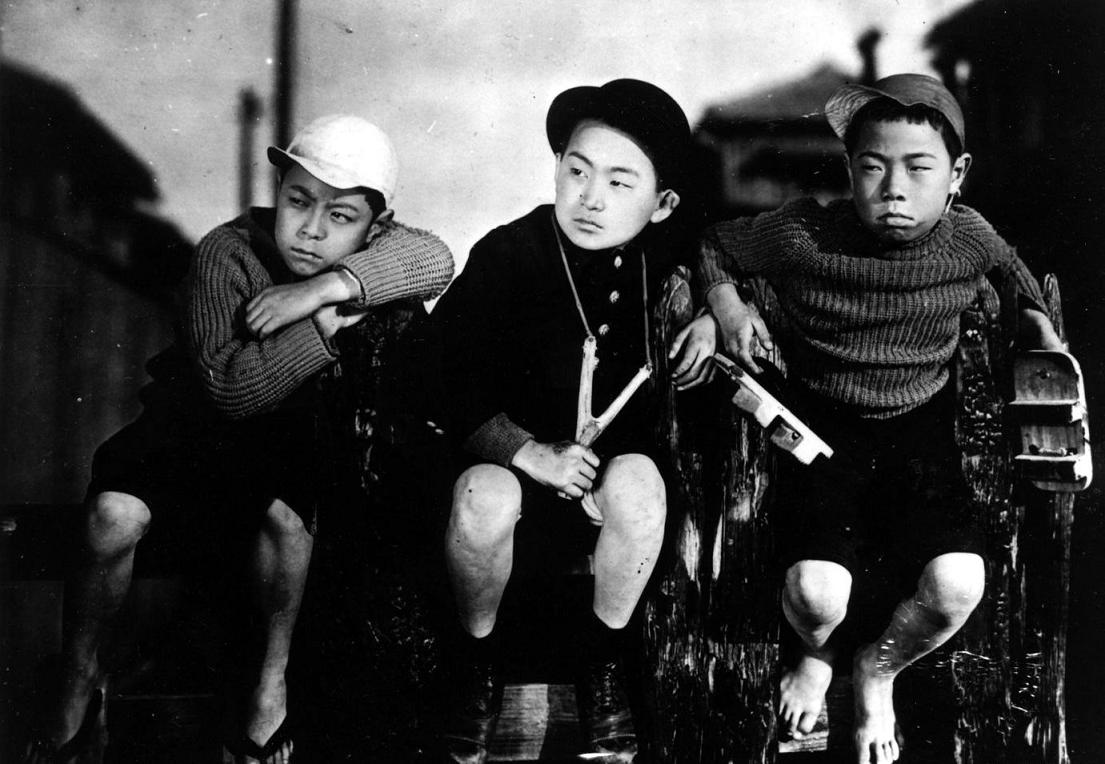
I was born but stillWhen one thinks of the classic examples of children in Japanese cinema, Hiroshi Shimizu is the name which comes to mind but family chronicler Yasujiro Ozu also made a few notable forays into the genre. I Was Born, But… (大人の見る絵本 生れてはみたけれど, Otona no miru ehon – Umarete wa mita keredo) stars one of the premier child actors of the silent era in Tokkan Kozo (later known as Tomio Aoki) who also worked repeatedly with Shimizu (Children in the Wind, Star Athlete) and Naruse (No Blood Relation, Apart from You, Street Without End, Forget Love for Now) among many others. Like Children in the Wind, I Was Born, But… is the story of two young boys and their well meaning dad only this time the boys’ faith in their father is not entirely justified. Ozu would also revisit this theme some years later with the genial comedy Good Morning which also sees a pair of cute as a button brothers going on strike though theirs is one of silence rather than hunger and provoked by the desire for a television rather than just shock and disillusionment on discovering the unfairness and hypocrisy of the adult world.

Mr. Yoshi (Tatsuo Saito) has moved his family into a nice house in the suburbs not far from that of his boss, Mr. Iwasaki (Takeshi Sakamoto). His two sons, Keiji (Tomio Aoki/Tokkan Kozo) and Ryoichi (Hideo Sugawara) quickly make enemies of some of the neighbourhood kids and start playing truant from school in order to avoid them. Making an ally of the delivery boy from the local sake shop, Keiji and Ryoichi enlist his efforts to get back at the head bully landing themselves top of the local pack.

However, one of the boys, Taro, is none other than the son of their dad’s boss, Mr. Iwasaki. Furiously engaging in a battle of my dad’s better than your dad, the boys are dismayed to see how their father obsequiously greets his superior. Their faith is well and truly crushed when Mr. Iwasaki invites all the kids over to watch some home movies (cutting edge technology for the time) which features some of the employees goofing off, including Yoshi who enthusiastically gurns and performs silly walks for his boss’ benefit. To Keiji and Ryoichi, Yoshi had been a kind of superhero – austere, but strong, honest and inspiring. Realising he’s just another corporate stooge betraying his true self for commercial gain, the boys are thrown into a period of acute existential confusion.

Yoshi’s mantra dictates that he wants his sons to grow up to become “someone”. Keiji and Ryoichi ironically turn this back on him with the charge that he himself is a “no one”. Yoshi cannot argue with their judgement, he is “no one”, in his own mind at least, and harbours a sense of disappointment in his dull and ordinary middle class life. Checking in with his sons after they’ve fallen asleep, Yoshi offers a different kind of mantra during a speech to his wife in that he hopes neither of his sons become company men like he has. He truly wants them to be “someones” but more than that, he wants them to be their own men, living their lives on their own terms and finding a greater sense of fulfilment than he has been able to in willingly debasing himself to curry favour with a boss he doesn’t particularly like to put food on the table for his family.

Keiji and Ryoichi, in a gesture of defiance, go on a hunger strike to prove that they don’t need their father to humiliate himself daily on their behalf. Yoshi can’t get through to them, his authority is significantly damaged and the boys are stubborn but then again their mother’s rice balls are just so tasty they might eventually be persuaded to abandon their mini protest by the power of a rumbly tum. The lesson they learn is one familiar to Ozu’s general philosophy, that battles must be picked and compromises made in the name of pragmatism even if they may uncomfortable to bear.

Ozu shoots with his characteristic naturalism, allowing the boys to goof off as only children can as they pull faces, dance, and strike poses to poke fun at the other boys but also engage in a strange “resurrection” gimmick rather than a secret handshake to bond with their new frenemines. Forgiveness and reconciliation are all around as the boys learn to accept their slightly less black and white world, embrace their new friends, and stride forward towards their eventual destinies. The children occupy one world, and the adults another but perhaps they aren’t so different after all.


Short scene from the film (English subtitles)