Don’t Call it Mystery (ミステリと言う勿れ, Hiroaki Matsuyama, 2023)

Totono once again finds himself at the centre of of conspiracy in the big screen edition of the popular drama based on the manga by Yumi Tamura, Don’t Call it Mystery (ミステリと言う勿れ). Embroiled in what first looks like a family succession drama as he points out recalling The Inugami Family, he soon discovers there’s more in play than might be expected but also that the wounds of the past are slow to heal and often cause people to act in unexpected ways.

In any case, he ends up getting involved care of Garo (Eita Nagayama) who is still on the run following the end of the TV series so unable to help a teenage girl, Shioji (Nanoka Hara), who is one of four grandchildren in line to inherit her grandfather’s legacy if only she can fulfil the bizarre quest he left for them in his will. Her worry is that, as family law dictates one person inherits everything, there will inevitably be deaths and violence involved as the cousins battle each other for the prize of a giant estate near Hiroshima where Totono also just happened to be on a day trip.

Once again, the running gag is that mystery just seems to find Totono who only wants to get on with living his peaceful life as a student eating curry and going to museums though there are some tantalising clues to his own backstory littered through the piece such as his unexpected familiarity with the city of Hiroshima. The case this time as also has a link to Totono’s famously curly hair which only adds to his Kindaichi-esque sense of eccentricity deepened by his reluctance to allow Shioji’s family to do his laundry or to a take a bath in another person’s home. But these foibles are, as he points out to those around him, reflective of a conflict in what is considered considerate behaviour. They think they’re being nice by offering to do his laundry, but he doesn’t want them to so it’s just additional inconvenience for him much in the same way as you if offer someone a lift to the station thinking that’s easier for them and they accept not to cause offence but are secretly disappointed because they were looking forward to the walk.

Totono’s defining characteristic as an accidental detective is indeed his emotional intelligence and ability to pick up on the slightest things that might be bothering those around him, often prone to lengthy monologues that advocate for a more compassionate world and better understanding between people. As the mystery becomes clear, he begins to realise that the parents of the grandchildren were trying to protect them from the toxic legacy of tradition and end the ridiculous family succession drama that apparently led to the deaths of some of their immediate relatives. He gives similar advice to Shoji’s cousin Yura (Ko Shibasaki) on hearing her father tell her that women are happiest as wives and mothers and she should drop what she’s doing to pay more attention to her husband and daughter. Totono takes him to task for his sexist thinking and tells him it’s unfair, advising Yura that she might not unwittingly want to pass these ideas on to her own daughter by suppressing herself to conform to her father’s outdated idea of conventional femininity.

As Totono says, children are like wet cement and the things dropped on them leave their mark for the rest of the child’s life. It seems that the family was in a sense haunted by a child they’d wronged and worried would someday come back to wreak their revenge as a phantasmagorical embodiment of their latent guilt and shame about how they usurped their fortune. What the grandchildren come to realise, is that their late parents did actually understand them and wanted them to be happy following their own paths rather than bound by tradition or outdated notions of properness regardless of whatever happens with the grandfather’s more literal legacy and the buried skeletons it contains. Filled with the same kind of gentle intrigue and mystery along with the compassionate spirit of the TV series and manga, the big screen edition features another difficult case for Totono that also begins to illuminate his own troubled past and the secrets behinds his empathetic soul.


Don’t Call it Mystery screened as part of this year’s Toronto Japanese Film Festival.

Original trailer (English subtitles)
Honnouji Hotel (本能寺ホテル, Masayuki Suzuki, 2017)

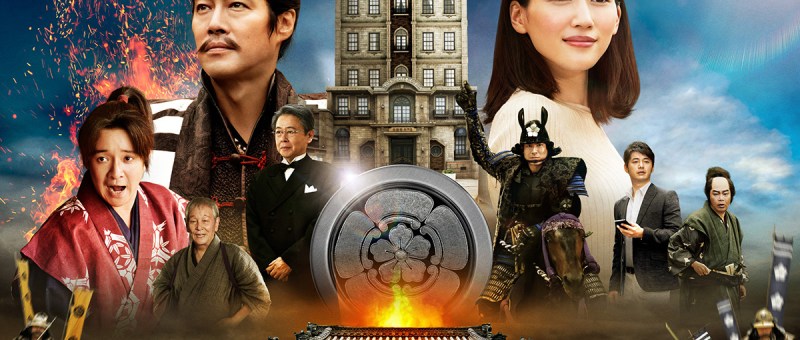
According to the opening quote from Otto von Bismark, fools learn from experience and the wise man from history, but in truth you’ll need a little of the former to correctly interpret the latter. The heroine of Honnoji Hotel (本能寺ホテル) is not exactly lacking in life experience, but hers has been of the passive variety. She’s blithely gone along with the path her society laid out for her, but now she’s hit an unexpected bump in the road it’s prompted her into a reconsideration of where it was she was going. Most people wouldn’t meet such a crisis by asking “what would Nobunaga do?”, but that’s where our heroine finds herself after accidentally exiting a hotel lift right into the middle of the Sengoku era. 

20-something Mayuko (Haruka Ayase) is in Kyoto for a short holiday and to meet up with her fiancé to be formally introduced to his family. The problem begins when it transpires that owing to an administrative error, her hotel reservation has been made for the following month and everything is currently fully booked seeing as the city is such a tourist hotspot. After wandering around a while, she stumbles across a dated, slightly musty establishment named the “Honnouji Hotel” which, she realises even given her shaky grasp of history, is a fairly inauspicious name. Everyone knows that 16th century general and noted tyrant Oda Nobunaga committed seppuku at the Honno temple after he was betrayed by one of his retainers who rose against him. Nobunaga had been primed to bring peace to Japan after more than a century of destructive warfare, paving the way for unification under the Tokugawa Shogunate, but is a somewhat ambiguous figure known for his extreme volatility and tendency towards cruel authoritarianism. 

That vision of Nobunaga is indeed the one Mayuko first encounters when she finds herself accidentally thrown back into the Sengoku era after exiting the lift in her hotel. The first person that she meets turns out to be Mori Ranmaru (Gaku Hamada) with whom she bonds over a shared sense of anxiety, she over meeting her boyfriend’s family, and he over an important tea ceremony with life or death consequences. She gives him some modern-day stomach medicine while he warns her that his lord is “cruel and demonic”. Still not quite grasping that things work differently (to a point at least) in the feudal world, she advises him to quit rather than allow himself to be exploited to the point that it’s ruining his health but he exasperatedly reminds her that you can’t simply drop out of samurai society. Mayuko gets another cruel awakening when observing the tea ceremony and witnessing a man, whom she later realises to be Nobunaga (Shinichi Tsutsumi), extorting a tea caddy from a distressed master who tries to protest that he’d only been informed that the caddy would be displayed and is unwilling to give it away. Nobunaga reminds him that the nation will soon be unified under his banner, at which point he will be in control of business affairs, threatening him with economic consequences backed up with the possibility of immediate violence. 

Despite her essential passivity, Mayuko cannot bear injustice and immediately springs into action, handing the caddy back to its original owner and instructing him that he shouldn’t allow himself to be intimidated into giving up his prized possessions. In her own life, however, she’s nowhere near as certain. We find out that she’s only known her fiancé for six months, and is still ambivalent about the idea of marriage. When the company she’d been working for suddenly went bust, she found herself at a loss, told that the teacher’s certificate she’d taken as a backup is largely useless because even teaching is oversaturated in today’s difficult job market. Now, it’s not feudal times anymore, but many people in Japan still expect a woman to give up her career to get married, which is what most of her friends advise her to do especially seeing as she had no particular ambitions or goals in life. Kyoichi’s (Hiroyuki Hirayama) proposal comes at an opportune moment, but she finds herself asking opportune for whom and if this is really what she wants or if she’s just allowing herself to be railroaded into conventional “success” without really thinking it through. 

It might be going too far to read too much in to a similarity between Nobunaga’s dictatorial dynamism and Kyoichi’s domineering manliness, but that’s largely where Mayuko seems to be. Beginning to realise his mistakes, Kyoichi confesses that he cynically took advantage of the situation to manipulate Mayuko into marrying him, believing that she was “insecure and unreliable”, “unable to do anything alone” and in need of his protection. Talking with Kyoichi’s father and beginning to assert herself in opposition to Nobunaga’s injustices, she begins to realise that she can take charge of her own destiny and has a duty to find what it is she wants to do, and do that as best she can.

The lesson is, however, somewhat problematically learned in her realisation both that she can’t change “history” and that she can because history is a consequence of our collective choices. This Nobunaga, apparently wanted a peaceful society for all, one in which class divisions had been eradicated and equality ruled. He sees our world and deems it good enough to sacrifice his life for, but Mayuko by turns becomes enamoured of the past, finding her vocation as a teacher of history in a move which is both progressive in seeing her reject a marriage of “convenience” to strike out under her own steam, but also backward looking in its reevaluation of Nobunaga and his unfinished revolution as if there is no real need for change “now”. Granted, Honnouji Hotel is partly concerned with selling the charms of Kyoto as an unchanging historical centre, but it’s difficult to escape the slightly sour note of conservatism as Mayuko finds her forward path only by embracing the samurai past. 


Original trailer (no subtitles)